
How Long Does It Take to Learn a Skill? The 10,000-Hour Claim Checked
What the 1993 violinist study measured, what the 2014 meta-analysis and a 2019 replication found, and how to plan practice by the hours you really have each week.
By Redbison Dev · · Updated · 9 min read

You want to learn the guitar, a language or programming, and somewhere you read that mastery takes 10,000 hours. The short answer is that 10,000 hours is not a rule and not a research finding. It is a rounded average from one 1993 study of student violinists, popularized by Malcolm Gladwell's 2008 book Outliers. Later research found that the amount of practice explains only part of why some people get better than others, and how long a skill takes depends on the skill, the level you want and how you practise.
This post reads what the original study measured, what the 2014 meta-analysis and a 2019 replication found, and then plans a realistic practice schedule with the Time Card Calculator and Life in Weeks.
Where the 10,000 hours came from
The source is a paper by K. Anders Ericsson, Ralf Krampe and Clemens Tesch-Römer in Psychological Review in 1993, "The role of deliberate practice in the acquisition of expert performance". Its first study compared three groups of ten violin students at the music academy in West Berlin: the best students, as rated by their professors, good students, and students training to be music teachers.
The students kept diaries for a week and estimated, year by year since they started, how many hours a week they had practised alone. Added up to age 18, the averages were:
- best violinists: 7,410 hours
- good violinists: 5,301 hours
- future music teachers: 3,420 hours
Projected to age 20, the best group averaged about 10,000 hours, and that is where the number comes from. Ericsson and Robert Pool later wrote that it was only an average, that half of the ten best violinists had not reached 10,000 hours by 20, and that at 18 or 20 these students were nowhere near masters of the violin. They also pointed out that there is nothing special about the figure: in their account, pianists who win international competitions tend to do so around age 30, after roughly 20,000 to 25,000 hours of practice.
The paper's real claim was about the kind of practice. Deliberate practice means activities designed to improve performance, usually with a teacher or a clear goal, done with full concentration, with feedback, and often not much fun. Playing for fun or performing for others was counted separately. Gladwell's version kept the number and dropped most of that distinction.
What later research found
The 2014 meta-analysis. Brooke Macnamara, David Hambrick and Frederick Oswald pooled 88 studies in Psychological Science and asked how much of the difference between people's performance deliberate practice accounts for. Overall, about 12%. By field it was about 26% in games such as chess, 21% in music, 18% in sports, 4% in education and under 1% in professions. The link was weaker in studies that measured practice with logs instead of memory. Their conclusion was that practice matters, but less than had been claimed, and that other factors must account for the rest.
The response. Ericsson and Harwell (2019) argued that many of the studies counted practice that did not match the original definition. Taking only studies that did, they put the share of variance at about 29%, and higher once measurement error is corrected for. The two camps still disagree about how much, but both accept that practice explains a real share of the differences and not all of them.
The 2019 replication. Macnamara and Megha Maitra repeated the violin study with 39 violinists in three groups of 13: the best and good groups from the Cleveland Institute of Music, and the less accomplished group from Case Western Reserve University. By age 18 the best group had practised alone for about 8,224 hours, the good group 9,844 and the less accomplished group 4,558. Practice still explained about 26% of the differences across the three groups, but the best violinists had not practised significantly more than the good ones.
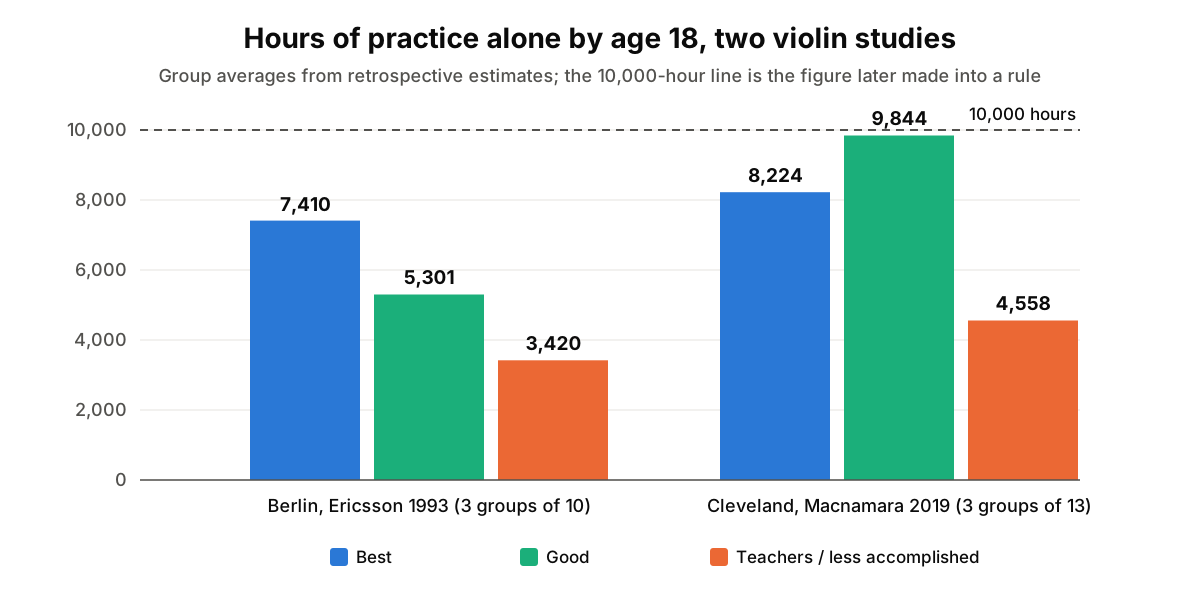
Put together: a lot of focused practice is part of how people get very good at music, chess or a sport, but no fixed number of hours guarantees it, and among people who all practise a lot, the hours stop telling them apart.
So how long does it take to learn a skill?
There is no honest single number, because "learn" means different things. Getting through your first songs, holding a conversation in a language, or competing at a national level are different goals, and the research above is about the highest levels in fields with clear rankings. For most people the useful question is narrower: how many focused hours a week can I give this, and how long will that take to reach the next milestone I care about?
That turns the 10,000-hour claim into something you can measure. Pick a milestone, measure the hours you really practise, and check how long the arithmetic says it will take.
Worked example: a practice week, and what 10,000 hours would mean
Say you are 30 and learning the guitar around a full-time job. You practise before work twice a week, after work twice a week and for longer on Saturday.
Step 1: measure a real week. Open the Time Card Calculator and enter your sessions as clock-in and clock-out times. It is built for work hours, but it adds up any timed sessions:
- Monday 06:30 to 07:15, break 0
- Tuesday 19:00 to 20:00, break 0
- Wednesday 06:30 to 07:15, break 0
- Thursday 19:00 to 20:00, break 0
- Friday: press Clear
- Saturday 09:00 to 11:00, break 15 (a rest in the middle)
The sample card fills Monday to Friday with work hours and breaks, so type over every time and break. You can ignore the pay lines or clear the hourly rate. Total hours shows 5:15, which is 5.25 decimal hours a week.
Step 2: weeks to a target. At 5.25 hours a week, 10,000 hours takes 10,000 / 5.25 = 1,905 weeks, about 36.5 years. A first milestone of 100 hours takes 19 weeks, and 1,000 hours about 190 weeks, or 3.7 years.
Step 3: set that against your calendar. Open Life in Weeks, choose Current age, enter 30, keep the life expectancy at 80 and press Visualize. It shows 1,565 weeks lived and 2,609 weeks remaining. At this pace, 10,000 hours would use 1,905 of those 2,609 weeks, about 73% of them.
That is not a reason to give up. It is a reason to drop 10,000 as the target, which was never a threshold anyway, and plan around milestones you can reach in months: a set of songs, a grade exam, a project you can finish.
How to plan practice that counts
The research points to the quality of practice more than to its length. Elements that Ericsson's definition of deliberate practice includes:
- A specific goal for each session. "Clean chord changes between G and C at 80 beats a minute" instead of "play for an hour".
- Work at the edge of what you can do. Repeating what you can already play feels productive but adds little.
- Fast feedback. A teacher, a recording of yourself, a metronome, test scores or code review.
- Focused sessions with rest. The 1993 paper argued that deliberate practice is limited by how long you can concentrate, and its best violinists also slept more, including afternoon naps. Concentration, not clock time, is the limit.
- A log. Record real hours with the time card each week, so the plan is based on what you did rather than on what you meant to do.
Expect diminishing returns: early hours bring visible progress, later ones smaller gains. If progress stalls for weeks, change how you practise before adding hours.
Tools for this job
- Time Card Calculator: log a week of practice sessions with start, end and break times and get the total in hours and minutes and decimal hours, the number you need for any time-to-goal sum.
- Life in Weeks: see the weeks you have lived and the weeks ahead on one grid, to judge whether a long-term practice target fits and to mark the milestones along the way.
For a way to structure focused sessions, read The Pomodoro Technique: How to Use 25-Minute Focus Sessions. For how the weeks grid is counted, see Your Life in Weeks: The Grid, the Maths and How to Use It.
Frequently asked questions
Is the 10,000-hour rule true?
Not as a rule. It comes from the average practice of the best student violinists by age 20 in a 1993 study, and half of them had not reached it. A 2014 meta-analysis of 88 studies found that deliberate practice accounted for about 12% of performance differences overall and 21% in music, so practice matters, but no fixed number of hours makes someone an expert.
What is the difference between practice and deliberate practice?
Deliberate practice is designed to improve a specific weakness, done with full concentration, often guided by a teacher, and checked with feedback. Ordinary practice, such as playing pieces you already know or simply doing your job, builds familiarity but adds much less skill per hour.
Who came up with the 10,000-hour rule?
Malcolm Gladwell coined the phrase in his 2008 book Outliers, based on the research of K. Anders Ericsson and colleagues. Ericsson later wrote that the book oversimplified the work: the figure was an average, it was not a threshold, and the type of practice mattered more than the count.
How many hours a day should I practise?
The research gives no single daily figure, and it depends on the skill. The 1993 paper argued that deliberate practice is limited by how long you can keep full concentration, so more hours are not always better. Start with what you can sustain every week, log it, and adjust if progress stalls.
Sources and further reading
- The role of deliberate practice in the acquisition of expert performance, Psychological Review. Ericsson, Krampe and Tesch-Römer (1993), the violinist study behind the 10,000-hour figure.
- Deliberate practice and performance in music, games, sports, education, and professions: a meta-analysis, Psychological Science. Macnamara, Hambrick and Oswald (2014), 88 studies and the share of variance by field.
- Becoming an expert takes more than practice, Association for Psychological Science. Plain-language summary of the 2014 meta-analysis.
- The role of deliberate practice in expert performance: revisiting Ericsson, Krampe and Tesch-Römer (1993), Royal Society Open Science. Macnamara and Maitra (2019), the Cleveland replication.
- Deliberate practice and proposed limits on the effects of practice on the acquisition of expert performance, Frontiers in Psychology. Ericsson and Harwell (2019), the reply to the meta-analysis.
- Malcolm Gladwell got us wrong, Salon. Ericsson and Pool (2016) on what the 10,000-hour rule got wrong.