
AI Meeting Notes: Consent, Accuracy and What to Check
One-party and all-party recording consent in the US, how word error rate is measured, and the names, numbers and negations to check before AI meeting notes go out.
By Redbison Dev · · Updated · 11 min read
You have a call with a client tomorrow, your AI note taker is set to join it, and afterwards you will email the summary to everyone who attended. Two things need checking first. Everyone on the call should know it is being recorded, and in the US states that require all-party consent, such as California, Florida and Washington, everyone has to agree. And the notes need a human check before they go out, because a transcript can be mostly right and still get the one word that matters wrong: a name, a number or a "not".
This post covers US recording-consent rules as summarised by the Reporters Committee for Freedom of the Press, what the big meeting platforms show participants, how transcription accuracy is measured as word error rate (WER), and a short check for AI summaries. The worked example uses the Speech to Text and Note Taker tools. It explains the rules in general terms and is not legal advice; for a recording you expect to rely on in a dispute, an HR investigation or a regulated field such as healthcare, ask a lawyer.
Consent: who has to agree before anything records
An AI note taker records audio, transcribes it, or both, so recording law applies to it as it would to a dictaphone on the table.
- Federal law is one-party consent. Under 18 U.S.C. § 2511(2)(d), a person who is a party to a conversation, or has the consent of one party, may record it, as long as the purpose is not criminal or tortious. If you are on the call and consent, that is enough under federal law.
- Some states require every party's consent. The Reporters Committee's Reporter's Recording Guide lists California, Delaware, Florida, Illinois, Maryland, Massachusetts, Michigan, Montana, New Hampshire, Pennsylvania and Washington. These are often called "two-party" states, but they require all parties. California's Penal Code § 632, for example, covers recording a confidential communication without the consent of all parties.
- Some states split the rule. The same guide notes that Missouri and Oregon require all-party consent for in-person conversations but one party for phone calls, Connecticut and Nevada the other way round, and that Michigan's rule may apply only to recordings by someone outside the conversation. Hawaii and Maine require all parties only in particularly private places.
- Calls across state lines. Courts disagree on which state's law applies when participants are in different states. The guide's advice is to assume the stricter law applies, which for a video call with people in several states means getting everyone's consent.
Open recording counts. The guide notes that recording after people have been told and keep talking is generally treated as consent, while recording in secret is where the risk lies. Other countries have their own rules, and many employers have policies on recording and on which AI tools may process meeting content; check both before you switch a bot on.
What the platforms tell participants
Built-in tools announce themselves. Microsoft's documentation says that when someone starts transcription in a Teams meeting, all participants see a notification that the meeting is being transcribed, and that participants can hide their identity in captions and transcripts. Google says that when "Take notes for me" runs in Google Meet, all participants see a blue pencil icon and a notification that notes are being taken, and the notes are saved in the meeting owner's Drive. Zoom's meeting summary documentation says participants see an indicator change colour while its AI Companion summary is running.
A notice on screen is not the same as a spoken agreement. People who join late, dial in by phone or do not notice an icon may not have seen it. Third-party note takers that join from someone's calendar as an extra participant can surprise the host, who may not have invited them. The usual habit is to say it out loud at the start, while the recording is running, so each person's answer is captured too.
"Before we start: I'm using an AI note taker to record and transcribe this call so I can send notes afterwards. Is everyone OK with that? If not, I'll turn it off and take notes by hand."
If anyone objects, switch it off and use the Note Taker instead: it is a plain text box that keeps your notes in this browser and records nothing.
How transcription accuracy is measured
The standard measure is word error rate. You line up a correct reference transcript against what the system produced and count three kinds of error. NIST's sclite scoring tool reports each as a percentage of the reference words, with every error weighted equally, and the word error rate is their total:
WER = (substitutions + deletions + insertions) ÷ words in the reference
A substitution is a wrong word, a deletion is a word that disappeared, and an insertion is a word that was never said. Word accuracy, as usually quoted, is 1 minus WER. Published accuracy figures come from particular test sets, so the only number that tells you how a system does with your accents, names and jargon is one you measure on your own speech.
Worked example: test a transcript in ten minutes
Write a short reference passage the way your meetings sound, with real names and numbers:
Priya will send the revised budget by Friday. We are not renewing the Acme contract. The launch moves to March 15 and the discount stays at fifteen percent.
- Paste it into the Note Taker. The counter shows Words: 28: that is N, the denominator.
- Open Speech to Text, leave the language on English (US) or pick yours, press the microphone button and read the passage at your normal meeting pace. Press it again to stop, then copy the transcript.
- Compare the two word by word.
Suppose the transcript comes back like this (an illustrative result, not a measurement of any particular system):
Korea will send the revised budget by Friday. Uh we are renewing the Acme contract. The launch moves to March 50 and the discount stays at fifty percent.
Ignoring capitals and punctuation, as WER scoring normally does, the alignment has three substitutions (Priya → Korea, 15 → 50, fifteen → fifty), one deletion (not) and one insertion (uh).
| Measure | Value |
|---|---|
| Reference words (N) | 28 |
| Substitutions / deletions / insertions | 3 / 1 / 1 |
| Word error rate | 5 ÷ 28 = 17.9% |
| Word accuracy | 82.1% |
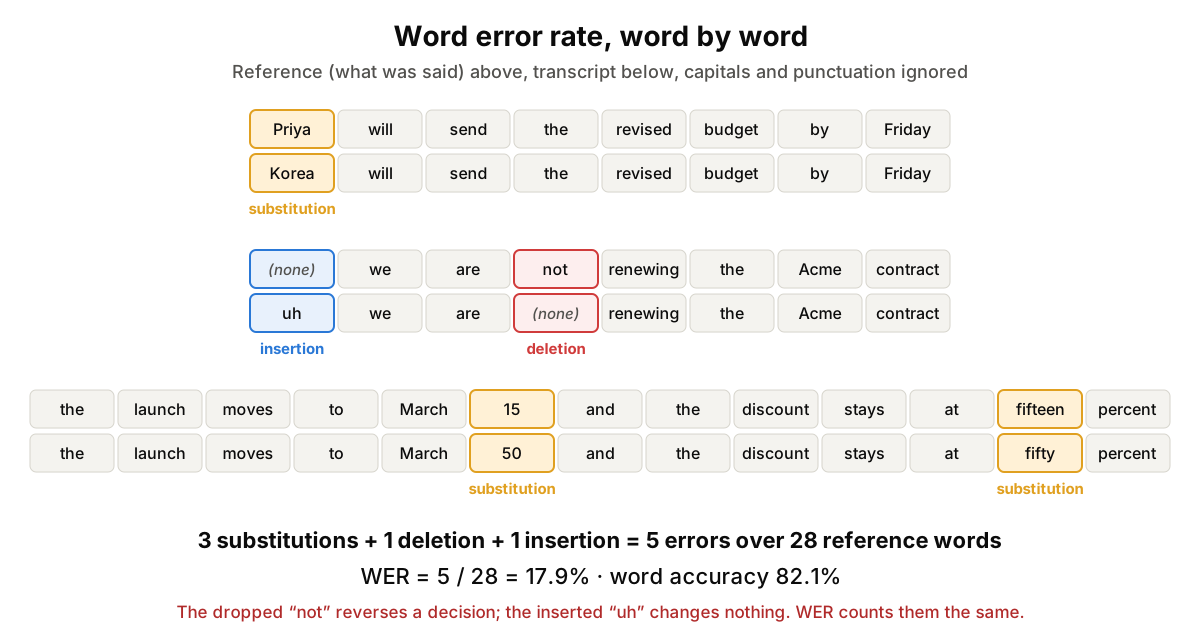
The number hides what matters. WER gives every error the same weight, so the harmless "uh" counts exactly as much as the missing "not", which turns a decision to drop a contract into a decision to keep it. The other three errors change a name, a date and a price. A transcript with a WER of a few percent can still contain one of these, and a summary written from it can repeat it in confident prose.
For a longer test, the Online Diff Tool does the comparison for you. Put one word per line in each box (replace spaces with line breaks in any editor) and tick Ignore case. In this example it marks 4 removed and 4 added lines: each removed word sitting next to an added one is a substitution, a removed word on its own is a deletion and an added word on its own is an insertion, which gives the same 3, 1 and 1.
Error rates also differ between speakers. A 2020 study in PNAS by Koenecke and colleagues tested five commercial speech recognition systems on recorded interviews and found an average WER of 0.35 for Black speakers and 0.19 for white speakers. Systems have changed since, but the lesson holds: test with the people who actually speak in your meetings.
Two notes on the Speech to Text tool itself. It uses your browser's speech service, and in Chrome and Edge the audio is sent to the browser vendor's servers for recognition, so do not use it for confidential material. It can also save a recording of what it heard, so the consent rules above apply when you use it in a meeting with other people.
What goes wrong in AI summaries
A summary adds a second layer of error on top of the transcript. Maynez and colleagues (ACL 2020) studied neural summarisation of news articles and found the models highly prone to "hallucinate" content that is not supported by the source document. Meeting summaries are a different task, but AI note takers also write them with neural language models, so the same failure is worth checking for, along with errors carried over from the transcript:
- Names and owners. A misheard name ("Korea") or an action item assigned to the wrong person.
- Numbers, dates and money. Fifteen and fifty, thirteen and thirty, March and May.
- Negations and conditions. "Not", "unless", "only if legal approves" dropped, turning a condition into a commitment.
- Discussion turned into decision. An idea someone floated appears as "the team agreed".
- Invented or missing items. A plausible follow-up nobody mentioned, or the objection somebody raised left out.
- Attribution. A sensitive opinion put in the wrong person's mouth.
A summary built from the example transcript could easily read: "Korea to send revised budget Friday. Acme contract renewed. Launch March 50, discount 50%." Every transcript error has become an action item, and the tidy wording makes it look more reliable than the raw transcript did.
A five-minute check before the notes go out
- Keep your own short record during the meeting. In the Note Taker, jot each decision, number, date and owner as it happens. It saves as you type and has a Download button, so you finish the meeting with a list to check against.
- Compare the summary's decisions and action items with that list, line by line. Anything in the summary that is not on your list gets checked against the transcript or the recording.
- Search the transcript for "not", "don't", "unless" and "if" near each decision, and for every number.
- Check spellings of names against the invite list.
- Remove what should not travel, such as side remarks, personal details or anything said after someone asked to go off the record.
- Send it as a draft for correction: "These are AI-assisted notes; reply with any fixes by Thursday." It invites the people who were there to catch what you missed.
Tools for this job
- Speech to Text: read a reference passage with your team's names and numbers and measure how a browser recogniser handles your voice before you trust automatic transcripts.
- Note Taker: count the words in a reference passage, and keep your own record of decisions and owners during a meeting so you can check an AI summary against it.
- Online Diff Tool: compare a reference passage with a transcript one word per line, so every substituted, missing or extra word is highlighted for counting.
The Web Speech API guide explains where browser speech recognition sends audio and why it behaves differently in each browser, Browser Reminders and Notes: What Survives a Closed Tab covers what the Note Taker keeps after a refresh, and the text diff guide explains how the Online Diff Tool lines up two versions of a text.
Frequently asked questions
Do I need everyone's consent to use an AI note taker?
Under US federal law, one party's consent is enough. In all-party consent states such as California, Florida, Illinois and Washington, everyone in the conversation must agree, and with participants in several states the safe assumption is that the strictest rule applies. Announcing the recording at the start and recording everyone's answer is the usual way to get all-party consent; for anything you may rely on in a dispute, ask a lawyer.
Does the meeting platform's banner count as consent?
It is a notice, and continuing to talk after a clear notice is generally treated as consent to open recording. People who dial in, join late or miss the icon may not have seen it, so a spoken announcement is the safer habit, especially when a third-party bot rather than the platform is recording.
What is a good word error rate for meeting transcription?
There is no single threshold, because WER depends on the audio, the speakers and the vocabulary, and it weights a missing "um" the same as a missing "not". Measure it on a passage like your own meetings, then check names, numbers and negations by hand whatever the score.
Should I send the AI summary or the full transcript?
Usually the checked summary. A raw transcript repeats every recognition error and every side remark verbatim. Keep the recording or transcript according to your organisation's retention rules, and tell participants how to request corrections.
Sources and further reading
- Reporter's Recording Guide, Reporters Committee for Freedom of the Press. Federal one-party consent, the all-party and split states, and calls across state lines.
- 18 U.S. Code § 2511, Interception and disclosure of wire, oral, or electronic communications, Legal Information Institute, Cornell Law School. Subsection (2)(d) is the federal one-party consent rule.
- California Penal Code § 632, California Legislative Information. Recording a confidential communication without the consent of all parties.
- Start, stop, and download live transcripts in Microsoft Teams meetings, Microsoft Support. All participants see a notification when transcription starts.
- Take notes for me in Google Meet is now available, Google Workspace Updates. August 2024 post on the participant notification and where notes are stored.
- SCLITE documentation, National Institute of Standards and Technology. How NIST's scoring tool counts substituted, deleted and inserted words against the reference.
- On Faithfulness and Factuality in Abstractive Summarization, arXiv. Maynez, Narayan, Bohnet and McDonald, ACL 2020, on hallucinated content in neural summaries.
- Racial disparities in automated speech recognition, Proceedings of the National Academy of Sciences. Koenecke and colleagues, 2020, five commercial systems compared.