
Air Changes per Hour: What ACH Means and How Much Ventilation You Need
ACH from airflow and volume, the CDC 5 ACH clean-air target, ASHRAE 62.2 for homes, ASHRAE 170 for hospitals, mixing and decay, and why ACH50 is a different number.
By Redbison Dev · · Updated · 9 min read
Air changes per hour is one of the most quoted numbers in ventilation and one of the most misunderstood. It is simple to calculate, but the same three letters are used for a portable air cleaner's effect on a bedroom, a hospital operating room's design airflow, and a blower-door test result that has nothing to do with ventilation at all. This post explains what ACH measures, what the main standards and agencies actually recommend, and how mixing turns air changes into cleaner air, using the Air Changes per Hour Calculator.
The calculation
ACH is the volume of air delivered to (or removed from, or cleaned in) a room each hour, divided by the room's volume:
ACH = airflow (m³/h) / volume (m³)
ACH = airflow (cfm) x 60 / volume (ft³)
The calculator's default room is 15 by 12 ft with an 8 ft ceiling, 1,440 ft³. With 120 cfm of airflow:
ACH = 120 x 60 / 1,440 = 5
One complete air change every 60 / 5 = 12 minutes. Turned around, the airflow needed for a target is
cfm  = ACH x volume (ft³) / 60
m³/h = ACH x volume (m³)
A 6 x 5 x 2.7 m office (81 m³) at 6 ACH needs 486 m³/h, which is 135 L/s or 286 cfm.
The airflow can be outdoor air from a ventilation system, exhaust from a fan, supply air that includes recirculated air, or the clean air delivery rate (CADR) of a portable air cleaner. Which one you use depends on the question. For removing an airborne contaminant, any air that comes back clean counts. For diluting carbon dioxide and odours from people, only outdoor air counts.
What each air change actually does
If the incoming air is clean and mixes perfectly with the room air, the contaminant concentration falls exponentially:
C / C0 = e^(−ACH x t)
where t is in hours. One air change leaves e⁻¹ = 37% of the contaminant, so each change removes 63% of what remains, not 100%. Two changes leave 14%, three leave 5%, and 99% removal takes ln(100) = 4.6 changes.
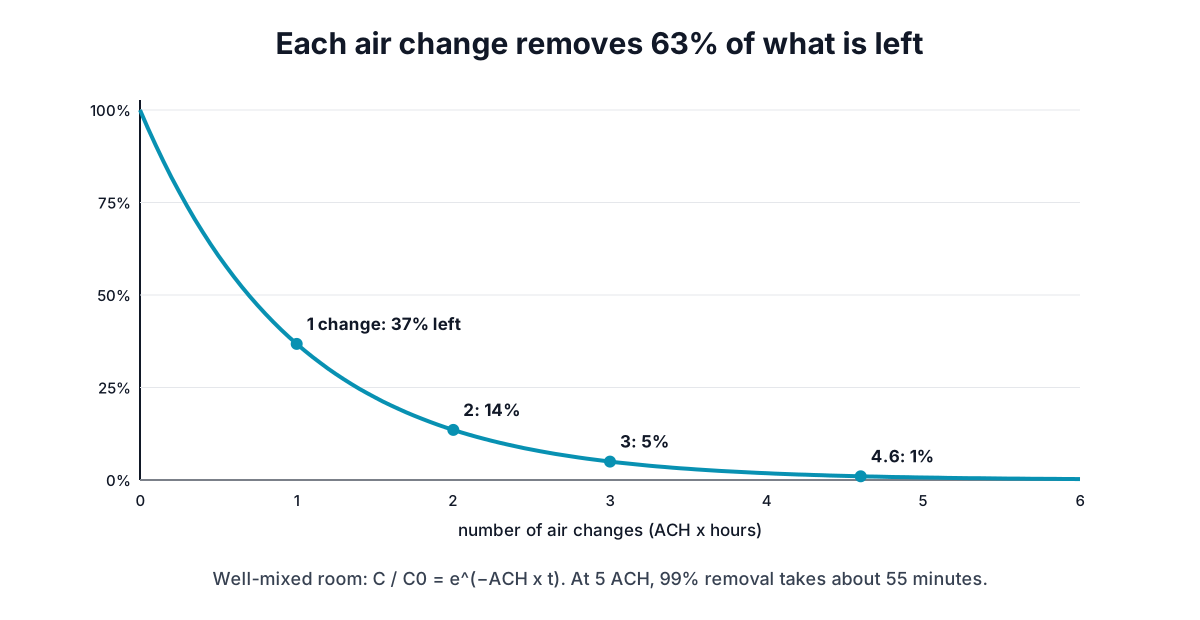
At 5 ACH, 99% removal takes 4.6 / 5 hours, about 55 minutes. At 12 ACH it takes 23 minutes. This decay is the basis of the CDC's tables of time needed to clear airborne contaminants from healthcare rooms.
Real rooms do not mix perfectly. If the supply diffuser sits next to the return grille, air short-circuits and the occupied zone sees fewer effective changes. Displacement ventilation does better than perfect mixing in the breathing zone. The calculator assumes ideal mixing, so treat its decay times as best case.
What the standards and agencies recommend
ACH targets are scattered across several documents, and each applies to a specific situation. These are the ones the calculator lists, with their sources:
| Space | Guidance | Source |
|---|---|---|
| Occupied rooms, reducing airborne viruses | 5 or more ACH of clean air | CDC/NIOSH, 2023 |
| Airborne infection isolation room | 12 ACH (new); 6 ACH existing | CDC 2003 guidelines, ASHRAE 170 |
| Operating room | 20 ACH total, 4 of outdoor air | ASHRAE 170 |
| Home kitchen exhaust | 5 ACH continuous, or 100 cfm range hood | ASHRAE 62.2 |
| Home bathroom exhaust | 20 cfm continuous, or 50 cfm intermittent | ASHRAE 62.2 |
| Whole home ventilation | 0.03 cfm/ft² + 7.5 cfm per occupant | ASHRAE 62.2 |
| New home airtightness | 3 ACH50 or less (zones 3 to 8) | IECC 2021 |
The CDC target, published in May 2023, counts every route to clean air together: outdoor air from the ventilation system, filtered return air, and portable air cleaners. A HEPA cleaner with a CADR of 120 cfm in the default room provides 5 equivalent ACH by itself. The CDC also recommends MERV-13 filters or better where the system can take them.
Commercial ventilation under ASHRAE 62.1 is not expressed as ACH at all. It sets outdoor air per person plus per unit floor area, varying by occupancy type, because the pollutant load depends on people and materials, not on the volume of the room. A tall atrium and a low meeting room with the same occupants need about the same outdoor air.
ASHRAE 62.2 for homes
For dwellings, ASHRAE 62.2 (2016 and later editions) sets the continuous whole-house mechanical ventilation rate as
Q (cfm) = 0.03 x floor area (ft²) + 7.5 x (bedrooms + 1)
Q (L/s) = 0.15 x floor area (m²) + 3.5 x (bedrooms + 1)
The bedroom term assumes two people in the main bedroom and one in each other, so occupants equal bedrooms plus one, with at least one bedroom counted. A 1,500 ft² three-bedroom house needs 0.03 x 1,500 + 7.5 x 4 = 45 + 30 = 75 cfm. With an average 8.5 ft ceiling that is 75 x 60 / 12,750 = 0.35 ACH.
That number surprises people who expect "a few air changes an hour" for a house. Whole-house ventilation is meant to dilute pollutants continuously, and it is supplemented by local exhaust in the kitchen and bathrooms where moisture and cooking pollutants are generated. Earlier editions of 62.2 used a lower floor-area coefficient and allowed an infiltration credit; the calculator follows the current formula, and your local code may adopt a specific edition.
ACH50 is a different number
A blower door test depressurizes a house to 50 Pa and measures the airflow needed to hold that pressure. Divided by the house volume, it gives ACH50, a measure of how leaky the envelope is. The 2021 IECC limits new homes to 3 ACH50 in climate zones 3 to 8 and 5 ACH50 in zones 0 to 2; Passive House targets 0.6 ACH50.
ACH50 is not the air change rate you live with. Under normal weather the pressure across the envelope is a few pascals, so natural infiltration is a small fraction of ACH50. A rough rule from Lawrence Berkeley National Laboratory work divides ACH50 by about 15 to 20, but the real value depends on climate, height, wind exposure and where the leaks are. A tight house therefore needs the mechanical ventilation that 62.2 specifies.
Practical points
- Use CADR for air cleaners. CADR already accounts for filter efficiency at the rated fan speed. If you run the unit on a lower setting, use the CADR for that setting.
- Outdoor air carries a load. Every cfm of outdoor air must be heated or cooled. Five ACH of outdoor air in winter is expensive; heat recovery ventilators and filtration of recirculated air deliver clean air at lower energy cost. The Heat Loss Calculator covers the fabric side, and the post on U-values and heat loss explains how ventilation adds to it.
- Measure the room correctly. Use the actual ceiling height, and for open-plan spaces include the connected volume the air mixes through. The Volume Calculator and Square Footage Calculator help with odd shapes.
- Ducts must deliver it. A fan rated at 120 cfm on a free-air test may deliver much less through a long or undersized duct. The Duct Size Calculator and the post on duct sizing cover the duct side.
- Healthcare and labs are specialist work. Pressure relationships, filtration and exhaust in those spaces are governed by ASHRAE 170, ANSI/AIHA Z9.5 and local health codes and need an engineer.
Frequently asked questions
How long does it take to clear a room at 5 air changes per hour?
In a well-mixed room with clean incoming air, 99% removal of an airborne contaminant takes 4.6 air changes. At 5 ACH that is 4.6 / 5 hours, about 55 minutes, and at 12 ACH about 23 minutes. Real rooms do not mix perfectly, so treat these decay times as a best case.
Does one air change remove all the air in a room?
No. With clean incoming air and perfect mixing, contaminant concentration falls exponentially as C / C0 = e^(−ACH x t). One air change leaves e⁻¹, or 37%, of the contaminant, so each change removes 63% of what remains. Two changes leave 14% and three leave 5%.
Why doesn't ASHRAE 62.1 use air changes per hour?
ASHRAE 62.1, which covers commercial ventilation, sets outdoor air per person plus per unit floor area, varying by occupancy type, rather than air changes per hour. The pollutant load depends on people and materials, not on room volume, so a tall atrium and a low meeting room with the same occupants need about the same outdoor air.
How many air changes per hour does a house get from ASHRAE 62.2?
Usually well under one. A 1,500 ft² three-bedroom house needs 0.03 x 1,500 + 7.5 x 4 = 75 cfm under ASHRAE 62.2, which with an 8.5 ft ceiling is about 0.35 ACH. Whole-house ventilation dilutes pollutants continuously and is supplemented by local kitchen and bathroom exhaust.
What is the ACH50 limit for new homes?
The 2021 IECC limits new homes to 3 ACH50 in climate zones 3 to 8 and 5 ACH50 in zones 0 to 2, while Passive House targets 0.6 ACH50. ACH50 comes from a blower door test at 50 Pa, and natural infiltration is only a small fraction of it, roughly ACH50 divided by 15 to 20.
Sources and further reading
- Ventilation in Buildings, Centers for Disease Control and Prevention. The 2023 target of 5 air changes per hour of clean air and MERV-13 filters (archived).
- Appendix B: Air, Centers for Disease Control and Prevention. The table of air changes and time to remove airborne contaminants.
- Standards 62.1 and 62.2: Ventilation and Acceptable Indoor Air Quality, ASHRAE. Commercial and residential ventilation rates.
- 2021 International Energy Conservation Code, International Code Council. Air leakage limits for new homes.
- Ventilation and Respiratory Viruses, US Environmental Protection Agency. Ventilation, filtration and portable air cleaners.
Open the Air Changes per Hour Calculator
More HVAC & Plumbing
Every tool in the HVAC & Plumbing section, free and in your browser.