
Artificial Sweeteners: What WHO and FDA Say About Safety
Aspartame is "possibly carcinogenic" yet safe within its ADI, and WHO and the new US guidelines still say limit sweeteners. What each agency said, and how to read a diet drink label.
By Redbison Dev · · Updated · 10 min read

You switched to diet cola and sugar-free yoghurt to cut sugar, then read that aspartame is "possibly carcinogenic" and that the new US dietary guidelines tell you to limit sweeteners too. Both are true, and they answer different questions. On safety, the US Food and Drug Administration (FDA) and the joint WHO and FAO expert committee (JECFA) consider the approved sweeteners safe to eat within their acceptable daily intake (ADI), which normal diets rarely approach. On usefulness, WHO's 2023 guideline advises against relying on them to control weight, and the 2025 to 2030 Dietary Guidelines for Americans say no amount of added sugars or non-nutritive sweeteners is recommended, while capping added sugars at 10 g per meal.
Below is what each agency said, how far a typical intake is from the ADI, what "FDA approved" means for a sweetener, and a worked example with the NOVA Food Classifier and Food Labeling Guide that reads a diet drink's label. It is general information, not dietary or medical advice.
Four statements, two questions
| Body | Year | What it said | Question it answers |
|---|---|---|---|
| IARC (WHO cancer agency) | 2023 | Aspartame is Group 2B, "possibly carcinogenic to humans", on limited evidence for liver cancer | Could it cause cancer at some level of exposure? (hazard) |
| JECFA (WHO and FAO) | 2023 | Kept aspartame's ADI at 0 to 40 mg per kg of body weight a day | How much is safe to eat every day? (risk) |
| US FDA | 2023 | Disagrees with the IARC classification; no safety concerns under approved conditions, ADI 50 mg/kg | Is it safe as approved in US food? (risk) |
| WHO guideline | 2023 | Conditional recommendation against using non-sugar sweeteners to control weight or reduce disease risk | Does it help your health? |
| Dietary Guidelines for Americans | 2026 | Limit low-calorie non-nutritive sweeteners; no amount is recommended | What should a healthy diet look like? |
Most confusing headlines mix IARC's hazard question with the risk and diet questions. Group 2B describes limited evidence that a substance can cause cancer, not how much is dangerous. JECFA and FDA set intake limits, which is the question that matters when you decide what to drink.
How far is a diet soda from the ADI?
An ADI is the amount a person can eat every day for a lifetime without appreciable health risk, and it is set with a large safety margin below the highest dose that caused no effect in studies. Multiply it by body weight:
- JECFA, 40 mg/kg: a 60 kg adult's ADI is 2,400 mg of aspartame a day; a 70 kg adult's is 2,800 mg.
- FDA, 50 mg/kg: a 60 kg adult's is 3,000 mg.
WHO's own worked figure: a 70 kg adult would have to drink more than 9 to 14 cans of diet soft drink a day to exceed the ADI, assuming 200 to 300 mg of aspartame per can and nothing else (2,800 ÷ 300 = 9.3 cans; 2,800 ÷ 200 = 14). Children weigh less, so the same can is a bigger share of their ADI. FDA expresses the same idea in tabletop packets: a 60 kg person would need 75 packets of aspartame a day to reach its ADI.
What "FDA approved" means for a sweetener
The FDA does not approve foods, but it does approve food additives, and six high-intensity sweeteners are authorised that way: aspartame, acesulfame potassium (Ace-K), sucralose, neotame, advantame and saccharin. Each has an ADI, and FDA judged that estimated intakes stay below it. Three more reach the market through "generally recognised as safe" (GRAS) notices that FDA did not question: high-purity steviol glycosides from stevia leaves, monk fruit (luo han guo) extract and thaumatin. Whole stevia leaf and crude stevia extracts are not GRAS and may not be imported as sweeteners. Cyclamate, allowed in the EU and elsewhere, is prohibited in the US. Sugar alcohols, allulose and tagatose are permitted too.
You can check how much a package claim is worth with the Food Labeling Guide: search fda and the only result is "FDA Approved", rated low reliability, because FDA approves certain additives, not individual products or their labels. A drink that says "FDA approved sweetener" is telling you about one ingredient, not about the drink.
One group must avoid aspartame entirely: people with phenylketonuria (PKU), who cannot break down phenylalanine. That is why US products with aspartame must carry a phenylalanine statement.
Stevia vs sucralose and the rest: ADIs side by side
Figures from FDA's sweetener page, per kg of body weight a day, with the amount for a 60 kg adult:
| Sweetener | Sweetness vs sugar | ADI (mg/kg) | 60 kg adult (mg/day) |
|---|---|---|---|
| Aspartame | about 200 times | 50 | 3,000 |
| Acesulfame K | about 200 times | 15 | 900 |
| Saccharin | 200 to 700 times | 15 | 900 |
| Sucralose | about 600 times | 5 | 300 |
| Rebaudioside A (stevia) | 200 to 400 times | 12 * | 720 |
| Advantame | about 20,000 times | 32.8 | 1,968 |
| Neotame | 7,000 to 13,000 times | 0.3 | 18 |
| Monk fruit extract | 100 to 250 times | not specified | not specified |
* Derived from JECFA's ADI for steviol glycosides of 4 mg/kg expressed as steviol. FDA specifies no ADI for monk fruit extract or thaumatin.
A lower ADI does not make a sweetener more dangerous in practice, because the sweeter it is, the less goes into a product. That is why FDA's packet counts are close for most of them: 23 packets for Ace-K, sucralose and neotame, 27 for rebaudioside A, 45 for saccharin and 75 for aspartame. "Natural" stevia and monk fruit must meet the same safety standard as sucralose, though they reach the market through GRAS notices rather than food additive approval; the label word "natural" has no formal FDA definition for these foods, as the Food Labeling Guide's "Natural" entry notes.
What WHO and the 2025 to 2030 Dietary Guidelines say
WHO, May 2023. WHO "recommends against the use of non-sugar sweeteners to control body weight or reduce the risk of noncommunicable diseases." The review behind it found no long-term benefit in reducing body fat in adults or children, and possible links between long-term use and type 2 diabetes, cardiovascular disease and mortality in adults, which may be confounded by who chooses diet products. It is a conditional recommendation. It covers acesulfame K, aspartame, advantame, cyclamates, neotame, saccharin, sucralose, stevia and stevia derivatives; it does not apply to people with pre-existing diabetes, to toothpaste, skin creams and medicines, or to low-calorie sugars and sugar alcohols (polyols), which have calories.
Dietary Guidelines for Americans 2025 to 2030 (USDA and HHS, January 2026). Under "Limit highly processed foods, added sugars and refined carbohydrates", the guidelines tell Americans to limit foods and drinks with "low-calorie non-nutritive sweeteners", alongside artificial flavours, petroleum-based dyes and artificial preservatives, and state: "While no amount of added sugars or non-nutritive sweeteners is recommended or considered part of a healthy or nutritious diet, one meal should contain no more than 10 grams of added sugars." Their examples are aspartame, sucralose, saccharin, xylitol and acesulfame K. Note the difference from WHO: the US list includes xylitol, a sugar alcohol.
Neither document says the approved sweeteners are unsafe. Both say they are not a route to better health.
Worked example: a diet cola and a light yoghurt
Open the NOVA Food Classifier, clear the box and paste a typical diet cola ingredient list:
Carbonated water, colour (caramel E150d), acids (phosphoric acid, citric acid), sweeteners (aspartame, acesulfame K), natural flavourings including caffeine, acidity regulator (sodium citrate)
It returns NOVA 4, ultra-processed, with three markers: Colour, Sweetener and Flavouring. Now paste the regular version: "Carbonated water, sugar, colour (caramel E150d), acid (phosphoric acid), natural flavourings including caffeine". It is also NOVA 4, on Colour and Flavouring alone. Switching to diet changes the sugar, not the processing.
Set Product to Drink (per 100 ml) and type the sugars from each label. A diet cola's 0 g per 100 mL is low on the UK front-of-pack scale; a regular cola listing 10.6 g per 100 mL is medium per 100 mL (high starts above 11.25 g). The UK guidance also has a portion rule the tool does not apply: for a drink served in portions over 150 mL, more than 13.5 g of sugars per portion is red. A 330 mL can at 10.6 g per 100 mL holds about 35 g, so on the can's front label it is red. The two tools answer the two questions separately: the sugar light says the diet drink has no sugar, and NOVA says it is no less processed.
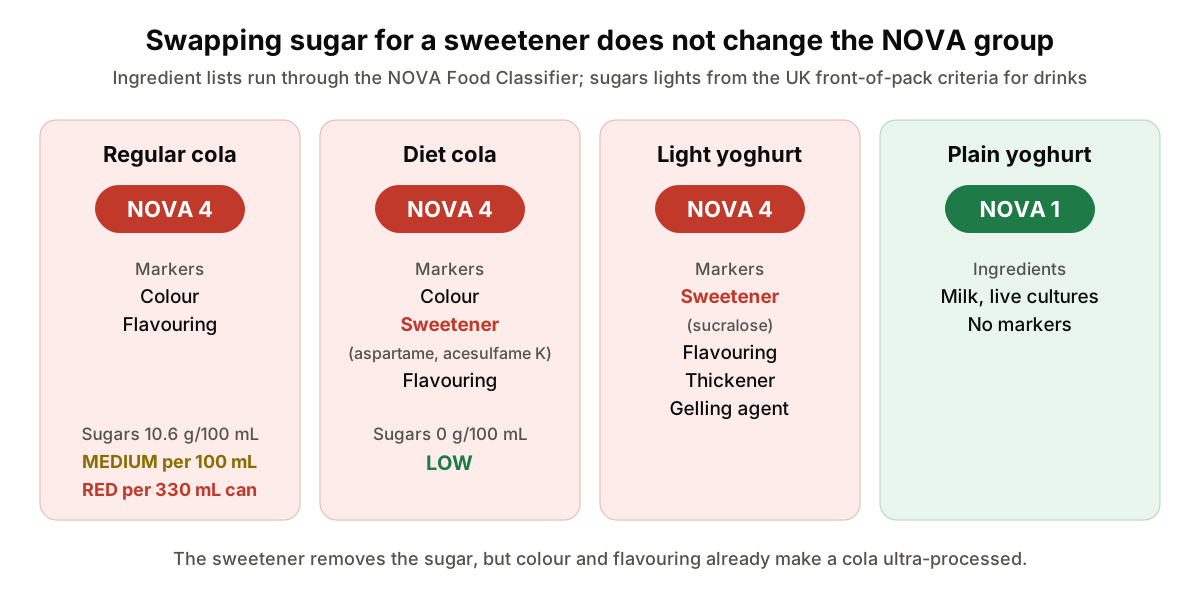
The same happens with yoghurt. "Greek yoghurt (milk, live cultures), strawberries, water, sucralose, natural flavouring, thickener (pectin)" is NOVA 4 (Sweetener, Flavouring, Thickener, Gelling agent), while plain "Milk, live cultures" is NOVA 1. Stevia gets no exemption: "Erythritol, stevia leaf extract" is flagged for both.
Who should take more care
- People with PKU: avoid aspartame; check for the phenylalanine statement.
- People with diabetes: the WHO guideline does not cover you, and sweeteners can be part of a plan to cut sugar; decide with your doctor or dietitian.
- Young children: a can is a larger share of a small body's ADI, and the Dietary Guidelines say to avoid added sugars from birth to age 4; ask your paediatrician before giving sweetened products.
- Large amounts of sugar alcohols such as sorbitol and xylitol can have a laxative effect, which product labels often warn about.
Tools for this job
- NOVA Food Classifier: paste an ingredient list to see the NOVA group and which markers (sweetener, colour, flavouring and others) decided it, with optional sugar, fat and salt traffic lights.
- Food Labeling Guide: what front-of-pack claims such as "FDA Approved" or "Natural" mean and how much weight each carries.
For the full NOVA groups and markers, read NOVA food classification explained. For the Nutrition Facts panel, %DV and added sugars line, see the food labels guide.
Frequently asked questions
Does aspartame cause cancer?
IARC classified aspartame as possibly carcinogenic (Group 2B) in 2023 on limited evidence for liver cancer, a judgement about the strength of evidence. In the same review cycle JECFA kept the acceptable daily intake at 40 mg/kg, and FDA said it has no safety concerns at approved uses. Exceeding the ADI would take more than 9 cans of diet soda a day for a 70 kg adult.
Is stevia safer than sucralose?
Both are permitted in the US on safety grounds, high-purity steviol glycosides through GRAS notices and sucralose as an approved food additive, and both have ADIs that typical diets stay well below. Neither is exempt from WHO's weight-control advice or from NOVA's sweetener marker.
Do artificial sweeteners help you lose weight?
WHO's 2023 review found no long-term benefit for body fat in adults or children, which is why it advises against using non-sugar sweeteners for weight control. The review did include short trials in which swapping sugar for sweeteners gave small weight losses, but WHO based its advice on the lack of long-term benefit.
Are sugar alcohols artificial sweeteners?
Not in WHO's definition: polyols such as sorbitol, xylitol and erythritol have calories, so the 2023 guideline excludes them. The 2025 to 2030 US Dietary Guidelines list xylitol among sweeteners to limit.
Sources and further reading
- WHO advises not to use non-sugar sweeteners for weight control in newly released guideline, World Health Organization. The 2023 conditional recommendation, who it covers and the evidence summary.
- Use of non-sugar sweeteners: WHO guideline, World Health Organization. The full 2023 guideline.
- Aspartame hazard and risk assessment results released, World Health Organization, IARC and JECFA. Group 2B, the 40 mg/kg ADI and the 9 to 14 cans example.
- Aspartame and Other Sweeteners in Food, US Food and Drug Administration. Approved and GRAS sweeteners, ADIs, sweetness and packet counts, and FDA's response to IARC.
- Dietary Guidelines for Americans, 2025 to 2030, US Department of Agriculture and Department of Health and Human Services. The added sugars and non-nutritive sweeteners advice.
- Guide to creating a front of pack (FoP) nutrition label for pre-packed products sold through retail outlets, UK Department of Health and Social Care and Food Standards Agency. Per 100 mL and per portion colour criteria for drinks.
- Ultra-processed foods: what they are and how to identify them, Monteiro and colleagues, Public Health Nutrition 2019. The NOVA markers, including sweeteners, used by the classifier.