
Attic Insulation R-Values by Climate Zone, and How to Get There
ENERGY STAR R-value targets for every IECC climate zone, crediting the insulation you already have, depth per R for cellulose and fiberglass, bag charts and batt layers.
By Redbison Dev · · Updated · 11 min read

Adding insulation to an attic is one of the few home improvements that is cheap, quick and pays for itself in most climates. The hard part is knowing how much is enough. The answer depends on your climate zone, on what is already up there, and on the material you add, because an inch of cellulose and an inch of loose fiberglass are not worth the same. This guide covers the recommended R-values, how to credit existing insulation, and how to turn a target into depth and bags. The Insulation Calculator does each step for you.
R-value in one paragraph
R-value is resistance to heat flow. In US units it is ft²·°F·h/BTU, which means the heat flow through each square foot, in BTU per hour, is the temperature difference in °F divided by R. An R-30 layer with 60 °F between the house and the attic lets 2 BTU per hour through each square foot. Layers in series add, so R-11 on top of R-19 is R-30. Doubling R halves heat loss through that layer, which is why the first few inches of insulation save the most and each extra inch saves less. Outside the US the same quantity is RSI, in m²·K/W; multiply an R-value by 0.1761 to get RSI, so R-60 is RSI 10.6.
Recommended R-values by climate zone
The International Energy Conservation Code divides the US into climate zones 1 (hottest) to 8 (coldest), following county lines, with letters for moist (A), dry (B) and marine (C) regions. ENERGY STAR publishes recommended insulation levels by zone, based on the 2021 IECC (Table R402.1.3):
| Zone | Attic, uninsulated | Attic, add over 3 to 4 in | Floor | Basement or crawlspace wall |
|---|---|---|---|---|
| 1 | R30 | R25 | R13 | none given |
| 2 | R49 | R38 | R13 | none given |
| 3 | R49 | R38 | R19 | R5 sheathing or R13 batt |
| 4A and 4B | R60 | R49 | R19 | R10 sheathing or R13 batt |
| 4C, 5 and 6 | R60 | R49 | R30 | R15 sheathing or R19 batt |
| 7 and 8 | R60 | R49 | R38 | R15 sheathing or R19 batt |
For above-ground walls the page recommends blowing insulation into empty wall cavities and, when siding is replaced, adding insulating sheathing: R5 in Zone 3 and R5 to R10 in Zones 4 to 8.
Rough geography: Zone 1 is southern Florida and Hawaii; Zone 2 the Gulf Coast and the low desert (Houston, New Orleans, Phoenix); Zone 3 a band from Atlanta and Dallas to Las Vegas and Los Angeles; Zone 4 the mid-Atlantic, St. Louis and Nashville, with 4C covering Seattle and Portland; Zones 5 and 6 most of the northern states (Chicago, Denver, Boston, Minneapolis); Zone 7 northern Minnesota and Wisconsin; Zone 8 interior Alaska. Check your county on the IECC map for the exact zone.
Credit what is already there
Most attics already have something. Measure its depth in several places, because it is rarely even, and multiply by a typical R per inch for the material:
| Existing material | Typical R per inch |
|---|---|
| Fiberglass batts | about 3.1 (2.9 to 3.8 depending on density) |
| Loose-fill fiberglass | about 2.5 (settled 2.2 to 2.7) |
| Loose-fill cellulose | about 3.5 (settled 3.2 to 3.8) |
| Rock wool | about 3.0 |
Three inches of old fiberglass batts is about R-9. Insulation that is compressed, wet, matted by pests or full of gaps is worth less; if it is mouldy or wet, remove it and fix the cause first.
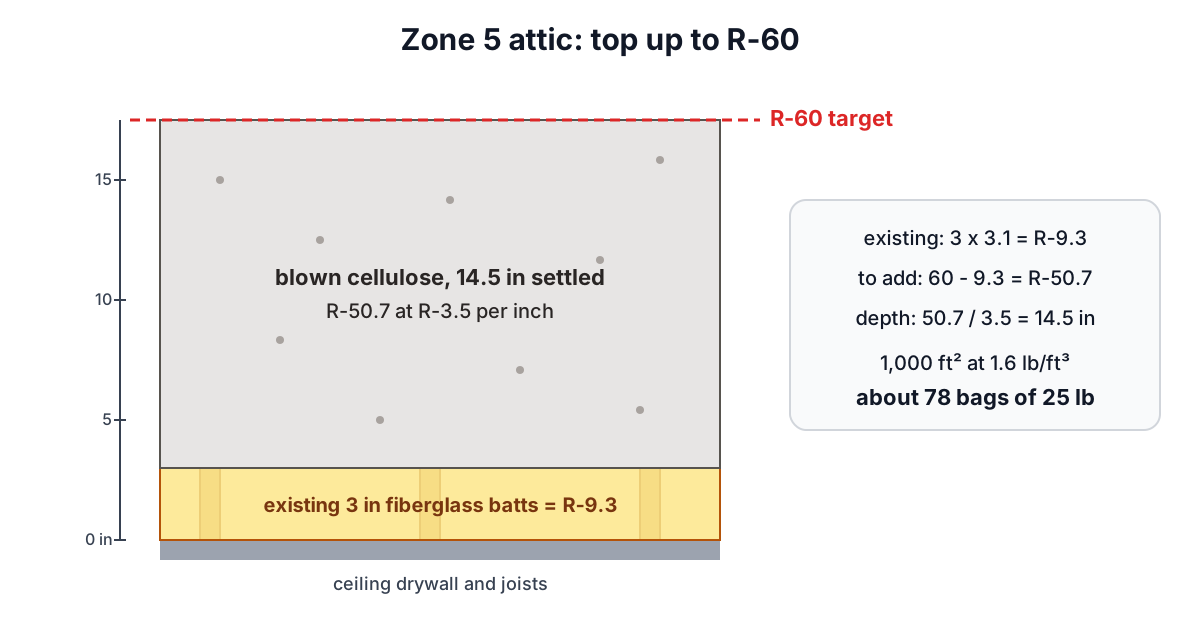
Then subtract: R to add = target - existing. For a Zone 5 attic with 3 inches of batts, that is 60 - 9.3 = R-50.7. ENERGY STAR's own "add over 3 to 4 inches" column (R49 in Zone 5) gives nearly the same answer.
Turn R into depth
For loose fill, depth is the R to add divided by the R per inch, using the settled value:
depth (in) = R to add / R per inch
| Target | Cellulose at R-3.5/in | Loose fiberglass at R-2.5/in |
|---|---|---|
| R-30 | 8.6 in | 12 in |
| R-38 | 10.9 in | 15.2 in |
| R-49 | 14 in | 19.6 in |
| R-60 | 17.1 in | 24 in |
The US Department of Energy gives settled values of about R-3.2 to 3.8 per inch for cellulose and R-2.2 to 2.7 for loose fiberglass, so treat these as mid-range. Cellulose settles noticeably after installation, which is why bag charts list both an installed and a settled thickness; the settled one is what determines the R-value. Staple depth rulers to the joists at the installed thickness before you start blowing.
Count the bags: use the chart
The US Federal Trade Commission's R-Value Rule (16 CFR Part 460) requires every bag of loose-fill insulation to carry a coverage chart. For each R-value it lists the minimum thickness, the minimum weight per square foot, the maximum net coverage per bag and the bags per 1,000 square feet. That chart is the definitive answer for your product, because it reflects how that material is meant to be blown.
Without the chart you can estimate from density. Settled attic cellulose is typically about 1.5 to 2.0 lb per cubic foot and loose fiberglass about 0.5 to 1.0:
weight (lb) = area (ft²) x depth (in) / 12 x density (lb/ft³)
bags        = weight / bag weight
For the Zone 5 example, 1,000 square feet x 14.5 inches / 12 x 1.6 lb/ft³ = about 1,930 lb of cellulose, or 78 bags of 25 lb. The calculator gives both methods; when you have the bag in hand, switch to the chart.
Batts
Batts and rolls come in fixed R-values. Typical fiberglass products are R-13 and R-15 for 2x4 walls (3.5 inches), R-19 and R-21 for 2x6 walls (about 6.25 and 5.5 inches), and R-30 and R-38 for attics and floors (about 9.5 to 10 and 12 inches). To reach an attic target, add layers: two layers of R-30 make R-60.
Lay the first layer between the joists and the second at right angles across them, which covers the wood (a thermal bridge) and the gaps between batts. Use unfaced batts for any layer over existing insulation, so you do not create a second vapour retarder that traps moisture.
Walls are limited by the cavity. A 2x4 stud wall holds R-13 to R-15 and a 2x6 wall R-19 to R-21; any more has to come from continuous insulation outside the studs.
Spray foam
Spray polyurethane foam is sold by the board foot: one square foot one inch thick. Open-cell foam is about R-3.5 to 3.6 per inch and closed-cell about R-6 to 7, depending on the product. A 200 square foot rim joist area at 2 inches of closed-cell foam is 400 board feet. DIY kits are rated in board feet, though real-world yield is often lower than the label because of temperature and technique, so add a margin. Large areas and anything inside living space are usually better left to a contractor.
Before you add insulation
- Air-seal first. Gaps around top plates, plumbing and wiring penetrations, attic hatches and recessed lights let warm, moist air into the attic. Sealing them with foam or caulk often saves as much as the insulation itself and prevents condensation in the new layer.
- Keep vents open. Install baffles at the eaves so insulation does not block soffit vents.
- Keep clear of heat. Leave clearance around chimneys and flues, and around recessed lights that are not rated for insulation contact (IC-rated).
- Check for moisture and pests. Fix roof leaks and remove contaminated insulation before topping up.
A worked plan
A 1,200 square foot attic in Zone 4A has about 4 inches of old loose fiberglass.
- Target: R-60 (ENERGY STAR, Zone 4A).
- Existing: 4 x 2.5 = R-10.
- R to add: 50. With cellulose at 3.5 per inch: 14.3 inches settled.
- Bags: from the density estimate, 1,200 x 14.3 / 12 x 1.6 = 2,290 lb, about 92 bags of 25 lb. Then confirm with the coverage chart on the bag.
Plan your own attic with the Insulation Calculator. To see what the insulation saves, the Heat Loss Calculator works through U-values, and the BTU Calculator sizes the heating or cooling that is left.
Frequently asked questions
Is cellulose or fiberglass better R-value per inch?
Loose-fill cellulose gives more R-value per inch than loose-fill fiberglass: about R-3.5 per inch (settled 3.2 to 3.8) against about R-2.5 (settled 2.2 to 2.7). Reaching R-60 therefore takes about 17.1 inches of cellulose but about 24 inches of loose fiberglass. Cellulose settles noticeably, so use the settled thickness.
How do I calculate how much insulation to add to my attic?
Measure the existing insulation's depth in several places and multiply by its R per inch to get the existing R-value, then subtract it from the target. A Zone 5 attic with 3 inches of fiberglass batts has about R-9.3, so reaching R-60 needs R-50.7. Divide that by the new material's settled R per inch for the depth.
How do I reach R-60 with fiberglass batts?
Add batt layers, since R-values in series add: two layers of R-30 make R-60. Lay the first layer between the joists and the second at right angles across them, which covers the wood thermal bridge and the gaps between batts. Use unfaced batts for any layer over existing insulation to avoid a second vapour retarder.
What is the R-value of spray foam insulation per inch?
Open-cell spray polyurethane foam is about R-3.5 to 3.6 per inch and closed-cell foam about R-6 to 7, depending on the product. Spray foam is sold by the board foot, one square foot one inch thick, so 200 square feet at 2 inches is 400 board feet. Real-world kit yield is often lower than the label.
Should I air-seal the attic before adding insulation?
Yes. Gaps around top plates, plumbing and wiring penetrations, attic hatches and recessed lights let warm, moist air into the attic, and sealing them with foam or caulk often saves as much as the insulation itself. It also prevents condensation in the new layer. Keep eave baffles clear and leave clearance around chimneys and non-IC-rated lights.
Sources and further reading
- Recommended home insulation R-values, ENERGY STAR. The zone table this guide uses.
- Chapter 4 RE Residential Energy Efficiency: 2021 International Energy Conservation Code, International Code Council. Contains Table R402.1.3.
- 16 CFR Part 460: Labeling and advertising of home insulation, Legal Information Institute. The FTC R-Value Rule and the bag coverage chart.
- Loose-fill insulation, Pacific Northwest National Laboratory. Settled densities and R-value per inch.
Open the Insulation Calculator
More Construction & Home
Every tool in the Construction & Home section, free and in your browser.