
Battery Runtime and Peukert's Law: How Long Will It Last?
Amp-hours versus watt-hours, usable depth of discharge for lead-acid and LiFePO4, inverter losses, and Peukert's 1897 law for why lead-acid batteries give less at high currents.
By Redbison Dev · · Updated · 10 min read

"How long will this battery last?" has a quick answer and a correct one. The quick answer divides capacity by load. The correct one asks how much of the capacity you can actually use, how much the inverter wastes, and whether the battery gives its full rating at the current you are drawing. For lead-acid batteries that last question has a name, Peukert's law, and it can shave a third off the runtime at heavy loads. This guide works through each factor with numbers you can reproduce in the Battery Runtime Calculator.
Amp-hours, watt-hours and voltage
Battery capacity is quoted in two ways. Amp-hours (Ah) count charge: a 100 Ah battery can in principle deliver 5 A for 20 hours. Watt-hours (Wh) count energy: Wh = Ah × V. A 12 V, 100 Ah lead-acid battery stores 1,200 Wh; a 12.8 V, 100 Ah LiFePO4 battery stores 1,280 Wh.
Watt-hours are the safer unit for runtime because loads are rated in watts and because they let you compare batteries at different voltages. Two 12 V, 100 Ah batteries in series make 24 V, 100 Ah; in parallel they make 12 V, 200 Ah. Both banks store 2,400 Wh and run a given load for the same time. Portable power stations and UPS units usually quote Wh directly.
The basic runtime equation
Runtime in hours = usable energy ÷ power drawn from the battery
= (Wh × depth of discharge) ÷ (load W ÷ inverter efficiency)
Each term deserves a moment.
Depth of discharge (DoD) is how much of the rated capacity you plan to take out. Lead-acid batteries suffer when deeply discharged: plates sulphate and cycle life drops sharply. Designing to about 50% DoD is the common rule for flooded, AGM and gel batteries if you want years of service. LiFePO4 tolerates deep cycling much better, and 80 to 90% is routine, with the battery management system cutting off before damage.
Inverter efficiency applies when the load is AC. A good inverter converts 90 to 95% of battery power to AC at moderate load, less at very light load. A 100 W AC load through a 90% inverter takes 111 W from the battery. Inverters also draw idle power, from a few watts on small units to 20 or 30 W on large ones, whether anything is plugged in or not.
Putting it together for a 12 V, 100 Ah AGM battery, a 100 W AC load, a 90% inverter and 50% DoD: (1,200 × 0.5) ÷ 111.1 = 5.4 hours. That is the ideal figure.
Peukert's law
In 1897 the German scientist Wilhelm Peukert measured how lead-acid capacity falls as discharge current rises. His empirical law, in the form used today, is:
t = H × (C ÷ (I × H))^k
where C is the rated capacity in Ah at the H-hour rate, I is the actual discharge current, t is the time to full discharge in hours and k is the Peukert exponent.
Battery capacity is quoted at a stated rate, most often 20 hours (C/20). At exactly the rated current, I = C ÷ H, the bracket equals 1 and t = H whatever k is. At higher currents the bracket is less than 1, and raising it to a power k greater than 1 makes it smaller still, so the runtime is shorter than simple division predicts. Physically, at high currents the acid near the plates is depleted faster than it can diffuse in, and the voltage reaches cut-off before all the active material is used.
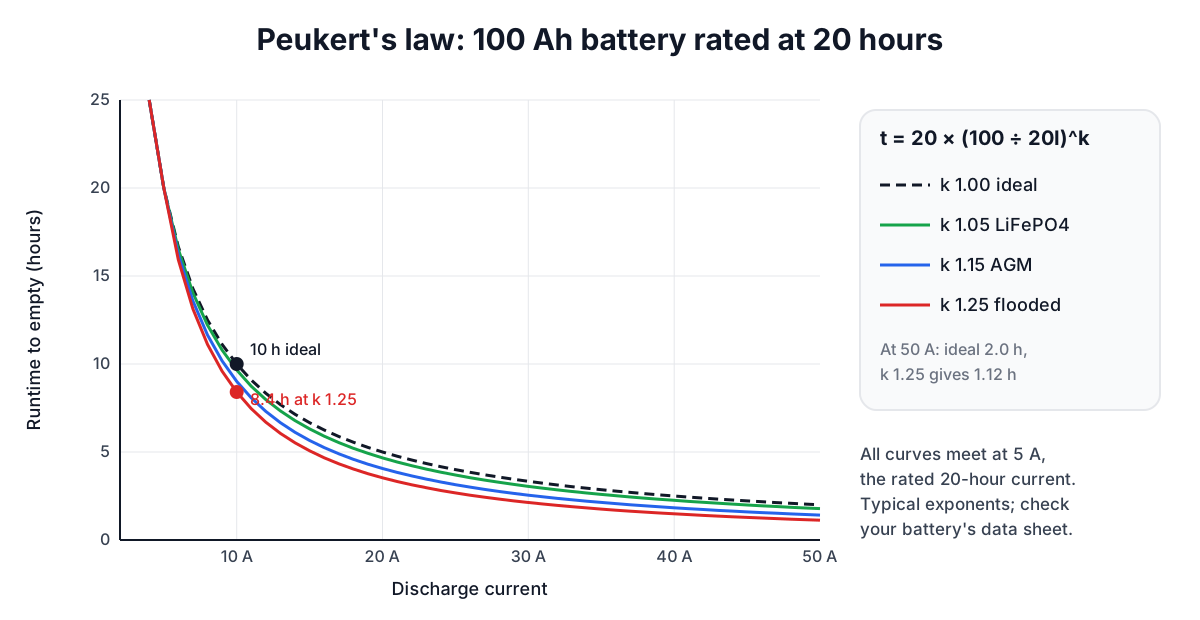
Typical exponents: 1.05 or less for LiFePO4, about 1.1 to 1.15 for AGM and gel, 1.2 to 1.3 for flooded lead-acid. Some manufacturers publish k; you can also derive it from two rated capacities: k = ln(t2 ÷ t1) ÷ ln(I1 ÷ I2). If a battery is rated 100 Ah at 20 h (5 A) and 80 Ah at 5 h (16 A), k = ln(5 ÷ 20) ÷ ln(5 ÷ 16) = 1.19.
Worked numbers for a 100 Ah C/20 battery at 10 A with k = 1.2: t = 20 × (100 ÷ 200)^1.2 = 20 × 0.435 = 8.7 hours, against 10 hours ideal. It effectively delivers 87 Ah.
The calculator applies Peukert to a full discharge and then scales by DoD. For the AGM example above (9.26 A, k = 1.15): full discharge would take 9.85 hours, and half of that is 4.9 hours, about 9% less than the ideal 5.4 hours. For a 225 Ah flooded bank driving 500 W through an inverter (46 A, k = 1.25) the ideal 2.4 hours becomes 1.7 hours, a 30% loss.
Sizing a battery for a target runtime
Turn the equation around to find the capacity you need:
Ah = (load W ÷ efficiency) × hours ÷ DoD ÷ V without Peukert, or
Ah = I × H × (hours ÷ (DoD × H))^(1 ÷ k) with it.
To run the same 100 W AC load for 8 hours on a 12 V AGM bank at 50% DoD: without Peukert, 111.1 × 8 ÷ 0.5 ÷ 12 = 148 Ah; with k = 1.15, about 153 Ah. Round up to standard sizes and leave margin for aging; lead-acid batteries are considered worn out at 80% of original capacity.
Lead-acid versus LiFePO4
The same rated Ah means very different usable runtime. A 100 Ah AGM battery at 50% DoD gives 600 Wh of usable energy, less at high current. A 100 Ah LiFePO4 battery at 90% gives 1,152 Wh with almost no Peukert loss. Running a 300 W load through a 90% inverter, the lithium battery lasts about 3.5 hours; the AGM battery would last under 2 hours once Peukert is included. Lithium costs more per Ah but often less per usable Wh over its life. It needs a compatible charger and should not be charged below freezing unless the battery has built-in heating.
What the simple model leaves out
- Temperature. Lead-acid capacity falls roughly 1% per °C below 25 °C; near freezing expect about 20% less.
- Aging. Capacity declines with cycles and calendar time.
- Cut-off voltage. UPS units and inverters shut down at a set voltage, often before the battery is truly empty.
- Variable loads. Fridges and pumps cycle. Use average watts from a plug-in meter, not peak.
- Recovery. Lead-acid batteries recover some capacity when rested, which Peukert's constant-current law does not capture.
For critical systems use the manufacturer's constant-power discharge tables; they already include these effects for that battery.
Where this fits
If the battery is charged by solar, size the array with the Solar Panel Calculator and read How Many Solar Panels Do I Need?. If the backup is a generator instead, see What Size Generator Do I Need?. To check what running a load costs from the grid, try the Electricity Cost Calculator.
Frequently asked questions
How do I find a battery's Peukert exponent?
Some manufacturers publish the Peukert exponent k. Otherwise derive it from two rated capacities with k = ln(t2 ÷ t1) ÷ ln(I1 ÷ I2). A battery rated 100 Ah at 20 h (5 A) and 80 Ah at 5 h (16 A) gives k = 1.19. Typical values are 1.05 or less for LiFePO4, 1.1 to 1.15 for AGM and gel, and 1.2 to 1.3 for flooded lead-acid.
How long will a 100Ah LiFePO4 battery last compared with AGM?
A 100 Ah LiFePO4 battery at 90% depth of discharge gives 1,152 Wh of usable energy with almost no Peukert loss, while a 100 Ah AGM battery at 50% gives 600 Wh. Running a 300 W load through a 90% inverter, the lithium battery lasts about 3.5 hours and the AGM battery under 2 hours.
Does connecting batteries in series or parallel change runtime?
No. Two 12 V, 100 Ah batteries in series make 24 V, 100 Ah, and in parallel they make 12 V, 200 Ah. Both banks store 2,400 Wh and run a given load for the same time, which is why watt-hours, Ah × V, are the safer unit for comparing battery runtime across voltages.
How big a battery do I need to run 100 W for 8 hours?
To run a 100 W AC load for 8 hours through a 90% inverter on a 12 V AGM bank at 50% depth of discharge, you need about 148 Ah without Peukert and about 153 Ah with an exponent of 1.15. Round up to a standard size and leave margin for aging, since lead-acid is worn out at 80% of original capacity.
How does cold affect battery capacity?
Lead-acid battery capacity falls roughly 1% per °C below 25 °C, so near freezing expect about 20% less runtime. LiFePO4 handles deep cycling better, but it should not be charged below freezing unless the battery has built-in heating. For critical systems, use the manufacturer's constant-power discharge tables.
Sources and further reading
- A critical review of using the Peukert equation for determining the remaining capacity of lead-acid and lithium-ion batteries, Journal of Power Sources. Doerffel and Abu Sharkh, 2006.
- A Critical Study of Using the Peukert Equation and Its Generalizations for Determining the Remaining Capacity of Lithium-Ion Batteries, Applied Sciences. Galushkin and colleagues, 2020.
- Expanding the Peukert equation for battery capacity modeling through inclusion of a temperature dependency, Journal of Power Sources. Hausmann and Depcik, 2013, on how temperature changes Peukert behaviour.
Open the Battery Runtime Calculator
More Electrical
Every tool in the Electrical section, free and in your browser.