
Carbon-14 Dating: How the Half-Life Gives an Age
Work out a radiocarbon age from the carbon-14 left in a sample, see why labs still use the 5,568-year half-life, and learn what calibration does to the answer.
By Redbison Dev · · 9 min read

You have a radiocarbon result in front of you, from a lab report, a museum label or a homework problem, and it says something like "F¹⁴C = 0.4000" or "7,360 ± 30 BP". Carbon dating works by measuring how much carbon-14 is left in once-living material compared with a modern standard: carbon-14 halves every few thousand years, so the fraction left fixes how long ago the organism stopped taking in carbon. A sample with 40% of the modern level is 7,360 radiocarbon years old by the lab convention, and a calibration curve then turns that into calendar years.
This post works that number out step by step with the Half-Life Calculator, shows where the three different carbon-14 half-lives you will see quoted come from, and explains why the answer a lab reports is not yet a date in years before today.
Where the carbon-14 comes from and why it works as a clock
Cosmic rays hitting the upper atmosphere produce neutrons, and some of those turn nitrogen-14 into carbon-14. The new carbon-14 is oxidised to carbon dioxide and mixes through the atmosphere, plants take it up by photosynthesis, and animals eat the plants. While an organism is alive it keeps exchanging carbon with its surroundings, so its carbon-14 level tracks the atmosphere's. When it dies the exchange stops, and the carbon-14 it holds decays back to nitrogen-14 without being replaced.
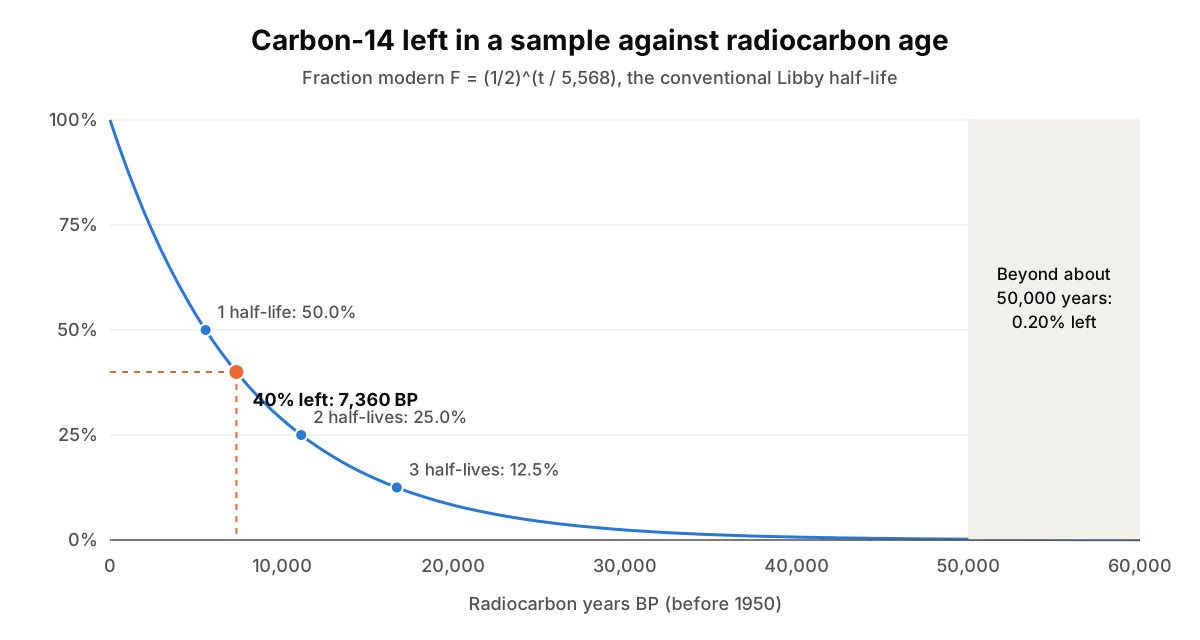
Decay is random for a single atom but completely regular for billions of them: in each half-life, half of what is left decays. That gives the familiar curve:
F = (1/2)^(t / T½)
where F is the fraction of the original carbon-14 still present, t the time since death and T½ the half-life. Solving for t needs a logarithm:
t = T½ × log₂(1 / F)
A radiocarbon lab does not count the atoms left from day one, because nobody measured the sample when it was alive. It compares the sample with a modern reference standard and reports the ratio as F¹⁴C (fraction modern carbon) or pMC (percent modern carbon, F¹⁴C × 100). The assumption is that the organism started with the reference level, and the calibration step below corrects for the years when that assumption was off.
Worked example: an age from the fraction left
Say a lab measures charcoal from a hearth and reports F¹⁴C = 0.4000: the charcoal holds 40% of the modern reference level of carbon-14.
Open the Half-Life Calculator, set Solve for to Time, and enter:
- Initial amount N₀: 100
- Remaining amount N: 40
- Half-life T½: 5568 years (the Carbon-14 preset fills in 5,700; type over it)
The calculator returns an elapsed time of 7,360.5 years, which is 1.3219 half-lives. A decay constant of 0.00012449 per year and a mean life of 8,032.9 years come out alongside it. Labs report this as a conventional radiocarbon age of about 7,360 BP, where BP means "before present" and present is fixed at AD 1950.
You can check the middle step with the Logarithm Calculator. Enter 2.5 (that is 1 / 0.40) as the number and 2 as the base: log₂ 2.5 = 1.321928, the number of half-lives. Multiply by 5,568 and you are back at 7,360.5 years.
Labs often write the same calculation as t = −8033 × ln(F¹⁴C). The 8,033 is the mean life for the Libby half-life, 5,568 / ln 2, which the calculator shows as 8,032.9 years. Enter 0.4 in the Logarithm Calculator and its natural log line shows ln 0.4 = −0.916291, and −8,033 × −0.916291 = 7,360.6 years, the same answer to rounding.
5,568, 5,730 or 5,700 years: which half-life is right?
You will see three values for the half-life of carbon-14, and each has a reason.
| Half-life | Where it comes from | Age for F¹⁴C = 0.40 |
|---|---|---|
| 5,568 years | Willard Libby's early measurements; the "Libby half-life" | 7,360 years |
| 5,700 years | Current evaluated value (5,700 ± 30), used by the NNDC nuclear data tables | 7,535 years |
| 5,730 years | The "Cambridge half-life" (5,730 ± 40) adopted in 1962 | 7,575 years |
The last column comes from the same Half-Life Calculator run with each half-life in turn. The difference is about 3%: 5,730 / 5,568 = 1.029, which is why older textbooks tell you to multiply a radiocarbon age by 1.03 to get a "true" age.
Do not do that today. Stuiver and Polach's 1977 reporting rules, still followed by radiocarbon labs, fix the conventional radiocarbon age to the Libby half-life, to AD 1950 as the zero point, and to a carbon-13 correction (the sample's δ¹³C is normalised to −25‰, which removes the effect of plants and animals taking up carbon isotopes at slightly different rates). Keeping the old half-life on purpose means every date published since the 1950s sits on one scale. The error in the half-life is then absorbed by calibration, because the calibration curve is built by measuring samples of known age on that same conventional scale.
So the rule of thumb is: use 5,568 years when you want to reproduce what a lab reports, and 5,700 years when you want a physics answer, such as how much carbon-14 a sample loses in a given time. Neither gives a calendar date on its own.
Calibration: from radiocarbon years to calendar years
The atmosphere's carbon-14 level has not been constant. It changes with the cosmic-ray flux, the strength of the Earth's magnetic field and the movement of carbon between the oceans and the air. A tree that died 8,000 years ago may have started with more or less carbon-14 than the modern standard, so its radiocarbon age drifts away from its true age.
Calibration fixes this by comparing your radiocarbon age with a curve built from samples whose calendar age is known independently: tree rings counted year by year, and for older periods lake and marine sediments, cave formations and corals. The current Northern Hemisphere curve is IntCal20 (Reimer et al., 2020), which runs from the present back to 55,000 calendar years BP. Separate curves exist for the Southern Hemisphere (SHCal20) and for marine samples (Marine20), because the oceans hold older carbon and southern air mixes differently.
Three things change when you calibrate:
- The unit changes. A result of "7,360 BP" is in radiocarbon years; a calibrated result is written "cal BP" or as a calendar range such as "cal BC". Mixing the two is a common mistake in articles and student work.
- The answer becomes a range. The curve has wiggles and flat stretches (plateaus), so one radiocarbon age can match several calendar spans. Calibration programs such as OxCal and CALIB report 68% and 95% probability ranges, sometimes in more than one piece.
- The age usually moves. Over most of the last 50,000 years calendar ages come out older than radiocarbon ages, by a few hundred years in the Holocene and by more further back. Running the radiocarbon age through the curve is the only reliable way to know by how much.
Limits: why carbon dating stops at about 50,000 years
The same exponential that makes the method work also caps it. After ten half-lives less than a thousandth of the carbon-14 is left. Run the Half-Life Calculator with an initial amount of 100, a half-life of 5,568 years and 50,000 years elapsed, and only 0.198 remains: 0.2% of the modern level. Most labs put their practical limit around that point, and IntCal20 itself ends at 55,000 cal BP.
At that level contamination dominates. Suppose a sample far too old to hold any carbon-14 picks up modern carbon worth 1% of the modern level, from roots, handling or poor pretreatment. Solve for elapsed time with remaining 1, initial 100 and half-life 5,568, and you get 36,993 years: an "infinitely old" sample now reads as about 37,000 radiocarbon years. That is why labs clean samples chemically before measuring them and treat dates near the limit with caution.
Three other effects to know about:
- Bomb carbon. Atmospheric nuclear tests in the 1950s and 1960s pushed carbon-14 far above its natural level, so material formed since then has F¹⁴C above 1. The half-life formula cannot give a negative age, and the Half-Life Calculator refuses a remaining amount larger than the initial amount for that reason. Such results are reported as F¹⁴C and matched against post-bomb curves instead.
- Reservoir effects. Shells and fish from the sea, and from some lakes, take up carbon that is older than the air's, so they read too old. Marine20 and local reservoir corrections handle that.
- What you date is what died. Charcoal from the heartwood of an old tree dates the growth of that wood, which may be centuries before the fire. The method dates the death of the organism, not the event you care about.
Tools for this job
- Half-Life Calculator: solve for elapsed time from the fraction left, or find how much carbon-14 a sample of known age should still hold. Its carbon-14 preset uses 5,700 years; type 5,568 over it when you want a conventional age.
- Logarithm Calculator: check the number of half-lives with log₂(1/F), or the lab formula −8033 × ln(F¹⁴C), step by step with the change-of-base working shown.
For the general half-life and decay-constant maths behind other isotopes, read Molar Mass, Molarity, Dilutions and Half-Life: Lab Maths. For why log₂ and ln give the same answer once you change base, see Logarithms Explained: Bases, ln, Change of Base and Real Uses.
Frequently asked questions
Why do labs still use the 5,568-year half-life if it is wrong?
By convention, set out by Stuiver and Polach in 1977, a conventional radiocarbon age always uses Willard Libby's 5,568-year half-life and AD 1950 as the zero point. That keeps every published date on one scale. The half-life error does not reach calendar dates, because calibration curves such as IntCal20 are built on the same conventional scale and absorb it.
How do I convert percent modern carbon to a radiocarbon age?
Divide percent modern carbon by 100 to get F¹⁴C, then use t = −8033 × ln(F¹⁴C). A result of 40 pMC gives F¹⁴C = 0.40 and an age of about 7,360 radiocarbon years BP. The same answer comes from 5,568 × log₂(1 / 0.40), which is 1.3219 half-lives.
What does cal BP mean on a radiocarbon date?
Cal BP means calibrated years before present, where present is fixed at AD 1950. It shows that a radiocarbon age has been converted to calendar years with a calibration curve such as IntCal20. An uncalibrated result is written simply as BP and is in radiocarbon years, which usually differ from calendar years by a few hundred years or more.
Can carbon dating be used on rocks or dinosaur bones?
No. Carbon dating works only on material that once took up carbon from the atmosphere, such as wood, charcoal, bone collagen, shell or cloth, and only back to about 50,000 years. After that less than 0.2% of the carbon-14 remains. Dinosaur fossils, millions of years old, are dated indirectly from volcanic ash layers above and below them, using argon-argon dating or uranium-lead dating of zircon crystals.
Sources and further reading
- The IntCal20 Northern Hemisphere Radiocarbon Age Calibration Curve (0-55 cal kBP), Reimer and colleagues, Radiocarbon 62(4), 2020. The current Northern Hemisphere calibration curve and the data behind it.
- Discussion: Reporting of 14C Data, Stuiver and Polach, Radiocarbon 19(3), 1977. Defines the conventional radiocarbon age, the Libby half-life convention and δ¹³C normalisation.
- Discussion: Reporting and Calibration of Post-Bomb 14C Data, Reimer, Brown and Reimer, Radiocarbon 46(3), 2004. F¹⁴C notation and the −8033 ln(F¹⁴C) age formula.
- NuDat 3, National Nuclear Data Center, Brookhaven National Laboratory. Evaluated half-life of carbon-14.
- 21.3 Radioactive Decay, OpenStax Chemistry 2e. Half-life maths and radiocarbon dating for students.