
camelCase, snake_case, kebab-case: Naming Conventions Across Languages
Which casing style each language and ecosystem expects, why it matters for APIs and URLs, and how to convert between styles without mangling acronyms.
By Redbison Dev · · Updated · 7 min read
Every programming ecosystem has opinions about how to write multi-word names. Python wants user_name, JavaScript wants userName, C# wants UserName for most public members, CSS wants user-name, and environment variables want USER_NAME. None of these is more correct than the others. What matters is following the convention of the place the name lives, and converting cleanly at the boundaries.
This guide maps the conventions to the ecosystems that use them, explains where they came from, and covers the tricky parts of converting between them. The Case Converter handles the mechanical part.
The styles
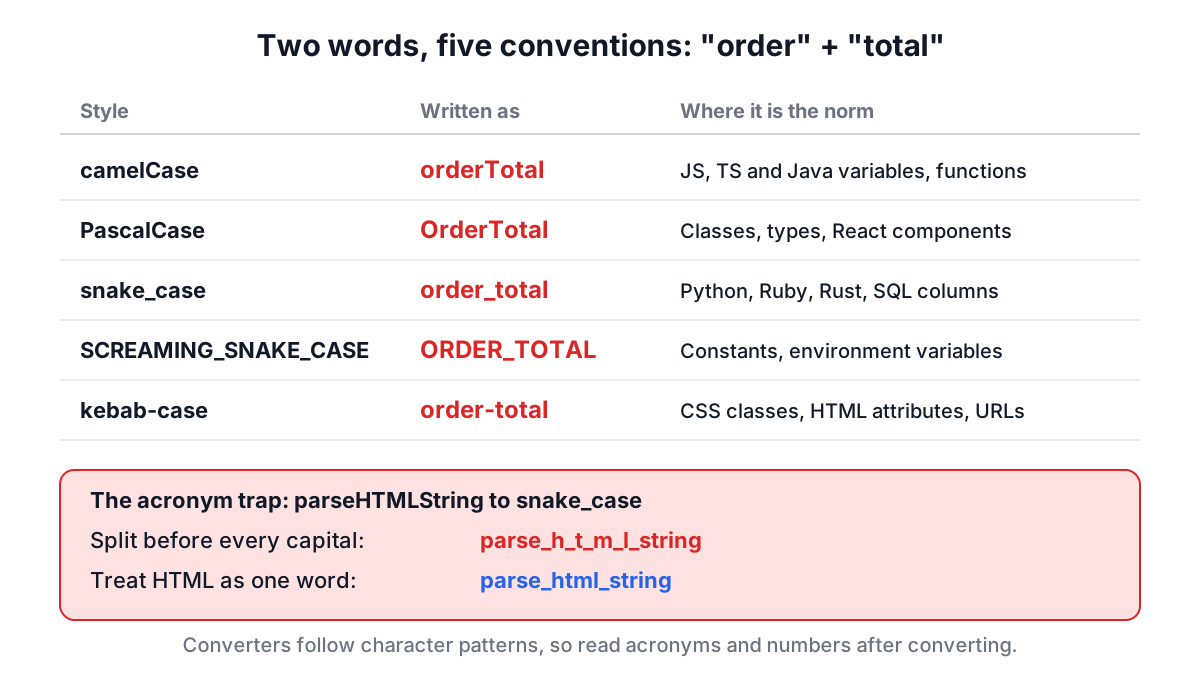
| Style | Example | Also called |
|---|---|---|
| camelCase | orderTotal | lower camel case, dromedary case |
| PascalCase | OrderTotal | upper camel case |
| snake_case | order_total | |
| SCREAMING_SNAKE_CASE | ORDER_TOTAL | constant case |
| kebab-case | order-total | dash case, lisp case |
| Title Case | Order Total |
Where each one comes from
snake_case has roots in C and Unix, where standard library names like str_len style identifiers and lower-case conventions were common. Python formalized it in PEP 8, which recommends snake_case for functions and variables. Ruby, Rust (for functions and variables) and most SQL schemas use it too.
camelCase was popularized by Smalltalk in the 1970s and 80s and inherited by Java and then JavaScript. JavaScript's own APIs use it throughout: getElementById, addEventListener, toLowerCase.
PascalCase takes its name from the Pascal language and its descendants. Today it is the near-universal convention for types: classes in Java, TypeScript, Python and C#, React components, and Go's exported identifiers (where an initial capital literally changes visibility).
kebab-case goes back to Lisp, where hyphens are legal in identifiers. Most C-family languages cannot use it for variable names, because order-total parses as subtraction, so it lives where names are strings: CSS properties and class names, HTML attributes, command-line flags like --dry-run, npm package names and URLs.
SCREAMING_SNAKE_CASE marks constants in many languages and is the standard for environment variables, partly because shells traditionally treat them case-sensitively and upper case makes them stand out.
By ecosystem
| Context | Variables / functions | Types / classes | Constants |
|---|---|---|---|
| JavaScript / TypeScript | camelCase | PascalCase | UPPER_SNAKE or camelCase |
| Python | snake_case | PascalCase | UPPER_SNAKE |
| Java | camelCase | PascalCase | UPPER_SNAKE |
| C# | camelCase (locals), PascalCase (public members) | PascalCase | PascalCase |
| Go | camelCase (unexported), PascalCase (exported) | same rule | same rule |
| Ruby | snake_case | PascalCase | UPPER_SNAKE |
| Rust | snake_case | PascalCase | UPPER_SNAKE |
| SQL | snake_case for tables and columns (common) | ||
| CSS / HTML | kebab-case | ||
| URLs | kebab-case |
Why it matters at boundaries
Conventions mostly cause friction where two ecosystems meet.
APIs. A Python or Ruby backend naturally produces created_at. A JavaScript frontend naturally wants createdAt. Teams have to choose: convert in the API layer, convert in the client, or accept snake_case in JavaScript. Google's JSON style guide recommends camelCase for JSON property names; many Rails and Django APIs use snake_case. Whichever you choose, choose once and document it.
Databases. PostgreSQL folds unquoted identifiers to lower case, so a column created as createdAt without quotes becomes createdat. Using snake_case in SQL avoids having to quote every identifier forever.
URLs. Google's URL guidance recommends hyphens to separate words, so /order-history rather than /order_history or /orderHistory. See the URL slug guide.
Files. Some file systems are case-insensitive (macOS and Windows by default) and some are not (Linux). Renaming userCard.tsx to UserCard.tsx can confuse Git on a Mac and break the build on a Linux CI server. Many teams use kebab-case for filenames to sidestep the problem.
The hard part: acronyms and word boundaries
Converting userName to user_name is easy: split before capitals. Real names are messier.
Acronyms. Is it XMLHttpRequest, XmlHttpRequest or xmlHTTPRequest? The browser API itself mixes styles. Style guides disagree:
- Microsoft's .NET guidelines keep two-letter acronyms upper case (
IOStream) and capitalize only the first letter of longer ones (XmlReader). - Google's Java style guide treats acronyms as words:
XmlHttpRequest,customerId. - Go's convention keeps initialisms consistently cased:
userID,HTTPServer.
An automatic converter splitting on capitals turns parseHTMLString into something like parse_h_t_m_l_string or parse_htmlstring depending on its rules. Always check acronyms after converting.
Numbers. Should address2 become address_2 or stay address2? Should utf8 become utf_8? There is no universal answer.
Non-ASCII text. Converters that rely on ASCII patterns may drop or mishandle accented letters.
Converting safely
- Convert, then read the result. Pay special attention to acronyms and numbers.
- For bulk renames in code, use your IDE's rename refactoring rather than search-and-replace, so references are updated too.
- For API payloads, convert at a single, well-tested layer, for example a serializer, rather than ad hoc throughout the code.
- Add a linter rule (ESLint's
camelcase, Pylint's naming checks, RuboCop) so new code follows the convention automatically.
Title case is its own topic
The converter's Title option capitalizes the first letter of every word. Editorial styles are more nuanced: AP, Chicago and APA all keep short articles, conjunctions and prepositions such as "of", "and" and "the" in lower case unless they start the title, and they disagree on details such as prepositions of four or more letters. For headlines, use the converter as a first pass and then apply your publication's style.
Related tools
- URL Slug Generator for URL-friendly kebab-case
- Regex Tester for custom renaming patterns
- JSON Formatter to review API payload keys
Frequently asked questions
What naming convention does Python use?
Python's PEP 8 recommends snake_case for functions and variables, such as user_name. Classes use PascalCase, as they do in Java, TypeScript and C#, and constants use SCREAMING_SNAKE_CASE, such as ORDER_TOTAL. Ruby and Rust follow the same pattern of snake_case for functions and variables and PascalCase for types.
Should JSON keys be camelCase or snake_case?
Either works for JSON keys, as long as an API chooses once and documents it. Google's JSON style guide recommends camelCase property names, while many Rails and Django APIs use snake_case. When a Python or Ruby backend meets a JavaScript frontend, convert at a single well-tested layer, such as a serializer, rather than ad hoc throughout the code.
Why use snake_case for database column names?
PostgreSQL folds unquoted identifiers to lower case, so a column created as createdAt without quotes becomes createdat. Using snake_case, such as created_at, for SQL tables and columns avoids having to quote every identifier forever, and it is the common convention in SQL schemas.
Why can't variable names use kebab-case?
Most C-family languages cannot use kebab-case for variable names because order-total parses as order minus total. Kebab-case comes from Lisp, where hyphens are legal in identifiers, and today it lives where names are strings: CSS properties and class names, HTML attributes, command-line flags like --dry-run, npm package names and URLs.
How should acronyms be written in camelCase and PascalCase?
Style guides disagree on acronyms in camelCase and PascalCase. Microsoft's .NET guidelines keep two-letter acronyms upper case, as in IOStream, and capitalize only the first letter of longer ones, as in XmlReader. Google's Java style guide treats acronyms as words, as in customerId. Go keeps initialisms consistently cased, as in userID and HTTPServer.
Sources and further reading
- PEP 8: Style Guide for Python Code, Python Software Foundation. snake_case for Python functions and variables.
- Capitalization Conventions, Microsoft Learn. Capitalization and acronym rules in .NET.
- Google Java Style Guide, Google. How Google treats acronyms in camel case.
- Naming: Rust API Guidelines, The Rust Project. Rust casing conventions.
- Effective Go, The Go Project. Exported and unexported names in Go.
- URL structure best practices for Google Search, Google Search Central. Hyphens rather than underscores in URLs.
More Text Processing
Every tool in the Text Processing section, free and in your browser.