
1099 Contractor vs W-2 Employee: How Classification Tests Work
The IRS control test, the Labor Department economic-reality test, state ABC tests, what misclassification costs, and what the label is worth in pay.
By Redbison Dev · · Updated · 11 min read
A company wants you for a year, 40 hours a week, on its schedule, with its laptop and your own manager, and it wants to pay you as a 1099 contractor instead of putting you on payroll. Whether you are an employee or an independent contractor is not decided by the contract or by which tax form you receive. In the US it is decided by the real working relationship, and three different tests apply: the IRS common-law control test for federal taxes, the Department of Labor's economic-reality test for minimum wage and overtime, and, in many states, a stricter ABC test.
This post explains each test as it stands in November 2026, what misclassification costs, and what classification is worth in pay, using the Salary Calculator and the Freelance Rate Calculator. It covers federal rules first; state rules differ, so check yours.
What changes when you are a contractor
For an employee, the employer withholds income tax, pays half of Social Security and Medicare (6.2% for Social Security up to a yearly wage cap plus 1.45% for Medicare, matched by the same 7.65% withheld from the employee's pay), pays federal and state unemployment tax, and usually carries workers' compensation. The federal Fair Labor Standards Act (FLSA) guarantees minimum wage and, for non-exempt workers, overtime at 1.5 times the regular rate over 40 hours a week.
An independent contractor gets none of that. You pay self-employment tax yourself: 12.4% for Social Security plus 2.9% for Medicare, on 92.35% of your net earnings, once those earnings reach $400 in a year. You can deduct half of that tax when you work out your income tax. You also pay for your own health cover, equipment, retirement saving and time off, and you have no FLSA overtime or unemployment insurance from that client.
That is why the label matters to both sides, and why the law looks past it.
The IRS test: who controls the work
For federal employment taxes the IRS applies the common-law rules. It groups the evidence into three categories:
- Behavioral control. Does the company control, or have the right to control, what you do and how you do it: instructions, training, set hours, required methods?
- Financial control. Does the company control the business side of the job: how you are paid, whether expenses are reimbursed, who provides the tools, whether you can make or lose money, whether you offer your services to others?
- Type of relationship. Is there a contract describing the relationship, employee-type benefits such as insurance or paid leave, an expectation that it continues indefinitely, and is the work a key part of the company's regular business?
The IRS says there is no "magic" number of factors and no single factor decides the case. A worker who works remotely can still be an employee. If the answer is unclear, either side can file Form SS-8 for an official IRS determination, which the IRS says may take at least six months. A worker who believes they were misclassified can use Form 8919 to pay only the employee's share of Social Security and Medicare on wages the employer reported as contract pay.
The Department of Labor test: in business for yourself?
For minimum wage and overtime, the FLSA uses an economic-reality test: is the worker economically dependent on the company, or in business for themselves? The rules for applying it have changed several times, so the date matters.
- 2024 rule. In force since 11 March 2024, it weighs six factors with none given more weight in advance: opportunity for profit or loss depending on managerial skill, investments by the worker and the company, permanence of the relationship, the nature and degree of control, whether the work is integral to the company's business, and skill and initiative.
- May 2025. Field Assistance Bulletin 2025-1 told Wage and Hour Division investigators to stop applying the 2024 rule's analysis in their investigations and to use the older Fact Sheet #13 (July 2008) and Opinion Letter FLSA2019-6 instead. The bulletin says the 2024 rule still applies in private lawsuits until the Department acts further.
- February 2026 proposal. The Department published a proposed rule on 27 February 2026 (91 FR 9932) that would rescind the 2024 rule and return to a core-factors test close to the 2021 rule. Two core factors carry the most weight: the nature and degree of the worker's control over the work, and the worker's opportunity for profit or loss based on initiative or investment. Three others help when those two point different ways: the skill required, the permanence of the relationship, and whether the work is part of an integrated unit of production. What the parties actually do counts for more than what the contract says is possible. Comments closed on 28 April 2026.
When we checked the Federal Register in early November 2026, no final rule had been published, so the proposal had no legal effect yet. Check the Department of Labor's rulemaking page before relying on this, because a final rule could change the federal test quickly.
State ABC tests
Many states set their own tests for state wage law, unemployment insurance and workers' compensation, and some are stricter than either federal test. California's ABC test presumes a worker is an employee unless the hiring company proves all three of the following:
- A. The worker is free from the company's control and direction in performing the work.
- B. The work is outside the usual course of the company's business.
- C. The worker is customarily engaged in an independently established trade, occupation or business.
Prong B is the hard one: a software developer building the core product of a software company fails it, however independent the arrangement looks. Massachusetts and New Jersey also use ABC tests for at least some laws, and states that do not may still use their own factor lists. A worker can be a contractor for federal tax purposes and an employee under state law at the same time.
Worked example: what reclassification is worth in pay
Back to the opening offer. Suppose the same company would also hire you as an employee at $45 an hour, with 10 paid holidays and 15 paid vacation days. Classification decides who pays for those days off, the employer's half of payroll tax and your benefits, so it helps to put a number on it.
Step 1: what the W-2 job pays. Open the Salary Calculator, enter 45 per Hourly and keep the defaults of 40 hours a week, 5 days, 10 holidays and 15 vacation days. Annual (unadjusted) shows $93,600: 2,080 paid hours, because an employee is paid for holidays and vacation. Annual (adjusted) shows $84,600 for 235 working days, which is what $45 an hour pays when those 25 days off are unpaid, the contractor's position. The employee's 7.65% share of payroll tax is $7,160.40, leaving $86,439.60 before income tax.
Step 2: the contractor rate that leaves the same. Open the Freelance Rate Calculator and enter take-home income 86440, business expenses 9000 (an assumption for health insurance, equipment and an accountant; use your own), effective tax rate 14.13 (self-employment tax: 15.3% on 92.35% of net earnings, with income tax left out on both sides), extra margin 0, 5 days a week, 8 hours a day, vacation days 15, public holidays 10, sick days 0 and billable share 100. Those are the same 25 days off as the offer, so both sides work 235 days.
The calculator shows an hourly rate of $58.33 and revenue needed of $109,663.79 over 1,880 billable hours, including $14,223.79 of self-employment tax. So the $45 W-2 offer is worth about $58.33 an hour as a contract, about 30% more, before counting any 401(k) match, paid sick leave or health premiums above $9,000.
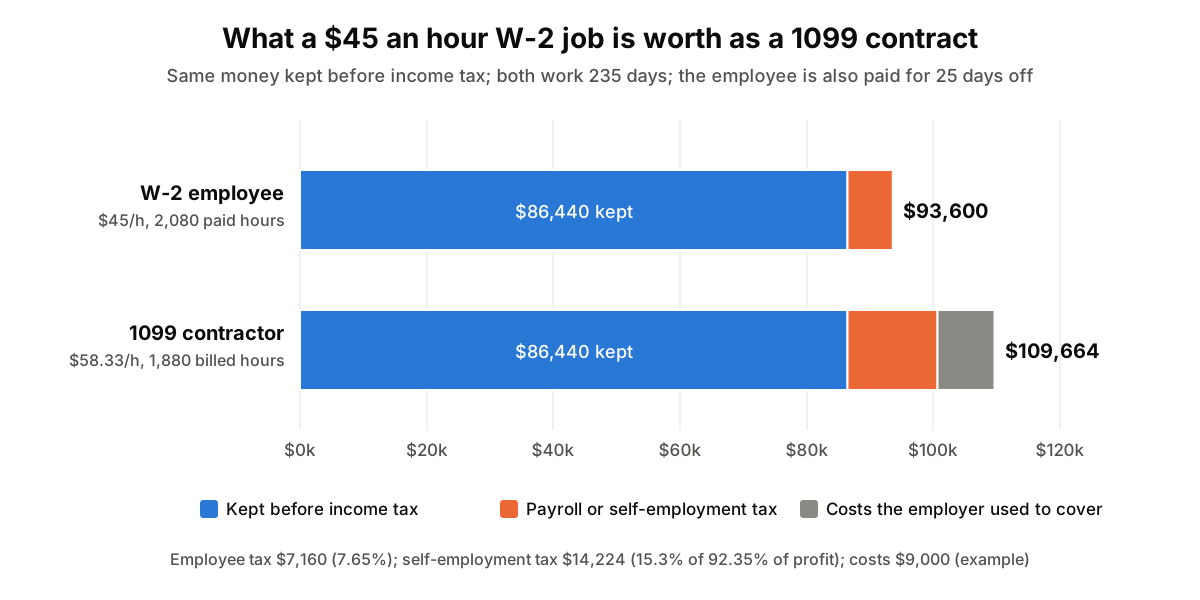
A business that calls this role a contract and pays $45 an hour is shifting about $13 an hour of cost to the worker, which is part of why the tests above look past the label.
The cost of getting it wrong
For the business, federal taxes. If the IRS reclassifies a worker, the business owes the employment taxes it should have paid. When the error was not intentional, section 3509 of the Internal Revenue Code sets reduced rates for the employee's share: 1.5% of wages for income tax that was not withheld and 20% of the employee's Social Security and Medicare tax, doubled to 3% and 40% if the business also failed to file the required information returns such as Form 1099. The employer's own share is owed in full, and intentional disregard removes the reduced rates entirely. Section 530 relief can apply when a business had a reasonable basis and treated similar workers consistently.
The settlement route. Under the IRS Voluntary Classification Settlement Program, a business that starts treating workers as employees going forward pays 10% of the employment tax that would have been due on the most recent tax year's compensation, figured at the reduced section 3509 rates, with no interest or penalties on that amount.
For the business, wages. Under the FLSA, a misclassified non-exempt worker can recover unpaid minimum wage and overtime plus an equal amount as liquidated damages. State law can add unemployment and workers' compensation premiums, penalties and interest.
For the worker. You may have paid the employer's half of Social Security and Medicare, missed overtime, and lost unemployment and workers' compensation cover. The usual routes are an SS-8 determination, Form 8919 with your tax return, a wage claim with the Department of Labor or your state labor agency, or a private lawsuit.
This is general information about US federal rules, not legal or tax advice for your situation. If you are a business deciding how to engage workers, or a worker who thinks you are misclassified, an employment lawyer, a tax adviser or your state labor department can apply the right test to your facts.
Tools for this job
- Salary Calculator: convert an hourly offer to annual pay with and without paid holidays and vacation, which shows how much of an employee's pay comes from paid time off.
- Freelance Rate Calculator: find the contractor rate that covers self-employment tax, your own benefits and expenses, unpaid days off and non-billable time.
For the full freelance pricing method, including utilisation, day rates and project prices, read How to Calculate Your Freelance Hourly Rate (and Day Rate). For what an employee's paycheck loses to withholding, see Take-Home Pay in 2026: How a US Paycheck Is Calculated, and for FLSA overtime rules, Salary, Overtime and Raises: The Pay Maths Explained.
Frequently asked questions
Does signing an independent contractor agreement make me a contractor?
No. The IRS, the Department of Labor and state agencies all look at how the work is actually done. A contract that calls you a contractor is one piece of evidence, but if the company controls your hours, methods and tools and you work only for it, you can still be an employee under the law.
Can I be a 1099 contractor and still be owed overtime?
Yes, if you were misclassified. FLSA overtime depends on whether you are an employee under the economic-reality test and whether your job is exempt, not on the tax form you received. A worker found to be a non-exempt employee can recover unpaid overtime plus an equal amount in liquidated damages.
What is the 20-factor test for independent contractors?
It is an older IRS list of factors from Revenue Ruling 87-41. The IRS now groups the same kinds of evidence into three categories, behavioral control, financial control and the type of relationship, and says no set number of factors decides the question.
How do I ask the IRS to decide whether I am an employee?
File Form SS-8 with the facts of the working relationship. Either the worker or the business can file it, and the IRS says a determination may take at least six months. In the meantime a worker who believes they are an employee can file Form 8919 to pay only the employee share of Social Security and Medicare.
Sources and further reading
- Independent contractor (self-employed) or employee?, Internal Revenue Service. The common-law rules, the three categories, Form SS-8, Form 8919 and Section 530 relief.
- Topic no. 554, Self-employment tax, Internal Revenue Service. The 12.4% plus 2.9% rate, the 92.35% rule, the $400 threshold and the deduction for half the tax.
- Field Assistance Bulletin No. 2025-1, US Department of Labor. May 2025 enforcement guidance setting aside the 2024 rule in investigations, with Fact Sheet #13 attached.
- Employee or Independent Contractor Status Under the FLSA, FMLA and MSPA, Federal Register. The February 2026 proposed rule and its core-factors test.
- Independent contractor rulemaking 2026, US Department of Labor. Status of the 2026 proposal and the comment period.
- ABC test, California Labor and Workforce Development Agency. The three prongs of California's test.
- Voluntary Classification Settlement Program, Internal Revenue Service. Eligibility and the 10% payment.
- 26 USC 3509, Determination of employer's liability for certain employment taxes, US Government Publishing Office. The reduced rates for misclassified workers.