
Game Night Kit: Dice, Brackets, Scores and Would You Rather
Run a game night from one browser tab: read dice notation like 4d6dl1, seed a bracket so byes go to the top seeds, keep a fair running score and fill the gaps between games.
By Redbison Dev · · Updated · 9 min read

Friends are coming over, the box of the board game you planned on is missing a die, and someone wants a table tennis tournament later. You can run the whole evening from one browser tab: the Dice Roller replaces lost dice and reads notation such as 3d6+2 or 4d6dl1, the Tournament Bracket Generator seeds a knockout so byes go to the strongest players, the Score Keeper holds the running totals, and the Would You Rather Questions fill the gap while the next game is set up.
This guide covers the three things that usually go wrong: misreading a dice code in a rulebook, building a bracket that does not divide evenly, and arguing over who won when two people pass the target in the same round.
Reading dice notation
Rulebooks write dice as NdS: N dice with S sides, added together. A number after a plus or minus sign is added or taken off the total. Letters after the dice change which ones count. Here is what the common forms mean, with the range and average the Dice Roller shows for each:
| Notation | What you roll | Range | Average |
|---|---|---|---|
2d6 | Two six-sided dice, added | 2 to 12 | 7 |
3d6+2 | Three d6, plus 2 | 5 to 20 | 12.5 |
d20+5 | One twenty-sided die, plus 5 | 6 to 25 | 15.5 |
d% | A percentile roll, the same as d100 | 1 to 100 | 50.5 |
2d20kh1 | Two d20, keep the higher (advantage) | 1 to 20 | 13.825 |
4d6dl1 | Four d6, drop the lowest | 3 to 18 | 12.245 |
The keep and drop letters are where people slip. kh keeps the highest dice and kl keeps the lowest; dl drops the lowest and dh drops the highest. So 4d6dl1 and 4d6kh3 are the same roll, written two ways: four dice, the lowest thrown away, three added up.
Worked example: rolling a character's ability score
A role-playing group wants each player to roll 4d6 and drop the lowest die for each ability score.
- Open the Dice Roller, type
4d6dl1in the Dice notation box (or tap the4d6kh3quick pick, which is the same roll) and press Roll. - Suppose the dice land 6, 5, 2 and 4. The 2 is struck through, and the result line reads
4d6kh3 [6, 5, (2), 4] = 15. The tool rewrites dl1 as kh3, because they mean the same thing. - Look across to the odds table. In the row for 15, the "At least" column reads 23.1%: a bit under one roll in four gives 15 or more.
For comparison, change the box to 3d6 and the same row reads 9.26%. Rolling an extra die and throwing away the worst more than doubles the chance of a 15 or better, and lifts the average from 10.5 to 12.245. That is why a group should agree on the method before anyone rolls.
The odds table is counted exactly over every combination of faces (1,296 of them for four dice), not simulated, so it is a fair referee when a player claims the dice are against them. Each die is drawn with the browser's crypto.getRandomValues, and draws that would favour some faces are thrown away and redrawn, so every face of a d6 has exactly one chance in six. For lost dice in an ordinary board game, type 2d6 and roll.
Who starts, and which game is next
Two small decisions start most arguments. For a two-player game, flip the Coin Toss: the result is exactly 50/50 and does not depend on who flips it. For three or more players, or when the group cannot agree what to play next, put the names or the game titles on the Spin Wheel so everyone watches the same pick. Our post on picking teams and who goes first compares these methods and covers how much going first is actually worth.
For team games, the Group Splitter makes teams whose sizes differ by at most one; the Group Splitter section of fair random decisions shows how.
Running a bracket with byes
A knockout bracket only divides evenly when the number of players is a power of two (2, 4, 8, 16, 32, 64 and so on). Anything in between needs byes: empty slots that send a player straight to the next round. The number of byes is the next power of two minus the number of players.
The Tournament Bracket Generator opens with six example names, so you can see this straight away. Leave Single elimination and "Seed in list order" selected; the list order is the seeding, strongest first.
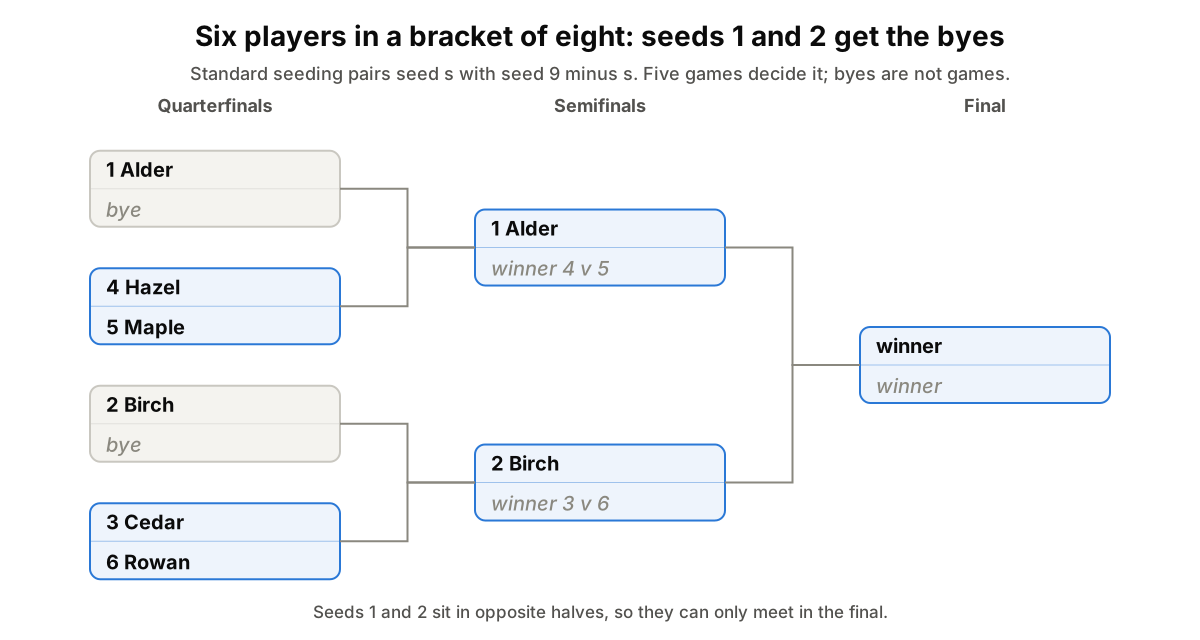
Six players fill a bracket of eight, so there are 2 byes. They go to seeds 1 and 2, and the round-one games are 4 against 5 and 3 against 6. That follows the standard rule of pairing the highest seed with the lowest, then the next pair inwards, which in a full bracket of eight gives 1 v 8, 4 v 5, 2 v 7 and 3 v 6. Seeds 1 and 2 sit in opposite halves, so if both keep winning they meet in the final rather than knocking each other out early.
Plan the evening from the game count, which the generator shows in the stats panel:
| Format | Games for 6 players | Why |
|---|---|---|
| Single elimination | 5 | Every game knocks out one player, and all but the champion go out |
| Double elimination | 10, or 11 with a reset | Everyone but the champion loses twice; the champion loses at most once |
| Round robin | 15, over 5 rounds | Every pair meets once: 6 × 5 ÷ 2 |
Multiply by the length of one game to see what fits in the evening. Double elimination suits short games where one bad round should not end someone's night. In its grand final, the player coming up from the losers bracket must win twice, because the other finalist has not lost yet; the second game is called the bracket reset. Round robin suits leagues and small groups where everyone wants plenty of games. When the field is too big for a round robin, split it into groups with the Group Splitter and run a round robin in each.
As games finish, click the winner's name. If you correct an earlier result, the generator clears only the later games that depended on it, then you can print the bracket or copy it as text for the group chat.
Keeping a fair running score
Paper score sheets fail in two predictable ways: someone adds a column wrong, and nobody agrees what happens when two players cross the target in the same round. The Score Keeper fixes the first by adding every row for you and showing running totals under each score. It fixes the second with one rule: the game ends at the end of the round in which someone reaches the target, so every player gets the same number of turns, and then the best total wins.
Worked example: a lowest-score card game to 100
Three friends play a card game where points are penalties and the game ends when anyone reaches 100.
- Open the Score Keeper, rename Player 1, 2 and 3 in the table header to Ana, Bo and Cy.
- Under Rules, choose "Lowest total wins" and type 100 in "Game ends at".
- Type round 1 as 20, 40 and 30. Enter moves to the next player's box, and Enter after the last player opens round 2, where you type 30, 45 and 26.
- Round 3 is 26, 18 and 50. The running totals are now 76, 103 and 106.
Bo and Cy both passed 100 in the third round, so the game ends there and the banner switches to "Ana wins": 76 is the lowest total. If Cy's last score had not been typed yet, the game would stay open until it was, because only a fully entered round can end the game. Rows typed after the deciding round are greyed out and do not change the result.
Ties are shared rather than broken. Totals of 42, 38, 38 and 30 in a highest-wins game rank 1, 2, 2 and 4, the way sports tables count ties. If your game has its own tie-break, such as the most cards left in hand, apply it after the Score Keeper reports a shared win.
The scores are saved in the browser's local storage after every change, so a phone that locks mid-game or a closed tab loses nothing. Nothing is uploaded; to share the result, copy the standings or download the CSV.
Between games: would you rather
There is always a lull while someone shuffles, sets up a board or fetches drinks. The Would You Rather Questions tool deals original questions sorted by audience: kids, family, work and party. Pick Family when children are at the table and Party for a group of adults. Read the question, let everyone choose, and tap A or B once per person to keep a tally. The questions come from a shuffled deck, so none repeats until the group has seen every one for that audience. If you want a list on paper, the tool will give you 5, 10 or 20 at once.
A one-tab game night checklist
- Before guests arrive, open the Dice Roller with the dice your games need and the bracket with the players you expect.
- Agree on house rules out loud: how ability scores are rolled, what the target score is, and whether ties are shared.
- Seed the bracket by list if you know who is strong, randomly if you do not or it would cause an argument.
- Use the Score Keeper's "Number of rounds" field for games with a fixed length, and "Game ends at" for games played to a target.
- Keep the Would You Rather tab open for the gaps.
Tools for this job
- Dice Roller: replaces lost dice and reads any notation, with the odds of each total.
- Tournament Bracket Generator: single or double elimination with byes, or a round robin, filled in as you play.
- Score Keeper: running totals, ties and the winner for any scored game, saved in your browser.
- Would You Rather Questions: audience-sorted questions for the breaks between games.
- Coin Toss: a fair 50/50 call for two players or two teams.
- Spin Wheel: a visible random pick of the next game or the first player.
- Group Splitter: even teams from a list of names.
For how these tools stay fair, read fair random decisions; for solo games on a quiet evening, see classic browser games.
Frequently asked questions
How long does a double elimination evening take?
Count the games, then multiply by the length of one game and the number of tables. Eight players need 14 games, or 15 if the grand final is reset. Games in the same round can run side by side, but the losers bracket final and the grand final cannot, so leave time for the last two or three games to be played one at a time.
Is it fair to give the top seeds byes?
It is the usual convention, because seeding is a reward for being stronger and byes keep the first round full of real games. If nobody knows who is strongest, use random seeding so the byes fall by chance.
What if a player has to leave in the middle of a bracket?
Agree on the rule at the start. The usual choice is to treat their remaining games as forfeits: click their opponent as the winner of their next game, and in double elimination of any later losers bracket game too. Their earlier results stand, so nobody they already beat is affected.
Can I run a tournament from a phone?
Yes. The bracket, the Score Keeper and the Dice Roller all work on a phone screen, keep their state in the browser, and do not need an account.
Sources and further reading
- Web Cryptography API: getRandomValues, W3C. The random source behind each die and shuffle.
- Dice, Wolfram MathWorld. How the number of ways to roll each total is counted.
- Single-elimination tournament, Wikipedia. Standard seeding of highest against lowest.
- Double-elimination tournament, Wikipedia. The losers bracket, the bracket reset, and 2n - 2 or 2n - 1 games.
- Round-robin tournament, Wikipedia. The circle method for round robin schedules.
- HTML Standard: Web storage, WHATWG. How local storage keeps a game between visits.
More Decision & Selection
Every tool in the Decision & Selection section, free and in your browser.