
GPA and Final Grades: The Weighted Averages Behind Your Transcript
How grade points and credits make a GPA, what weighting really adds, how to plan a cumulative target, and the one formula that tells you what you need on the final.
By Redbison Dev · · Updated · 9 min read

A grade point average and a course grade are both weighted averages. Once you see them that way, most of the questions students ask, from "why did my A barely move my GPA?" to "what do I need on the final?", turn into short, checkable sums. This guide walks through those sums with the GPA Calculator and the Final Grade Calculator, using real numbers you can reproduce, and points out where schools make different choices.
How a GPA is built
A GPA is calculated in three steps.
- Convert each grade to grade points. On the most common US 4.0 scale: A and A+ are 4.0, A- 3.7, B+ 3.3, B 3.0, B- 2.7, C+ 2.3, C 2.0, C- 1.7, D+ 1.3, D 1.0, D- 0.7 and F 0.
- Multiply by credits. Grade points times the course's credits (or units, or hours) gives its quality points.
- Divide. Total quality points divided by total credits is the GPA.
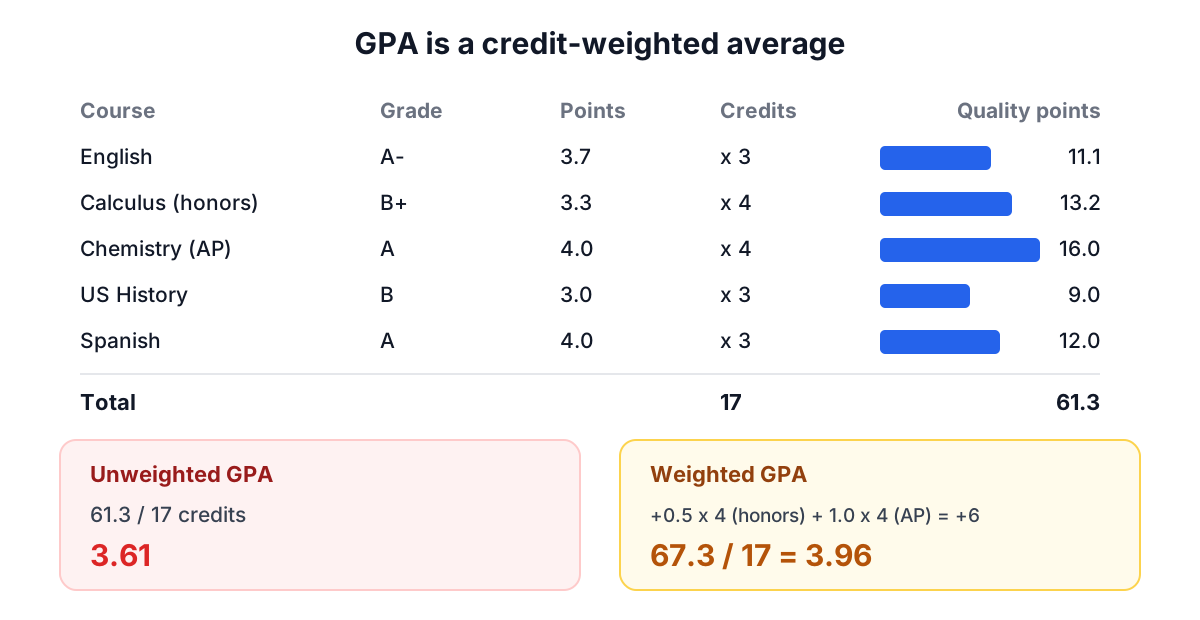
In the term above, the quality points are 3.7 x 3 + 3.3 x 4 + 4.0 x 4 + 3.0 x 3 + 4.0 x 3 = 61.3, and 61.3 / 17 = 3.61. Notice what the credits do. The 4-credit Calculus B+ contributes 13.2 points, while a 3-credit B+ would contribute only 9.9. A grade in a heavy course moves the average more than the same grade in a light one, which is why a GPA is not simply the average of your letter grades.
Scales are not universal
The table above is common but not standard. Some schools give A+ a 4.3. Some ignore plus and minus grades, so a B- and a B+ are both 3.0. Percentage cut-offs differ as well: the College Board's own conversion chart, for instance, uses whole letters only, with 90 to 100 as an A. The GPA Calculator offers the three scales you are most likely to meet and converts percentages using the widespread 93/90/87 cut-offs, but your school's handbook is the final word. When the handbook and a calculator disagree, enter letter grades rather than percentages so the conversion is under your control.
Weighted and unweighted
High schools often reward harder classes by adding a bonus to their grade points, usually +0.5 for honors and +1.0 for AP or IB. An A in an AP course then counts as 5.0, which is how weighted GPAs climb above 4.0. In the example, the honors course adds 0.5 x 4 credits and the AP course adds 1.0 x 4, so the weighted GPA is (61.3 + 6) / 17 = 3.96.
Two judgment calls hide in that bonus. First, schools disagree on whether a failing grade gets it; most do not, and neither does the calculator. Second, colleges frequently recalculate applicants' GPAs on their own basis, often removing the weighting or capping it, because every high school weights differently. The unweighted figure is the more comparable number; the weighted one tells you how your own school will rank you.
Cumulative GPA and why it gets harder to move
Your cumulative GPA is the same calculation over every graded credit you have taken. You do not need old transcripts to update it, only your current cumulative GPA and how many credits it covers:
cumulative = (old GPA x old credits + this term's quality points) / (old credits + this term's credits)
With a 3.2 over 30 credits and a term of an A and a B in two 3-credit courses (21 quality points over 6 credits), the new cumulative GPA is (96 + 21) / 36 = 3.25. A 3.50 term lifted the average by only 0.05, because 30 credits were already behind it.
That inertia is the key to planning. The GPA Calculator's target planner rearranges the same formula:
required GPA = (target x (old credits + future credits) - old GPA x old credits) / future credits
Going from a 3.0 over 60 credits to a 3.3 with 30 credits left needs (3.3 x 90 - 180) / 30 = 3.9, nearly straight As. The same 0.3-point rise with 90 credits left would need only a 3.45. The lesson is that a GPA is easiest to shape early, and a planner result above 4.0 means the target is not reachable in that many credits, however hard you work.
Pass/fail courses, withdrawals and incompletes normally earn credit (or not) without grade points, so they are left out of the average. Repeated courses vary most: some schools replace the old grade, others average both. Enter them the way your registrar counts them.
What do I need on the final?
A course grade is another weighted average, this time of categories such as homework, quizzes, a midterm and the final exam. If the final is worth a share w of the course and your grade on everything else is "current", then:
course grade = current x (1 - w) + final x w
Solve that for the final and you get the formula behind the Final Grade Calculator:
required final = (target - current x (1 - w)) / w
With 88% so far, a final worth 25% and a target of 85%, the required score is (85 - 88 x 0.75) / 0.25 = (85 - 66) / 0.25 = 76%.
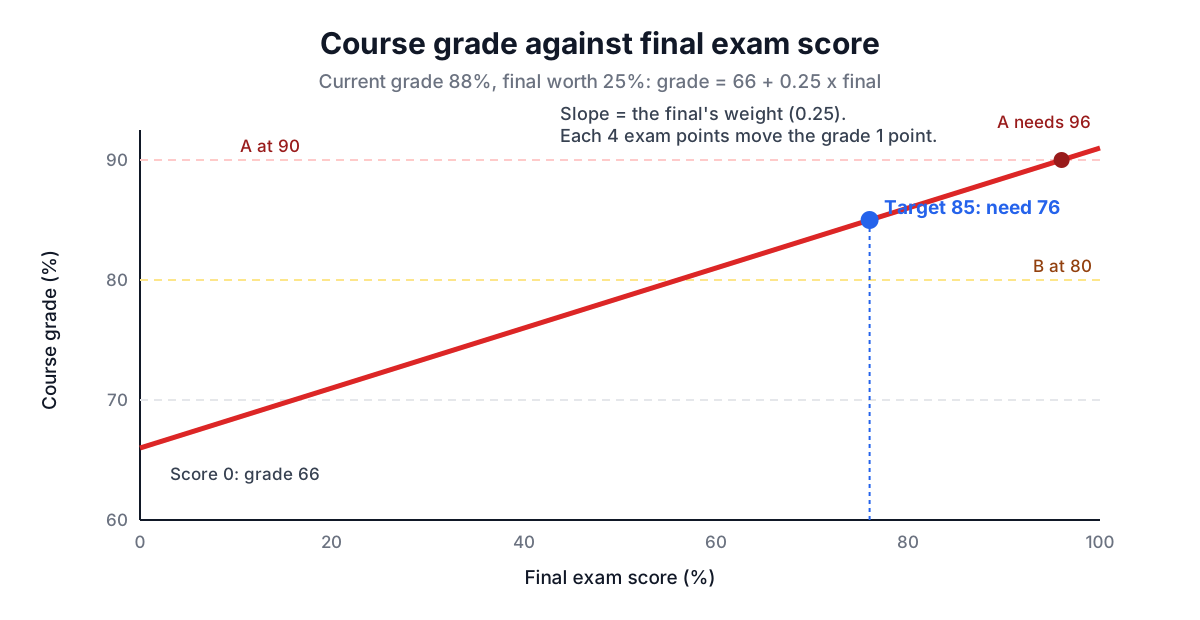
The chart shows the relationship as a straight line whose slope is the final's weight. Here every 4 exam points move the course grade by 1 point. A score of zero still leaves 66%, and a perfect score caps the course at 91%. Reading across from any letter cut-off gives the exam score it needs, which is what the calculator's threshold table lists.
Reading the answer
- Above 100% means the target cannot be reached on the exam alone. Look at the next grade down in the table, or ask whether extra credit or a curve applies.
- Below 0% means the grade is already secure; even a blank paper keeps it.
- Between 90 and 100% is possible but leaves no room for a bad day. That is useful information when you are deciding where to spend revision time.
The "What if I score X?" mode runs the same formula forwards. At 80% with a final worth 40%, scoring 50% gives 80 x 0.6 + 50 x 0.4 = 68%. A heavily weighted final can move a grade by a full letter in either direction.
When your gradebook is incomplete
The single-number method assumes your current grade already reflects every category except the final, weighted as in the syllabus. If some work is not graded yet, or your gradebook only shows raw points, use the weighted categories mode instead. List each category with its weight and score; the calculator averages the graded ones by weight and solves for the final.
For a syllabus of homework 20% at 95, quizzes 20% at 85, a midterm 25% at 78 and a final worth 35%:
- Banked points are 0.20 x 95 + 0.20 x 85 + 0.25 x 78 = 19 + 17 + 19.5 = 55.5 out of 65 possible.
- The current average is 55.5 / 65 = 85.38%.
- To finish on 85, the final must supply 85 - 55.5 = 29.5 points out of 35, so it needs 29.5 / 0.35 = 84.29%.
If a category is still ungraded, the calculator assumes it will finish at your current average. That is a neutral guess, not a prediction, so rerun the numbers once those scores are in.
Checks and caveats
- Use the weights from the syllabus. If a course is graded purely on total points, the final's weight is its points divided by the course total.
- Apply dropped scores and curves before you enter anything, because the formula cannot know about them.
- If your instructor rounds 89.5 up to 90, lower the cut-off in the table by half a point.
- Whether a GPA is "good" depends on the scale and the reader. On an unweighted 4.0 scale a 3.5 is a B+ to A- average, a common threshold for scholarships and honours programmes, but selective programmes compare it with their own admitted range, and a weighted 3.5 is a weaker signal than an unweighted one.
- For anything percentage-shaped outside grades, such as working out what share of points you scored, the Percentage Calculator is quicker.
None of this replaces your school's official record, which is the only GPA that counts on a transcript. What the arithmetic does give you is a clear view of which grades are within reach and how much each exam, course and credit is really worth.
Frequently asked questions
What do I need on my final exam to get the grade I want?
The required final score is (target - current x (1 - w)) / w, where w is the final's weight in the course. With 88% so far, a final worth 25% and a target of 85%, the required score is (85 - 88 x 0.75) / 0.25 = 76%. The Final Grade Calculator, which sits alongside the GPA Calculator, runs this formula.
What does it mean if I need more than 100% on my final?
A required final score above 100% means the target course grade cannot be reached on the exam alone. Look at the next grade down, or ask whether extra credit or a curve applies. A required score below 0% means the grade is already secure, and anything between 90 and 100% is possible but leaves no room for a bad day.
Why does my cumulative GPA barely change after a good semester?
A cumulative GPA averages every graded credit, so earlier credits weigh against each new term. With a 3.2 over 30 credits, a 3.50 term of 6 credits lifts the cumulative GPA only to (96 + 21) / 36 = 3.25. That inertia grows with every credit taken, so a GPA is easiest to shape early.
Do colleges recalculate high school GPAs?
Colleges frequently recalculate applicants' GPAs on their own basis, often removing the weighting or capping it, because every high school weights honors, AP and IB courses differently. That makes the unweighted GPA the more comparable number, while the weighted GPA mainly shows how your own school will rank you.
How do weighted grade categories work?
Each category's score is multiplied by its weight and the results are added. With homework 20% at 95, quizzes 20% at 85 and a midterm 25% at 78, the banked points are 55.5 out of 65, a current average of 85.38%. To finish on 85 with a final worth 35%, the final must supply 29.5 points, a score of 84.29%.
Sources and further reading
- How to Calculate Your GPA on a 4.0 Scale, College Board. The College Board's letter-grade conversion chart.
- NAEP High School Transcript Study: How is Grade Point Average Calculated?, US National Center for Education Statistics. A credit-weighted GPA in a national study.
- How do I weight the final course grade based on assignment groups?, Instructure. How a common gradebook weights categories.
- WEIGHTED MEAN, US National Institute of Standards and Technology. The weighted mean that both GPAs and course grades use.
More Everyday Calculators
Every tool in the Everyday Calculators section, free and in your browser.
- Age Calculator
- Time Card Calculator
- Time Calculator
- GPA Calculator
- Final Grade Calculator
- Fuel Cost Calculator
- Tire Size Calculator
- Ring Size Converter
- Shoe Size Converter
- Cooking Measurement Converter
- Heat Index Calculator
- Wind Chill Calculator
- Week Number Calculator
- Day of the Week Calculator
- Recipe Scaler
- Unit Price Calculator