
Square Roots, Cube Roots and nth Roots: Simplifying Radicals Properly
Simplest radical form by prime factors, rationalising denominators, why odd roots of negatives are real but even ones are not, and the n complex roots every number has.
By Redbison Dev · · Updated · 9 min read
A root undoes a power. The square root of 49 is 7 because 7² = 49, and the cube root of 125 is 5 because 5³ = 125. That much is familiar. The interesting parts are the details around it: how to write an irrational root exactly, what to do with a fraction or a negative number under the radical, why a calculator shows one answer when there are really n of them, and how to estimate a root without a calculator at all. The worked examples below can all be checked in the Root Calculator.
Roots as powers
The nth root of x, written ⁿ√x, is the number r with rⁿ = x. The small n is the index, the number under the radical sign is the radicand, and a plain √ with no index means n = 2.
Roots fit into the exponent rules as fractional powers:
ⁿ√x = x^(1/n) ⁿ√(xᵐ) = x^(m/n)
That is why the rules for radicals look like the rules for exponents. ⁿ√(ab) = ⁿ√a × ⁿ√b, because (ab)^(1/n) = a^(1/n) b^(1/n), and ⁿ√(a/b) = ⁿ√a / ⁿ√b for positive a and b. Both rules are what make simplification possible. The Exponent Calculator uses the same equivalence in reverse to evaluate powers like 8^(2/3).
The principal root
Both 6 and −6 square to 36, so 36 has two square roots. The radical sign picks one of them, the non-negative one, called the principal root. √36 is 6, full stop, and an equation like x² = 36 has the solutions x = ±√36 = ±6 because the ± is written separately. The same convention holds for every even index: ⁴√81 is 3, not −3.
Simplest radical form
Most roots are irrational: √2 = 1.41421356237309504880… never ends or repeats. To keep an answer exact you leave it as a radical, and the agreed way of writing it, simplest radical form, has three conditions:
- The radicand has no factor that is a perfect nth power (other than 1).
- There is no fraction under the radical.
- There is no radical in a denominator.
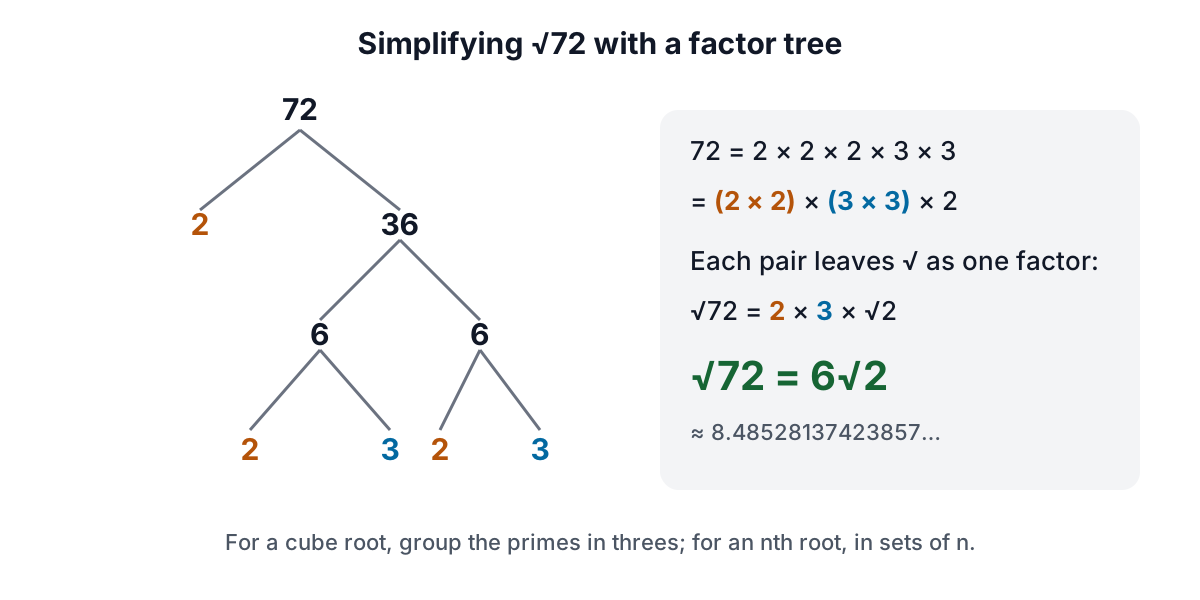
The method for condition 1 is prime factorisation. Write the radicand as a product of primes, group equal primes into sets of n, and move one copy of each complete set outside.
| Radical | Prime factors | Groups out | Left in | Simplest form |
|---|---|---|---|---|
| √72 | 2³ × 3² | 2, 3 | 2 | 6√2 |
| √50 | 2 × 5² | 5 | 2 | 5√2 |
| √180 | 2² × 3² × 5 | 2, 3 | 5 | 6√5 |
| ∛54 | 2 × 3³ | 3 | 2 | 3∛2 |
| ∛250 | 2 × 5³ | 5 | 2 | 5∛2 |
| ⁴√48 | 2⁴ × 3 | 2 | 3 | 2·⁴√3 |
A shortcut that works for small numbers is to look for the largest perfect square (or cube) that divides the radicand: 72 = 36 × 2, so √72 = √36 × √2 = 6√2. If you pick a smaller square first, say 72 = 4 × 18, you get 2√18 and have to go again: 2√18 = 2 × 3√2 = 6√2. Prime factorisation gets there in one pass every time.
Fractions and rationalising
For a fraction, make the denominator a perfect power by multiplying top and bottom by what it is missing:
√(1/2) = √(2/4) = √2 / 2
√(2/3) = √(6/9) = √6 / 3
∛(1/4) = ∛(2/8) = ∛2 / 2
For a square root you multiply by the denominator once; for a cube root of 1/4 = 1/2², you need one more 2 to make 2³. In general ⁿ√(a/b) = ⁿ√(a·bⁿ⁻¹) / b, and then you simplify the top as before. The calculator does exactly this, which is why √(1/2) comes back as √2/2 rather than 1/√2.
Rationalising used to matter for hand calculation, because dividing 1.41421 by 2 is far easier than dividing 1 by 1.41421. Today it is mostly a convention, but a useful one: it gives every number a single standard form, so 1/√2, √2/2 and √(1/2) are all recognised as the same answer.
Negative numbers under a root
Odd and even indices behave differently with negatives.
- Odd index. A negative number cubed is negative, so every negative number has a real cube root, fifth root and so on. ∛(−27) = −3 and ∛(−54) = −3∛2. Just take the root of the absolute value and keep the minus sign.
- Even index. Any real number raised to an even power is zero or positive, so √(−12) has no real value. Over the complex numbers, using i with i² = −1, √(−12) = i√12 = 2i√3.
Software is not always consistent here. Many programming languages compute x^(1/3) as exp(ln(x)/3), and because ln of a negative number is not real they return NaN for (−8)^(1/3), even though the real cube root is −2. Dedicated cube-root functions such as JavaScript's Math.cbrt(−8) return −2 correctly.
Every number has n roots
Over the complex numbers the story is tidier. Every non-zero number has exactly n distinct nth roots, and they sit evenly spaced on a circle of radius |x|^(1/n) around the origin, separated by 360°/n.
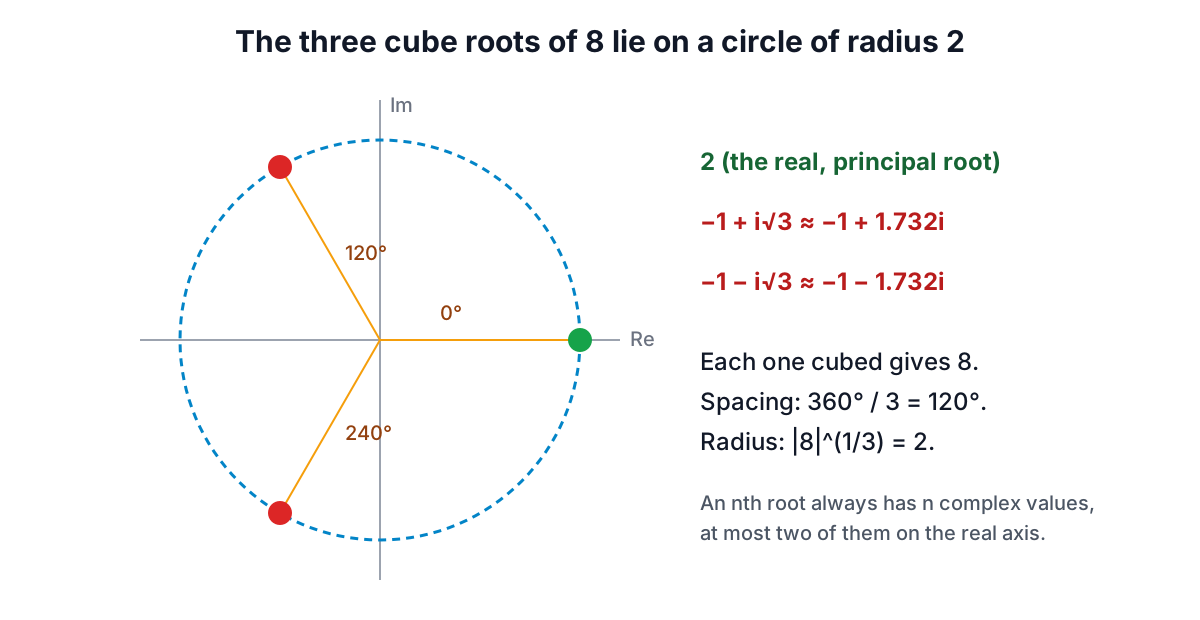
The cube roots of 8 are 2, −1 + i√3 and −1 − i√3. You can check the second: (−1 + i√3)² = 1 − 2i√3 − 3 = −2 − 2i√3, and multiplying by (−1 + i√3) again gives 2 − 2i√3 + 2i√3 + 6 = 8. The fourth roots of −16 are √2 ± i√2 and −√2 ± i√2, all at 45° off the axes. For indices up to 12 the calculator lists every root and highlights the principal one, which for a positive real number is the positive real root and in general is the root with the smallest non-negative angle.
This picture also explains why there are at most two real nth roots: the circle crosses the real axis in only two places.
Estimating a root by hand
Two quick methods are worth knowing.
Bracketing. Find the perfect powers either side. √50 lies between 7 (49) and 8 (64), much closer to 7. The calculator shows this bracket for every positive radicand.
One Newton step. To refine a guess g for √x, average g with x/g:
better guess = (g + x/g) / 2
Starting from 7 for √50: (7 + 50/7) / 2 = (7 + 7.142857) / 2 = 7.0714. The true value is 7.0710678…, so one step gives four correct digits, and each further step roughly doubles the number of correct digits. For an nth root the same idea gives g ← ((n − 1)g + x/gⁿ⁻¹) / n. Babylonian clay tablets from around 1800 BCE already record √2 to about six decimal places, and this averaging method is still the core of how computers take square roots.
How the calculator gets 30 correct digits
Floating-point numbers in a phone or spreadsheet carry about 15 to 17 significant digits, so the last few digits of √2 printed there are rounding noise. The Root Calculator first checks whether the radicand is a perfect nth power using exact whole-number arithmetic, which works for integers of any length: √12345678987654321 = 111111111 exactly. If not, it computes the root with 80 significant digits and shows 30, so every displayed digit is correct. The simplified radical comes from a full prime factorisation, which is fast for numbers up to about 60 digits.
Common mistakes
- √(a + b) is not √a + √b. √(9 + 16) = √25 = 5, while √9 + √16 = 7. The product rule works; there is no sum rule.
- Forgetting the ± when solving. x² = 50 gives x = ±5√2, but √50 alone is just 5√2.
- Stopping too early. 2√18 is not simplified; 18 still contains 9.
- Even roots of negatives. √(−4) is 2i, not −2.
When you need the decimal, keep the radical form until the last step and convert once. When you need to compare, reduce both to simplest form first: 3√8 and 2√18 look different but are 6√2 and 6√2.
Try any of these in the Root Calculator, or go the other way with the Exponent Calculator and the Prime Factorization Calculator for the factor step on its own.
Frequently asked questions
What is simplest radical form?
A radical is in simplest radical form when three conditions hold: the radicand has no factor that is a perfect nth power other than 1, there is no fraction under the radical, and there is no radical in a denominator. So √72 becomes 6√2, ∛54 becomes 3∛2, and √(1/2) is written as √2 / 2.
What is the principal square root?
The principal square root is the non-negative one of a number's two square roots, and it is the one the radical sign picks. Both 6 and −6 square to 36, but √36 is 6. Solving x² = 36 gives x = ±√36 = ±6 because the ± is written separately. The same convention holds for every even index, so ⁴√81 is 3.
How do you estimate a square root without a calculator?
First bracket it between perfect squares: √50 lies between 7 and 8, much closer to 7. Then refine a guess g with one Newton step, (g + x/g) / 2. Starting from 7 for √50 gives (7 + 50/7) / 2 = 7.0714, against a true value of 7.0710678, and each further step roughly doubles the number of correct digits.
Is the square root of a sum equal to the sum of the square roots?
No. √(a + b) is not √a + √b: √(9 + 16) = √25 = 5, while √9 + √16 = 7. Radicals have a product rule, ⁿ√(ab) = ⁿ√a × ⁿ√b, and a quotient rule for positive numbers, but there is no sum rule. Mixing them up is one of the most common radical mistakes.
Why does (−8)^(1/3) return NaN in programming languages?
Many programming languages compute x^(1/3) as exp(ln(x)/3), and because the natural logarithm of a negative number is not real, they return NaN for (−8)^(1/3), even though the real cube root is −2. Dedicated cube-root functions avoid the problem: JavaScript's Math.cbrt(−8) correctly returns −2.
Sources and further reading
- DLMF §4.2: Definitions of the logarithm, exponential and powers, NIST Digital Library of Mathematical Functions. Principal values of powers and roots.
- IEEE 754-2019: IEEE Standard for Floating-Point Arithmetic, IEEE Standards Association. Double precision and its 15 to 17 significant digits.
- ECMAScript Language Specification (ECMA-262), Ecma International TC39. Math.pow and Math.cbrt, including NaN for a negative base with a non-integer exponent.
- decimal.js API, Michael Mclaughlin. The arbitrary-precision decimal library used for the 80-digit arithmetic.
- Abramowitz and Stegun, Handbook of Mathematical Functions, NBS Applied Mathematics Series 55, section 3.7 on roots and powers of complex numbers.
- Yale Babylonian Collection, tablet YBC 7289, which gives √2 to the equivalent of about six decimal places.
More Math Calculators
Every tool in the Math Calculators section, free and in your browser.
- Percentage Calculator
- Fraction Calculator
- Ratio Calculator
- GCF and LCM Calculator
- Prime Factorization Calculator
- Quadratic Equation Solver
- Long Division Calculator
- Scientific Notation Calculator
- Number to Words Converter
- Roman Numeral Converter
- Percent Error Calculator
- Root Calculator
- Exponent Calculator
- Logarithm Calculator
- Rounding Calculator
- Weighted Average Calculator
- System of Equations Solver