
Pool Volume and Chlorine Dosing: Gallons, ppm and Salt
Working out pool volume for every common shape and a sloping floor, what 1 ppm means, chlorine doses for liquid, cal-hypo, dichlor and trichlor, and salt for a salt cell.
By Redbison Dev · · Updated · 11 min read
Every chemical you put in a pool is dosed by volume. A bottle that says "one gallon treats 10,000 gallons" is useless if you do not know whether your pool holds 14,000 or 24,000, and guessing low on a shock dose is how algae survives. This guide works out pool volume for the common shapes, explains what a part per million really is, and turns that into doses of chlorine and salt you can trust. The Pool Volume Calculator does the same arithmetic.
Volume is area times average depth
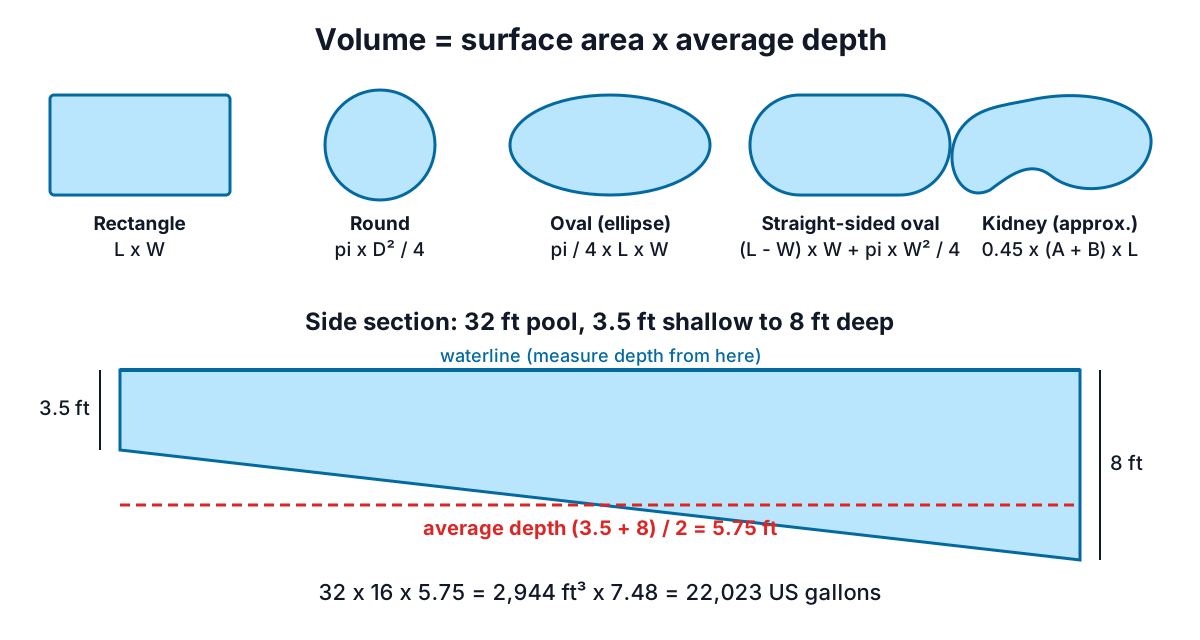
Any pool with vertical walls holds its surface area times its average water depth. Measure depth to the waterline, not to the top of the wall; water usually sits about halfway up the skimmer opening, several inches below the coping.
For a floor that slopes evenly from a shallow end to a deep end, the average depth is the mean of the two:
average depth = (shallow + deep) / 2
A pool 3.5 feet deep at one end and 8 feet at the other averages 5.75 feet. Pools with a sudden drop into a small deep "hopper" hold less than this average suggests, because the deep part covers only part of the floor. For those, split the pool into a shallow rectangle and a deep rectangle and add them, or accept that the result is a slight overestimate.
Then convert. One cubic foot is 7.4805 US gallons. One cubic metre is 1,000 litres. One US gallon is 3.785 litres and one imperial gallon 4.546 litres.
Surface area by shape
| Shape | Area | Notes |
|---|---|---|
| Rectangle | length x width | Most in-ground pools |
| Round | pi x diameter² / 4 | Above-ground rounds |
| Oval (true ellipse) | pi / 4 x length x width | Source of the "x 5.9" shortcut |
| Oval with straight sides | (length - width) x width + pi x width² / 4 | Many above-ground "ovals" |
| Kidney | 0.45 x (width A + width B) x length | Trade rule of thumb |
| Free-form | from plans | Ask the builder or measure in pieces |
The well-known shortcut "length x width x average depth x 5.9 = gallons" for oval pools is just pi / 4 x 7.48 = 5.875, rounded. It is right for a true ellipse. Many above-ground pools sold as ovals are really a rectangle with half circles on each end, and those hold noticeably more: a 15 by 30 foot straight-sided oval has 402 square feet of surface, against 353 for an ellipse of the same size.
Worked volumes
| Pool | Area | Average depth | Volume |
|---|---|---|---|
| 16 x 32 ft rectangle, 3.5 to 8 ft | 512 ft² | 5.75 ft | 2,944 ft³ = 22,023 gal |
| 16 x 32 ft rectangle, flat 4 ft | 512 ft² | 4 ft | 2,048 ft³ = 15,320 gal |
| 24 ft round, 4 ft of water | 452 ft² | 4 ft | 1,810 ft³ = 13,536 gal |
| 15 x 30 ft ellipse, 4 ft | 353 ft² | 4 ft | 1,414 ft³ = 10,575 gal |
| 10 x 5 m rectangle, 1.2 to 2 m | 50 m² | 1.6 m | 80 m³ = 80,000 L |
What 1 ppm means
Pool chemistry is measured in parts per million, which for water means milligrams per litre. Raising free chlorine by 1 ppm in 10,000 US gallons (37,854 litres) needs 37,854 milligrams, or 37.9 grams, of available chlorine. Every chlorine dose follows from that number and the strength of the product:
available chlorine (g) = ppm x litres / 1,000
product (g)            = available chlorine / strength      (solids, strength as a fraction)
product (mL)           = available chlorine / (strength% x 10) x 1,000   (liquids, trade percent)
Liquid pool chlorine is sold by trade percent: grams of available chlorine per 100 millilitres. A 12.5% product holds 125 grams per litre. Household bleach is labelled by weight of sodium hypochlorite, which works out close to its trade percentage; treat a 6% bleach as roughly 6% available chlorine and expect a little less from old stock.
Chlorine doses per 10,000 gallons
| Product | Strength | To raise 1 ppm in 10,000 US gal | Side effect per 1 ppm |
|---|---|---|---|
| Liquid chlorine | 12.5% | about 10.2 fl oz | none (raises pH slightly) |
| Liquid chlorine | 10% | about 12.8 fl oz | none |
| Household bleach | about 6% | about 21 fl oz | none |
| Cal-hypo | 65% | about 2.05 oz | +0.7 ppm calcium hardness |
| Cal-hypo | 73% | about 1.8 oz | +0.7 ppm calcium hardness |
| Dichlor | 56% | about 2.4 oz | +0.9 ppm cyanuric acid |
| Trichlor | 90% | about 1.5 oz | +0.6 ppm cyanuric acid |
The side effects come straight from the chemistry. A trichlor molecule carries three chlorine atoms on one cyanuric acid ring; three equivalents of available chlorine (3 x 70.9 g) arrive with one ring (129 g of cyanuric acid), so every 1 ppm of chlorine adds 129 / 212.7 = 0.61 ppm of CYA. Dichlor has two chlorines per ring, so 0.91 ppm. Cal-hypo carries one calcium for two hypochlorites, about 0.7 ppm of calcium hardness (as calcium carbonate) per ppm of chlorine.
Those side effects accumulate. A season of trichlor tablets can push cyanuric acid well past 100 ppm, at which point chlorine is so tightly bound that much more is needed to keep the water sanitised. Test CYA every few weeks and switch to liquid chlorine or cal-hypo when it climbs.
For the 22,023 gallon pool above, raising free chlorine from 1 to 3 ppm (2 ppm) takes 2.2 x 2 x 10.2 = 45 fluid ounces of 12.5% liquid, a little over a third of a gallon.
Salt for a salt-water chlorinator
A salt-water pool makes its own chlorine from dissolved salt, and the cell needs the salt within its range, typically about 2,700 to 3,400 ppm with an ideal around 3,200 for many residential cells. Check your cell's manual; some run lower.
Salt in ppm is milligrams per litre, so the dose is:
salt (kg) = (target ppm - current ppm) x litres / 1,000,000
salt (lb) = (target ppm - current ppm) x US gallons x 8.34 / 1,000,000
The 22,023 gallon pool going from 0 to 3,200 ppm needs 3,200 x 22,023 x 8.34 / 1,000,000 = 588 lb, fifteen 40 lb bags. A pool already at 2,800 ppm needs only 74 lb to reach 3,200. Add salt slowly with the pump running and wait 24 hours before re-testing; adding too much is only fixed by draining and refilling.
Filling time
Hose flow varies with pressure and hose size. Time how long your hose takes to fill a 5 gallon bucket: 30 seconds means 10 gallons per minute. Then:
hours = gallons / gallons per minute / 60
At 10 gpm the 22,023 gallon pool takes about 37 hours. Many water utilities offer a pool-fill allowance on the sewer charge if you call ahead, which can save more than the water itself.
Safe dosing habits
- Add chlorine with the pump running, in front of a return, and let it circulate before testing.
- Never mix chlorine products with each other or with acids, and never add water to chemicals; add chemicals to water.
- Pre-dissolve cal-hypo in a bucket of pool water for vinyl pools, so granules do not bleach the liner.
- Liquid chlorine loses strength with heat and time. A jug stored through a summer may be half its labelled strength.
- Dose to a target measured with a good test kit, not to a schedule.
Work out your own pool in the Pool Volume Calculator. For tanks and other containers the Tank Volume Calculator covers cylinders and capsules, and the Water Heating Time Calculator estimates how long a heater takes.
Frequently asked questions
What is the formula for pool volume?
Pool volume is surface area times average water depth, measured to the waterline rather than the top of the wall. For an evenly sloping floor, average depth is (shallow + deep) / 2. Multiply cubic feet by 7.4805 to get US gallons, or use 1,000 litres per cubic metre. A 16 x 32 ft pool averaging 5.75 ft holds 22,023 gallons.
How do I calculate the gallons in an oval pool?
For a true ellipse, multiply length x width x average depth x 5.9 to get US gallons, since pi / 4 x 7.48 is about 5.875. Many above-ground pools sold as ovals are really a rectangle with half circles on each end and hold more, using (length - width) x width + pi x width² / 4 for the area.
What does 1 ppm of chlorine mean in a pool?
In pool water, one part per million means one milligram per litre. Raising free chlorine by 1 ppm in 10,000 US gallons, which is 37,854 litres, needs 37.9 grams of available chlorine. Every chlorine dose follows from that number and the strength of the product, whether liquid chlorine, bleach, cal-hypo, dichlor or trichlor.
Does trichlor raise cyanuric acid in a pool?
Yes. Each trichlor molecule carries three chlorine atoms on one cyanuric acid ring, so every 1 ppm of chlorine from trichlor adds about 0.6 ppm of cyanuric acid, and dichlor adds about 0.9 ppm. A season of trichlor tablets can push cyanuric acid past 100 ppm, so test it every few weeks and switch to liquid chlorine or cal-hypo when it climbs.
Sources and further reading
- NIST Guide to the SI, Appendix B.8: Factors for units listed alphabetically, NIST. Cubic foot, US gallon and litre conversions.
- Cyanuric acid, NIST Chemistry WebBook. Formula and molar mass.
- Symclosene (trichloroisocyanuric acid), NIST Chemistry WebBook. Formula and molar mass of trichlor.
- Chlorine, NIST Chemistry WebBook. The Cl2 molar mass used to express available chlorine.
Open the Pool Volume Calculator
More Construction & Home
Every tool in the Construction & Home section, free and in your browser.