
SMD Resistor Codes Explained: 3-Digit, 4-Digit and EIA-96
Reading chip resistor markings: the power-of-ten 3-digit code, the 1% 4-digit code, R as a decimal point, and the EIA-96 index-plus-letter system used on 0603 parts.
By Redbison Dev · · Updated · 9 min read
A through-hole resistor tells you its value with colour bands. A surface-mount chip resistor has no room for bands, so it carries a tiny printed code, or on the smallest sizes nothing at all. Three marking systems cover nearly every part you will meet, and once you know which one you are looking at, each takes seconds to read. This guide explains all three, the letter R as a decimal point, and the traps that catch people during repair work. The SMD Resistor Code Calculator decodes and encodes every format described here.
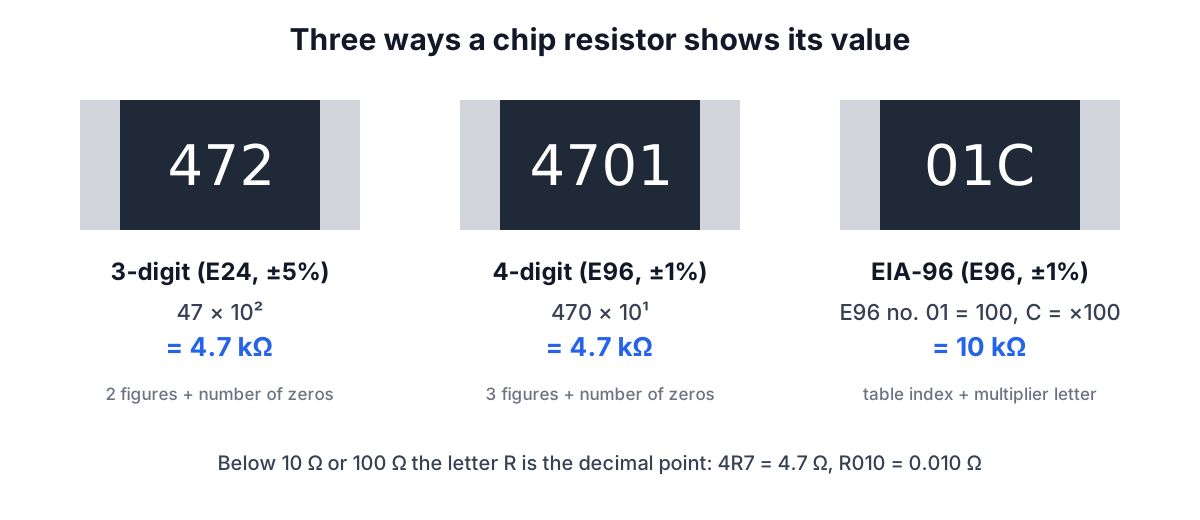
The three systems at a glance
| Marking | Example | How to read it | Typical tolerance | Fits series |
|---|---|---|---|---|
| 3-digit | 472 | 47 × 10² = 4.7 kΩ | ±5% | E24 |
| 4-digit | 4701 | 470 × 10¹ = 4.7 kΩ | ±1% or better | E96, E192 |
| EIA-96 | 01C | E96 value no. 01 (100) × 100 = 10 kΩ | ±1% | E96 |
The right-hand column is the key to why three systems exist. Resistor values are not arbitrary: they follow the preferred number series of IEC 60063. The E24 series has 24 values per decade with two significant figures (1.0, 1.1, 1.2, 1.3, 1.5 ...), which suits ±5% parts. The E96 series has 96 values with three significant figures (1.00, 1.02, 1.05, 1.07 ...), which suits ±1% parts. A marking system has to carry enough digits for the series it serves.
The 3-digit code
The first two digits are the significant figures and the third is the number of zeros to add, the same rule as the colour code and ceramic capacitor codes.
- 100 = 10 × 10⁰ = 10 Ω
- 221 = 22 × 10¹ = 220 Ω
- 103 = 10 × 10³ = 10 kΩ
- 474 = 47 × 10⁴ = 470 kΩ
- 105 = 10 × 10⁵ = 1 MΩ
A common slip is reading 100 as 100 Ω. It is ten ohms: one, zero, and no zeros added. 101 is 100 Ω.
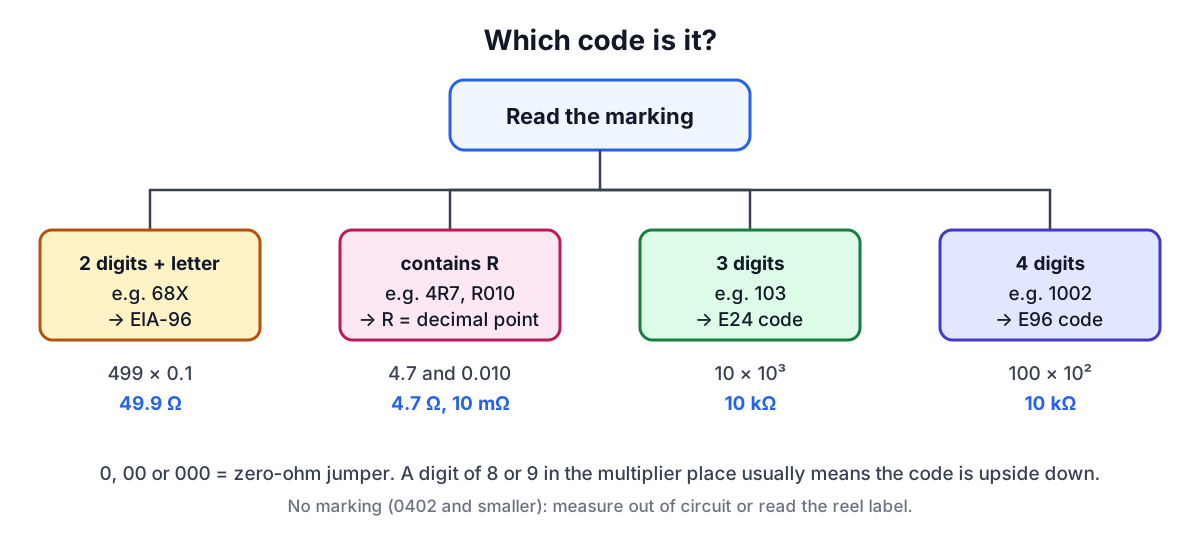
Values under 10 Ω cannot be written this way because the multiplier cannot go negative on resistors. Instead the letter R replaces the decimal point: 4R7 is 4.7 Ω, 1R0 is 1.0 Ω and R47 is 0.47 Ω. Third digits of 8 and 9, which mean ×0.01 and ×0.1 on some capacitors, are not used on resistors, so a code like 109 is usually 601 read upside down.
The 4-digit code
Four digits work the same way with three significant figures: the first three digits and then the number of zeros.
- 1000 = 100 × 10⁰ = 100 Ω
- 4991 = 499 × 10¹ = 4.99 kΩ
- 1002 = 100 × 10² = 10 kΩ
- 1213 = 121 × 10³ = 121 kΩ
Below 100 Ω the R takes over again: 47R5 is 47.5 Ω, 4R70 is 4.70 Ω and R100 is 0.100 Ω. Current-sense resistors use the four-character R codes heavily: R010 is 10 mΩ, R005 is 5 mΩ.
The EIA-96 code
On an 0603 (1.6 × 0.8 mm) part, four characters are too many to print legibly. The EIA-96 system squeezes a 1% value into three: two digits that are the value's position in the E96 table, followed by a letter multiplier.
| Letter | Multiplier | Range covered |
|---|---|---|
| Z | ×0.001 | 0.100 to 0.976 Ω |
| Y or R | ×0.01 | 1.00 to 9.76 Ω |
| X or S | ×0.1 | 10.0 to 97.6 Ω |
| A | ×1 | 100 to 976 Ω |
| B or H | ×10 | 1.00 to 9.76 kΩ |
| C | ×100 | 10.0 to 97.6 kΩ |
| D | ×1,000 | 100 to 976 kΩ |
| E | ×10,000 | 1.00 to 9.76 MΩ |
| F | ×100,000 | 10.0 to 97.6 MΩ |
The index is the hard part to remember, so here is a slice of the E96 table:
| Code | Value | Code | Value | Code | Value | Code | Value |
|---|---|---|---|---|---|---|---|
| 01 | 100 | 09 | 121 | 30 | 200 | 66 | 475 |
| 02 | 102 | 10 | 124 | 43 | 274 | 68 | 499 |
| 03 | 105 | 17 | 147 | 49 | 316 | 80 | 665 |
| 05 | 110 | 24 | 174 | 60 | 412 | 96 | 976 |
Worked readings: 01C = 100 × 100 = 10.0 kΩ. 68X = 499 × 0.1 = 49.9 Ω. 30H = 200 × 10 = 2.00 kΩ (H is the alternative letter for B). 09C = 121 × 100 = 12.1 kΩ. The calculator holds the full 96-entry table, with a filter to look up any code.
Because the two digits count from 01 to 96, codes like 00C or 97A cannot exist. If you read one, look again under magnification.
Going the other way: which code will a value have?
Encoding is decoding run backwards, with one catch: not every value has an exact code in every family.
- 10 kΩ: 3-digit 103, 4-digit 1002, EIA-96 01C. All exact.
- 4.7 Ω: 3-digit 4R7, 4-digit 4R70. 4.7 is not an E96 value, so the nearest EIA-96 code is 66Y (4.75 Ω, +1.1%).
- 12.1 kΩ: 4-digit 1212 and EIA-96 09C are exact, but the 3-digit code can only say 123 (12 kΩ, 0.83% low), because two figures cannot hold 12.1.
So if a BOM calls for 12.1 kΩ and the reel says 123, someone substituted an E24 part. Whether that matters depends on the circuit: in a feedback divider setting a regulator's output, it shifts the voltage by nearly 1%.
Ambiguous codes and other traps
Upside-down codes. 0603 text is barely 0.5 mm tall. 601 upside down reads 109, and 106 reads 901. When a reading gives an unlikely value or an impossible digit, rotate the board.
Trailing R. A code like 47R fits the EIA-96 pattern (47 = 301, R = ×0.01, so 3.01 Ω), but a few older parts used a trailing R simply to mean "ohms", so 47R meant 47 Ω. Measure if the circuit makes either plausible. The calculator reads it as EIA-96 and shows the warning.
Zero-ohm links. 0, 00, 000 or 0000 marks a jumper. Its resistance is tens of milliohms and it is specified by current, often 1 A or more for an 0603 part.
Unmarked parts. Most 0402 and 0201 resistors have no marking at all. The reel label is the only record, so keep cut tape labelled.
Maker-specific codes. Some precision, automotive and thin-film ranges use the maker's own marking. If a code fits none of the systems here, look up the marking table in the maker's datasheet.
Measuring to confirm
A code tells you what the part should be, not whether it still is. Resistors fail open or drift after overheating. Measure out of circuit, or lift one end with a soldering iron; in circuit, any parallel path makes the meter read low. For values under 1 Ω use a four-wire (Kelvin) measurement or a meter with a low-ohms range, because test lead resistance is comparable to the part.
A short history
The 3-digit scheme borrows from the colour code that dates to the 1920s Radio Manufacturers Association, the predecessor of the EIA. The E-series preferred numbers were standardised internationally as IEC 63 in 1952, now IEC 60063. EIA-96 marking spread as chip sizes shrank and remains the usual way to mark 1% parts too small for four characters.
For through-hole parts with bands, use the Resistor Color Code Calculator; for ceramic and film capacitor markings, the Capacitor Code Calculator. Our series and parallel guide covers combining values once you know them.
Frequently asked questions
What is the difference between the E24 and E96 resistor series?
E24 and E96 are preferred number series from IEC 60063. E24 has 24 values per decade with two significant figures, such as 1.0, 1.1 and 1.2, which suits ±5% resistors. E96 has 96 values per decade with three significant figures, such as 1.00, 1.02 and 1.05, which suits ±1% parts. SMD marking systems carry enough digits for the series they serve.
What does 100 mean on an SMD resistor?
On a 3-digit SMD resistor, 100 means 10 Ω, not 100 Ω. The first two digits, 1 and 0, are the significant figures and the third digit is the number of zeros to add, which here is none. A 100 Ω resistor is marked 101, and on the 4-digit system 100 Ω is written 1000.
What is an R010 resistor?
An R010 resistor is a 10 mΩ part, 0.010 Ω, marked with the 4-character code in which R stands for the decimal point. Current-sense resistors use these R codes heavily, for example R005 for 5 mΩ. To check values under 1 Ω, use a four-wire (Kelvin) measurement or a meter with a low-ohms range, because test lead resistance is comparable to the part.
Why does my SMD resistor code show an impossible value like 109?
The code is probably upside down. Text on 0603 parts is barely 0.5 mm tall, so 601 read upside down looks like 109, and 106 looks like 901. Third digits of 8 and 9 are not used on resistors, so a code like 109 is a sign to rotate the board. EIA-96 codes such as 00C or 97A cannot exist either.
What does 47R mean on an SMD resistor?
47R is ambiguous. Read as EIA-96, it means index 47, which is 301, times the R multiplier of 0.01, giving 3.01 Ω. But a few older parts used a trailing R simply to mean ohms, so 47R meant 47 Ω. If the circuit makes either value plausible, measure the resistor out of circuit to confirm.
Sources and further reading
- IEC 60063:2015 Preferred number series for resistors and capacitors, International Electrotechnical Commission.
- CR Series Thick Film Chip Resistors, Bourns. A maker's datasheet with EIA-96 and 4-digit marking.
- E series of preferred numbers, Wikipedia. The E24 and E96 value tables.
- Resistor makers' chip resistor marking guides describing 3-digit, 4-digit and EIA-96 codes.
Open the SMD Resistor Code Calculator
More Electronics
Every tool in the Electronics section, free and in your browser.