
Wavelength, Frequency and Photon Energy: One Equation, Every Wave
v = fλ and E = hf for radio, light, X-rays and sound. Exact SI constants, the spectrum bands, light in glass and water, the speed of sound with temperature, and antenna lengths.
By Redbison Dev · · Updated · 10 min read
Radio broadcasts, Wi-Fi, visible light, X-rays, a guitar string and an ultrasound scanner all have something in common: they are waves, and the same relation links their wavelength, their frequency and their speed. For light there is a second relation linking frequency to the energy of each photon. With those two equations and a few constants you can move between nanometres, terahertz, electronvolts and centimetres with confidence. This post explains both, the spectrum they map out, and the speed of sound, with numbers you can check in the Wavelength and Frequency Calculator.
The wave equation: v = f × λ
A wave repeats in space and in time. The distance between two crests is the wavelength λ (lambda). The number of crests passing a point each second is the frequency f, in hertz. In one second, f crests each λ apart go past, so the wave front moves f × λ metres:
v = f × λ
The time between crests is the period, T = 1 ÷ f. Physicists often use the angular frequency ω = 2πf (radians per second), and spectroscopists use the wavenumber, 1 ÷ λ, usually in cm⁻¹.
Given any one of λ, f or T and the wave speed, you have all of them. The only thing that changes between radio, light and sound is the speed v.
Light: the speed is exact
In vacuum every electromagnetic wave travels at the speed of light, c = 299,792,458 m/s. That number is exact: since 1983 the metre has been defined as the distance light travels in 1/299,792,458 of a second. So:
f = c ÷ λ and λ = c ÷ f
Worked examples
- Green light, 500 nm: f = 299,792,458 ÷ 500 × 10⁻⁹ = 5.996 × 10¹⁴ Hz, or 599.6 THz.
- FM radio, 100 MHz: λ = 299,792,458 ÷ 10⁸ = 2.998 m, close to 3 m.
- Wi-Fi, 2.4 GHz: λ = 0.1249 m, or 12.5 cm. The 5.8 GHz band is 5.17 cm.
A handy approximation is λ (m) ≈ 300 ÷ f (MHz), which radio amateurs use constantly. A quarter-wave antenna for 2.4 GHz is about 3.1 cm in free space, trimmed a few percent shorter in practice because signals travel slightly slower along a conductor.
Photon energy: E = h × f
Light is also a stream of photons, each carrying a fixed amount of energy proportional to its frequency:
E = h × f = h × c ÷ λ
where Planck's constant h = 6.62607015 × 10⁻³⁴ J·s, exact since the 2019 redefinition of the SI. In joules the numbers are tiny, so atomic and optical physics use the electronvolt, 1 eV = 1.602176634 × 10⁻¹⁹ J (also exact). Combining the constants gives a formula worth memorising:
E (eV) = 1239.84 ÷ λ (nm)
| Light | Wavelength | Photon energy |
|---|---|---|
| Red laser | 650 nm | 1.91 eV |
| Green laser | 532 nm | 2.33 eV |
| Germicidal UV-C lamp | 254 nm | 4.88 eV |
| Copper Kα X-rays | 0.154 nm | 8.04 keV |
| Microwave oven | 12.2 cm (2.45 GHz) | 10.1 µeV |
Photon energy explains why some radiation is dangerous and some is not. A chemical bond such as carbon-carbon takes roughly 3.6 eV to break. Ultraviolet photons carry that much and more, which is why UV causes sunburn and is used to sterilise surfaces. Visible photons are just below it, which is why they drive photosynthesis and vision but rarely break molecules. Microwave photons carry a hundred-thousandth of an electronvolt; they heat food by making water molecules rotate, but no single photon can ionise anything, however many there are.
To compare with chemistry, multiply eV by 96.485 to get kJ/mol. One mole of 532 nm photons carries 224.9 kJ.
The electromagnetic spectrum
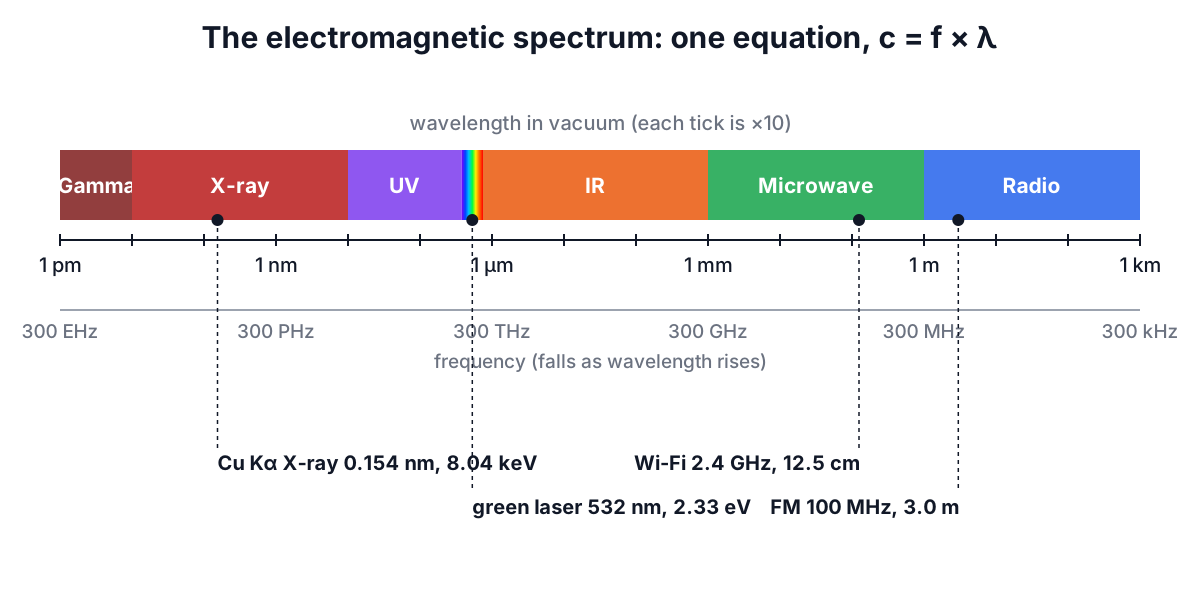
The spectrum is continuous; the band names are conventions, and different standards draw the edges slightly differently. The calculator uses these common boundaries:
| Region | Vacuum wavelength | Notes |
|---|---|---|
| Gamma rays | below about 0.01 nm | Nuclear transitions |
| X-rays | 0.01 to 10 nm | Hard below 0.1 nm, soft above |
| Ultraviolet | 10 to 380 nm | UV-C 100 to 280, UV-B 280 to 315, UV-A 315 to 400 nm (CIE) |
| Visible | 380 to 750 nm | Violet, blue, green, yellow, orange, red |
| Infrared | 750 nm to 1 mm | Near, mid and far infrared |
| Microwave | 1 mm to 1 m | 300 GHz to 300 MHz |
| Radio | above 1 m | Below 300 MHz |
Visible colours run roughly violet 380 to 450 nm, blue 450 to 495, green 495 to 570, yellow 570 to 590, orange 590 to 620 and red 620 to 750 nm. The eye's sensitivity fades gradually at both ends, so these edges are approximate.
Radio frequencies have their own naming scheme from the ITU (Recommendation ITU-R V.431). Band number N covers 0.3 × 10ᴺ to 3 × 10ᴺ Hz:
| Band | Name | Range | Example |
|---|---|---|---|
| 5 | LF | 30 to 300 kHz | Longwave broadcasting |
| 6 | MF | 300 kHz to 3 MHz | AM radio |
| 7 | HF | 3 to 30 MHz | Shortwave |
| 8 | VHF | 30 to 300 MHz | FM radio, airband |
| 9 | UHF | 300 MHz to 3 GHz | TV, mobile phones, 2.4 GHz Wi-Fi |
| 10 | SHF | 3 to 30 GHz | 5 GHz Wi-Fi, satellite TV, radar |
| 11 | EHF | 30 to 300 GHz | Millimetre-wave radar and 5G |
Light in glass and water
In a material, light travels slower, at c ÷ n, where n is the refractive index: about 1.0003 for air, 1.333 for water and around 1.5 for common glass. The frequency does not change at the boundary (each crest that arrives must leave), so the wavelength shrinks by the same factor n:
λ in medium = λ in vacuum ÷ n
A 532 nm green laser shone into water has a wavelength of 532 ÷ 1.333 = 399 nm there, but it does not turn violet. Colour depends on the frequency the eye receives, and that is unchanged. This is why band names and colours are always quoted for the vacuum wavelength, and why the calculator reports both when you choose a medium.
Sound: the speed depends on the medium
Sound is a pressure wave in a material, so its speed depends on how stiff and how dense the material is. In a gas it depends mostly on temperature. Treating dry air as an ideal gas:
v = √(γ R T ÷ M)
with γ = 1.4 for air, R = 8.314462618 J/(mol·K), T in kelvin and M = 0.02896 kg/mol. That gives:
| Air temperature | Speed of sound |
|---|---|
| −10 °C | 325.2 m/s |
| 0 °C | 331.3 m/s |
| 10 °C | 337.3 m/s |
| 20 °C | 343.2 m/s |
| 30 °C | 349.0 m/s |
| 40 °C | 354.8 m/s |
Humidity raises the speed slightly (by a few tenths of a percent at room temperature) because water vapour is lighter than air. In fresh water at 20 °C sound travels at about 1,482 m/s, in seawater about 1,500 m/s, and in steel about 5,900 m/s for longitudinal waves.
Worked example: concert A
The tuning note A4 is 440 Hz (ISO 16). In air at 20 °C its wavelength is 343.2 ÷ 440 = 0.780 m. On a hot stage at 30 °C the same note has a wavelength of 0.793 m. Wind instruments go sharp as they warm up for this reason: the air column's length is fixed, so a faster speed of sound raises its resonant frequency.
Human hearing spans roughly 20 Hz to 20 kHz in young adults, which in air is wavelengths from about 17 m down to 1.7 cm. Below 20 Hz is infrasound, above 20 kHz ultrasound. A 40 kHz ultrasonic distance sensor works at a wavelength of 8.6 mm, which sets the smallest objects it can detect well.
Musical pitch follows a logarithmic scale. In twelve-tone equal temperament each semitone multiplies the frequency by 2^(1/12) = 1.0595, and a cent is a hundredth of a semitone. The calculator names the nearest note for any sound frequency and how many cents sharp or flat it is.
Common mistakes
- Mixing nm and m. 500 nm is 5 × 10⁻⁷ m, not 5 × 10⁻⁹.
- Using c for sound. Sound in air is about 343 m/s, nearly a million times slower than light.
- Assuming wavelength sets colour in a medium. Frequency sets colour; wavelength changes with n.
- Treating MHz and Mbps as the same thing. Data rate depends on bandwidth and modulation, not directly on carrier frequency.
- Rounding hc too early. 1240 eV·nm is fine for estimates, but use 1239.84 for anything quoted to four figures.
Try it
The Wavelength and Frequency Calculator converts between wavelength, frequency, period and photon energy for light in vacuum or any refractive index and for sound in air, water and steel, and names the spectrum band, colour, ITU radio band or musical note. For antenna element lengths see the Antenna Length Calculator, and for sound levels the Decibel Calculator.
Frequently asked questions
Why is ultraviolet light harmful when visible light is not?
Each photon's energy is E = h × f, so higher-frequency light carries more energy per photon. A carbon-carbon chemical bond takes roughly 3.6 eV to break, and ultraviolet photons carry that much and more, which is why UV causes sunburn and sterilises surfaces. Visible photons fall just below it, and a 2.45 GHz microwave photon carries only about 10.1 µeV.
Why is the speed of light an exact number?
The speed of light in vacuum, c = 299,792,458 m/s, is exact because since 1983 the metre has been defined as the distance light travels in 1/299,792,458 of a second. Planck's constant and the electronvolt have also been exact since the 2019 redefinition of the SI, so conversions between wavelength, frequency and photon energy rest on fixed constants.
What are the ITU radio frequency bands?
ITU-R Recommendation V.431 numbers radio bands so that band N covers 0.3 × 10ᴺ to 3 × 10ᴺ Hz. Band 8, VHF, runs from 30 to 300 MHz and carries FM radio; band 9, UHF, runs from 300 MHz to 3 GHz and includes TV, mobile phones and 2.4 GHz Wi-Fi; band 10, SHF, covers 3 to 30 GHz, including 5 GHz Wi-Fi.
Why do wind instruments go sharp as they warm up?
The speed of sound in air rises with temperature, from 343.2 m/s at 20 °C to 349.0 m/s at 30 °C. A wind instrument's air column has a fixed length, so a faster speed of sound raises its resonant frequency and the pitch goes sharp. Concert A at 440 Hz has a wavelength of 0.780 m at 20 °C but 0.793 m at 30 °C.
How long is a quarter-wave antenna for 2.4 GHz?
A quarter-wave antenna for 2.4 GHz is about 3.1 cm long in free space, a quarter of the 12.5 cm wavelength. In practice it is trimmed a few percent shorter, because signals travel slightly slower along a conductor than in free space. The radio rule of thumb λ (m) ≈ 300 ÷ f (MHz) gives the full wavelength quickly.
Sources and further reading
- CODATA value: speed of light in vacuum, US National Institute of Standards and Technology. c = 299,792,458 m/s exactly.
- CODATA value: Planck constant, US National Institute of Standards and Technology. The exact value of h used for photon energy.
- SI base unit: metre, Bureau International des Poids et Mesures. How the metre is defined from the speed of light.
- The Electromagnetic Spectrum (University Physics Volume 2, section 16.5), OpenStax, Rice University. Bands, wavelengths and frequencies of light.
- Speed of Sound (University Physics Volume 1, section 17.2), OpenStax, Rice University. Sound speed in air, water and solids, and √(γRT/M).
- Nomenclature of the frequency and wavelength bands used in telecommunications (ITU-R V.431), International Telecommunication Union. The radio band names.
- Photoelectric Effect (University Physics Volume 3, section 6.2), OpenStax, Rice University. Photon energy E = hf in practice.
- BIPM, The International System of Units (SI Brochure), 9th edition, 2019: exact values of c, h and e.
- CIE (International Commission on Illumination), definitions of the UV-A, UV-B and UV-C bands.
- ISO 16:1975, Acoustics: Standard tuning frequency (A4 = 440 Hz).
- ISO 20473:2007, Optics and photonics: Spectral bands.
- CRC Handbook of Chemistry and Physics: refractive indices and speed of sound in water and metals.
Open the Wavelength and Frequency Calculator
More Physics & Chemistry
Every tool in the Physics & Chemistry section, free and in your browser.