
How Alcohol Affects Sleep Quality
Alcohol can speed up falling asleep but cuts REM sleep and breaks up the second half of the night. What the studies measured, and when the alcohol is still in your blood.
By Redbison Dev · · Updated · 9 min read
You had two glasses of wine with dinner, fell asleep quickly, and still woke at 3 am and felt flat the next morning. That pattern is what sleep studies find: alcohol can shorten the time it takes to fall asleep, but it delays and cuts rapid eye movement (REM) sleep, and the second half of the night becomes lighter and more broken as the body clears the alcohol. A 2025 meta-analysis found REM sleep disrupted after about two standard drinks, and a moderate dose taken six hours before bed still upset sleep in a laboratory study, even though breath alcohol was zero by lights-out.
Below is what the research measured, a worked evening with the Sleep Calculator and BAC Calculator showing when the alcohol is still in your body during the night, and what the evidence says about how many hours before bed matters. It is general information, not medical advice.
What alcohol does to a night's sleep
Two reviews summarise the laboratory work, in which healthy adults drink a measured dose and sleep in a lab wired for polysomnography (brain waves, eye movements and muscle tone).
Ebrahim and colleagues (2013) reviewed the studies available at the time and reported that, at all doses, alcohol shortened the time to fall asleep, made the first half of the night more consolidated and increased disruption in the second half. The most recognisable REM effect was a delay to the first REM period at all doses. Total-night REM fell in most studies at moderate and high doses, with no clear trend at low doses. Deep (slow-wave) sleep rose in the first half of the night across doses, and over the whole night at high doses.
Gardiner and colleagues (2025) ran a newer systematic review and meta-analysis of 27 studies, and were stricter about dose:
- REM sleep was delayed and reduced after a low dose, up to 0.50 g of alcohol per kg of body weight (about two standard drinks), and the effect grew with dose.
- Falling asleep faster and reaching deep sleep sooner were only found after a high dose, 0.85 g/kg or more (about five standard drinks).
- Total sleep time, sleep efficiency and time awake after sleep onset could not be pinned down: the studies disagreed too much.
So the "nightcap helps me sleep" feeling is real for some people, mostly at doses that do more harm to the rest of the night. What changes reliably, even at two drinks, is REM sleep.
Why the second half of the night falls apart
Your liver clears alcohol at a roughly steady rate. In their review for the National Institute on Alcohol Abuse and Alcoholism (NIAAA), Roehrs and Roth note that in the laboratory studies, where alcohol given 30 to 60 minutes before bed put breath alcohol at roughly 0.06 to 0.08% at lights-out, typical elimination rates clear it within about four to five hours of falling asleep. Less alcohol clears sooner, as the worked example below shows. At higher doses, wake periods and light stage 1 sleep increased in the second half, which they interpret as a rebound once the alcohol is gone, along with a rebound of REM sleep late in the night.
Two more findings from the same review matter for regular drinkers. Tolerance to alcohol's sedative and sleep-stage effects developed within three nights: deep sleep and REM returned to their usual levels, so a nightly drink soon stops working as a sedative. And alcohol interacts with short sleep: daytime sleepiness and impaired performance were worse after alcohol when people were already short of sleep.
Breathing is a separate issue. A meta-analysis by Simou and colleagues (2018) found that higher alcohol intake was linked to a 25% higher risk of sleep apnoea (relative risk 1.25), with wide differences between studies. If you snore heavily, stop breathing in your sleep or wake gasping, tell a clinician rather than adjusting your drinking around it.
Worked example: two glasses of wine and a 6:30 alarm
Take a 65 kg woman who drinks two 150 mL glasses of 12% wine starting at 7:00 pm and has to get up at 6:30 am.
Step 1: pick a bedtime. Open the Sleep Calculator, keep the I need to wake at tab, set the Wake-up time to 06:30, and keep the defaults of 15 minutes to fall asleep and 90-minute cycles. It suggests 9:15 pm (six cycles, 9 hours), 10:45 pm (five cycles, 7 h 30 min), 12:15 am or 1:45 am. She picks 10:45 pm, which meets the American Academy of Sleep Medicine (AASM) recommendation of 7 or more hours for adults.
Step 2: check what is still in her blood at bedtime. Open the BAC Calculator and set Sex Female, Body weight 65 kg, Hours since first drink 3.75 (7:00 pm to 10:45 pm), set the Beer count to 0 (it starts at 3) and the Wine count to 2 at 150 mL and 12%. It shows:
- Alcohol consumed 28.4 g, 2.0 US standard drinks (14 g each). That is 0.44 g per kg of body weight, inside the low-dose band where Gardiner and colleagues still found REM disrupted.
- If all absorbed at once: 0.079%.
- Estimated BAC now: 0.023%, and 1 h 33 min until about zero, so the alcohol runs out at about 12:18 am, during her first sleep cycle.
Step 3: add a nightcap. Change the Spirits count to 1 (44 mL at 40%). Total alcohol rises to 42.3 g, or 0.65 g/kg. BAC at bedtime is now about 0.062%, and the calculator gives 4 h 08 min until about zero: alcohol is in her blood until roughly 2:53 am, near the middle of the night. Because the liver clears alcohol at a steady rate, the time to zero depends on the total drunk, not much on when the last one went down, so entering every drink since the first one gives the right clearing time.
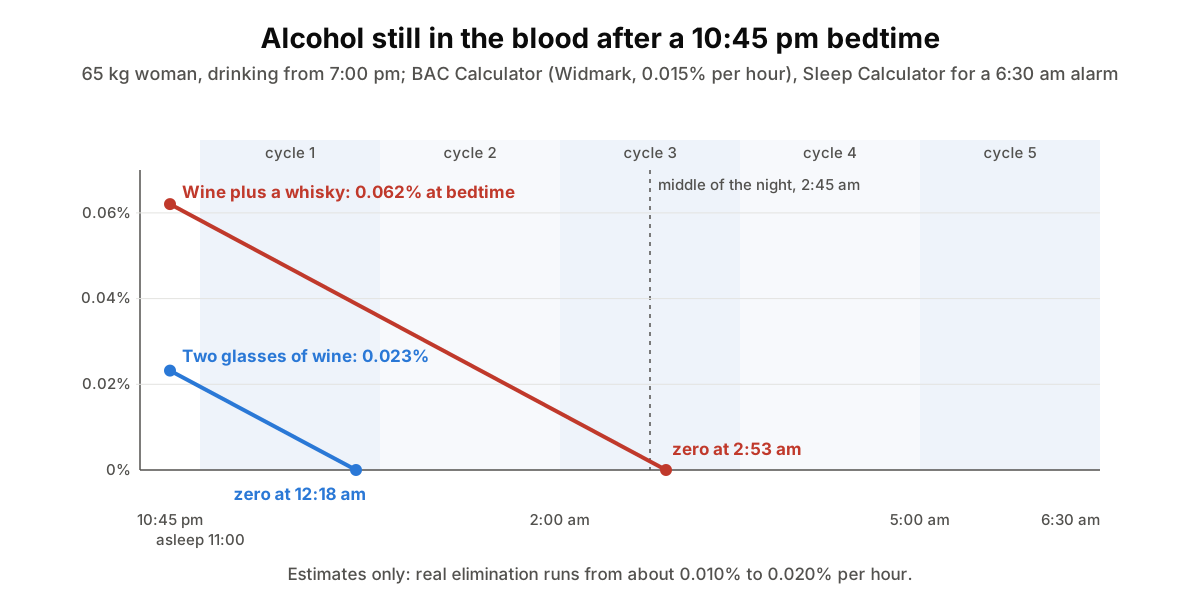
These are Widmark estimates at an average elimination rate of 0.015% per hour; real rates run from about 0.010% to 0.020% per hour, and food slows absorption. Use the numbers to see the shape of the night, never to judge whether you are fit to drive.
How many hours before bed should you stop drinking?
None of the studies above tests a specific cut-off, so there is no evidence-based number of hours. What they do show:
- Alcohol still in the blood at bedtime is the usual laboratory set-up (drinks 30 to 60 minutes before bed), and it produces the classic pattern above.
- Alcohol gone by bedtime is not enough. Landolt and colleagues gave ten healthy middle-aged men 0.55 g/kg (for an 80 kg man, 44 g or about three US standard drinks) six hours before bedtime. Breath alcohol was zero at the start of sleep in every subject, yet sleep efficiency, total sleep time and REM sleep fell, wakefulness in the second half of the night roughly doubled, and the men rated their sleep lighter.
A practical reading: the BAC Calculator's "until about zero" figure is the minimum gap between your first drink and bed, not a safe window. In the example, getting to zero by 10:45 pm would have meant starting the first glass by about 5:27 pm (5 h 18 min earlier), and Landolt's study suggests even that may not protect the night. Fewer drinks, earlier in the evening, and some nights without any, is what the evidence points to. The 2025 to 2030 Dietary Guidelines for Americans now simply advise drinking less alcohol for better overall health.
Who should not drink at all, and when to see someone
The Dietary Guidelines list people who should avoid alcohol completely: anyone pregnant, anyone recovering from alcohol use disorder or unable to control how much they drink, and anyone taking medicines or living with conditions that interact with alcohol; a pharmacist can tell you whether yours do. If you find you need a drink to fall asleep most nights, or you wake every night and cannot get back to sleep, talk to a doctor; chronic insomnia and sleep apnoea are treatable, and alcohol tends to make both worse.
Tools for this job
- BAC Calculator: grams of alcohol, standard drinks and an estimate of when blood alcohol reaches zero, which tells you how much of the night it covers.
- Sleep Calculator: bedtimes or wake-up times that fit whole 90-minute cycles, and the hours of sleep the AASM recommends for your age.
For the Widmark formula and what a standard drink means in different countries, read the blood alcohol guide. For the sleep stages behind the cycle arithmetic, see sleep cycles explained, and for fluids the morning after, the hydration guide.
Frequently asked questions
Does alcohol reduce REM sleep?
Yes. Laboratory studies consistently find that alcohol delays the first REM period and reduces REM sleep, and the 2025 meta-analysis by Gardiner and colleagues found this even after about two standard drinks, with larger effects at higher doses. Some REM returns late in the night as the alcohol is cleared.
Why do I wake up at 3 am after drinking?
As the liver clears the alcohol, sleep becomes lighter, with more wake periods and light sleep in the second half of the night. In the worked example above, a nightcap moved the point where alcohol runs out from about 12:18 am to about 2:53 am, right into that window.
Does one drink affect sleep?
The evidence for a single standard drink is thinner than for two or more. Gardiner and colleagues' low-dose group went up to 0.50 g/kg, about two drinks, and already showed REM disruption, so the safest assumption is that any alcohol near bedtime changes sleep somewhat, and more alcohol changes it more.
Is it better to drink earlier in the evening?
Earlier is better than later, because more of the alcohol is cleared before sleep, but it is not a guarantee: in Landolt and colleagues' study, 0.55 g/kg (about three drinks for an 80 kg man) six hours before bed still reduced REM sleep and sleep efficiency with breath alcohol at zero at lights-out.
Sources and further reading
- Alcohol and sleep I: effects on normal sleep, Ebrahim and colleagues, Alcoholism: Clinical and Experimental Research 2013. Review of sleep onset, slow-wave sleep and REM effects by dose.
- The effect of alcohol on subsequent sleep in healthy adults: a systematic review and meta-analysis, Gardiner and colleagues, Sleep Medicine Reviews 2025. 27 studies; REM disrupted from about two drinks, faster sleep onset only at about five.
- Sleep, sleepiness, and alcohol use, Roehrs and Roth, Alcohol Research and Health (NIAAA) 2001. Second-half rebound, tolerance within three nights, doses and timing used in studies.
- Late-afternoon ethanol intake affects nocturnal sleep and the sleep EEG in middle-aged men, Landolt and colleagues, Journal of Clinical Psychopharmacology 1996. 0.55 g/kg six hours before bed with zero breath alcohol at lights-out.
- Alcohol and the risk of sleep apnoea: a systematic review and meta-analysis, Simou and colleagues, Sleep Medicine 2018. Relative risk 1.25 for higher alcohol intake.
- Seven or more hours of sleep per night: a health necessity for adults, American Academy of Sleep Medicine. The 2015 AASM and Sleep Research Society consensus of 7 or more hours for adults aged 18 to 60.
- About Standard Drink Sizes, US Centers for Disease Control and Prevention. A US standard drink is 14 g of alcohol.
- Dietary Guidelines for Americans, 2025 to 2030, US Department of Agriculture and Department of Health and Human Services. "Consume less alcohol for better overall health" and who should avoid it entirely.