
How Much Water Do You Need? The Math Behind Hydration Calculators
Where the "8 glasses a day" rule came from, what official intake guidelines say, and how weight, activity and climate change a daily hydration estimate.
By Redbison Dev · · Updated · 7 min read
"Drink eight glasses of water a day" is one of the most repeated pieces of health advice there is. It is easy to remember, and it is not really based on anything. Actual water needs vary a lot with body size, activity, climate and diet.
This guide looks at where the eight-glasses rule came from, what official bodies recommend, and how a weight-based calculation like the one in the Hydration Calculator works. It is general information, not medical advice.
Where "8 x 8" came from
The "eight 8-ounce glasses" rule, about 1.9 liters, has no clear scientific source. In 2002, Heinz Valtin, a kidney physiologist at Dartmouth Medical School, reviewed the evidence in the American Journal of Physiology and found no scientific studies supporting it.
The rule is often traced to a 1945 recommendation from the US Food and Nutrition Board, which suggested about 2.5 liters of water a day for adults. The next sentence of that recommendation said that most of this quantity is contained in prepared foods. That second sentence was largely forgotten, and the idea that you need to drink all of it took hold.
What official guidelines say
Modern guidance is expressed as total water intake, which includes water from all drinks and from food.
| Source | Women | Men |
|---|---|---|
| US National Academies (2004), adequate intake | about 2.7 L/day | about 3.7 L/day |
| European Food Safety Authority (2010), adequate intake | 2.0 L/day | 2.5 L/day |
Food typically supplies around 20% of total water, more if your diet is rich in fruit, vegetables and soups. These figures are population averages for healthy adults in temperate climates, and they are adequate intakes rather than strict minimums. The National Academies' report also noted that most healthy people meet their needs by letting thirst guide them.
How the calculator estimates your needs
Weight-based formulas are a common way to personalize a starting estimate, because larger bodies contain and lose more water. The RedBison Hydration Calculator uses this approach:
1. Base amount by weight and age
| Age | Base |
|---|---|
| Under 18 | 40 ml per kg |
| 18 to 65 | 35 ml per kg |
| Over 65 | 30 ml per kg |
Imperial weights are converted to kilograms first (1 lb = 0.453592 kg).
2. Activity adjustment
| Activity level | Extra on top of base |
|---|---|
| Sedentary | 0% |
| Light | 20% |
| Moderate | 40% |
| High | 60% |
| Very high | 80% |
3. Climate adjustment
Hot or humid climates add 500 ml; cold climates subtract 200 ml.
A worked example
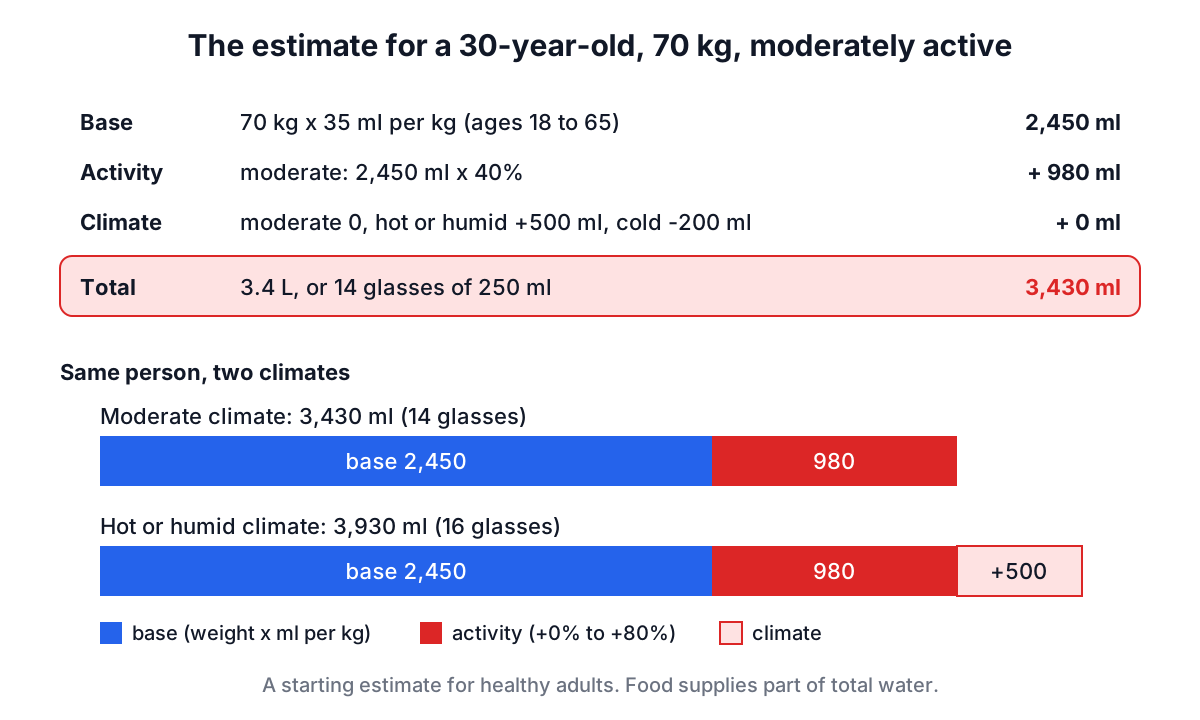
A 30-year-old weighing 70 kg, moderately active, in a moderate climate:
Base:      70 kg x 35 ml       = 2,450 ml
Activity:  2,450 ml x 40%      =   980 ml
Climate:   moderate            =     0 ml
Total:                           3,430 ml (about 3.4 L, or 14 glasses of 250 ml)
That is in line with the National Academies' total water figure for men, keeping in mind that some of it will come from food.
Factors that change your needs
- Exercise. Sweat rates vary widely between people, from well under half a liter to two liters or more per hour of hard exercise in the heat. Athletes sometimes weigh themselves before and after training: each kilogram lost is roughly a liter of fluid to replace.
- Heat and humidity. You sweat more, sometimes without noticing in dry heat.
- Altitude. Faster breathing in thin, dry air increases water loss.
- Illness. Fever, vomiting and diarrhea all increase fluid needs.
- Pregnancy and breastfeeding. Both increase requirements; the National Academies and EFSA publish specific figures.
- Diet. High-protein and high-salt diets increase water needs; water-rich foods reduce how much you need to drink.
Does coffee count?
Yes. Caffeine is a mild diuretic, but studies have found that for regular consumers, moderate amounts of coffee and tea contribute to hydration much like water does. A 2014 study published in PLOS ONE found no significant difference in hydration markers between men drinking moderate amounts of coffee and those drinking the same volume of water. Alcohol is different: it increases urine output and is best not counted.
Signs you are getting it right
For most healthy people, simple signals work well:
- Thirst is a reliable guide at rest.
- Urine color: pale straw yellow suggests good hydration; dark yellow suggests you need more.
- Frequency: urinating regularly through the day.
Older adults are a notable exception, because the sense of thirst weakens with age. A daily target is more useful for them.
Can you drink too much?
Yes. Drinking very large amounts of water in a short time can dilute blood sodium, a condition called hyponatremia. It is rare in everyday life but has occurred in endurance events, where athletes drink large volumes while losing sodium through sweat, and in water-drinking contests. Spreading intake through the day and using electrolyte drinks during long, sweaty exercise reduces the risk.
When to ask a professional
People with kidney disease, heart failure, liver disease or certain other conditions may need to limit fluids, and some medications affect fluid balance. If that applies to you, follow your clinician's guidance rather than any calculator.
Using the calculator
Choose metric or imperial, enter your age and weight, pick an activity level and climate, and calculate. The result shows your estimate in milliliters, liters and 250 ml glasses, with the base and activity amounts broken out. Treat it as a starting point and adjust based on thirst, urine color and how you feel.
Related tools
- BMI Calculator for another everyday health estimate
- Epoch Converter, if you are logging intake in a spreadsheet with timestamps
Frequently asked questions
How much water should I drink a day?
Official guidance is expressed as total water intake from drinks and food. The US National Academies (2004) set adequate intakes of about 2.7 liters a day for women and 3.7 liters for men, and the European Food Safety Authority (2010) 2.0 and 2.5 liters. Food typically supplies around 20% of total water, and thirst guides most healthy people well.
Where does the 8 glasses of water a day rule come from?
The "eight 8-ounce glasses" rule, about 1.9 liters, has no clear scientific source; a 2002 review by kidney physiologist Heinz Valtin found no studies supporting it. It is often traced to a 1945 US Food and Nutrition Board recommendation of about 2.5 liters a day, whose next sentence, largely forgotten, said most of that is contained in prepared foods.
How much water should I drink when exercising?
Sweat rates during exercise vary widely, from well under half a liter to two liters or more per hour of hard exercise in the heat. Athletes sometimes weigh themselves before and after training, because each kilogram lost is roughly a liter of fluid to replace. For long, sweaty sessions, electrolyte drinks help reduce the risk of diluting blood sodium.
How can I tell if I am drinking enough water?
For most healthy people, thirst is a reliable guide at rest. Pale straw yellow urine suggests good hydration, dark yellow suggests more is needed, and urinating regularly through the day is another good sign. Older adults are a notable exception, because the sense of thirst weakens with age, so a daily target is more useful for them.
Who should not follow a daily water intake target?
People with kidney disease, heart failure, liver disease or certain other conditions may need to limit fluids rather than meet a target, and some medications affect fluid balance. They should follow their clinician's guidance instead of any calculator. Pregnancy and breastfeeding increase requirements, and the National Academies and EFSA publish specific figures for both.
Sources and further reading
- Dietary Reference Intakes for Water, Potassium, Sodium, Chloride, and Sulfate, National Academies Press. US adequate intakes for total water.
- Scientific Opinion on Dietary Reference Values for water, EFSA Journal. European reference values for water.
- "Drink at least eight glasses of water a day." Really? Is there scientific evidence for "8 x 8"?, American Journal of Physiology. Valtin's 2002 review of the eight glasses rule.
- Water, drinks and hydration, NHS. Practical NHS guidance on drinks and hydration.
More Fitness Calculators
Every tool in the Fitness Calculators section, free and in your browser.
- BMI Calculator
- Calorie Calculator
- Protein Calculator
- Hydration Calculator
- Calorie Deficit Planner
- Body Fat Calculator
- Ideal Weight Calculator
- Running Pace Calculator
- Target Heart Rate Calculator
- One Rep Max Calculator
- Barbell Plate Calculator
- RPE Calculator
- Interval Timer
- Calories Burned Calculator
- Body Surface Area Calculator
- Waist-to-Hip Ratio Calculator
- VO2 Max Calculator
- Steps to Distance & Calories Calculator