
Blackout Supplies: How Much to Stock, and How to Make It Last
A gallon of water per person per day is easy to store for three days and impossible for thirty. Six tiers from 12 hours to 90 days, plus how to stock and how to ration.
By Redbison Dev · · 12 min read

Ask someone how long they could manage without electricity and most say three days. Ask them how much drinking water is in the house and the honest answer is usually a few bottles in the door of a fridge that stopped being cold four hours ago. The gap between those two answers is not courage or equipment. It is arithmetic nobody has done.
This post does the arithmetic across six tiers, 12 hours, one day, three days, one week, 30 days and 90 days, and then covers the two things that decide whether any of it works: how to stock so the store rotates itself, and how to spend it so it reaches the end of the outage. The Blackout Preparedness Checklist is the same material as a list you can tick, edit and print. For what to do while the power is actually off, the first hour, reporting the fault, carbon monoxide, the Power Outage Checklist is the companion.
Start with the number that does not fit
Ready.gov plans on one gallon of water per person per day, split roughly half for drinking and half for cooking and basic hygiene. Children, nursing mothers, anyone ill, and anyone in a hot climate need more.
That number is unremarkable until you multiply it:
| Household | 3 days | 1 week | 30 days | 90 days |
|---|---|---|---|---|
| 1 person | 3 gal | 7 gal | 30 gal | 90 gal |
| 2 people | 6 gal | 14 gal | 60 gal | 180 gal |
| 4 people | 12 gal | 28 gal | 120 gal | 360 gal |
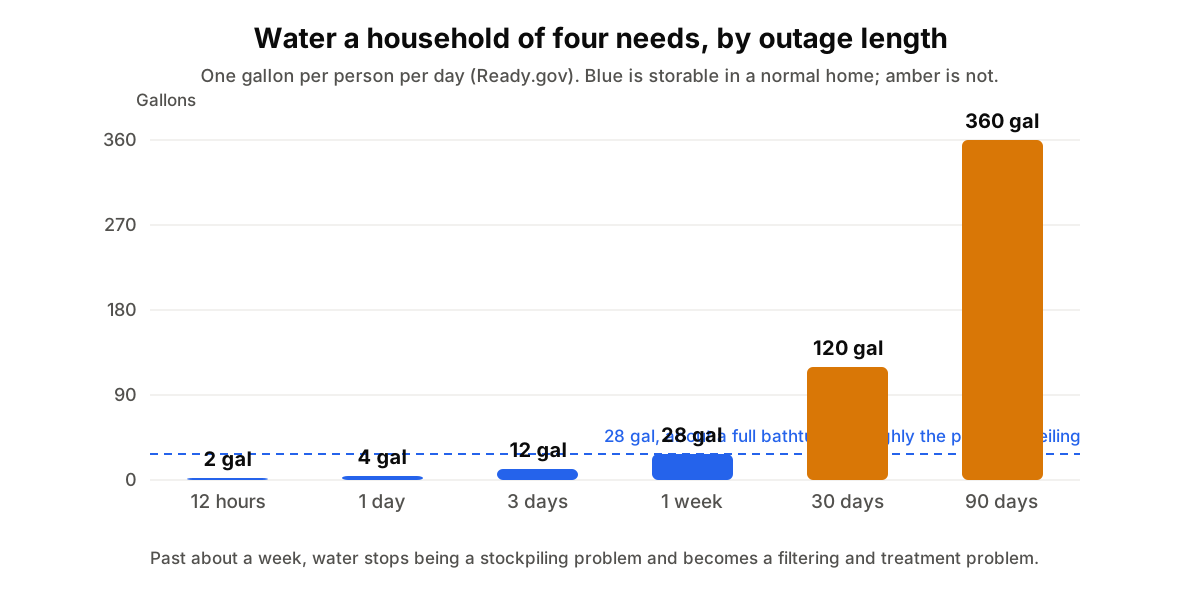
A week for a family of four is 28 gallons, about 230 pounds of water, roughly a bathtub, and it has to go somewhere that is not the garage floor in August. Thirty days is 120 gallons. Ninety is 360.
This is the single most useful thing to understand about long outages: somewhere around a week, water stops being a stockpiling problem and becomes a treatment problem. Past that point the plan is a filter rated for the volume, a clean way to collect, and a second method, boiling, or unscented household bleach with a measuring guide, so that one failure does not end the supply. People who skip this step discover it on day eight.
The six tiers, and why they are cumulative
Each tier assumes the one before it. Work down as far as your situation warrants and then stop. A 90-day plan you never maintain is worth less than a three-day one you rotate, and the households that come unstuck in a long outage are usually the ones who bought deep once and never touched it again.
The first 12 hours is about what is already in the house, reachable in the dark. A torch or lantern per person, a phone torch flattens the phone you need for outage updates, and open flames are a leading cause of fires during outages. A charged power bank per phone. Half a gallon of drinking water per person. One meal each that needs no heat, no water and no tin opener, because the first hours are spent finding out how long this will last, not cooking.
One day adds the full gallon per person, a cool box and a route to ice, and an appliance thermometer in both the fridge and the freezer. It also adds a battery or wind-up radio, because mobile masts run on their own batteries and start dropping out after a few hours in a wide outage, and small cash, because card terminals and cash machines fail together.
Three days is the minimum horizon in every national guide. Three gallons of water per person, three days of food needing no refrigeration and little cooking, one off-grid way to boil water used outdoors only, a battery-powered carbon monoxide alarm, and a sanitation plan if the water or the pump stops. Add three days of whatever a baby, a pet or a carer needs, formula and nappies run out faster than you expect and are the hardest things to improvise.
One week is where the character of the problem changes. Stored charge stops being enough and you need generation: a folding solar panel, or a car inverter. Hygiene without hot running water becomes an infection-risk question rather than a comfort one. And a week of every regular prescription should already be in hand, because pharmacies in an area-wide outage may be shut or unable to process anything.
Thirty days is planned in calories rather than meals, roughly 2,000 a day per adult, more for manual work or cold, and built on rice, oats, pasta, oil, dried beans and tinned protein. Add a multivitamin and something green: a month of rice and tinned meat is calorically fine and nutritionally poor.
Ninety days is not really a stockpiling question. It is a habitability question, heating, water, sanitation, anything medically dependent on power, and the useful preparation is deciding now what would trigger leaving, and practising a weekend cooked entirely from the store on the stove you plan to use.
The food rules are thresholds, not advice
Most outage advice is soft. The food rules are not, and they are worth memorising because they decide what you throw away.
USDA puts an unopened refrigerator at about four hours. A full freezer holds about 48 hours; a half-full one about 24. Refrigerated perishables are discarded once they reach 40°F or above, meat, poultry, fish, eggs, dairy, cooked leftovers, cut fruit. Frozen food may be refrozen only if it still has ice crystals or is at or below 40°F.
And the rule that matters most: never taste food to decide. Food that has been unsafely warm looks and smells completely normal. That is precisely why it makes people ill. A cheap appliance thermometer in each appliance turns every one of these judgements into a reading.
Two practical consequences follow. First, fill the freezer's empty space with bottles of water: a full freezer holds cold roughly twice as long as a half-empty one, and the bottles become drinking water as they thaw. Second, decide what you are taking out before you open the door, and open it once. Tape the list to the front. Every opening spends part of a 48-hour budget.
How to stock so the store does not quietly expire
The failure mode of long-term food storage is not spoilage. It is a sealed box in a cupboard that nobody opens for six years and then throws away.
Store what you already eat, and eat what you store. A store you cook from weekly rotates itself and teaches you how to cook from it. A box of unfamiliar freeze-dried meals teaches you nothing, and an outage is a bad moment to discover that nobody in the house likes it.
Date every item on the front in marker and use the oldest first. First in, first out is the entire discipline. Without it, a store becomes waste silently.
Buy more of fewer things. Six kinds of tinned bean with one tin each is a store that runs out of everything simultaneously. Depth in a few staples beats variety.
Split it across two places so a leak, a flood or a broken window cannot take all of it. Keep it cool, dark, dry and off the floor, heat ages food faster than time does, which makes an uninsulated garage that reaches 100°F in summer the worst place in the house.
Own the manual versions of the tools the store needs: a tin opener, a bottle opener, a lighter. A store you cannot open is not a store. And keep a paper inventory with quantities and dates, checked twice a year, you cannot ration what you have not counted, and paper survives the outage that takes your phone.
One more, for anything containing oil: oil goes rancid long before rice spoils. Buy cooking oil in smaller units and rotate it hardest. It is the usual weak link in an otherwise sound 90-day store.
How to spend it: the order, the ration, the fuel
Eat in order: fridge, then freezer, then cupboard, then the long-term store. Spend the food that is already spoiling before the food that keeps. Most of the food wasted in a power cut is cupboard food eaten on day one while the fridge quietly rots, a completely avoidable loss that costs nothing to prevent.
Start rationing on day one, not when it starts to look tight. Divide what you have by the days you are planning for, then cut that by a quarter. Adjusting a ration upward later is easy and cheerful; adjusting it downward on day five is neither. Re-count daily against the network operator's restoration estimate rather than against hope.
Cook once a day, in one pot, and hold it hot in a thermos. Every separate heating costs fuel, and fuel runs out well before food does, a fact that surprises people at the 30-day tier more than any other. A wide pot with a lid plus a thermos turns ten minutes of boiling into an hour of residual cooking. One hot meal a day with cold food around it is the efficient pattern.
Separate drinking water from washing and flushing water, and label the containers. Treated drinking water poured into a toilet cistern is the most common avoidable loss in a long outage.
The part that actually kills people
Generators are where preparedness turns dangerous. Both CDC and the Consumer Product Safety Commission say the same thing: outside only, at least 20 feet from any door, window or vent, and never in a garage, not even with the door open. Carbon monoxide builds up quickly in nearby spaces and lingers for hours after the engine stops. CPSC has found that some manufacturer manuals suggest distances as short as five feet; the 20-foot figure is the one to follow regardless.
The same logic covers heating. Never warm a room with a barbecue, a camping stove or charcoal. Anything burning fuel indoors produces carbon monoxide you cannot smell, and a mains-powered CO alarm is switched off during exactly the event that creates the risk, which is why the battery-powered one is on the three-day list.
For warmth without combustion: gather everyone into one room, close the doors, and heat people rather than rooms. Layers, hats, sleeping bags. One warm room is far easier to hold than a warm house, and it costs nothing.
Where to start
If you do one thing this week, do the water arithmetic for your own household and find the physical space for three days of it. If you do two, put an appliance thermometer in the fridge and one in the freezer.
Then work the tiers in order with the Blackout Preparedness Checklist, which you can edit down to your own situation, tick off, and print or export. Pair it with the Power Outage Checklist for the response side, and the Winter Home Checklist if your outages are a seasonal certainty rather than a surprise.
Frequently asked questions
Is three days of supplies enough?
Three days is the minimum every national guide sets, and it covers most outages. Two weeks is the usual goal for staying at home, because that is roughly where a severe storm or grid failure stops being a local repair. Work down the tiers as far as your own risk warrants, then stop and maintain what you have.
How do I store a month of water if it will not fit?
You mostly do not. Thirty gallons a person is around 250 pounds for one adult, so past about a week the plan shifts to a filter rated for the volume, a clean way to collect, and a second treatment method such as boiling or unscented household bleach so that one failure does not end the supply.
Does rotating a food store actually matter?
It is the difference between a store and a cupboard of waste. Date each item on the front, use the oldest first, and buy things the household already eats so the store feeds you weekly. Sealed boxes of unfamiliar food reliably expire untouched, and teach nobody how to cook from them.
What runs out first in a long outage?
Cooking fuel, usually well before food. Every separate heating costs gas or charcoal, so cooking once a day in one covered pot and holding it hot in a thermos roughly thirds the fuel bill. Lighting and phone charging come next, which is why generation beats stored charge past about 48 hours.
Sources and further reading
- Power Outages, FEMA. Freezer timings, coolers and thermometers, and what to discard.
- Build A Kit, FEMA. The one gallon of water per person per day the tiers are built on.
- Keep Your Food Safe During Emergencies, USDA Food Safety and Inspection Service. The four-hour fridge, 48 and 24-hour freezer, refreezing and the 40F threshold.
- Food Safety During a Power Outage, US Department of Health and Human Services. The discard-or-keep chart, food by food.
- Use a Generator Safely, Centers for Disease Control and Prevention. Why 20 feet from any opening, and never indoors.
- Portable Generator Safety Alert, US Consumer Product Safety Commission. How fast carbon monoxide builds and how long it lingers.
Open the Blackout Preparedness Checklist
More Home & Seasonal
Every tool in the Home & Seasonal section, free and in your browser.
- Winter Home Checklist
- Moving House Checklist
- Power Outage Checklist
- Blackout Preparedness Checklist
- Home Fire Safety Checklist
- Home Security Checklist
- Storm Preparation Checklist
- Annual Home Maintenance Checklist
- Wildfire Preparation Checklist
- Rental Move-Out Checklist
- Spring Cleaning Checklist
- Flood Preparation Checklist
- Rental Move-In Checklist
- Home Energy Saving Checklist
- Home Inventory Checklist