
Heat Pump vs Gas Furnace: Running Costs and Payback
Cost per kWh of heat for gas, oil, propane and heat pumps, the break-even electricity price, what COP and HSPF2 mean, and why backup heat matters.
By Redbison Dev · · Updated · 11 min read
Heat pump sales pitches tend to promise big savings, and gas utilities tend to say the opposite. Both can be right, because the answer depends almost entirely on two prices and two efficiency numbers. This guide shows how to compare the running cost of a heat pump with gas, oil, propane and electric resistance heat using your own bills, explains COP and HSPF2, and works through the cases where a heat pump saves a lot and the case where it may not save anything. The Heat Pump Savings Calculator does the same arithmetic with your numbers.
Step 1: how much heat does your home use?
You do not need a heat loss survey to start. Your current fuel bills already measure it. The useful heat delivered to your home is:
heat delivered = fuel used x energy per unit x system efficiency
Energy per unit comes from the US Energy Information Administration:
| Fuel | Energy content | In kWh |
|---|---|---|
| Natural gas | 1 therm = 100,000 Btu | 29.31 kWh |
| Natural gas | about 1,036 Btu per cubic foot | 30.36 kWh per ccf |
| Heating oil | 138,500 Btu per gallon | 40.59 kWh |
| Propane | 91,452 Btu per gallon | 26.80 kWh |
| Electricity | 3,412 Btu per kWh | 1 kWh |
System efficiency is the AFUE (annual fuel utilisation efficiency) on the furnace or boiler label. Standard non-condensing gas furnaces are about 80%; condensing furnaces and boilers 90% to 98%; oil furnaces typically low to mid 80s; electric resistance 100%.
A home that burns 600 therms a year for heating in an 80% furnace receives 600 x 29.31 x 0.8 = 14,068 kWh of heat. Use the heating part of your gas: subtract a summer month's use, multiplied by 12, from the year's total to remove water heating and cooking.
If you already know your heat load from a survey or a heat loss calculation, the calculator also accepts it directly in kWh.
Step 2: what a heat pump needs to supply it
A heat pump moves heat from outdoors to indoors rather than making it, so it delivers more heat than the electricity it uses. The ratio is the coefficient of performance (COP). A COP of 3 means 3 kWh of heat for every 1 kWh of electricity.
COP falls as the outdoor temperature drops, so what matters is the average over the whole heating season, the seasonal COP (SCOP). In the US, heat pumps are rated by HSPF2, the heating seasonal performance factor, in Btu of heat per watt-hour of electricity. Because a watt-hour is 3.412 Btu:
seasonal COP = HSPF2 / 3.412
The federal minimum for split-system heat pumps since 2023 is HSPF2 7.5, a COP of 2.2. HSPF2 9 is about 2.6 and HSPF2 10 about 2.9. HSPF2 is calculated for a moderate climate (DOE climate region IV), so real seasonal COP is lower in very cold places and higher in mild ones. Ask an installer for the expected seasonal COP in your climate, not the COP at 47 °F printed on the data sheet, which is the best case.
On the coldest days many systems switch on electric resistance strips, which run at COP 1. The calculator lets you put a share of the season's heat on backup.
heat pump electricity = heat x (1 - backup share) / SCOP + heat x backup share
For the 14,068 kWh home with a SCOP of 2.8 and 5% backup: 14,068 x 0.95 / 2.8 + 14,068 x 0.05 = 5,476 kWh.
Step 3: compare the cost of a kWh of heat
The clearest way to compare fuels is the cost of one kWh of delivered heat:
cost per kWh of heat = fuel price / (energy per unit x efficiency)
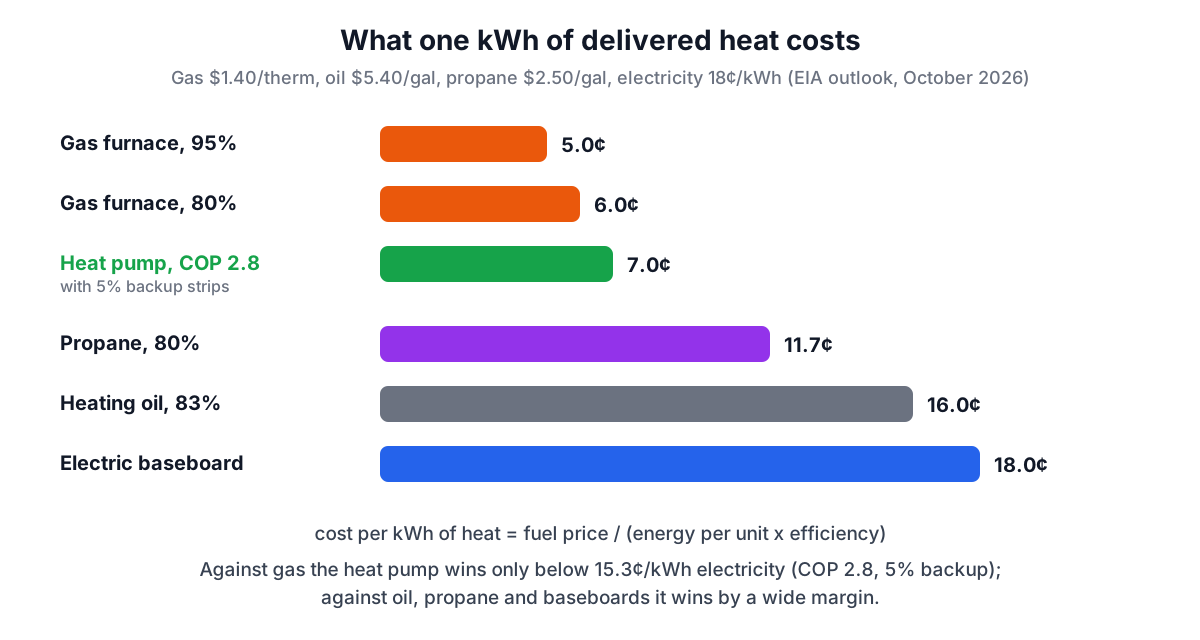
With prices close to the EIA's October 2026 outlook (residential electricity about 18 cents per kWh for 2026; for the 2026-27 heating season about $1.40 per therm of gas, $5.40 per gallon of heating oil and $2.50 per gallon of propane):
| Heating system | Price | Cost per kWh of heat |
|---|---|---|
| Gas furnace, 95% AFUE | $1.40 per therm | 5.0 cents |
| Gas furnace, 80% AFUE | $1.40 per therm | 6.0 cents |
| Heat pump, SCOP 3.5, no backup | 18 cents per kWh | 5.1 cents |
| Heat pump, SCOP 2.8, no backup | 18 cents per kWh | 6.4 cents |
| Heat pump, SCOP 2.8, 5% backup | 18 cents per kWh | 7.0 cents |
| Propane furnace, 80% | $2.50 per gallon | 11.7 cents |
| Oil furnace, 83% | $5.40 per gallon | 16.0 cents |
| Electric baseboard | 18 cents per kWh | 18.0 cents |
The table explains most of the arguments about heat pumps. Against oil, propane and resistance heat, a heat pump is far cheaper per kWh of heat. Against gas at these prices, it is roughly level, and depends on the details.
Worked examples
Each example uses a heat pump with a seasonal COP of 2.8, 5% backup heat, 18-cent electricity and a $14,000 installed cost with no incentives.
| Replacing | Fuel used | Now per year | Heat pump per year | Saving | Payback |
|---|---|---|---|---|---|
| Heating oil, 83% | 550 gallons at $5.40 | $2,970 | $1,298 | $1,672 | 8.4 years |
| Electric baseboard | 15,000 kWh at $0.18 | $2,700 | $1,051 | $1,649 | 8.5 years |
| Propane, 80% | 700 gallons at $2.50 | $1,750 | $1,052 | $698 | 20 years |
| Gas, 80% AFUE | 600 therms at $1.40 | $840 | $986 | -$146 | none |
| Gas, 95% AFUE | 600 therms at $1.40 | $840 | $1,171 | -$331 | none |
The pattern is consistent: oil and resistance heat are strong cases, propane depends on the install cost, and gas is marginal at average US prices.
The break-even price
For gas, it helps to know how close the decision is. The calculator reports the electricity price at which both systems cost the same:
break-even electricity price = current yearly cost / heat pump kWh
For the 80% gas furnace: $840 / 5,476 kWh = 15.3 cents per kWh. If you pay less than that for electricity in winter, the heat pump is cheaper to run; above it, gas is. Turned around, the heat pump wins if gas costs more than $1.64 a therm.
Several things can move a gas home below the break-even line:
- A better heat pump or milder climate. At a seasonal COP of 3.5, the 80% gas home saves $26 a year instead of losing $146.
- A cheaper winter electricity rate. Some utilities offer heat pump or time-of-use rates. At 12 cents per kWh and a COP of 3.2 with no backup, the same home saves $312 a year.
- Replacing air conditioning at the same time. A heat pump is also an air conditioner. If your AC is due for replacement anyway, the extra cost of choosing a heat pump instead may be a few thousand dollars, which changes the payback completely.
Why COP matters more than anything
Seasonal COP is the number with the most uncertainty and the most effect. For the oil home, savings range from $1,219 a year at COP 2.0 to $1,898 at COP 3.5. For the gas home they range from -$489 to +$26. The calculator's sensitivity table shows this for your inputs.
Backup heat matters in the same way. If the oil home's heat pump is undersized and covers 20% of the season with resistance strips, its electricity rises from 7,214 kWh to 9,000 kWh and the saving falls to $1,350. Sizing the heat pump for your design temperature, often with a cold-climate model, keeps backup use low.
Emissions
Using EPA's 2025 emission factors (5.31 kg CO₂e per therm, 10.24 kg per gallon of oil, 5.74 kg per gallon of propane) and the US average grid from eGRID2023 (0.352 kg per kWh), the heat pump cuts emissions in every example: from 3.19 to 1.93 tonnes a year against 80% gas, from 5.63 to 2.54 tonnes against oil, and from 5.27 to 2.05 tonnes against baseboards. The gap is largest on clean grids such as New England, upstate New York and California and smallest on coal-heavy grids. For the full household picture, see how to calculate your carbon footprint.
Incentives and rebates
The federal section 25C energy efficient home improvement credit, which covered up to $2,000 of heat pump costs, ended for property placed in service after 31 December 2025 under the One Big Beautiful Bill Act. State energy offices, utilities and some local programmes still offer rebates; enter them in the calculator's incentives field and check IRS guidance if your installation straddled the deadline.
Before you get quotes
- Pull a year of fuel bills and separate heating from other uses.
- Note your current system's AFUE from its label or model number.
- Run the Heat Pump Savings Calculator at COPs of 2.5 and 3.0 to see the range.
- Ask installers for a heat load calculation (Manual J in the US), the expected seasonal COP in your climate, and how much backup heat they expect.
- If you are considering solar too, see solar payback: a heat pump raises winter electricity use, which changes how much solar you can use yourself.
Frequently asked questions
How many kWh are in a therm of natural gas?
One therm of natural gas is 100,000 Btu, which is 29.31 kWh, according to the US Energy Information Administration. A cubic foot of gas holds about 1,036 Btu, so one ccf is about 30.36 kWh. For comparison, a gallon of heating oil is 40.59 kWh and a gallon of propane 26.80 kWh.
How do I work out how much heat my home uses?
Use your fuel bills: heat delivered equals fuel used x energy per unit x system efficiency. A home burning 600 therms a year for heating in an 80% AFUE furnace receives 600 x 29.31 x 0.8 = 14,068 kWh of heat. Subtract a summer month's use, multiplied by 12, to remove water heating and cooking first.
How do I compare the cost of a kWh of heat from different fuels?
Divide the fuel price by its energy per unit times the system efficiency. At $1.40 per therm, a 95% gas furnace delivers heat for 5.0 cents per kWh and an 80% furnace for 6.0 cents. At 18 cents per kWh of electricity, a heat pump with a seasonal COP of 3.5 costs 5.1 cents, while oil at $5.40 a gallon in an 83% furnace costs 16.0 cents.
What is the break-even electricity price for a heat pump?
The break-even electricity price is the current yearly heating cost divided by the heat pump's yearly kWh. For a home spending $840 on gas in an 80% furnace, with a heat pump needing 5,476 kWh, break-even is 15.3 cents per kWh. Below that, the heat pump is cheaper to run; equivalently, it wins if gas costs more than $1.64 a therm.
What is the payback period for a heat pump?
With a seasonal COP of 2.8, 5% backup heat, 18-cent electricity and a $14,000 installed cost with no incentives, a heat pump pays back in about 8.4 years when replacing an 83% oil furnace, 8.5 years against electric baseboards and 20 years against an 80% propane furnace. Against gas at $1.40 a therm it costs more to run, so there is no payback.
Sources and further reading
- Energy units and calculators explained, US Energy Information Administration. Heat contents of gas, heating oil, propane and electricity.
- Short-Term Energy Outlook, US Energy Information Administration. Electricity and heating fuel price forecasts.
- Heat Pump Equipment Key Product Criteria, ENERGY STAR. HSPF2 and SEER2 thresholds for efficient heat pumps.
- GHG Emission Factors Hub, US Environmental Protection Agency. Fuel and electricity emission factors.
- Energy Efficient Home Improvement Credit, Internal Revenue Service. Status of the section 25C credit.
- Public Law 119-21, US Government Publishing Office. The One Big Beautiful Bill Act.
- US Department of Energy, energy conservation standards for central air conditioners and heat pumps (10 CFR 430.32), effective 2023: HSPF2 minimums.
- US EPA, GHG Emission Factors Hub (January 2025), including eGRID2023 electricity emission rates.
- One Big Beautiful Bill Act (Public Law 119-21, 2025): termination of the section 25C credit for property placed in service after 31 December 2025.
Open the Heat Pump Savings Calculator
More Energy & Sustainability
Every tool in the Energy & Sustainability section, free and in your browser.