
How to Calculate Your Carbon Footprint from Your Bills
Turn kWh, therms, gallons, miles and flights into tonnes of CO2e with the latest EPA and UK DESNZ emission factors, and see which part of a household footprint is biggest.
By Redbison Dev · · Updated · 11 min read

Most carbon footprint quizzes ask a dozen lifestyle questions and return a number you cannot check. You can do better with a year of bills and a few published emission factors. Every kilowatt-hour, therm, gallon and passenger-kilometre has an official conversion to kilograms of carbon dioxide equivalent (CO₂e), and multiplying is all it takes. This guide walks through each part of a household footprint with the factors the US EPA and the UK government published in 2025, shows a worked example, and explains what the number does and does not include. The Carbon Footprint Calculator applies the same factors and shows them on the page.
What CO₂e means
Carbon dioxide is not the only greenhouse gas that burning fuel releases. Methane (CH₄) and nitrous oxide (N₂O) come out in small amounts, and each traps far more heat per kilogram. To add them up, each gas is multiplied by its global warming potential (GWP) over 100 years. The EPA GHG Emission Factors Hub uses the values from the IPCC Fifth Assessment Report: 1 for CO₂, 28 for methane and 265 for nitrous oxide. The total is reported as CO₂e.
For fossil fuels burned at home or in a car, CO₂ dominates: methane and nitrous oxide add well under 1% to the total. They matter more for food, where methane from cattle and nitrous oxide from fertiliser are large parts of the footprint.
Step 1: electricity
Find twelve months of kilowatt-hours on your bills and add them up. Then multiply by an emission rate for the grid that supplies you.
In the US the standard source is EPA's eGRID, the Emissions and Generation Resource Integrated Database. The 2025 Emission Factors Hub uses eGRID2023, which gives a US average of 771.5 lb CO₂, 0.057 lb CH₄ and 0.008 lb N₂O per megawatt-hour. With the GWPs above that is 775.2 lb CO₂e per MWh, or 0.352 kg CO₂e per kWh.
The average hides a wide spread. eGRID divides the country into 26 subregions, and the cleanest emits a sixth as much per kWh as the dirtiest:
| eGRID subregion | kg CO₂e per kWh | 10,800 kWh a year |
|---|---|---|
| Upstate New York (NYUP) | 0.110 | 1.18 t |
| California (CAMX) | 0.199 | 2.15 t |
| New England (NEWE) | 0.245 | 2.65 t |
| US average | 0.352 | 3.80 t |
| RFC West: Ohio, Indiana, West Virginia (RFCW) | 0.415 | 4.49 t |
| SERC Midwest: Missouri, Illinois (SRMW) | 0.566 | 6.11 t |
| MRO East: eastern Wisconsin (MROE) | 0.639 | 6.91 t |
| Hawaii, Oahu (HIOA) | 0.680 | 7.34 t |
In the UK, the DESNZ 2025 conversion factor for grid electricity is 0.177 kg CO₂e per kWh.
If you have rooftop solar or a certified renewable tariff, you can reduce the electricity line by the share it covers. That is the "market-based" method used in corporate reporting; the grid you are connected to still emits at its regional rate, which is the "location-based" view.
Step 2: heating fuels
Gas, oil and propane are burned in your home, so their emissions depend only on how much you use.
| Fuel | EPA factor | Per bill unit |
|---|---|---|
| Natural gas | 53.06 kg CO₂ per million Btu | 5.31 kg CO₂e per therm |
| Heating oil (distillate No. 2) | 10.21 kg CO₂ per gallon | 10.24 kg CO₂e per gallon |
| Propane | 5.72 kg CO₂ per gallon | 5.74 kg CO₂e per gallon |
A therm is 100,000 Btu, or 0.1 million Btu, which is why the gas factor is about a tenth of the per-million-Btu figure. If your bill shows ccf (hundreds of cubic feet), multiply by about 1.036 to get therms; if it shows cubic metres, use about 1.94 kg CO₂e per m³ (based on EIA's average of 1,036 Btu per cubic foot).
Step 3: driving
For a petrol or diesel car, work out the fuel burned in a year and multiply. EPA's mobile combustion factors are 8.78 kg CO₂ per gallon of gasoline and 10.21 kg per gallon of diesel.
A car driven 11,000 miles at 28 mpg burns 11,000 / 28 = 393 gallons, which is 393 x 8.78 = 3,449 kg, or 3.45 tonnes.
For an electric car, multiply its electricity by your grid factor. At 30 kWh per 100 miles, 11,000 miles uses 3,300 kWh; on the US average grid that is 1.16 tonnes, and on the California grid 0.66 tonnes. The EV vs Gas Cost Calculator compares the two directly, and our EV vs gas guide goes into the costs.
These factors cover only what comes out of the tailpipe (or the power station). Extracting, refining and transporting fuel adds more, as does building the car.
Step 4: flights
Flights are the most uncertain part of a footprint and often the largest for frequent flyers. The most widely used per-passenger factors come from the UK Department for Energy Security and Net Zero (DESNZ), which publishes them every year for company reporting. The 2025 factors, per passenger-kilometre of great-circle distance, are:
| Flight type | Without RF | With RF |
|---|---|---|
| Short haul, economy | 0.07435 kg | 0.12576 kg |
| Long haul, economy | 0.06926 kg | 0.11704 kg |
| Long haul, premium economy | 0.11081 kg | 0.18726 kg |
| Long haul, business | 0.20083 kg | 0.33940 kg |
| Long haul, first | 0.27701 kg | 0.46814 kg |
Three things are worth knowing about these numbers. First, DESNZ already adds 8% to great-circle distances for indirect routes and holding patterns, so you enter the airport-to-airport distance without adding anything. Second, business and first class seats take up more of the cabin, so they are allocated more of the plane's fuel. Third, "RF" stands for radiative forcing: aircraft also warm the climate through contrails and nitrogen oxides at altitude. DESNZ represents this with a 1.7 multiplier on the CO₂ part, while noting that the size of the effect is uncertain. The calculator includes it by default and lets you switch it off.
A return flight between London and New York, about 5,570 km each way, is 11,140 passenger-km. In economy that is 1.30 tonnes with RF or 0.77 tonnes without. In business class it is 3.78 tonnes with RF.
Step 5: food
Food emissions are harder to measure from receipts, so most calculators use averages by diet type. The best-known figures come from Scarborough and colleagues, who analysed the diets of more than 55,000 people in the UK EPIC-Oxford study (Climatic Change, 2014). Standardised to a 2,000 kcal diet, they found:
| Diet | kg CO₂e per day | tonnes per year |
|---|---|---|
| High meat (100 g or more a day) | 7.19 | 2.62 |
| Medium meat (50 to 99 g) | 5.63 | 2.05 |
| Low meat (under 50 g) | 4.67 | 1.70 |
| Fish but no meat | 3.91 | 1.43 |
| Vegetarian | 3.81 | 1.39 |
| Vegan | 2.89 | 1.05 |
The difference between a high-meat and a vegan diet is about 1.6 tonnes per person per year, comparable to a long-haul return flight with RF.
A worked example
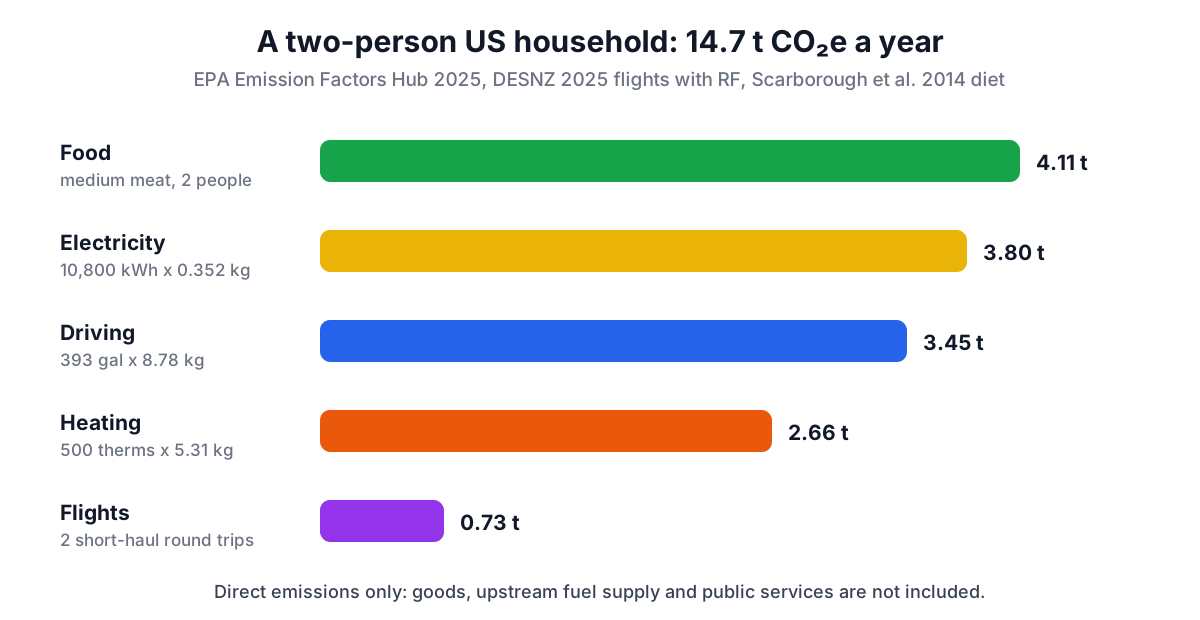
Here is a two-person US household, which is the calculator's default:
- 900 kWh of electricity a month (10,800 a year) on the US average grid: 10,800 x 0.352 = 3.80 t
- 500 therms of gas: 500 x 5.31 = 2.66 t
- One car, 11,000 miles at 28 mpg: 3.45 t
- Two short-haul economy round trips of 900 miles each way (1,448 km), with RF: 4 x 1,448 x 0.12576 = 0.73 t
- Two people on a medium-meat diet: 2 x 5.63 x 365 = 4.11 t
The total is 14.7 tonnes of CO₂e a year, or 7.4 tonnes per person. Food is the largest single slice, followed closely by electricity and driving.
Move the same household to California, swap the car for an EV using 30 kWh per 100 miles, skip the flights and eat vegetarian, and the total falls to about 8.2 tonnes. The gas heating is now the biggest single item, which is where a heat pump would come in.
What this number leaves out
A bill-based footprint covers the emissions you can measure directly: home energy, personal travel and food. It does not cover:
- Goods and services you buy, such as clothes, electronics, furniture and the emissions embedded in their manufacture and shipping.
- Upstream fuel emissions, from extracting, refining and transporting fuel, and electricity lost in transmission.
- Public services, such as roads, schools, hospitals and the military, which national per-capita figures share out across the population.
- Waste and water.
That is why national per-capita figures, which include everything a country emits divided by its population, are higher than a household energy footprint. Treat the calculator's result as the part of your footprint you control most directly, and track how it changes as you change things.
Where to cut first
The breakdown tells you where the leverage is. In most homes, the biggest options are:
- Heating: a heat pump replacing oil, propane or resistance heat cuts both cost and emissions; see heat pump vs gas running costs.
- Driving: an EV on a clean grid, or simply fewer miles.
- Flights: one fewer long-haul return trip can save more than a year of careful recycling.
- Electricity: a cleaner tariff or rooftop solar.
- Diet: shifting from high to low meat saves about 0.9 tonnes per person a year.
Frequently asked questions
What does CO₂e mean?
CO₂e, carbon dioxide equivalent, adds up greenhouse gases by multiplying each one by its global warming potential over 100 years. The EPA GHG Emission Factors Hub uses the IPCC Fifth Assessment Report values: 1 for carbon dioxide, 28 for methane and 265 for nitrous oxide. For fossil fuels burned at home or in a car, methane and nitrous oxide add well under 1%.
How much CO2 does a flight produce per km?
Under the UK DESNZ 2025 factors, short-haul economy flying emits 0.07435 kg CO₂e per passenger-kilometre without radiative forcing and 0.12576 kg with it, while long-haul economy is 0.06926 kg and 0.11704 kg. Business and first class are allocated more fuel because their seats take up more of the cabin. The factors already add 8% to great-circle distance.
What is the carbon footprint of a return flight from London to New York?
A return flight between London and New York, about 5,570 km each way or 11,140 passenger-km in total, is 1.30 tonnes of CO₂e in economy with radiative forcing, or 0.77 tonnes without, using the UK DESNZ 2025 factors. In business class the same return trip comes to 3.78 tonnes with radiative forcing.
How do I calculate my household carbon footprint?
Add up a year of bills and multiply each quantity by a published emission factor: kilowatt-hours by your grid's rate, therms or gallons of heating fuel, gallons of car fuel and flight passenger-kilometres, then add a diet average. A two-person US household example worked this way comes to 14.7 tonnes of CO₂e a year, or 7.4 tonnes per person.
How much CO2 does an electric car produce?
An electric car's emissions are its electricity use multiplied by the grid's emission factor. At 30 kWh per 100 miles, 11,000 miles uses 3,300 kWh, which is 1.16 tonnes of CO₂e on the US average grid and 0.66 tonnes on the California grid. A petrol car covering 11,000 miles at 28 mpg emits 3.45 tonnes from the tailpipe.
Sources and further reading
- GHG Emission Factors Hub, US Environmental Protection Agency. Combustion factors, eGRID rates and AR5 warming potentials.
- Emissions & Generation Resource Integrated Database (eGRID), US Environmental Protection Agency. Electricity emission rates by subregion.
- Greenhouse gas reporting: conversion factors 2025, UK Department for Energy Security and Net Zero. UK grid, fuel and flight factors.
- Energy units and calculators explained, US Energy Information Administration. Heat content of natural gas and other fuels.
- Dietary greenhouse gas emissions of meat-eaters, fish-eaters, vegetarians and vegans in the UK, Climatic Change. Scarborough and colleagues, 2014.
Open the Carbon Footprint Calculator
More Energy & Sustainability
Every tool in the Energy & Sustainability section, free and in your browser.