
Training Numbers Explained: Pace, Heart Rate Zones, 1RM and METs
The maths behind pace and Riegel race predictions, max heart rate formulas and Karvonen zones, one rep max estimates, and calories burned from MET values.
By Redbison Dev · · Updated · 10 min read

Most training numbers come from a handful of simple formulas: a division for pace, a power law for race predictions, a subtraction for maximum heart rate, a few curve fits for strength, and one multiplication for calories. They are simple enough to do on a napkin, which is part of their appeal, and simple enough to mislead you if you forget what they leave out. This guide works through each one with real numbers from the Running Pace Calculator, the Target Heart Rate Calculator, the One Rep Max Calculator and the Calories Burned Calculator.
Pace, splits and the unit trap
Pace is time divided by distance. A 10 km run in 50:00 is 3,000 seconds / 10 = 300 seconds, or 5:00 per km. The only real trap is units. A mile is defined as exactly 1,609.344 m, so pace per mile is pace per km multiplied by 1.609344: 300 × 1.609344 = 482.8 seconds, or 8:03 per mile. Speed is the reciprocal: 3,600 / 300 = 12 km/h.
Race distances are fixed: the half marathon is 21.0975 km (13.1094 miles) and the marathon 42.195 km, the length run at the 1908 London Olympics and adopted as the standard in 1921. A four-hour marathon therefore needs an average of 14,400 / 42.195 = 341.3 seconds per km, or 5:41 per km and 9:09 per mile. The split table puts you at 28:26 at 5 km and 56:53 at 10 km, with halfway at exactly 2:00:00.
That table is worth printing, because the most common pacing mistake is starting fast. Reaching halfway in 1:58 sounds like a useful two-minute buffer, but it means running about 6 seconds per km faster than goal pace for 21 km, and the bill arrives after 30 km. Analyses of world record races from 5,000 m up show near-even or slightly negative splits, with the second half the same or a little quicker.
Predicting race times with Riegel
In 1977, and again in a 1981 American Scientist article, research engineer Peter Riegel noticed that world record times across running, swimming, cycling and walking fit a simple power law:
T2 = T1 × (D2 / D1)^1.06
The exponent of 1.06 means pace slows by a little over 4% each time the distance doubles. From a 10K in 50:00, the formula predicts a 5K in 23:59, a half marathon in 1:50:19 and a marathon in 3:50:01. From a 25:00 5K it predicts 52:07 for 10K and 3:59:47 for the marathon.
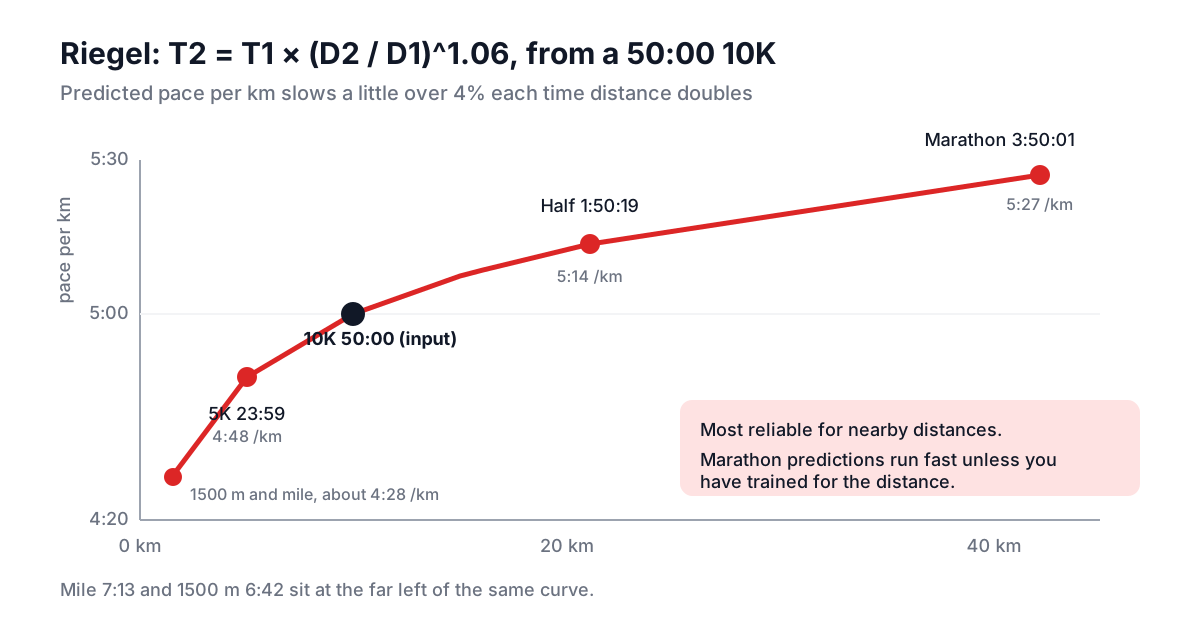
Riegel fitted his law to elite athletes over efforts lasting roughly 3.5 minutes to 4 hours. It works best when you predict a nearby distance (10K to half marathon) and when you have trained for the target. For the marathon it is usually optimistic for recreational runners. Running out of glycogen, heat, and simply not having done enough long runs cost more time than the exponent allows, and a common rule of thumb is to add 5 to 10% to a marathon prediction for runners on less than about 50 km a week. Use a real race or a hard time trial as the input; an easy training run predicts nothing.
Heart rate: maximum, reserve and zones
Every heart rate zone is a percentage of something, so the first question is what your maximum is. The familiar 220 − age is usually credited to Fox, Naughton and Haskell in 1971, though it was a line drawn through older data rather than a fitted model. In 2001 Hirofumi Tanaka and colleagues pooled 351 studies covering about 18,700 adults and confirmed with a lab study of 514 people that 208 − 0.7 × age fits better, especially after 40. Gellish and colleagues found 207 − 0.7 × age in 2007 from repeated treadmill tests, and Martha Gulati's group found 206 − 0.88 × age in 2010 from 5,437 women.
At age 40, Fox and Tanaka agree on 180 bpm. At 55 they are 165 and 170, while Gulati gives 158 for a woman. More important than the choice of formula is that each has a standard deviation of about 10 bpm, so two healthy 40-year-olds can have true maximums of 165 and 195. If your watch regularly shows numbers above your formula maximum during hard efforts, believe the watch (with a chest strap) rather than the formula.
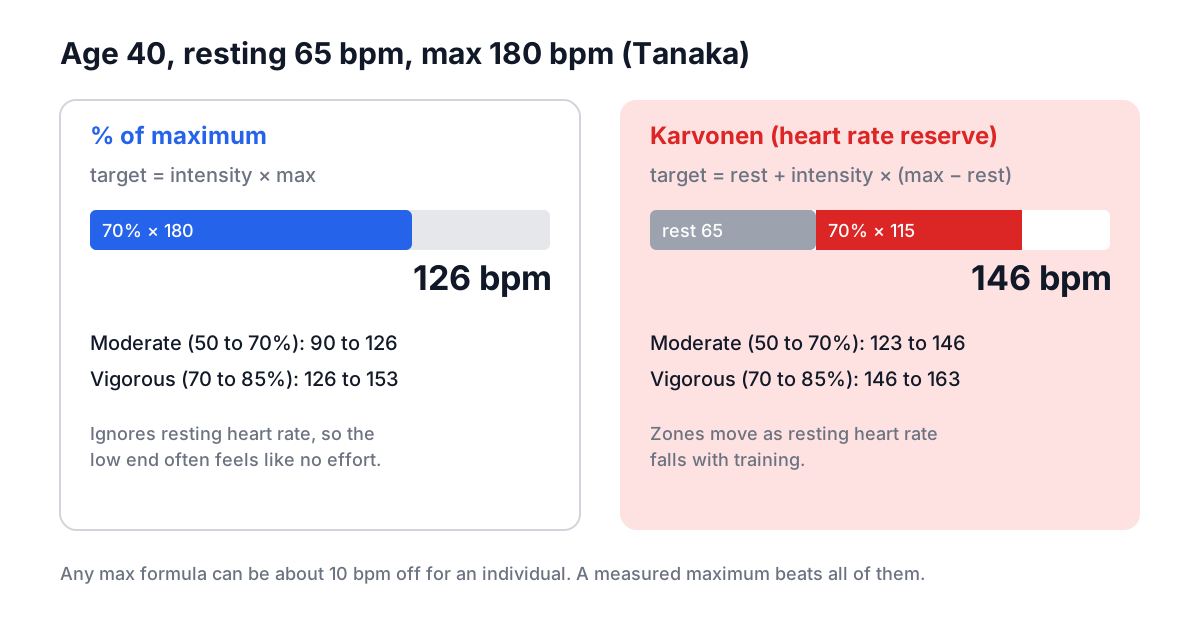
Zones can then be set in two ways. Percentage of maximum is simply intensity × maximum: 70% of 180 is 126 bpm. Martti Karvonen's 1957 method uses heart rate reserve, the gap between resting and maximum:
target = resting + intensity × (maximum − resting)
70%: 65 + 0.70 × (180 − 65) = 145.5 bpm
Karvonen zones are higher at the same nominal intensity, and they move as you get fitter, because resting heart rate falls with training. That makes them better matched to how hard exercise feels. For public health guidance, the American Heart Association describes moderate intensity as about 50 to 70% of maximum and vigorous as about 70 to 85%. Those bands are percentages of maximum, so for our 40-year-old they are 90 to 126 bpm and 126 to 153 bpm whichever zone method you use. The same percentages of heart rate reserve give 123 to 146 and 146 to 163 bpm on Karvonen, but they are reserve figures, not the AHA's moderate and vigorous bands, so do not count minutes against the guidelines with them.
Medicines such as beta blockers lower heart rate at every effort, and heat, dehydration and caffeine raise it. On those days, let perceived effort lead. The talk test is a good cross-check: moderate means you can talk but not sing, vigorous means only a few words between breaths.
Estimating a one rep max
Strength programmes are often written as percentages of a one repetition maximum, but testing a true single is slow, tiring and carries some risk. The workaround is to lift a heavier set to near failure and estimate. The two most used equations are Boyd Epley's from 1985 and Matt Brzycki's from 1993:
Epley:   1RM = w × (1 + r / 30)
Brzycki: 1RM = w × 36 / (37 − r)
For 100 kg × 5 reps, Epley gives 116.7 kg and Brzycki 112.5 kg. At exactly 10 reps they agree, both giving 133.3 kg from 100 kg. Lombardi (w × r^0.1) and O'Conner (w × (1 + 0.025 r)) tend to be more conservative, and the exponential curves of Mayhew and Wathan, fitted to college athletes, tend to run higher. The calculator averages all seven; for 100 kg × 5 that is 115.5 kg, with a spread from 112.5 to 119.0.
The spread is the useful warning. With 3 to 6 reps the formulas agree within about 5%. At 15 reps they disagree wildly: 60 kg × 15 gives anything from 78.7 to 98.2 kg. High-rep sets measure endurance as much as strength. If you need a number for programming, test with a heavier set of 3 to 6 reps, count only reps with full range of motion, and consider using about 90% of the estimate as a training max. Inverting the equations gives the familiar rule of thumb that 5 reps is about 87% of 1RM, 8 reps about 80% and 10 reps about 75%.
Calories burned and METs
The last number is the one people most want and should trust least. A MET, or metabolic equivalent of task, expresses an activity's energy cost as a multiple of sitting quietly, which is defined as 3.5 mL of oxygen per kilogram per minute. Each litre of oxygen releases about 5 kcal, which gives the standard formula:
kcal per minute = MET × 3.5 × weight (kg) / 200
Brisk walking at 3.5 to 3.9 mph is 4.8 MET in the 2024 Adult Compendium of Physical Activities. For a 70 kg person over 30 minutes: 4.8 × 3.5 × 70 / 200 × 30 = 176 kcal. Running at 6 mph is 9.3 MET, so the same 30 minutes burns 342 kcal.
The Compendium, first published by Barbara Ainsworth's team in 1993 and updated in 2000 and 2011, was revised again in 2024 by Stephen Herrmann and colleagues. It lists 1,114 activities, 912 of them backed by measured data, and now covers adults aged 19 to 59 only. Because 3.5 mL/kg/min overstates resting metabolism for many people, the Compendium team describes a correction that uses a predicted resting rate from the Harris-Benedict equation. A 35-year-old, 60 kg, 165 cm woman has a predicted resting rate of 1,370 kcal a day rather than the 1,512 kcal the standard MET implies, so her 30-minute run is about 266 kcal, not 293.
Two judgement calls matter more than the formula. First, count only the minutes you were moving. Second, if you are adding exercise to a daily calorie budget, use the calories above resting, MET minus 1, because your resting burn is already in your maintenance estimate. Then expect an error of 20% or more either way. Use the number to compare activities and plan a week, not to justify a dessert.
Using the four together
These tools fit into one simple training loop. Race or time-trial once every couple of months and use the result to set paces and predict your next goal. Set heart rate zones from a measured resting rate, and keep easy runs easy. Estimate strength from heavy sets rather than frequent max tests. Use MET calories to compare sessions, and pair them with the Calorie Calculator and Hydration Calculator when you plan food and fluid around training. Every formula here is a starting point; what your body does over a few weeks is the measurement that counts.
Frequently asked questions
Should I run even splits in a marathon?
Roughly, yes. Analyses of world record races from 5,000 m up show near-even or slightly negative splits, with the second half the same or a little quicker. Reaching halfway of a four-hour marathon in 1:58 means running about 6 seconds per km faster than goal pace for 21 km, and the cost arrives after 30 km.
How do I predict a marathon time from a 10K?
Riegel's formula, T2 = T1 × (D2 / D1)^1.06, predicts a 3:50:01 marathon from a 50:00 10K. For recreational runners the marathon prediction is usually optimistic, and a common rule of thumb is to add 5 to 10% for runners on less than about 50 km a week. The input should be a real race or a hard time trial, not an easy training run.
What is the Tanaka maximum heart rate formula?
The Tanaka formula estimates maximum heart rate as 208 − 0.7 × age. Hirofumi Tanaka and colleagues pooled 351 studies covering about 18,700 adults in 2001 and found it fits better than 220 − age, especially after 40. At 55 it gives 170 bpm against 165, though every such formula has a standard deviation of about 10 bpm.
Why is a marathon 42.195 km?
The marathon is 42.195 km because that was the length run at the 1908 London Olympics, and it was adopted as the standard distance in 1921. Running a four-hour marathon over that distance needs an average pace of 5:41 per km, or 9:09 per mile, with halfway reached at exactly 2:00:00.
Should exercise calories be counted with MET or MET minus 1?
Use MET minus 1 when adding exercise to a daily calorie budget, because the resting burn is already in a maintenance estimate. The standard formula is kcal per minute = MET × 3.5 × weight (kg) / 200, so 30 minutes of brisk walking at 4.8 MET burns 176 kcal in total for a 70 kg person. Expect an error of 20% or more either way.
Sources and further reading
- An Analysis of Pacing Strategies During Men's World-Record Performances in Track Athletics, International Journal of Sports Physiology and Performance. Tucker, Lambert and Noakes, 2006.
- Age-predicted maximal heart rate revisited, Journal of the American College of Cardiology. Tanaka, Monahan and Seals, 2001.
- Longitudinal Modeling of the Relationship between Age and Maximal Heart Rate, Medicine and Science in Sports and Exercise. Gellish and colleagues, 2007.
- Heart Rate Response to Exercise Stress Testing in Asymptomatic Women, Circulation. Gulati and colleagues, 2010.
- Strength Testing: Predicting a One-Rep Max from Reps-to-Fatigue, Journal of Physical Education, Recreation and Dance. Brzycki, 1993.
- 2024 Adult Compendium of Physical Activities: A third update of the energy costs of human activities, Journal of Sport and Health Science. Herrmann and colleagues.
- Book of Rules, World Athletics. Official competition rules and race distances.
Open the Running Pace Calculator
More Fitness Calculators
Every tool in the Fitness Calculators section, free and in your browser.
- BMI Calculator
- Calorie Calculator
- Protein Calculator
- Hydration Calculator
- Calorie Deficit Planner
- Body Fat Calculator
- Ideal Weight Calculator
- Running Pace Calculator
- Target Heart Rate Calculator
- One Rep Max Calculator
- Barbell Plate Calculator
- RPE Calculator
- Interval Timer
- Calories Burned Calculator
- Body Surface Area Calculator
- Waist-to-Hip Ratio Calculator
- VO2 Max Calculator
- Steps to Distance & Calories Calculator