
How Much Does a Space Heater Cost to Run?
A 1,500 W heater uses 1.5 kWh an hour. Cost per hour and per month at your rate, why it rarely runs flat out, why every electric heater is equally efficient, and fire safety.
By Redbison Dev · · 9 min read
Your home office or a back bedroom never gets warm, and you are thinking of plugging in a space heater instead of turning up the whole house. A typical 1,500 W space heater uses 1.5 kWh for every hour it runs at full power, which costs about 27 cents an hour at 18.2 cents per kWh, the US residential average the Energy Information Administration forecasts for 2026. Eight hours a day at full power for a month comes to about $66, but a heater with a thermostat cycles on and off, so in a reasonably insulated room the real bill is often a fraction of that.
Below are the numbers for your own heater and rate with the Electricity Cost Calculator, a way to estimate how hard the heater will actually work with the Heat Loss Calculator, why no electric heater is cheaper per unit of heat than another, and the safety rules that matter more than the bill.
Cost per hour and per month: the basic sum
Electricity is billed in kilowatt-hours. A heater's wattage is printed on its label, and most plug-in heaters sold in the US top out at 1,500 W, close to the most a standard 120 V, 15 A household circuit can supply. The arithmetic is:
kWh = watts × hours / 1,000 cost = kWh × price per kWh
Open the Electricity Cost Calculator, pick Space heater from the typical appliances or type 1500 W, then enter 8 hours a day, 7 days a week and a price of 0.182. It returns:
| Period | Energy | Cost at 18.2 cents |
|---|---|---|
| One hour | 1.5 kWh | $0.27 |
| One day (8 hours) | 12 kWh | $2.18 |
| One month | 365 kWh | $66.43 |
| One year, if used every day | 4,380 kWh | $797.16 |
The month is a calendar average of 365 / 12 days. Nobody runs a heater every day of the year, so the year line is only an upper bound; multiply the monthly figure by the number of months you actually use it.
Your price matters as much as the heater. Use the energy charge from your own bill, including any delivery charges billed per kWh. At 12 cents per kWh the same 8 hours a day costs $43.80 a month, and at 30 cents it costs $109.50. Rates differ widely by state, which is why the EIA publishes them state by state as well as nationally.
Why your heater rarely runs at 1,500 W all day
Those figures assume the heating element is on for every minute of the 8 hours. Most heaters have a thermostat: once the room reaches the set temperature the element switches off and only comes back on as the room cools. Over an hour, the heater's average draw equals the rate at which the room loses heat. So the useful question is not "how many watts is my heater" but "how many watts does my room lose".
That is a job for the Heat Loss Calculator. Take a 12 × 10 ft bedroom with 8 ft ceilings, one outside wall and a 15 sq ft window, kept at 68 °F while it is 20 °F outside:
- The wall. Choose US units and the ASHRAE wall air films. Add three layers as known R-values: drywall R-0.45, wall insulation R-13, sheathing R-0.62. Enter the net area 81 sq ft (96 sq ft of wall minus the window), inside 68 °F and outside 20 °F. The calculator gives a total of R-14.92 and a heat loss of 76.4 W (261 BTU/h).
- The window. Run it again with one layer of R-3.33 (a window with a U-factor of 0.30, which already includes its air films, so set the surface films to none) and an area of 15 sq ft: 63.3 W (216 BTU/h).
- Air leaks. The calculator handles conduction only. Air leakage is estimated separately as 0.018 × room volume × air changes per hour × temperature difference, in BTU/h; 0.018 is the heat needed to warm one cubic foot of air by 1 °F (air weighs about 0.075 lb per cubic foot and holds 0.24 BTU per pound per °F). With 960 cubic feet and half an air change per hour that is 415 BTU/h, or 121.5 W.
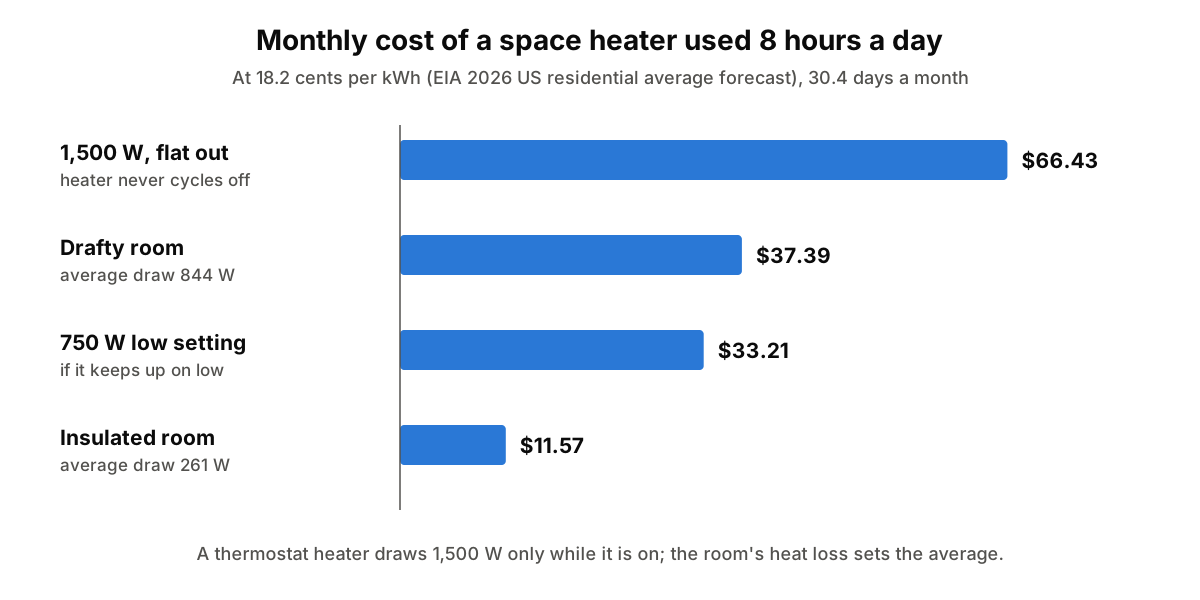
The total is about 261 W, so a 1,500 W heater keeping this room at 68 °F is on roughly 17% of the time. Put 261 W and 8 hours a day into the Electricity Cost Calculator and the month costs $11.57, not $66.43.
The same room in an older house tells a different story. With an empty stud cavity (about R-1 in place of R-13, R-2.92 in total), a single-pane window with a U-factor of 1.0 and one air change an hour, the loss is about 844 W, the heater runs more than half the time, and the month costs $37.39.
Two caveats. On a mild day the loss is smaller still, and on the coldest day bigger. And if you turn the central heating down while the heater runs, the walls between this room and the cooler rest of the house lose heat too, so the real figure lands somewhere between the outside-wall estimate and full power.
Oil-filled, ceramic or infrared: is any heater cheaper to run?
No electric resistance heater makes more heat per kWh than another. Natural Resources Canada puts it plainly: electric space heaters produce one unit of heat for every unit of electricity, which makes them 100% efficient at the point of use. A 1,500 W oil-filled radiator, a 1,500 W ceramic fan heater and a 1,500 W quartz infrared heater all turn 1.5 kWh into 1.5 kWh of heat every hour they run flat out.
What differs is how the heat reaches you:
- Oil-filled radiators warm a sealed reservoir of oil that keeps radiating after the element switches off. They heat slowly and evenly and are quiet, but the oil stores heat; it does not create more.
- Ceramic and fan heaters blow warm air, so they heat a small room quickly and cool down quickly.
- Infrared or radiant heaters warm the people and objects in front of them rather than the air, which can feel comfortable at a lower room temperature if you sit still in one spot.
A heater can lower your bill only by running fewer hours or at a lower setting: a good thermostat, a timer, or heating a smaller space. Be wary of any heater sold on the promise of cutting your bill by a big percentage through its technology alone. A 750 W low setting halves the draw, $33.21 a month in the example, but in a cold room it may simply run twice as long to deliver the same heat.
Space heater vs central heat: when it actually saves money
A space heater saves money only if it lets you heat less of the house. Heating one room to 68 °F while the thermostat for the rest of the home sits at, say, 60 °F can cost less than heating everything. Running a space heater on top of unchanged central heating just adds to the bill.
The comparison also depends on what heats the rest of the house. Every kWh of heat from a space heater costs a full kWh of electricity: 18.2 cents at the average rate. A heat pump typically delivers two to three kWh of heat per kWh of electricity, and gas heat at typical prices often costs well under 10 cents per kWh of heat. The heat pump vs gas furnace comparison works through the cost per kWh of heat for each fuel. If your central system is cheap per unit of heat, a space heater pays off only for a small room used for a few hours, with the rest of the house turned down.
Space heater fire safety
The bill is the smaller risk. The National Fire Protection Association estimates that US fire departments responded to an average of 37,365 home fires involving heating equipment each year from 2020 to 2024, with 417 civilian deaths a year. Space heaters and heating stoves were involved in 30% of those fires but 73% of the deaths, and 46% of the fires happened from December to February.
NFPA's checklist for portable electric heaters:
- Buy a heater listed by a qualified testing laboratory, with a thermostat, overheat protection and an automatic shut-off if it tips over.
- Keep it at least 3 feet (1 metre) from anything that can burn, including bedding, curtains and people.
- Put it on a solid, flat surface, out of walkways, and never block an exit. Keep children away from it.
- Plug it directly into a wall outlet. Never use an extension cord.
- Turn it off and unplug it when you leave the room or go to bed.
The US Consumer Product Safety Commission gives the same advice and adds two points: never plug an electric space heater into a power strip either, and never leave a portable heater running while you sleep. CPSC estimates that portable heaters, including electric space heaters, were involved in an average of 1,700 fires, 70 deaths and 160 injuries a year from 2017 to 2019, and warns that a heater left running in a closed room can also overheat infants, older adults and people with disabilities.
The outlet rule has a simple reason: at 120 V a 1,500 W heater draws 12.5 A, most of what a 15 A circuit is built for, and a light extension cord or a strip shared with other appliances can overheat. If the plug or outlet feels hot, stop using that outlet and ask a licensed electrician to check it.
Tools for this job
- Electricity Cost Calculator: cost per day, month and year from the heater's wattage, your hours and your price per kWh. Use the average draw from a heat loss estimate, not just the label, for a realistic bill.
- Heat Loss Calculator: how many watts a wall, window or ceiling loses at a given indoor and outdoor temperature, which tells you whether a heater can keep up and roughly how often it will run.
For the R-values and U-factors behind the heat loss estimate, read U-Value, R-Value and Heat Loss: Calculating a Wall Layer by Layer. To compare electric resistance heat with gas, oil and heat pumps per kWh of heat, see Heat Pump vs Gas Furnace: Running Costs and Payback.
Frequently asked questions
How many kWh does a 1,500 watt space heater use in a day?
A 1,500 W heater uses 1.5 kWh for each hour it runs at full power, so 8 hours flat out is 12 kWh a day, about $2.18 at 18.2 cents per kWh. With a thermostat it usually uses less, because the element switches off once the room is warm; the room's heat loss sets the real average.
Are oil-filled heaters cheaper to run than fan heaters?
No. Every electric resistance heater turns one kWh of electricity into one kWh of heat, so a 1,500 W oil-filled radiator and a 1,500 W fan heater cost the same per hour at full power. The oil-filled model releases heat more slowly and evenly, which some people find more comfortable, but it does not make extra heat.
Is it cheaper to run a space heater or central heat?
It is cheaper only when the space heater lets you turn the central heating down for the rest of the house. Electric resistance heat costs a full kWh of electricity per kWh of heat, while heat pumps and gas furnaces usually deliver heat for less, so heating one small room beats heating the whole house, not every room.
Can I leave a space heater on overnight?
No. The National Fire Protection Association says to turn portable space heaters off and unplug them when you leave the room or go to bed, and the US Consumer Product Safety Commission says never to leave one on while sleeping. Space heaters and heating stoves were involved in 30% of US home heating equipment fires from 2020 to 2024 but 73% of the deaths.
Sources and further reading
- Short-Term Energy Outlook, US Energy Information Administration. October 2026 forecast of 18.2 cents per kWh for the 2026 US residential average.
- Electric Power Monthly, Table 5.6.A, US Energy Information Administration. Average residential electricity price by state.
- Home Heating Safety, National Fire Protection Association. Heating fire statistics for 2020 to 2024 and safety tip sheets.
- Portable Electric Space Heater Safety tip sheet, National Fire Protection Association. Heater types and the safety checklist.
- CPSC Warns Consumers to be Cautious When Using Space Heaters, Furnaces and Fireplaces This Winter, US Consumer Product Safety Commission. Portable heater fire estimates for 2017 to 2019 and safety advice.
- Electric heaters, Natural Resources Canada. Why electric space heaters are 100% efficient at the point of use and how heat pumps compare.