
Balance Transfer or Debt Consolidation Loan in Australia?
$6,000 and $15,000 of card debt: an 18-month 0% balance transfer with a 2% fee against an 11.5% personal loan with an establishment fee, in AUD.
By Redbison Dev · · 10 min read
Australia edition. Written for Australian borrowers, with amounts in AUD, 0% offers that revert to a higher rate, a personal loan with an establishment fee taken from the loan, ASIC's findings on balance transfers and the National Consumer Credit Protection Act rules on credit cards. US edition
With 0% for 18 months, a typical Australian balance transfer beats a personal loan at any repayment you could also afford on the loan, on paper. $6,000 moved at a 2% fee and repaid at $250 a month costs about $240 in total; the same $6,000 on an 11.5% personal loan with a 2.2% establishment fee, repaid at the same $250, costs about $1,028. The real risk in Australia is not the arithmetic but what happens around it: ASIC found that almost a third (31.6%) of people who transferred a balance had increased their total credit card debt by more than 10% by the end of the promotional period.
The numbers below come from the Australian versions of the Balance Transfer Calculator and the Debt Consolidation Calculator, so you can repeat them with your own offers.
What the offers look like
ASIC's review of credit card lending (Report 580, July 2018, using data to June 2017) is still the most detailed public picture of Australian balance transfers:
- 79% of balance transfers in its data had a promotional rate of 0%.
- Almost all promotional periods were 24 months or less; the most common were 6, 12, 15 and 18 months, and 60.9% ran between 12 and 18 months.
- Some providers charge a transfer fee, often a proportion of the balance moved.
- When the promotion ends, whatever is left is charged a much higher rate, sometimes the cash advance rate.
That last point is the Australian catch. The revert rate is set in the card's terms and can be higher than the card you are leaving, so the leftover balance can cost more than it did before you moved it.
A personal loan has a fixed rate and term, and often an establishment fee. The Australian consolidation calculator takes the fee out of the loan, so you borrow a little more than your debts to cover it, and shows the rate including the fee the way a comparison rate is worked out. Lenders must show a comparison rate with a warning that it applies only to the example given (National Consumer Credit Protection Regulations, regulation 99), so recheck it on your own amount and term.
Worked example 1: $6,000 at $250 a month
Open the Balance Transfer Calculator; its Australian defaults are this offer:
- Balance 6,000 at a current rate of 20.99
- Transfer fee 2, minimum fee 0
- Promotional rate 0 for 18 months, then an example revert rate of 21.99
- Monthly repayment 250
The fee is $120, so you start at $6,120. After 18 repayments, $1,620 is left and reverts to 21.99%. It is cleared in month 25, and the transfer costs $240.39 in total. Repaying $340 a month ($6,120 ÷ 18) would clear it inside the offer for the fee alone. Staying on the old card at $250 takes 32 months and $1,848.97 of interest.
In the Debt Consolidation Calculator, remove the sample debts and enter one credit card of 6,000 at 20.99% with a repayment of 250. Set the loan to 11.5%, 36 months, a 2.2% establishment fee taken from the loan. You borrow $6,134.97 (the fee is $134.97), the scheduled repayment is $202.31, and the rate including the fee is 13.05%. Repaid at your $250 instead, it is gone in 29 months for $1,027.66, about $787 more than the transfer.
Worked example 2: $15,000 at $500 a month
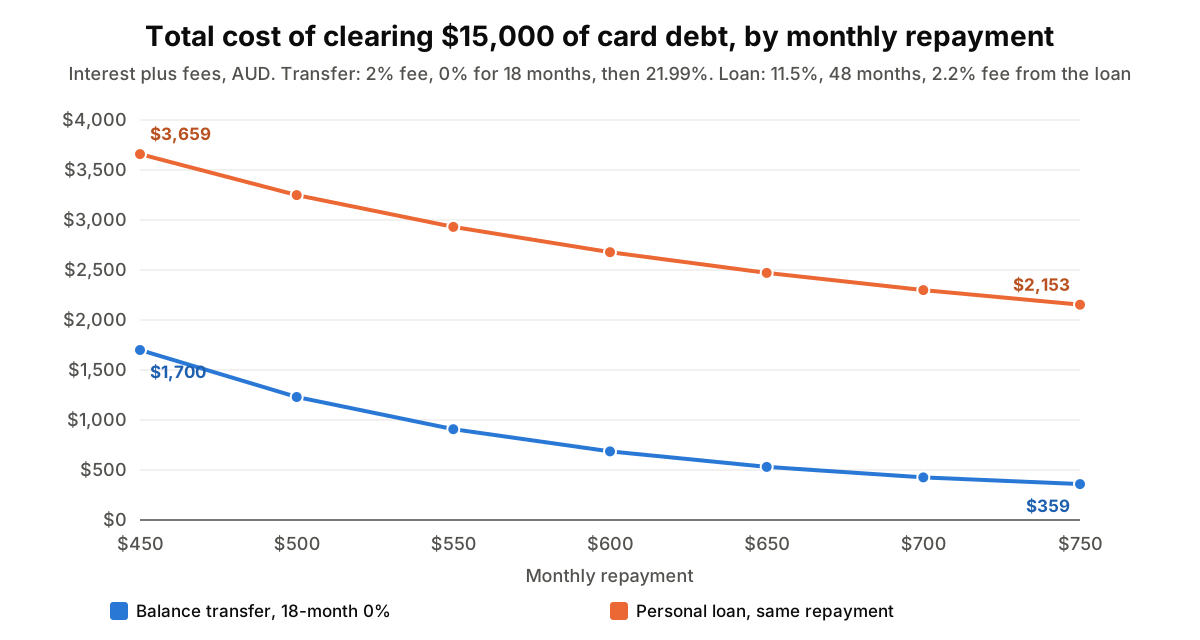
Bigger balances are where people reach for a loan. Enter 15,000 in both calculators and a repayment of 500, and give the loan a 48-month term.
The transfer fee is $300. After 18 months, $6,300 is left, it is cleared in month 33, and the transfer costs $1,229.66. Clearing it within the offer would take $850 a month. The loan is $15,337.42 with a $400.14 scheduled repayment; repaid at $500 it takes 37 months and costs $3,248.89. Staying on the card at $500 would cost $6,450.65 over 43 months.
The catch with a large balance is approval. A card provider has to assess whether a credit card contract would be unsuitable for you before it enters it or raises the limit, so the limit you are offered may be well short of $15,000. If it is, move what you can and put the rest on a loan or a plain payoff plan, and add the two totals.
When the loan is the better choice
The loan wins when the transfer's assumptions fail:
- You cannot repay much of it inside the offer. If most of the balance will still be there after 18 months, ask what the revert rate is. At a cash advance rate, the leftover balance gets expensive quickly.
- You will keep using cards. ASIC found that 31.6% of people who transferred a balance increased their total card debt by more than 10% during the promotion, and 15.7% increased it by 50% or more. Only about 8% paid it off completely. A loan with a fixed end date, plus a closed card, removes the temptation.
- You need one repayment for several debts. A loan can clear a card, a car loan and buy now pay later at once. Leave interest-free debts out unless you are struggling with them.
Australian rules that help you
The National Consumer Credit Protection Act 2009 has a set of credit card rules that work in your favour when you transfer a balance. Its section headings say what they do:
- 133BQ Application of payment against the last statement balance, with higher interest debts to be discharged first. If you do spend on the new card, your repayments go to the higher-rate purchases before the 0% balance.
- 133BS Credit provider not to impose retrospective interest charges.
- 133BFA and 133BU Credit providers must let you request a lower limit, or end the card contract, online. Use them on the old card once the balance has moved.
ASIC also reported that, under the Banking Code of Practice, banks that are members of the Australian Banking Association are to give 30 days' notice before a balance transfer's promotional period ends. Put the end date in your calendar anyway.
ASIC's review of debt consolidation lending listed the risks on the loan side: higher long-term costs from a longer term, moving unsecured debt onto the family home, leaving old accounts open to draw on again, and broker and establishment fees. It found consolidation loans were often structured over 30 years, which is what refinancing card debt into a home loan usually means.
How the tools count interest
Both calculators charge the annual rate divided by 12 on the opening balance each month. Your card may work interest out daily, so statements can differ by a few dollars a month. They assume no new purchases and every repayment on time.
This comparison does not fit you if you are already missing repayments. The National Debt Helpline (1800 007 007) offers free financial counselling, and warns never to respond to debt consolidation ads on social media or in unsolicited emails.
Tools for this job
- Balance Transfer Calculator: fee, what reverts when the offer ends and the repayment that clears it in time.
- Debt Consolidation Calculator: a card, car loan and buy now pay later against one personal loan, with the establishment fee and the rate including it.
- Debt Payoff Calculator: the plan with no new credit, by avalanche or snowball.
- APR Calculator: the cost of a loan offer once its fees are included.
For paying off several debts in order, read the Australian edition of car loans and paying off debt.
Frequently asked questions
What is a revert rate?
The rate charged on any transferred balance left when the promotional period ends. It is set in the card's terms; ASIC found it is sometimes the cash advance rate. Enter it in the "rate after the promotion" box to see what the leftover costs.
How much should I repay on a 0% balance transfer?
The balance plus the fee, divided by the months in the offer. On $6,000 with a 2% fee over 18 months that is $340 a month; on $15,000 it is $850.
Is a personal loan's comparison rate the same as its interest rate?
No. The comparison rate includes the interest rate and fees on a set example amount and term, so it is higher when there is an establishment fee. In example 1 the 11.5% loan with a 2.2% fee comes to 13.05% over three years.
Should I close my old card after the transfer?
Closing it, or cutting its limit, stops the old card filling up again, which ASIC identified as a main reason people end up with more debt after a transfer. Card providers must let you do this online.
Sources and further reading
- Report 580: Credit card lending in Australia, Australian Securities and Investments Commission. Promotional rates and periods, revert rates, debt outcomes after transfers and notice before promotions end.
- ASIC review of debt consolidation sector, Australian Securities and Investments Commission. Risks of consolidation loans, including longer terms and the family home.
- National Consumer Credit Protection Act 2009, Federal Register of Legislation. Sections 133BQ, 133BS, 133BFA and 133BU on credit cards.
- National Consumer Credit Protection Regulations 2010, Federal Register of Legislation. Part 7-8 on comparison rates and their warning.
- Consolidate your loans, National Debt Helpline. Comparing total repayments, longer terms and debt consolidation scams.
Open the Balance Transfer Calculator
More Loans & Mortgages
Every tool in the Loans & Mortgages section, free and in your browser.