
0% Balance Transfer or Personal Loan to Clear Card Debt?
£8,000 on a card at 24.9%: a 0% balance transfer with a 3.49% fee against a 9.9% APR personal loan, and why the length of the 0% period decides it.
By Redbison Dev · · 10 min read
United Kingdom edition. Written for UK borrowers, with pounds, a percentage transfer fee and 0% period, a no-fee personal loan quoted as a UK annual effective APR, the FCA persistent debt rules and the Consumer Credit Act cap on early repayment charges. US edition
You have £8,000 on a credit card at 24.9% and can pay about £300 a month. A 0% balance transfer card with a 3.49% fee will cost you about £334 in total if the 0% period lasts 24 months, against roughly £1,019 for a 9.9% APR personal loan paid at the same £300. If the 0% period is only nine months, the order flips: the transfer costs about £1,823 and the loan is cheaper unless you can pay more than about £566 a month. The deciding number in the UK is usually the length of the 0% period, not the fee.
The figures below come from the UK versions of the Balance Transfer Calculator and the Debt Consolidation Calculator, so you can type in your own offers and get the same kind of answer.
How UK offers are priced
A balance transfer card charges no interest on the moved balance for a set number of months and takes a one-off fee for the move. nidirect, the Northern Ireland government's advice service, says the fee can be a flat amount or depend on how much you transfer; most cards quote a percentage. On £8,000 a 3.49% fee is £279.20, added to the new card on day one, so you start with £8,279.20 at 0%. Anything still owed when the 0% period ends is charged interest as normal at the card's standard rate.
A personal loan is a fixed sum repaid in equal monthly instalments over a fixed term. Check whether the loan has an arrangement fee; the rate you see is an APR. Under the FCA's Consumer Credit sourcebook (CONC App 1.2) a UK APR is an annual effective rate that includes any compulsory fees, so a 9.9% APR works out at a little under 0.79% a month. US calculators divide the rate by 12, which is why the UK calculator has its own setting.
Two traps sit in the small print of each:
- The advertised rate may not be yours. A loan advert shows a representative APR, which at least 51% of people accepted through that advert must get (the 51% test that CONC 3.5.6G points to). The rest can be offered more. For a card, the length of the 0% period and the fee can also depend on your credit file.
- The 0% period is not always long. nidirect describes the interest-free period on a transfer as usually six to nine months. Offers on the market vary a great deal, and the length is printed in the summary box of the card agreement. That number, more than anything else, settles which option wins.
Worked example: a 24-month 0% card
Open the Balance Transfer Calculator and enter:
- Balance 8,000, current rate 24.9
- Transfer fee 3.49, minimum fee 0
- Rate during the offer 0, 0% period 24 months, rate after the offer ends 24.9
- Monthly payment 300
After 24 payments of £300, £1,079.20 is still owed. It is cleared in month 28, and the whole transfer costs £333.73: the £279.20 fee and £54.53 of interest charged after the 0% period. Paying £344.97 a month (the £8,279.20 divided by 24) would clear it inside the offer for the fee alone.
Staying on the current card with the same £300 a month takes 40 months and costs £3,773.23 in interest on the calculator's basis. The break-even fee it shows is 38.6%, far above any fee you are likely to see, which is another way of saying that on a long 0% period the fee hardly matters.
Worked example: the same debt on a 9.9% loan
In the Debt Consolidation Calculator, clear the sample debts and enter one credit card of 8,000 at 24.9% with a payment of 300. Then set the loan to 9.9% APR, 36 months, arrangement fee 0.
The scheduled payment is £256.18 and the loan costs £1,222.43 in interest if you stick to it. Pay the £300 you were already paying and it is gone in 31 months for £1,018.71. That is about £685 more than the 24-month card, even though the loan's rate is fixed and the card's 0% is only temporary.
Overpaying a UK loan is usually cheap. Section 95A of the Consumer Credit Act 1974 lets a lender claim compensation for early repayment only when, among other conditions, more than £8,000 is repaid early in a 12-month period, and caps it at 1% of the amount repaid early (0.5% if a year or less is left). Check the loan agreement anyway.
When the 0% period is short
Now change the 0% period in the transfer calculator to 9 months and keep everything else.
At £300 a month, £5,579.20 is left when the offer ends and goes on to cost interest at 24.9% for another two years: the transfer takes 33 months and costs £1,822.95, against the loan's £1,018.71. To finish within nine months you would need £919.91 a month. Between those two, the loan stays cheaper up to about £566 a month; above that, the short offer catches up.
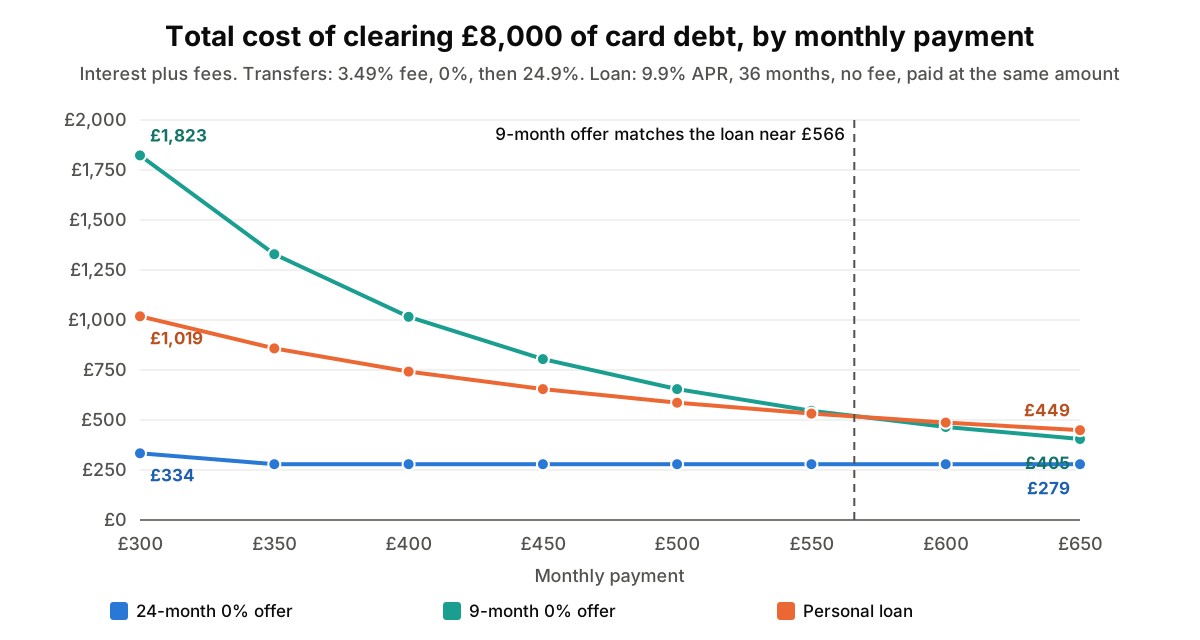
The chart makes the rule of thumb visible. Divide the balance plus the fee by the number of 0% months. If you can pay that, take the transfer. If you cannot get near it, a fixed-rate loan you can afford is the safer choice, because whatever is left on the card meets the full standard rate.
UK rules that change the answer
Persistent debt. Under the FCA's persistent debt rules (CONC 6.7), if you have paid more in interest, fees and charges than off the balance over 18 months, your card provider has to contact you and offer help. After 27 months it must remind you if you look likely to still be in persistent debt at 36 months, and at 36 months it must offer ways to repay faster or, if you cannot afford that, steps such as reducing, waiving or cancelling interest and charges. A balance transfer resets the interest but not the habit: if you are near those milestones, the payment you commit to matters more than which product you pick.
Spending on the new card. nidirect warns that even when the transferred balance is interest-free, new purchases can build up interest quickly, and suggests not using the new card for purchases. The calculator assumes no new spending on either card.
Missed payments. Check the card's summary box and terms for whether a missed payment ends the 0% offer. Set up a direct debit for at least the amount you plan to pay, not just the minimum.
Secured loans and remortgaging. nidirect's page on consolidating debts warns that a longer term can mean paying more overall, that setting up the new loan usually carries charges, and that a loan secured on your home puts the property at risk of repossession if you fall behind. Moving card debt into a mortgage gives a lower rate over a much longer term, which can cost more in total.
How the tools count interest. The transfer calculator divides the card's rate by 12 each month, which slightly overstates interest on a UK card whose APR is an annual effective rate, so any balance left after the 0% period is, if anything, costed on the high side. The consolidation calculator, set to UK APRs, uses the effective monthly rate. Card providers usually charge interest daily, so real statements differ by a few pounds a month.
This comparison is not for you if you are already missing payments or can only manage the minimum. Free debt advice, which the FCA points to in its persistent debt guidance, can look at your whole budget before you take on new credit.
Tools for this job
- Balance Transfer Calculator: the fee in pounds, what is left when the 0% period ends, the payment that clears it in time and the cost against staying put.
- Debt Consolidation Calculator: cards, store cards and an overdraft against one personal loan at UK APRs, including the cost of keeping your current payment.
- Debt Payoff Calculator: the baseline with no new credit, ordering extra payments by avalanche or snowball.
- APR Calculator: checks the APR on a loan quote, including an arrangement fee, the way UK lenders state it.
For paying down several debts in order, see the UK edition of car loans and paying off debt.
Frequently asked questions
Can I move only part of my debt to a 0% card?
Yes. The new card's limit is often lower than the balance you want to move. Run the transfer calculator on the amount the provider accepts and the consolidation calculator on the rest, then add the two totals, keeping the payment you planned for each.
What happens to the old card after a balance transfer?
It stays open with a zero balance unless you close it or ask for a lower limit. A card left open with its full limit makes it easy for the debt to come back, which is the main way consolidation fails.
Is a loan cheaper than a balance transfer if I can only pay the minimum?
Often, yes. At the minimum, most of the moved balance will still be there when the 0% period ends and will be charged the standard rate. A loan has a fixed end date; pick the shortest term whose payment you can keep up.
Does a balance transfer or a loan affect my credit file?
Applying for either means a credit search, and the new account appears on your file. Paying card balances down lowers how much of your available credit you use. How much each affects a lender's view depends on your whole file.
Sources and further reading
- Credit cards and debt, nidirect. Balance transfer fees, the usual six to nine month interest-free period, interest after it ends, and purchases on the new card.
- Consolidating debts, nidirect. Longer terms, set-up charges, early repayment and the risk to your home with a secured loan.
- Help for consumers who are in persistent credit card debt, Financial Conduct Authority. The 18, 27 and 36 month steps and forbearance.
- CONC Consumer Credit sourcebook, Financial Conduct Authority. App 1.2 on the total charge for credit and APR; 3.5.5R and 3.5.6G on the representative APR and its 51% test; 6.7 on persistent debt.
- Consumer Credit Act 1974, section 95A, legislation.gov.uk. Compensation for early repayment: the £8,000 threshold and the 1% and 0.5% caps.
- The Consumer Credit (Total Charge for Credit) Regulations 2010, Schedule, legislation.gov.uk. The APR equation.
Open the Balance Transfer Calculator
More Loans & Mortgages
Every tool in the Loans & Mortgages section, free and in your browser.