
How to Compare Unit Prices at Australian Supermarkets
Use the unit price on Coles, Woolworths and Aldi labels the right way: per 100 g, per kg and per litre bases, half-price specials and value packs, worked in A$.
By Redbison Dev · · 8 min read
Australia edition. Written for Australian shoppers: the ACCC-enforced Unit Pricing Code, its per 100 g default and per kg, per litre and per 10 g exceptions, half-price specials, value packs and the shops the Code leaves out, all in A$. US edition
Australian supermarkets print a unit price on almost every shelf label, because the Unit Pricing Code requires it of large grocery retailers and online grocers. Used well, it answers "which pack is cheaper?" in a glance: compare the unit prices, not the shelf prices. The catch is that the Code uses different bases for different products, specials change the answer week to week, and some products and shops have no unit price at all. When that happens, enter the packs in the Australian Unit Price Calculator, which ranks them in A$ on one basis and shows what each would need to cost to match the cheapest.
What the Unit Pricing Code requires
The Code is Schedule 1 to the Competition and Consumer (Industry Codes, Unit Pricing) Regulations 2021, and the ACCC administers and enforces it. It applies to:
- online grocery sellers that sell items from all of the listed categories (bread, breakfast cereal, butter, eggs, flour, fresh fruit and vegetables, fresh milk, meat, rice, sugar and other packaged food);
- physical stores selling those categories that use more than 1,000 square metres of floor space for groceries;
- smaller retailers that opt in, which must then follow all of it.
The unit price has to be prominent, close to the selling price, legible and unambiguous, in dollars and cents rounded to the nearest cent, and it applies in store, online and in advertising.
The basis depends on the product:
| Product | Unit of measure under the Code |
|---|---|
| Most groceries sold by weight or volume | per 100 g or per 100 ml |
| Meat, fruit and vegetables | per kg if sold by weight, otherwise per item |
| Cheese; flour; ice | per kg |
| Packaged eggs | per 100 g |
| Beverages | per litre |
| Herbs and spices | per 10 g |
| Products sold by number | per item |
That is why the label on a block of cheese reads per kg while the biscuits beside it read per 100 g. The calculator can show any of these, so pick the one on the labels you are checking, or pick one basis for everything.
The Code also leaves things out. Alcohol, clothing, household and electrical goods, prepared meals, tobacco and vending machine items are exempt, and so are marked-down items and bundles of different products. A multi-buy of two or more of the same item for one price does need a unit price, according to the ACCC's consumer page.
Half-price specials beat the big pack
Specials are where the unit price on the label changes most. Take instant coffee:
| Option | Price | Grams | Per 100 g |
|---|---|---|---|
| 150 g jar at half price | A$4.50 | 150 | A$3.00 |
| 400 g jar | A$20.00 | 400 | A$5.00 |
| 150 g jar, normal price | A$9.00 | 150 | A$6.00 |
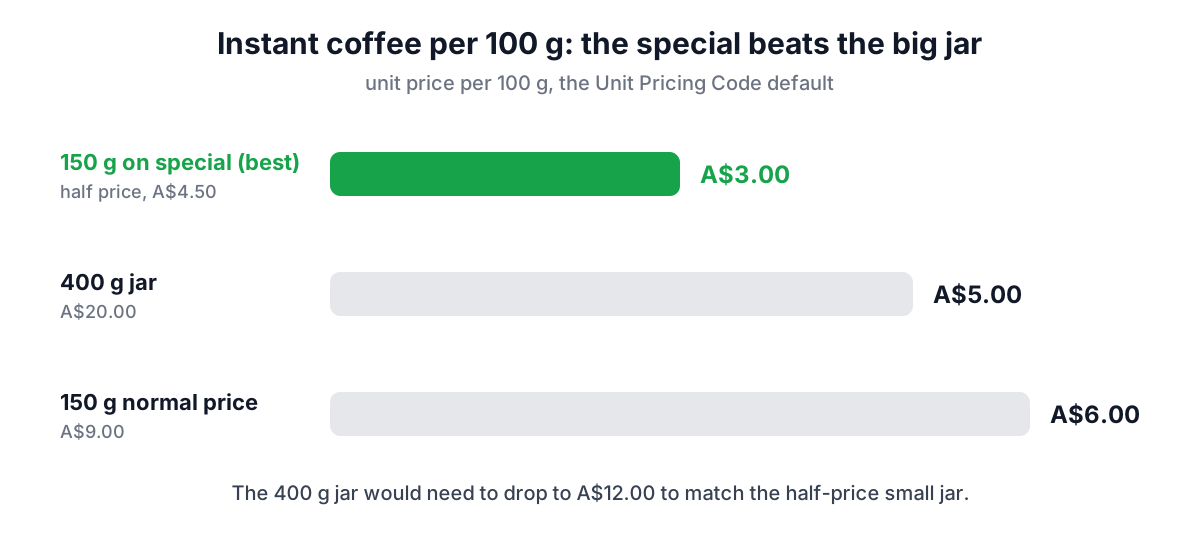
At its normal price the small jar costs 20% more per 100 g than the big one, the usual pattern. At half price it costs 40% less than the big jar, so the 400 g jar would need to drop to A$12.00 to match. If the special recurs, buying two or three small jars on special and skipping the big jar is the cheaper habit. An item marked down because it is damaged, discontinued or close to its use-by date may carry no unit price at all, since the Code exempts it, so this is where working it out yourself pays.
Value packs that are not
"Value" and "family" packs are often, but not always, the cheapest per kilo. Beef mince compared per kg, the basis you will usually see on meat:
| Option | Price | Quantity | Per kg |
|---|---|---|---|
| 1 kg tray | A$13.00 | 1 kg | A$13.00 |
| 2 kg value pack | A$27.00 | 2 kg | A$13.50 |
| 500 g tray | A$7.00 | 500 g | A$14.00 |
The 2 kg pack costs 3.8% more per kilo than the 1 kg tray. To match it, it would need to be A$26.00. The gap is small, but the lesson is general: the biggest pack is a claim, not a guarantee, so read the per kg figure on both labels.
Milk per litre and herbs per 10 g
Fresh milk is one of the categories that brings a store under the Code. Compare per litre:
| Option | Price | Per litre |
|---|---|---|
| 3 L | A$4.50 | A$1.50 |
| 2 L | A$3.10 | A$1.55 |
| 1 L | A$1.90 | A$1.90 |
The 2 L bottle is only 3.3% dearer per litre than the 3 L, so buy the size you will finish before the use-by date. The 1 L bottle is 26.7% dearer.
Herbs and spices use the smallest basis in the Code, per 10 g. A 10 g jar of dried oregano at A$3.00 is A$3.00 per 10 g; a 30 g refill bag at A$4.50 is A$1.50 per 10 g. The jar costs twice as much for the same herb, so buy the jar once and refill it.
A routine at the shelf
- Read the unit price under the shelf price, and check the basis: per 100 g, per kg, per litre, per 10 g or per item.
- If two labels use different bases, convert (per 100 g x 10 = per kg) or put both in the calculator.
- Check specials against the big pack, not just the normal price.
- For multi-packs, count every item: 4 x 170 g is 680 g.
- Weigh up waste: a cheaper litre of milk that goes off is not cheaper.
If a large store or an online grocer leaves out a unit price or shows one that is wrong, raise it with the store first; the ACCC takes reports but does not resolve individual complaints. For a percentage-off promotion, the Australian discount calculator works out the sale price, and the Australian GST calculator splits GST from a price. The guide to sales tax, VAT and discounts covers discounts and tax together, and how to scale a recipe helps you use the bigger pack.
Frequently asked questions
Do all Australian shops have to show unit prices?
No. The Unit Pricing Code covers online grocery sellers and physical stores using more than 1,000 square metres of floor space for groceries, if they sell items in all of the listed categories. Smaller shops can opt in. Convenience stores, many independents and bottle shops may show none, and alcohol is exempt anyway.
Why is cheese priced per kg but biscuits per 100 g?
The Code sets per 100 g as the default for goods sold by weight, then lists exceptions: meat, fruit and vegetables sold by weight, cheese, flour and ice per kilogram, packaged eggs per 100 g, beverages per litre and herbs and spices per 10 g. Multiply a per 100 g price by 10 to compare it with a per kg price.
Does a half-price special show the right unit price?
It should: a special is still the selling price, and the unit price must reflect it. Items marked down because they are damaged, discontinued or close to their use-by date are exempt, though, so check those yourself. In the example above a half-price 150 g coffee jar works out at A$3.00 per 100 g against A$5.00 for the 400 g jar.
Where do I report a missing unit price?
Raise it with the store first. If that does not fix it, report it to the ACCC, which administers and enforces the Code. The ACCC uses reports to decide what to investigate but does not resolve individual complaints.
Sources and further reading
- Competition and Consumer (Industry Codes, Unit Pricing) Regulations 2021, Federal Register of Legislation. Schedule 1, the Unit Pricing Code: who is covered, units of measurement and exemptions.
- Unit Pricing Code, Australian Competition and Consumer Commission. The listed categories, the 1,000 square metre test, display rules and exemptions.
- Unit prices for groceries, Australian Competition and Consumer Commission. Consumer guidance, multi-buys and how to report a problem.
- Unit Pricing Guide: A Best Practice Approach to Unit Pricing, National Institute of Standards and Technology. Why a single basis per category matters.
- Special Publication 811: Guide for the Use of the International System of Units, National Institute of Standards and Technology. Metric prefixes and conversion factors.
Open the Unit Price Calculator
More Everyday Calculators
Every tool in the Everyday Calculators section, free and in your browser.
- Age Calculator
- Time Card Calculator
- Time Calculator
- GPA Calculator
- Final Grade Calculator
- Fuel Cost Calculator
- Tire Size Calculator
- Ring Size Converter
- Shoe Size Converter
- Cooking Measurement Converter
- Heat Index Calculator
- Wind Chill Calculator
- Week Number Calculator
- Day of the Week Calculator
- Recipe Scaler
- Unit Price Calculator