
How to Compare Unit Prices in UK Supermarkets
Read UK shelf labels per kg, per litre and per item under the amended Price Marking Order, with milk in pints, Clubcard-style prices and multibuys worked in pounds.
By Redbison Dev · · 8 min read
United Kingdom edition. Written for UK shoppers: the Price Marking Order rules in force in Great Britain since 6 April 2026, loyalty card unit prices, milk sold in pints, multibuys and the small shop exemption, all in pounds. US edition
In Great Britain the quickest way to compare two packs is the small print under the shelf price: the unit price, which the Price Marking Order requires for most goods sold by weight, volume or number. Since 6 April 2026 that figure should be per kilogram, per litre or per item, and a shop that shows a loyalty card price must show its unit price too. When the labels still disagree, or a multibuy has no unit price at all, divide the price by the quantity yourself, or put the packs into the UK Unit Price Calculator, which ranks them in pounds and shows the price each loser would need to drop to.
This edition explains what changed on UK labels, then works through milk sold in pints, a member price on laundry capsules and a crisps multibuy, three common places where shelf reading goes wrong.
What UK labels must show
The Price Marking Order 2004 sets the rules. The selling price and the unit price both mean the final price including VAT, so the figure under the shelf price is directly comparable with the price you pay. Shops with a relevant floor area of 280 square metres or less are exempt for pre-packed goods of a constant quantity, which is why convenience stores and corner shops often leave the unit price off.
For years the Order also told shops which basis to use for named products in its Schedule 1: coffee, crisps, biscuits and soft drinks per 100 g or 100 ml, herbs and spices per 10 g. That is how one aisle ended up with per 100 g on one product and per kg on its neighbour. The government consulted on the problem in September 2023 and published its response in January 2024.
The result was the Price Marking (Amendment) Order 2024, whose start date was moved to 6 April 2026 by the Price Marking (Amendment) Order 2025. For Great Britain it:
| Change | What it means at the shelf |
|---|---|
| Schedule 1 and its per 10 g and per 100 g units removed | Unit prices per kg, litre, metre, square metre or cubic metre, or per item for goods sold by number |
| New article 7A on multiple prices | Where a product has more than one selling price, such as a member price, each price and each unit price must be shown, with the conditions close to the product |
| Legibility | Price indications must be clearly legible, in a clear font of reasonable size |
| Deposits | A deposit, such as one under a deposit return scheme, is left out of both the selling price and the unit price |
Northern Ireland has its own Price Marking Order, which these amendments do not change, so labels there can still follow the older bases. Online listings and printed promotions can lag behind too.
Milk in pints, priced per litre
Milk is the British awkward case: the cartons say pints, the unit price says litres. A UK pint is 0.56826125 litres by definition in Schedule 1 to the Weights and Measures Act 1985, so a 4 pint bottle holds about 2.27 litres and a 2 pint bottle about 1.14 litres. The calculator has no imperial pint, so enter the millilitres printed on the label (2,272 ml and 1,136 ml are typical).
Example shelf prices, compared per litre:
| Pack | Price | Litres | Per litre |
|---|---|---|---|
| 4 pints | £1.65 | 2.272 | £0.73 |
| 1 litre carton | £0.95 | 1 | £0.95 |
| 2 pints | £1.15 | 1.136 | £1.01 |
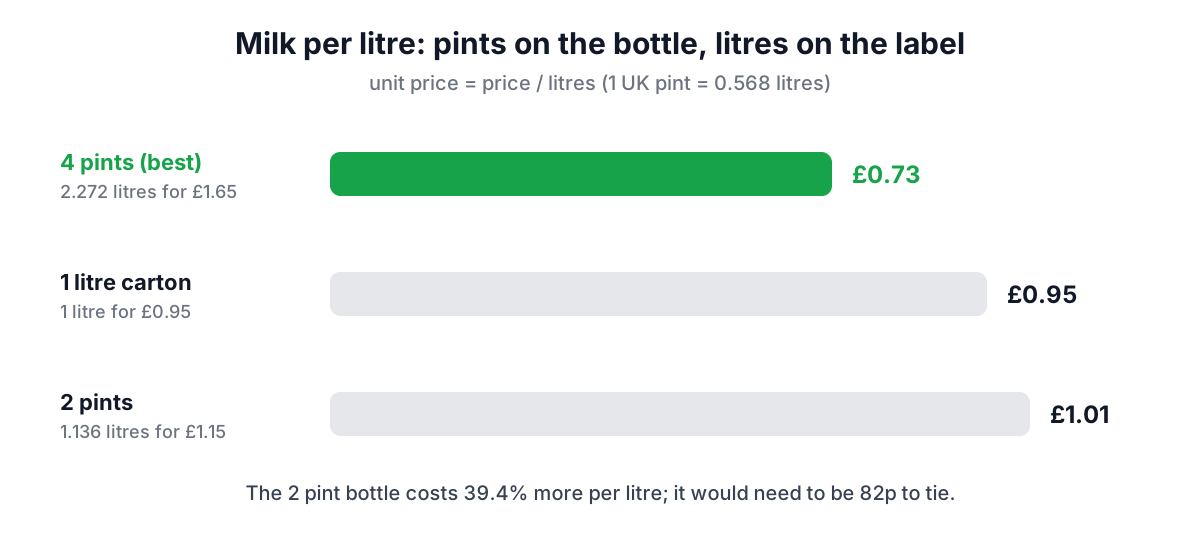
The 2 pint bottle costs 39.4% more per litre than the 4 pint one. To tie, it would have to fall to £0.825, which in practice means 82p: the 4 pint rate of £0.7262 a litre times 1.136 litres. The 1 litre carton is 30.8% dearer and would need to be 72p to beat the big bottle. If half of a 4 pint bottle goes down the sink each week, though, it is the 2 pint bottle that is cheaper for you; unit prices compare packs, not your fridge.
Loyalty card prices: compare both rows
Member prices are common in the large chains, and article 7A means the label should carry a unit price for the member price as well as the shelf price. To see what the card is worth, enter the same pack twice.
Laundry capsules compared per wash (per item):
| Pack | Price | Washes | Per wash |
|---|---|---|---|
| 22 washes, member price | £4.00 | 22 | £0.182 |
| 38 washes, shelf price | £8.00 | 38 | £0.211 |
| 22 washes, shelf price | £5.50 | 22 | £0.250 |
With the card, the small pack wins and the 38 wash pack costs 15.8% more per wash. Without the card, the order flips: the big pack beats the small one, which at £5.50 is 37.5% dearer than the member price. Count washes, not grams, for detergent: two brands with the same weight can give a different number of loads, and the pack states the wash count.
Multibuys: enter the deal as one row
"2 for £2.50" and "3 for £5" deals often carry the unit price of a single pack, not the deal. Enter the deal as one row with the number of packs in the pack field.
Crisps, compared per kg:
| Option | Price | Grams | Per kg | Old label basis, per 100 g |
|---|---|---|---|---|
| 150 g sharing bag, 2 for £2.50 | £2.50 | 300 | £8.33 | £0.83 |
| 150 g sharing bag, single | £1.50 | 150 | £10.00 | £1.00 |
| 6 x 25 g multipack | £1.80 | 150 | £12.00 | £1.20 |
The multipack of small bags costs 44% more per kilo than the multibuy, the price of having the crisps portioned. The last column shows why the old per 100 g labels looked so close (£0.83 against £1.20): the same gap, written in smaller numbers. Since April 2026 a crisps label in Great Britain should read per kg instead.
A routine for the aisle
- Check the unit price basis on each label. If one says per 100 g and the other per kg, multiply the first by 10 before comparing, or ignore both and use the calculator.
- For a member price, compare it against the best non-member option as well, so you know what the card is saving you.
- Treat a multibuy as one row. Two packs you will not finish are not a saving.
- Use count for products sold by number (washes, teabags, nappies) and weight or volume for the rest. The calculator will not rank a weight against a count.
- If a label looks wrong or is missing in a large store, tell the shop. Your council's Trading Standards service (the local weights and measures authority) enforces the Order.
For the next step of the shop, the UK discount calculator checks a percentage off, and the UK VAT calculator splits VAT out of a price. The guide to sales tax, VAT and discounts explains why a unit price already includes VAT, and how to scale a recipe helps use up the big pack you bought.
Frequently asked questions
Do UK supermarkets still show prices per 100 g?
In Great Britain they should not for products sold by weight since 6 April 2026, when the Price Marking (Amendment) Order 2024 removed Schedule 1 and its per 100 g and per 10 g units. Labels should now read per kilogram, per litre or per item. Shops in Northern Ireland, older printed labels and some online listings may still use per 100 g, so check the basis before comparing.
Does a loyalty card price have to show a unit price?
Yes, in Great Britain. Article 7A, added by the 2024 amendment, says that where a trader offers a product at more than one selling price, the indication must set out each selling price and each unit price, and any conditions such as scheme membership must be displayed close to the product. Enter the member and shelf prices as two rows to see the saving per kilo or per wash.
How do I compare milk sold in pints?
Use the litres printed on the bottle. A UK pint is 0.56826125 litres, so a 4 pint bottle is about 2.27 litres and a 2 pint bottle about 1.14 litres. At £1.65 and £1.15 those work out at £0.73 and £1.01 a litre, so the smaller bottle costs 39.4% more per litre.
Why do small shops not show unit prices?
The Price Marking Order exempts shops with a relevant floor area of 280 square metres or less from showing unit prices on pre-packed goods of a constant quantity. Larger stores are covered. In a corner shop, divide the price by the quantity on the pack yourself.
Sources and further reading
- The Price Marking Order 2004, legislation.gov.uk. Unit price including VAT and the 280 square metre small shop exemption.
- The Price Marking (Amendment) Order 2024, legislation.gov.uk. Removes Schedule 1, adds article 7A on multiple prices, legibility and deposits; extends to Great Britain.
- The Price Marking (Amendment) Order 2025, legislation.gov.uk. Moves the 2024 changes to 6 April 2026.
- Smarter regulation: improving price transparency and product information for consumers, Department for Business and Trade. Consultation of September 2023 and government response of January 2024.
- Weights and Measures Act 1985, Schedule 1, legislation.gov.uk. The pint as 0.56826125 cubic decimetre.
- Unit Pricing Guide: A Best Practice Approach to Unit Pricing, National Institute of Standards and Technology. Why one basis per category matters, from the US national measurement institute.
Open the Unit Price Calculator
More Everyday Calculators
Every tool in the Everyday Calculators section, free and in your browser.
- Age Calculator
- Time Card Calculator
- Time Calculator
- GPA Calculator
- Final Grade Calculator
- Fuel Cost Calculator
- Tire Size Calculator
- Ring Size Converter
- Shoe Size Converter
- Cooking Measurement Converter
- Heat Index Calculator
- Wind Chill Calculator
- Week Number Calculator
- Day of the Week Calculator
- Recipe Scaler
- Unit Price Calculator