
How Much Do You Need to Retire in Canada?
Build a Canadian retirement target from your spending, CPP and OAS, and the age they start, with RRSP and TFSA savings and the inputs that move it most.
By Redbison Dev · · 6 min read
Canada edition. Canadian edition in Canadian dollars, built around CPP and OAS (amounts, start ages and the OAS recovery tax), RRSP and TFSA limits, and RRIF withdrawals. US edition
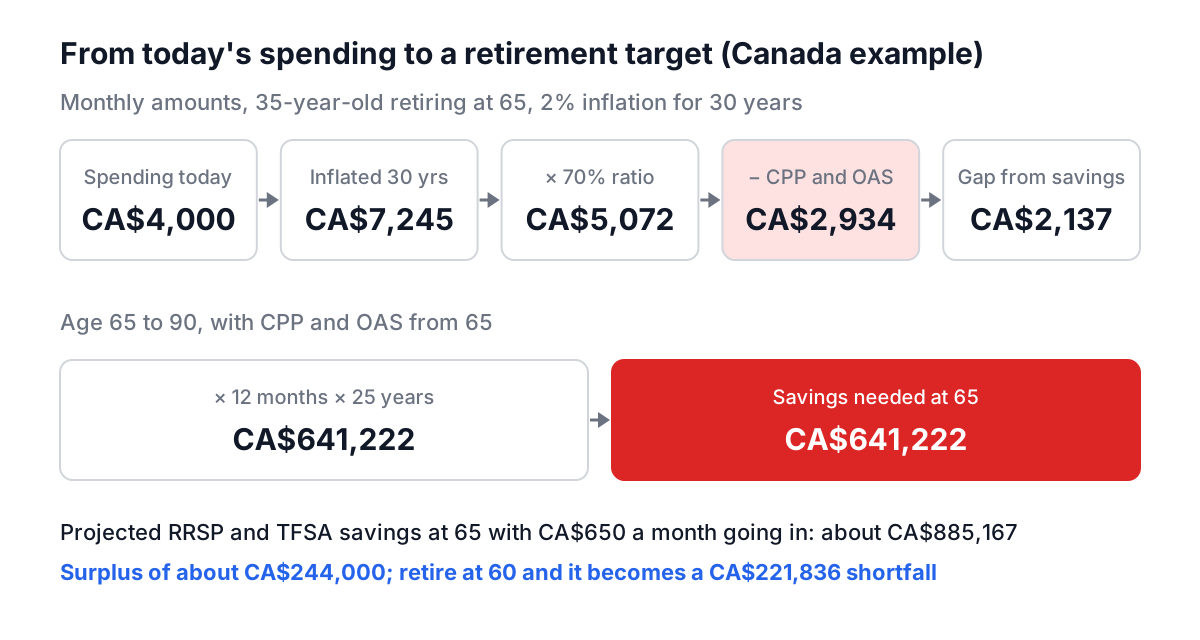
A 35-year-old Canadian spending CA$4,000 a month who wants 70% of that in retirement, and expects an average CPP pension plus full OAS, needs about CA$641,000 of savings at 65. That is in the dollars of 2056; at today's prices it is about CA$354,000. A plan with CA$50,000 saved and CA$650 a month going in is on course for about CA$885,000. Stop at 60 instead and the same plan falls CA$221,836 short, because five years of saving disappear and five years pass before CPP and OAS begin.
This edition builds that number one input at a time with the Retirement Calculator (Canada) and its default figures. It explains a planning method, not financial advice. If you have a defined benefit pension, a large RRSP to draw down or a business to sell, a fee-only planner or a Certified Financial Planner can test the plan against your tax situation.
Step 1: Inflate today's spending
Begin with what your household spends, not what it earns. Earnings include CPP and EI premiums, RRSP contributions and a mortgage that will likely be gone by retirement.
spending at retirement = spending today × (1 + inflation)^years
CA$4,000 × 1.02^30 = CA$7,245 a month at 65. The Bank of Canada targets 2% inflation, which is why the calculator uses 2% by default; at 3% the target rises from CA$641,222 to CA$859,251.
The calculator then applies a retirement income ratio, 70% by default, for CA$5,072 a month. Provincial health plans cover doctor and hospital care, so the health insurance field starts at zero; add extended health, dental, drug costs your province does not cover, or long-term care if you expect them.
Step 2: Subtract CPP and OAS
Canada's two public pensions do most of the work for a middle-income retiree.
CPP. The maximum CPP retirement pension at 65 is CA$1,507.65 a month in 2026, but the average new pension at 65 was CA$858.34 in July 2026. Few people get the maximum, because it needs contributions at or near the yearly maximum pensionable earnings (CA$74,600 in 2026) for most of a career; up to eight of your lowest-earning years are dropped from the base calculation. Your own estimate is in My Service Canada Account. Quebec workers have the QPP instead.
OAS. The maximum OAS pension for October to December 2026 is CA$762.50 a month at 65 to 74 and CA$838.75 from 75. It depends on years lived in Canada after 18 (40 years for the full amount) and is reduced for higher incomes.
The calculator's default of CA$1,620 is an average CPP plus full OAS. Both are indexed, so it is entered at today's rate and raised with inflation to CA$2,934 a month at 65. That covers 58% of the CA$5,072 spending, leaving CA$2,137 a month for savings.
savings needed = (spending − CPP and OAS) × 12 × years in retirement
CA$2,137 × 12 × 25 = CA$641,222.
Leave OAS out and the picture changes sharply. With only an average CPP (CA$858 a month today), the target rises to CA$1,055,299 and the default plan is CA$170,132 short. Newcomers with fewer than 40 years in Canada should enter their partial OAS rather than the full rate.
Step 3: Decide when CPP starts
CPP can start any time from 60 to 70. Each month before 65 reduces it by 0.6%, up to 36% at 60; each month after 65 raises it by 0.7%, up to 42% at 70. The change is permanent and the pension stays indexed.
| CPP start | Average pension (CA$858.34 at 65) | Maximum pension (CA$1,507.65 at 65) |
|---|---|---|
| 60 | CA$549 | CA$965 |
| 65 | CA$858 | CA$1,508 |
| 70 | CA$1,219 | CA$2,141 |
Delaying works like buying an inflation-protected annuity with your own savings during your 60s. It tends to suit people in good health with RRSP money to live on in the meantime. Starting early suits people who need the income now or expect a shorter retirement.
Step 4: The bridge years if you retire early
The CPP and OAS Start at Age field is where early retirement shows up. In the years between leaving work and that age, savings must cover all of the spending, not just the gap.
| Stop work at | Years before CPP and OAS | Savings needed | Savings projected | Result |
|---|---|---|---|---|
| 55 | 10 | CA$1,025,304 | CA$443,764 | short CA$581,540 |
| 58 | 7 | CA$929,109 | CA$551,894 | short CA$377,215 |
| 60 | 5 | CA$856,396 | CA$634,560 | short CA$221,836 |
| 62 | 3 | CA$776,292 | CA$726,754 | short CA$49,538 |
| 65 | 0 | CA$641,222 | CA$885,167 | surplus CA$243,945 |
| 68 | 0 | CA$598,814 | CA$1,071,235 | surplus CA$472,421 |
OAS cannot start before 65, so anyone retiring earlier needs at least those years funded from an RRSP, TFSA, workplace plan or bridge benefit from a pension.
Step 5: Project RRSP, TFSA and workplace savings
The calculator grows the savings each year at the expected return and adds contributions that rise with pay, credited mid-year:
balance next year = balance × (1 + return) + 12 × monthly contributions × (1 + return ÷ 2)
With CA$50,000 saved, CA$500 a month from you and CA$150 from an employer group RRSP or DC plan, contributions rising 2% a year and a 5% return, the balance reaches CA$885,167 at 65, about CA$488,675 at today's prices.
Where to put the money changes what you keep, not what the calculator projects:
- RRSP. Contributions are deductible up to 18% of the previous year's earned income, to a dollar limit of CA$33,810 for 2026 (CA$35,390 for 2027), less any pension adjustment. Withdrawals are fully taxable. The RRSP must become a RRIF, or buy an annuity, by the end of the year you turn 71, after which minimum withdrawals apply each year.
- TFSA. The dollar limit is CA$7,000 for 2026. No deduction going in, but withdrawals are tax-free and do not count as income for OAS or the Guaranteed Income Supplement.
- Group RRSP or DC pension. Contribute at least enough to get the full employer match; it is the highest return available.
The OAS link is the reason many retirees hold both. OAS is reduced by 15% of net income above a threshold: CA$93,454 for 2025 income, which sets the recovery tax from July 2026 to June 2027. Large RRIF withdrawals can push income over it; TFSA withdrawals cannot.
Which assumptions move the answer most
Each row changes one input from the default plan (retire at 65, 5% return, 2% inflation, plan to 90):
| Change | Savings needed | Savings projected | Result |
|---|---|---|---|
| Default | CA$641,222 | CA$885,167 | surplus CA$243,945 |
| Return 3% | CA$641,222 | CA$608,972 | short CA$32,250 |
| Return 6% | CA$641,222 | CA$1,076,943 | surplus CA$435,721 |
| Inflation 3% | CA$859,251 | CA$885,167 | surplus CA$25,916 |
| Plan to 95 | CA$769,466 | CA$885,167 | surplus CA$115,700 |
| Need 80% of spending | CA$858,585 | CA$885,167 | surplus CA$26,582 |
| No yearly rise in contributions | CA$641,222 | CA$747,276 | surplus CA$106,054 |
Because CPP and OAS are indexed and cover more than half of the spending, this plan holds up better than most to inflation and longevity. It is most exposed to the retirement age and to the return.
How this compares with the 4% rule
The 4% rule comes from William Bengen's 1994 study of US market history: withdraw 4% of the starting balance and raise it with inflation, and it lasted 30 years in every period he tested. For the CA$2,137 gap it asks for 25 × CA$2,137 × 12, about CA$641,000, the same as the calculator because both cover 25 years here. A Canadian retiree also has mandatory RRIF minimums and the OAS recovery tax, so the order in which you draw RRSP, TFSA and non-registered money changes how long it lasts after tax. Neither figure is a guarantee.
A practical routine
- Download your CPP Statement of Contributions and estimate from My Service Canada Account.
- Run the Retirement Calculator (Canada) with your own spending, savings and CPP and OAS amounts.
- Re-run it with a return one point lower, inflation one point higher and retirement three years earlier.
- If you plan to stop before 65, check the bridge years, then compare starting CPP at 60, 65 and 70.
- Decide the RRSP and TFSA split with your expected retirement income and the OAS threshold in mind.
For the growth math underneath, the compound interest calculator shows TFSA and RRSP growth on their own, and the FIRE Planner (Canada) handles very early retirement with a savings-rate lens.
Frequently asked questions
Is CA$1 million enough to retire in Canada?
For many single retirees and couples, yes, once CPP and OAS are counted. Spread over 25 years with returns roughly matching inflation, CA$1 million provides about CA$3,333 a month before tax on top of the public pensions. Retiring well before 65, renting, or high spending in the first years can make it tight.
Should I take CPP at 60, 65 or 70?
Starting at 70 pays 42% more than at 65 for life, and starting at 60 pays 36% less. If you are healthy and have savings to live on in your 60s, delaying usually raises lifetime income; if you need the money or expect a shorter retirement, starting earlier can make sense.
Do TFSA withdrawals affect OAS?
No. TFSA withdrawals are not taxable income, so they do not count toward the OAS recovery tax threshold or reduce the Guaranteed Income Supplement. RRSP and RRIF withdrawals do.
How much CPP and OAS should I enter?
Your CPP estimate from My Service Canada Account and the current OAS amount (CA$762.50 a month at 65 to 74 for October to December 2026), both at today's rates. The calculator raises them with inflation when the indexing box is ticked. Couples should enter each person's amounts.
Can I retire at 55 in Canada?
Yes, if your savings can fund ten years before CPP and OAS start. In the default example, retiring at 55 needs CA$1,025,304 against CA$443,764 projected, a shortfall of CA$581,540. Taking CPP at 60 would shorten the bridge but cut the pension for life.
Sources and further reading
- CPP retirement pension: how much you could receive, Government of Canada. Maximum and average amounts.
- CPP retirement pension: when to start, Government of Canada. 0.6% less a month before 65, 0.7% more after.
- Old Age Security: payment amounts, Government of Canada. Quarterly OAS amounts.
- Old Age Security pension recovery tax, Government of Canada. 15% above the income threshold for each income year.
- MP, DB, RRSP, DPSP, ALDA, TFSA limits, YMPE and the YAMPE, Canada Revenue Agency. RRSP, TFSA and YMPE figures by year.
- Determining withdrawal rates using historical data, Journal of Financial Planning. William Bengen's 1994 study behind the 4% rule.
Open the Retirement Calculator
More Calculators
Every tool in the Calculators section, free and in your browser.
- Investment Calculator
- Compound Interest Calculator
- Simple Interest Calculator
- Interest Calculator
- EMI Calculator
- Retirement Calculator
- Time-Weighted Return Calculator
- Savings Goal Calculator
- Inflation Calculator
- CAGR Calculator
- ROI Calculator
- Present and Future Value Calculator
- NPV and IRR Calculator
- 401(k) Calculator
- Roth IRA Calculator
- APY and CD Calculator
- SIP Calculator
- Annuity Calculator
- Bond Price and Yield Calculator
- Currency Converter
- Dividend Calculator
- Stock Average Calculator
- RMD Calculator