
How Much Do I Need to Retire in NZ? KiwiSaver and NZ Super
Work out how much you need to retire in New Zealand: NZ Super at after-tax rates, KiwiSaver at 3.5%, 4% or 6%, the gap savings must cover, and retiring before 65.
By Redbison Dev · · 6 min read
New Zealand edition. Written for New Zealanders: NZ Super from 65 at the 1 April 2026 after-tax rates for singles, sharers and couples, KiwiSaver at the 3.5% default rising to 4% in 2028 with the government contribution, and the years from 60 to 65 that neither covers. US edition
In New Zealand, the question "how much do I need to retire?" has a smaller answer than many people expect, because NZ Super pays a set amount to every eligible person from 65. A single person living alone gets $1,110.30 a fortnight after tax on the M code from 1 April 2026, about $2,405.65 a month. Your KiwiSaver and other savings only need to cover the gap between that and what you will spend. For a 35-year-old spending $4,000 a month today, that gap is about $1,439 a month at 65, and a fund of about $431,657 covers it to age 90. This edition works through that gap with the Retirement Calculator (New Zealand); all amounts are NZ dollars. It is a model, not advice: a licensed financial adviser or Sorted's tools can test your own plan.
Step 1: what NZ Super pays
NZ Super is paid fortnightly and rises every 1 April to keep pace with changes in the average wage. Rates from 1 April 2026:
| Situation | Before tax, a fortnight | After tax (M code), a fortnight | After tax, a month |
|---|---|---|---|
| Single, living alone | $1,294.74 | $1,110.30 | $2,405.65 |
| Single, sharing with someone 18 or over | $1,191.14 | $1,024.90 | $2,220.62 |
| Couple, both qualify (each) | $984.28 | $854.08 | $1,850.51 |
A month is the fortnightly amount × 26 ÷ 12. A couple who both qualify get $44,412 a year after tax between them; a single person living alone, $28,868.
To qualify you must be 65 or older, a citizen, permanent resident or residence class visa holder, ordinarily resident in New Zealand (or the Cook Islands, Niue or Tokelau) when you apply, and have lived in New Zealand for a set number of years since age 20, including 5 since age 50. That number is 10 years for people born on or before 30 June 1959, rising a year at a time to 20 years for anyone born on or after 1 July 1977. If you arrived later in life, check this first: it decides whether the largest line in your retirement income exists at all.
Enter NZ Super at the current rate and tick the inflation box. The calculator then raises it to your retirement date alongside your spending. The calculator raises both with your inflation rate; NZ Super actually moves with the average wage each 1 April.
Step 2: the gap your savings must cover
The calculator starts from your spending today, takes the share you expect to need in retirement, inflates it to 65, and subtracts NZ Super:
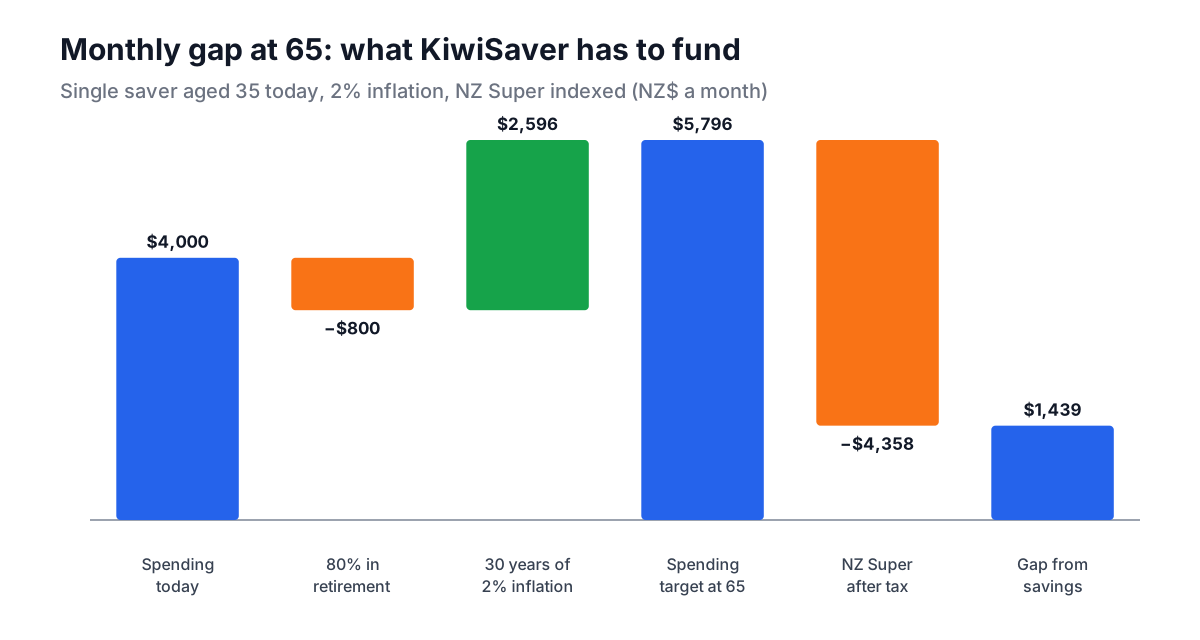
At 65 NZ Super covers about 75% of this saver's spending target. Without it, the same plan would be short by more than $1.1 million, which is the clearest way to see how much of an ordinary New Zealand retirement the pension carries.
The single-sharing rate changes the answer more than people expect. If the same saver will share a home in retirement, NZ Super is $2,220.62 a month rather than $2,405.65, the gap at 65 rises to $1,774 a month and the fund needed rises from $431,657 to $532,205.
Step 3: what KiwiSaver builds
KiwiSaver contributions come from three places:
- You. From 1 April 2026 the default employee rate is 3.5% of gross pay, rising to 4% on 1 April 2028. You can choose a higher rate, and you can apply to stay at 3% temporarily for 3 to 12 months at a time.
- Your employer. The matching default employer contribution is 3.5%, rising to 4% in 2028, but employer superannuation contribution tax (ESCT) is taken off first, so enter the net amount from your KiwiSaver statement.
- The government. From 1 July 2025 it adds 25 cents for each dollar you contribute, up to $260.72 a year. You need to contribute about $1,043 a year to get the full amount. People with taxable income over $180,000 do not qualify, and it stops at 65.
Worked example: the calculator's default saver
Age 35, retiring at 65, planning to 90. Spending $4,000 a month today, 80% needed in retirement, 2% inflation, 5% return. $30,000 already in KiwiSaver. On a $75,000 salary at 3.5%, own contributions are $218.75 a month, plus $21.73 of government contribution (entered together as $240.48), and the employer's contribution after ESCT is entered as $160, the calculator's round example figure. Contributions rise 3% a year.
| Result | Amount |
|---|---|
| Fund needed at 65 | $431,657 |
| Projected KiwiSaver at 65 | $596,309 |
| Surplus | $164,652 |
The ESCT rate depends on salary plus employer contributions for the previous tax year. Inland Revenue's April 2026 PAYE tables (IR340) put $64,201 to $93,720 at 30%, and $75,000 plus the employer's $2,625 is $77,625, so the employer's $218.75 a month nets $153.13. Entering $153.13 instead of $160 gives $588,304 at 65 and a surplus of $156,647. Use the net figure on your own KiwiSaver statement.
What the return assumption does
The 5% return is the input you control least and that matters most. Your KiwiSaver fund type sets most of it: conservative funds hold more cash and bonds, growth funds more shares. Same saver, different returns:
| Return after fees and tax | Projected at 65 | Against $431,657 needed |
|---|---|---|
| 3% | $417,667 | short $13,990 |
| 4% | $497,361 | surplus $65,705 |
| 5% | $596,309 | surplus $164,652 |
| 6% | $719,475 | surplus $287,819 |
Fees come straight off the return, so a fund charging less is worth comparing on Sorted before you change anything else.
Worked example: starting at 45
A 45-year-old earning $85,000 with $90,000 in KiwiSaver, spending $4,500 a month today, retiring at 65 as a single person living alone, with $173.54 a month entered for the employer's contribution (3.5% of $85,000 less 30% ESCT, since $85,000 plus $2,975 of employer contributions falls in the 30% band) and the same 5% return and 2% inflation. Their own 3.5% is $247.92 a month, plus $21.73 from the government.
| Own contribution rate | Monthly own + government | Projected at 65 | Against $532,422 needed |
|---|---|---|---|
| 3.5% | $269.64 | $469,702 | short $62,720 |
| 4% | $305.06 | $488,157 | short $44,266 |
| 6% | $446.73 | $561,970 | surplus $29,547 |
The government contribution is already maxed out at 3.5% on this salary, so the extra comes from the saver's own pay: moving from 3.5% to 6% costs $177.08 a month before tax. The 2028 step to 4% narrows the gap but does not close it on its own; the table treats 4% as starting now, so the real effect is a little smaller.
Retiring before 65
KiwiSaver can be withdrawn in full at the age of eligibility, currently 65, and NZ Super also starts at 65. Stopping work at 60 means five years funded entirely from other savings. For the default saver, retiring at 60 lifts the fund needed to $705,961 and leaves a shortfall of $286,015, because the bridge years have no NZ Super and five years of contributions are lost. If you want to stop early, plan the 60 to 65 years as a separate pot outside KiwiSaver.
Working past 65 is the opposite lever. Work and Income says working does not stop you getting NZ Super, though the extra income can change your tax code. You can keep contributing to KiwiSaver, but the government contribution stops at 65 and employer contributions may stop depending on your employment agreement.
Drawing it down
The calculator spreads savings evenly across your retirement and assumes they keep earning. Sorted describes four ways people actually draw down: take 6% of the starting balance as a fixed amount each year; take 4% and raise it each year by 2% for inflation; divide savings by the years you want them to last and recalculate each year; or divide by your life expectancy and recalculate every year or two. The 6% approach gives more early income and a higher risk of running out; the 4% approach is steadier and more likely to last.
Tools for this job
- Retirement Calculator (New Zealand): opens on the default saver; change the NZ Super amount for sharing or couple rates and the contribution for a different KiwiSaver rate.
- Compound Interest Calculator: growth of a lump sum at different returns.
- Rent or buy in New Zealand: the other big decision that uses KiwiSaver.
- Retirement savings in detail: the method step by step, and how it compares with the 4% rule.
Frequently asked questions
How much is NZ Super after tax?
From 1 April 2026, $1,110.30 a fortnight on the M code for a single person living alone, $1,024.90 for a single person sharing with someone 18 or over, and $854.08 each for a couple who both qualify. Rates rise every 1 April with changes in the average wage.
How much KiwiSaver do I need at 65?
Enough to cover the gap between your spending and NZ Super for as long as you expect to live. For a 35-year-old spending $4,000 a month today who will live alone, the calculator puts it at about $431,657, assuming 2% inflation and a 5% return; sharing a home in retirement raises it to about $532,205.
Should I contribute 3.5%, 4% or 6% to KiwiSaver?
At least enough to get the full $260.72 government contribution, which takes about $1,043 a year of your own money. Above that, a higher rate trades take-home pay now for a bigger balance at 65; for the 45-year-old above, 6% instead of 3.5% turns a $62,720 shortfall into a $29,547 surplus.
Can I retire at 60 in New Zealand?
You can stop work, but KiwiSaver is generally locked until 65 and NZ Super starts at 65, so the five years in between need other savings. In the default example that adds $274,304 to the fund needed.
Sources and further reading
- NZ Super: how much you can get, Work and Income. Fortnightly rates before and after tax from 1 April 2026; yearly increase with the average wage.
- NZ Super: who can get it, Work and Income. Age, residence status and the 10 to 20 years residence requirement.
- Changes to KiwiSaver, Inland Revenue. 3.5% from 1 April 2026, 4% from 1 April 2028, temporary rate reduction, government contribution of 25 cents per dollar up to $260.72.
- Weekly and fortnightly PAYE deduction tables, IR340 (April 2026), Inland Revenue. ESCT rates by salary plus employer contributions, including 30% from $64,201 to $93,720.
- Getting my KiwiSaver when I retire, Inland Revenue. Withdrawal at 65; government contribution stops; employer contributions may stop.
- Four approaches to spending in retirement, Sorted. The 6%, 4%, fixed date and life expectancy approaches.
Open the Retirement Calculator
More Calculators
Every tool in the Calculators section, free and in your browser.
- Investment Calculator
- Compound Interest Calculator
- Simple Interest Calculator
- Interest Calculator
- EMI Calculator
- Retirement Calculator
- Time-Weighted Return Calculator
- Savings Goal Calculator
- Inflation Calculator
- CAGR Calculator
- ROI Calculator
- Present and Future Value Calculator
- NPV and IRR Calculator
- 401(k) Calculator
- Roth IRA Calculator
- APY and CD Calculator
- SIP Calculator
- Annuity Calculator
- Bond Price and Yield Calculator
- Currency Converter
- Dividend Calculator
- Stock Average Calculator
- RMD Calculator