
How Much Concrete, Tiles and Stone? A South African Guide
Cubic metres of concrete for strip foundations, surface beds and driveways, ready-mix truck loads, floor tiles by the box and stone by the tonne, with SA examples.
By Redbison Dev · · 9 min read

South Africa edition. Written for South African building and DIY jobs: metric throughout, strip foundations and surface beds in m³, 6 m³ and 8 m³ ready-mix trucks, 50 kg cement bags and 25 kg premix, PPC and AfriSam guidance on mixing and curing, floor tiles sold by the box and stone by the cube or tonne, with prices in rand. US edition
To work out concrete in South Africa, multiply length by width by depth in metres to get cubic metres, add 5 to 10% for uneven trenches and spillage, and round up to what your supplier sells. A strip foundation 28 m long in total, 600 mm wide and 200 mm deep is 3,36 m³, 3,53 m³ with 5% extra, which fits on one ready-mix truck. The South African Concrete Calculator works in m³ and rand from the start. This guide works through the jobs that come up on SA plots, from foundations and a surface bed to a driveway, then the floor tiles and the stone, so you order once and do not run short on the day.
Millimetres on the plan, metres in the sum
Plans give thicknesses in millimetres (a 200 mm strip, a 100 mm surface bed, a 600 mm tile) and lengths in metres. Convert every measurement to metres before multiplying: 200 mm is 0,2 m, 100 mm is 0,1 m, 50 mm is 0,05 m. Multiply 28 x 0,6 x 200 and you get 3 360, a number a thousand times too big. A cubic metre is also 1 000 litres, which is how a bag yield on the back of a sack relates to the volume.
Concrete for the three common jobs
Strip foundations
PPC's guide to laying a foundation uses a strip 600 mm wide and 200 mm deep, mixed from 50 kg bags of SUREBUILD 42,5N cement, clean concrete sand and 19 mm stone. It sets out the corners with the 3-4-5 method (3 m one way, 4 m the other, 5 m across) and checks the diagonals are equal. The width and depth you build to come from your approved plans and the soil, not from a calculator. Under section 4 of the National Building Regulations and Building Standards Act 103 of 1977, nobody may erect a building that needs plans without the local authority's prior written approval, so those plans are the ones your municipality approved.
For the volume, add up the length of every trench and treat the result as one long slab. In the calculator choose "Slab / patio / driveway", enter the total length, the width and the depth:
- 28 m x 0,6 m x 0,2 m = 3,36 m³
- with 5% extra for trench sides that are not straight: 3,53 m³
- rounded up to the half cubic metre: an order of 4 m³
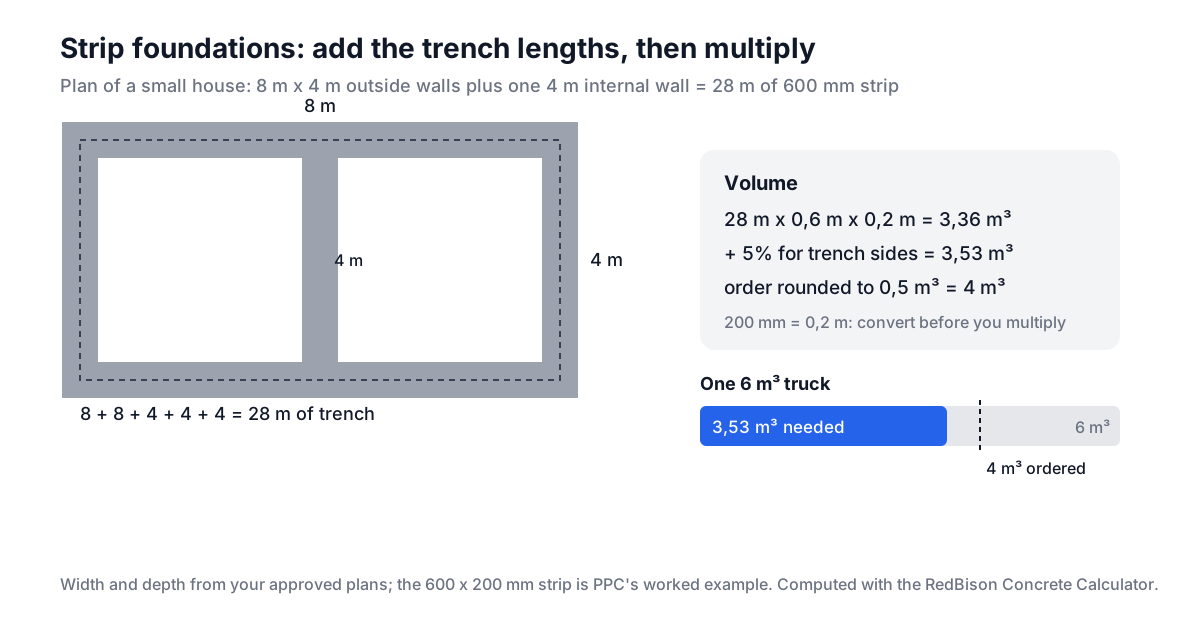
At an example price of R 2 200 per m³ that is R 8 800 for the concrete; put in your supplier's quote, which will include delivery terms for part loads.
A surface bed for a patio
A 4 x 3 m patio, 100 mm thick, with 5% extra is 1,26 m³: an order of 1,5 m³ of ready-mix, or 108 bags of 25 kg premix. AfriSam puts floors, patios and footpaths in its medium strength group, 25 MPa. At this size a site mix from 50 kg cement bags with sand and stone, using the proportions printed on the bag, is usually easier than 108 premix bags, which weigh 2,7 tonnes between them.
A driveway strip
One car's width, 6 x 3 m and 125 mm thick, with 5% extra is 2,36 m³, an order of 2,5 m³. Driveways and carports are in AfriSam's high strength group, 30 MPa, so ask for a 30 MPa mix. Compact the base before you pour.
Putting a job on one truck
AfriSam runs 6 m³ and 8 m³ ready-mix trucks. A room extension needs both of the first two jobs at once: 18 m of strip, 600 mm by 200 mm, is 2,16 m³, and a 5 x 4 m surface bed 100 mm thick is 2 m³. Together with 5% extra that is 4,37 m³, an order of 4,5 m³, which fits on one 6 m³ truck. Pour each element in one go: PPC says to pour a foundation in one day, so the joint between old and new concrete is not left in the middle of a trench.
| Job | Sizes | With 5% extra | Ready-mix order | 25 kg premix bags |
|---|---|---|---|---|
| Strip foundations | 28 m x 0,6 m x 200 mm | 3,53 m³ | 4 m³ | 302 |
| Patio surface bed | 4 x 3 m x 100 mm | 1,26 m³ | 1,5 m³ | 108 |
| Driveway | 6 x 3 m x 125 mm | 2,36 m³ | 2,5 m³ | 202 |
| Extension: strips and bed | 18 m strip and 5 x 4 m bed | 4,37 m³ | 4,5 m³ |
The ready-mix column rounds up to half a cubic metre, the step set in the calculator; change it to your supplier's increment.
Mixing, placing and curing
Strength is set by the mix, and SA cement brands print their mix tables on the bag, so follow the bag for the MPa you need rather than a generic ratio. AfriSam's StarBuild guidance gives 15 MPa for foundations and footings, 25 MPa for floors, patios and footpaths, and 30 MPa for driveways and carports.
The time limits are short. PPC says concrete must be placed within an hour of mixing; AfriSam says within two hours, preferably one. Mix in batches you can place in that time, starting at the corner furthest from the mixer as PPC shows. Wet the trench or the base first so the ground does not draw water out of the fresh mix, but leave no standing water. Tamp the concrete into the corners to remove air pockets.
AfriSam asks for concrete to be kept moist for at least 7 days, covered with plastic, damp sand or hessian against sun and wind, and for cement to be used within three months of purchase, stored off the ground under cover. Wear gloves, boots and eye protection: wet cement burns skin.
Floor tiles by the box
Floor area is length x width in square metres, and an L-shaped open-plan room is two rectangles added together: 6 x 4 m plus 3 x 2 m is 30 m². The Square Footage Calculator and the Tile Calculator both work in metric.
For a 5 x 4 m lounge, 20 m², in 600 x 600 mm porcelain tiles with 3 mm joints:
- each tile with its joint covers 0,364 m², so the room needs 55 tiles exactly
- with 10% for cuts and breakages: 61 tiles
- if a box holds 4 tiles (1,44 m²): 16 boxes
The 30 m² open-plan room needs 91 tiles and 23 boxes with 10% extra, or 95 tiles and 24 boxes with 15% for a diagonal layout with more cuts. Buy every box from the same batch so the shade matches, and keep a few spare tiles for repairs.
Stone and sand by the cube or the tonne
Builders' merchants sell sand and stone by the cubic metre, often called a cube, and quarries by the tonne. The Gravel and Mulch Calculator converts between them with a typical density.
- A gravel path, 10 m long, 1,2 m wide and 50 mm deep with 5% extra, is 0,63 m³, about 1,05 tonnes of gravel at the calculator's 1 661 kg/m³.
- A crushed stone base under the driveway, 6 x 3 m and 100 mm deep with 5% extra, is 1,89 m³, about 3,03 tonnes at 1 602 kg/m³.
Real densities vary with the stone, its size and how wet it is, so check the weight per cube with your supplier before ordering by the tonne.
A short checklist before you order
- Measure twice and draw the plan with every length labelled in metres.
- Convert every thickness from millimetres to metres before you multiply.
- Add 5% for formwork on a level base, 10% or more for dug trenches.
- Round up to the supplier's increment and check the job fits the truck.
- Choose the strength on the plans or the cement bag table for the use.
- Have water, tools, help and plastic for curing ready before the truck arrives.
Frequently asked questions
How many cubic metres of concrete do I need for a strip foundation?
Multiply the total trench length by the width and depth in metres. A 28 m strip, 0,6 m wide and 0,2 m deep, is 3,36 m³, or 3,53 m³ with 5% extra. Use the width and depth on your approved plans.
How big is a ready-mix truck in South Africa?
AfriSam's trucks carry 6 m³ or 8 m³. A job of 4,5 m³ fits on one 6 m³ truck; ask your supplier about part-load charges for small orders.
How many 25 kg bags of premix make a cubic metre?
About 86 bags at the calculator's yield of about 11,7 litres per 25 kg bag. A 1,26 m³ patio needs 108 bags. Check the yield printed on the bag you buy.
What MPa concrete do I need for a driveway?
AfriSam's guidance puts driveways and carports at 30 MPa, floors and patios at 25 MPa and foundations at 15 MPa. Anything an engineer has designed follows the strength on the drawings.
How many tiles do I need for a 20 m² floor?
With 600 x 600 mm tiles and 3 mm joints, 55 tiles exactly and 61 with 10% extra, which is 16 boxes of 4 tiles. Allow 15% for diagonal layouts.
Sources and further reading
- National Building Regulations and Building Standards Act 103 of 1977, section 4, Acts Online. Prior written approval of the local authority before erecting a building that needs plans.
- How to lay a concrete foundation, PPC. The 600 x 200 mm strip, 50 kg SUREBUILD 42,5N, 3-4-5 setting out, placing within an hour and pouring in one day.
- StarBuild cement brochure, AfriSam. 15, 25 and 30 MPa uses, use within two hours, 7 days of curing and cement storage.
- Readymix FAQ, AfriSam. 6 m³ and 8 m³ trucks.
- The International System of Units (SI) brochure, BIPM. The metre, the cubic metre and the litre.
- Publications, Tile Council of North America. Tile installation handbooks, including layout and joint guidance.
More Construction & Home
Every tool in the Construction & Home section, free and in your browser.