
Concrete, Flooring, Tiles and Mulch: Estimating in Australia
Cubic metres to 20 kg bags or premix, N20 under the NCC, floor area in m² and squares, tiles by the box, and mulch and road base by the cubic metre.
By Redbison Dev · · 9 min read
Australia edition. Metric throughout for Australian jobs, with 20 kg concrete bags, Cement Australia's bags-or-premix rule, NCC Housing Provisions for concrete and wet areas, house sizes in m² and squares, tiles sold by m² per box, and landscape supplies by the cubic metre, priced in A$. US edition
Australian estimating is metric from start to finish, which removes the feet-and-yards trap but leaves three others: thicknesses given in millimetres, a choice between bags and premix that depends on volume, and house sizes still quoted in squares. This guide works through a shed slab, a garden path, a clothesline post, an open-plan floor, a bathroom and an alfresco, and a garden bed and road base, using the Australian versions of the Concrete Calculator, the Floor Area Calculator, the Tile Calculator and the Mulch and Gravel Calculator.
Millimetres in, cubic metres out
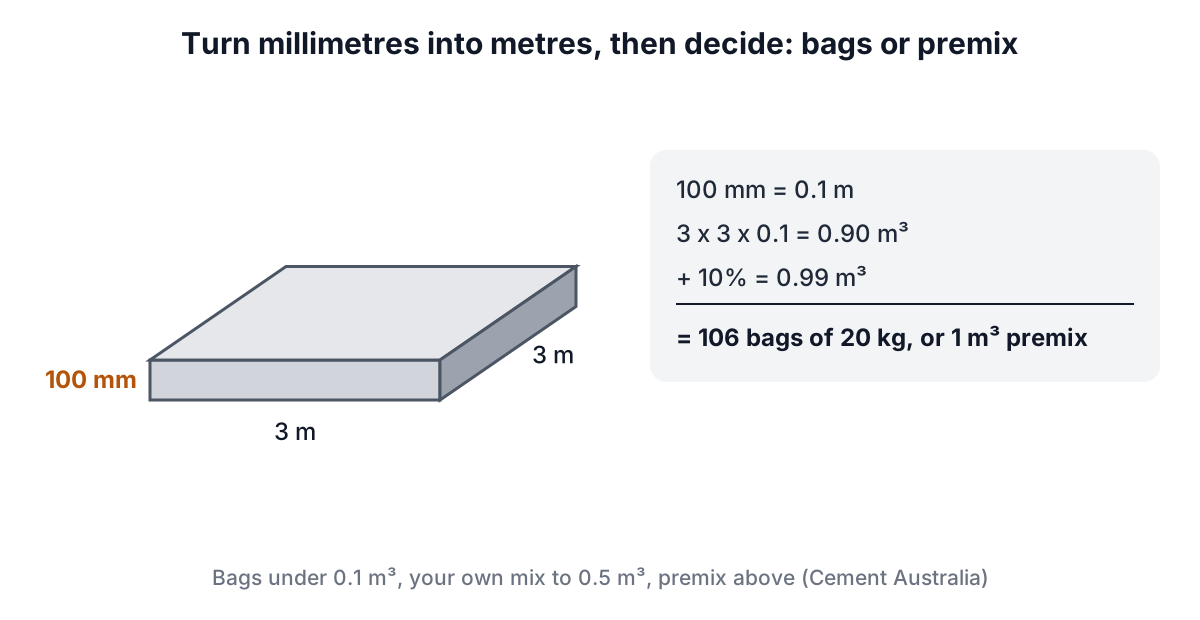
Plans and product sheets give thicknesses in millimetres: a 100 mm slab, a 75 mm path, a 75 mm layer of mulch. Lengths are in metres. Convert first (100 mm is 0.1 m, 75 mm is 0.075 m), then multiply. Put 100 in for the thickness of a 3 x 3 m slab and you get 900, which looks like a volume until you notice it is a thousand times too big.
One cubic metre is 1,000 litres, which links concrete volumes to the litre bags that mulch and potting mix come in. And one square, the old unit for house size, is 100 square feet, which is 9.29 m².
Concrete: bags, your own mix or premix
Bagged concrete mix in Australia comes in 20 kg bags. The calculator works with about 9.4 litres of concrete from each, scaled by weight from a published bag yield, so a cubic metre takes about 107 bags; check the yield on your brand's bag. Cement Australia, in its guide to laying a slab, gives a practical rule for choosing:
| Volume | Cement Australia's suggestion |
|---|---|
| Under 0.1 m³ | bags of concrete mix |
| 0.1 to 0.5 m³ | mix your own from builder's cement, sand and aggregate |
| Over 0.5 m³ | premix delivered by truck, where it can get in |
Three common jobs fall neatly into the three bands:
| Job | Size | Volume with 10% extra | 20 kg bags | Band |
|---|---|---|---|---|
| Clothesline post | 300 mm hole, 600 mm deep | 0.047 m³ | 5 | bags |
| Garden path | 6 m x 900 mm x 75 mm | 0.446 m³ | 48 | your own mix |
| Garden shed slab | 3 x 3 m x 100 mm | 0.99 m³ | 106 | premix, 1 m³ |
Forty-eight bags of pre-blended mix for the path is a lot of carrying, and Cement Australia treats a 20 kg bag as a two-person lift, which is why mixing builder's cement, sand and aggregate in a hired mixer makes sense at that size. The shed slab at 106 bags is firmly a truck job. For the post, Cement Australia's Concrete Mix product page gives about 1.75 litres of water per 20 kg bag.
Sit a DIY slab on about 5 cm of compacted road base or crusher dust, as Cement Australia describes, so the concrete thickness stays even and the volume estimate holds, and cut control joints at about 1.5 m intervals. Allow about 5% extra on a formed slab over a level base and 10% or more for dug holes and trenches. Before digging any hole, check for underground services through Before You Dig Australia, the free national referral service.
House slabs are an engineering job
The NCC Housing Provisions, Part 4.2, call for concrete to AS 3600 with at least 20 MPa at 28 days (N20), 20 mm maximum aggregate and a nominal 100 mm slump, with no water added on site to raise the slump, and slabs moist cured for seven days. A specified strength like that comes from a premix plant, not from bags, and an engineered slab may specify more. Whether a garden shed slab needs approval depends on your state and council; small sheds are often exempt within size, height and setback limits, so check before pouring.
Floor area: square metres and squares
Australian plans, contracts and flooring are all in square metres, and the Australian trade measurement laws require goods sold by measurement to use legal units. Yet brochures and conversations still give house size in squares. A 16 x 14 m house footprint is 224 m², which is 24.11 squares; a 25-square house is 232.26 m². When comparing, ask what was included: builders often quote everything under the main roof, including the garage, alfresco and porch, while a living area figure leaves them out.
For flooring, measure to the inside face of the walls and to the middle of door openings, and split open-plan spaces into rectangles that do not overlap. An open-plan living area of 8.5 x 4.2 m with a 3.6 x 3.0 m dining nook is 35.7 + 10.8 = 46.5 m². With 10% for cuts, 51.15 m² of hybrid flooring; at A$65 per m², A$3,324.75. Cartons list the m² they cover, so divide and round up, then keep a spare carton for repairs.
Tiles: m² per box, and what goes underneath
Australian tile boxes are labelled in square metres, and tiles are sized in millimetres. A box of four 600 x 600 mm tiles covers 1.44 m². Each tile with a 2 mm joint occupies 602 x 602 mm, so a 2.4 x 1.9 m bathroom floor (4.56 m²) takes 12.6 tiles exactly; with 10% waste, 14 tiles, four boxes. A 24 m² alfresco in the same tile with a 3 mm joint needs 73 tiles, 19 boxes.
| Layout or job | Waste to allow |
|---|---|
| Straight lay | 10% |
| Diagonal or herringbone | 15% or more |
| Splashback with power points and window returns | 15% |
| Large tiles in a small room | more than 10% |
Grout follows the formula adhesive makers publish, (A + B) / (A x B) x thickness x joint x 1.6 with sizes in millimetres. For the bathroom floor, with 10 mm tiles and a 2 mm joint, it comes to about half a kilogram.
The tiles in a bathroom or laundry sit on a waterproofing system, and that costs more than the grout. NCC Housing Provisions Part 10.2, or AS 3740, sets what must be waterproof or water resistant in wet areas. Check whether your state requires the work to be done by a licensed or registered waterproofer and certified; Victoria's Building and Plumbing Commission explains the position there. Outdoors, choose a tile with a suitable slip rating, and cut porcelain wet with a P2 respirator to keep down silica dust.
Mulch, pebbles and road base: by the cubic metre
Landscape yards sell mulch, soil, pebbles and road base by the cubic metre, loaded onto your trailer or delivered. Bagged stone comes in 20 kg bags and mulch in litre bags.
| Job | Area and depth | Volume with extra | Weight | Bags |
|---|---|---|---|---|
| Garden bed mulch | 15 m² at 75 mm, 5% | 1.18 m³ | about 0.42 t | 24 of 50 L |
| Road base under a shed slab | 3.6 x 3 m at 100 mm, 10% | 1.19 m³ | about 1.9 t | 96 of 20 kg |
| Decorative pebbles | 10 m² at 50 mm, 5% | 0.53 m³ | about 0.87 t | 44 of 20 kg |
Depth is the main decision for mulch. Queensland Government water-wise advice is a thin layer of about 2 cm for fine mulch, kept 6 to 7 cm clear of plant stems; coarse mulch is laid deeper, and local councils publish their own recommended depths. At 75 mm, the bed above needs 24 bags of 50 litres, or a single trailer load.
Weight is the trap with stone. Yards sell by volume, but a trailer is limited by weight, and a cubic metre of loose road base at about 1.6 tonnes can exceed a small trailer's load rating. Road base also compacts, so the 10% allowance above is a starting point; compact it in layers with a plate compactor. In bushfire-prone areas, keep flammable mulch away from the walls of the house and use gravel or pebbles next to the building.
Before you order
- Write every thickness in metres before multiplying.
- Use Cement Australia's bands to decide between bags, your own mix and premix.
- Get house slab and footing concrete specified by strength (N20 or more) from a premix plant.
- Compare house sizes in m², and ask what each figure includes.
- Price waterproofing with the tiles in wet areas.
- Check your trailer's load rating before collecting stone, and keep mulch off stems and away from the house in bushfire areas.
These figures are for ordering materials. Footings, house slabs and wet-area waterproofing follow the NCC, your state's rules and, where needed, an engineer's design.
Frequently asked questions
How many 20 kg bags of concrete make a cubic metre?
About 107. The calculator uses a yield of about 9.4 litres per 20 kg bag, scaled by weight from a published bag yield, so check the yield printed on your brand's bag. Above 0.5 m³, Cement Australia suggests premix rather than bags.
Should I use bags or premix for a shed slab?
A 3 x 3 m slab at 100 mm is 0.9 m³, or 0.99 m³ with 10% extra, which is 106 bags of 20 kg. That is well over Cement Australia's 0.5 m³ mark for premix, so order a 1 m³ load if the truck can reach the site.
What strength concrete does a house slab need?
NCC Housing Provisions Part 4.2 calls for concrete to AS 3600 with at least 20 MPa at 28 days (N20), 20 mm maximum aggregate and a nominal 100 mm slump, moist cured for seven days. Engineered slabs may specify more.
How many square metres is a square?
One square is 100 square feet, which is 9.29 m². A 24-square house is about 223 m², and a 224 m² house is 24.11 squares. Ask whether the garage and alfresco are included before comparing.
How much mulch do I need for a garden bed?
Multiply the area in m² by the depth in metres. A 15 m² bed at 75 mm is 1.125 m³, or 1.18 m³ with 5% extra: about 24 bags of 50 litres or one trailer load. Keep mulch 6 to 7 cm clear of plant stems.
Sources and further reading
- Part 4.2 Footings, slabs and associated elements, Australian Building Codes Board (NCC 2025 Housing Provisions). N20 concrete, aggregate, slump and curing.
- Part 10.2 Wet area waterproofing, Australian Building Codes Board (NCC 2025 Housing Provisions). Waterproofing in bathrooms and laundries.
- How to lay a concrete slab, Cement Australia. Bags, own mix or premix by volume; base, control joints and safe lifting.
- Concrete Mix, Cement Australia. 20 kg bag and water per bag.
- Australian trade measurement laws, business.gov.au. Legal units for goods sold by measurement.
- Waterwise gardening: mulching, Queensland Government. Mulch depth and clearance from stems.
- Waterproofing of wet areas, Building and Plumbing Commission, Victoria. Waterproofing requirements in Victoria.
More Construction & Home
Every tool in the Construction & Home section, free and in your browser.