
BMR and TDEE Explained: How Calorie Calculators Estimate Your Needs
The Mifflin-St Jeor equation worked by hand, what the 1.2 to 1.9 activity factors mean, how accurate the estimate is, and how to correct it with your own data.
By Redbison Dev · · Updated · 6 min read
Type the same height, weight and age into five online calorie calculators and you can get five answers spread over 400 kcal. Most of that spread does not come from the maths of metabolism. It comes from one dropdown: activity level. Understanding what each part of the estimate does, and which part is shaky, is the difference between a target that works and one that quietly stalls.
This guide walks through basal metabolic rate (BMR), total daily energy expenditure (TDEE), the Mifflin-St Jeor equation used by the Calorie Calculator, and how to correct the estimate with your own weight data. It is general information, not medical or dietetic advice.
What your daily energy goes on
Your total daily energy expenditure has four parts:
| Component | Typical share | What it is |
|---|---|---|
| Basal or resting metabolism | 60 to 70% | Keeping organs, brain and body temperature running at rest |
| Thermic effect of food | about 10% | Energy spent digesting and storing what you eat |
| Exercise | 0 to 15% for most people | Planned training |
| Non-exercise activity (NEAT) | 15 to 30% | Walking, standing, fidgeting, chores, a physical job |
The surprise for most people is how small exercise usually is next to NEAT. An hour in the gym burns a few hundred kcal; the difference between a desk worker and a nurse who walks 15,000 steps a shift can be larger, every day.
The Mifflin-St Jeor equation
You cannot measure BMR at home; it takes indirect calorimetry in a lab. So calculators predict it from body size, age and sex. The equation most of them use was published in 1990 by Mark Mifflin, Sachiko St Jeor and colleagues, from measurements of 498 healthy adults:
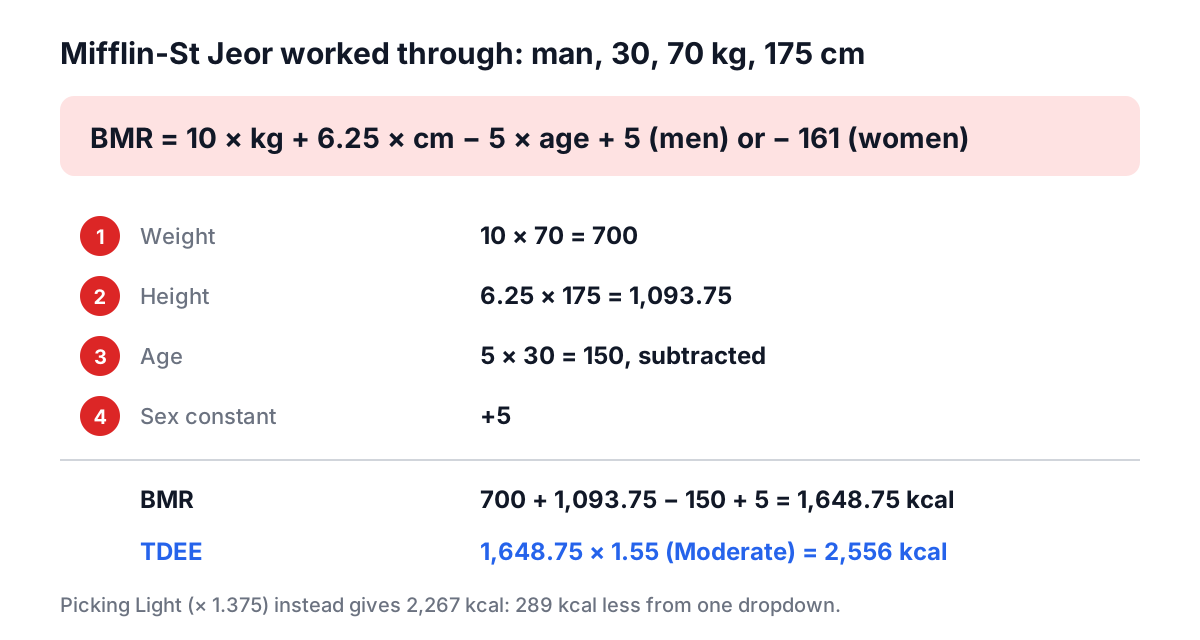
Men:    BMR = 10 × weight (kg) + 6.25 × height (cm) − 5 × age (years) + 5
Women:  BMR = 10 × weight (kg) + 6.25 × height (cm) − 5 × age (years) − 161
The only difference between the sexes is the constant, a gap of 166 kcal a day. Every extra kilogram adds 10 kcal, every centimetre 6.25, and every year of age removes 5.
In 2005 a systematic review by Frankenfield and colleagues for the American Dietetic Association compared the common prediction equations against measured resting metabolism. Mifflin-St Jeor came out as the most likely to land within 10% of the measured value in both non-obese and obese adults, ahead of the older Harris-Benedict equation (1919). That is why it became the default.
"Within 10%" is the honest accuracy statement. For someone whose true BMR is 1,600 kcal, the equation could say anywhere from about 1,440 to 1,760 and still count as accurate.
From BMR to TDEE: the activity factor
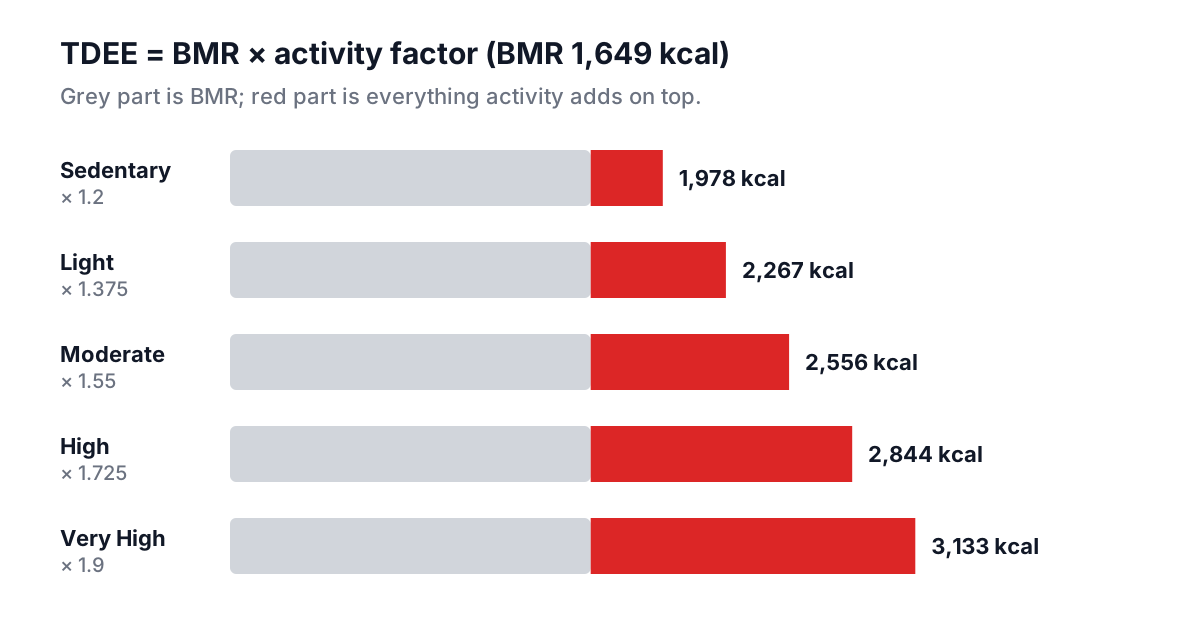
TDEE is estimated by multiplying BMR by an activity factor. The Calorie Calculator uses the standard five:
| Level in the tool | Factor | Description |
|---|---|---|
| Sedentary | 1.2 | Desk job, little or no exercise |
| Light | 1.375 | Light exercise 1 to 3 days a week |
| Moderate | 1.55 | Moderate exercise 3 to 5 days a week |
| High | 1.725 | Hard exercise 6 to 7 days a week |
| Very High | 1.9 | Very intense training or a physical job |
Going from Light to Moderate adds 12.7% to the estimate. For a BMR of 1,650 that is about 290 kcal a day, which is roughly the size of a modest deficit. Pick the wrong level and your "deficit" may be maintenance.
People reliably overestimate their activity. The descriptions are about exercise, but the factor has to cover all 168 hours of the week. Someone who trains hard for 45 minutes four times a week and sits the rest of the day is usually better described by Light than Moderate. When unsure, choose the lower level and correct upward with data.
A worked example
A 30-year-old man, 70 kg, 175 cm, who trains three or four times a week:
BMR  = 10 × 70 + 6.25 × 175 − 5 × 30 + 5
     = 700 + 1,093.75 − 150 + 5
     = 1,648.75 kcal  (shown as 1,649)

TDEE = 1,648.75 × 1.55 (Moderate)
     = 2,555.6 kcal   (shown as 2,556)
With Maintain Current Weight selected, the calculator splits 2,556 kcal into 25% protein, 50% carbohydrate and 25% fat. At 4, 4 and 9 kcal per gram that is 160 g protein, 319 g carbs and 71 g fat. Choosing Moderate Weight Loss subtracts 500 kcal for a target of 2,056; Slow Weight Loss subtracts 250, and Lean Muscle Gain adds 200.
Now the same man picks Light instead: 1,648.75 × 1.375 = 2,267 kcal. That 289 kcal gap is why two calculators disagree, and why the next section matters more than the equation.
Correcting the estimate with your own data
The formula gives you a starting point. Your scale gives you the answer. A simple method:
- Eat at the estimated TDEE as consistently as you can for two to three weeks, logging intake.
- Weigh yourself each morning under the same conditions and take the weekly average.
- If the average is stable, your intake is your real TDEE. If it is falling or rising, adjust.
Roughly, a steady change of 0.5 kg a week means you are about 550 kcal a day away from maintenance (0.5 × 7,700 / 7). Move intake by 100 to 200 kcal at a time and watch another two weeks. Ignore the first week of any new diet: changes in water, salt and glycogen can move the scale 1 to 2 kg on their own.
Common mistakes
- Adding exercise calories on top. If your activity level already includes training, adding a watch's estimate counts the same work twice. Wearables also tend to overestimate burn.
- Never recalculating. BMR drops by about 50 kcal for every 5 kg lost (10 kcal per kg), plus the activity factor on top. Rerun the numbers after each 4 to 5 kg change.
- Trusting it for very lean or very muscular people. The equation was built on ordinary adults. Bodybuilders are often underestimated; people with high body fat can be overestimated.
- Using it for children, pregnancy or illness. Needs differ, and these situations call for professional advice.
- Treating the macro split as personal. The 25/50/25 split is generic. If you train, set protein from body weight with the Protein Calculator first.
Putting it to work
Use the calculator to get a first number, pick the more conservative activity level, and eat at that number for two weeks before changing anything. If weight loss is the goal, the Calorie Deficit Planner turns that TDEE into a dated plan, and the calorie deficit guide explains why the plan will run slower than the arithmetic says. Fluid needs rise with activity too; the hydration guide covers that side.
Frequently asked questions
What is the Mifflin-St Jeor equation?
The Mifflin-St Jeor equation predicts basal metabolic rate from weight, height and age: BMR = 10 x weight (kg) + 6.25 x height (cm) − 5 x age (years), plus 5 for men or minus 161 for women. It was published in 1990 from measurements of 498 healthy adults, and a 2005 review found it the most likely common equation to land within 10% of measured values.
What activity factor should I use to calculate TDEE?
The standard TDEE activity factors are 1.2 for sedentary, 1.375 for light exercise 1 to 3 days a week, 1.55 for moderate exercise 3 to 5 days, 1.725 for hard exercise 6 to 7 days and 1.9 for very intense training or a physical job. People reliably overestimate their activity, so when unsure choose the lower level and correct upward with weight data.
How do I calculate TDEE by hand?
Calculate BMR first, then multiply by an activity factor. For a 30-year-old man of 70 kg and 175 cm, Mifflin-St Jeor gives 700 + 1,093.75 − 150 + 5 = 1,648.75 kcal. Multiplied by 1.55 for moderate activity, TDEE is about 2,556 kcal a day; at the light factor of 1.375 it would be about 2,267 kcal.
How do I adjust my TDEE using my weight?
Eat at the estimated TDEE consistently for two to three weeks, weigh yourself each morning and compare weekly averages. If the average is stable, that intake is your real TDEE. A steady change of 0.5 kg a week means you are about 550 kcal a day away from maintenance. Adjust by 100 to 200 kcal at a time and ignore the first week of any new diet.
What is NEAT?
NEAT, or non-exercise activity thermogenesis, is the energy spent on walking, standing, fidgeting, chores and physical work, and typically makes up 15 to 30% of total daily energy expenditure. Planned exercise is usually only 0 to 15%, so the difference in NEAT between a desk worker and someone who walks 15,000 steps a shift can outweigh an hour in the gym.
Sources and further reading
- A new predictive equation for resting energy expenditure in healthy individuals, The American Journal of Clinical Nutrition. Mifflin, St Jeor and colleagues, 1990.
- Comparison of Predictive Equations for Resting Metabolic Rate in Healthy Nonobese and Obese Adults: A Systematic Review, Journal of the American Dietetic Association. Frankenfield and colleagues, 2005.
- Dietary Reference Intakes for Energy, Carbohydrate, Fiber, Fat, Fatty Acids, Cholesterol, Protein, and Amino Acids, National Academies Press. The US reference on energy requirements.
- Body Weight Planner, National Institute of Diabetes and Digestive and Kidney Diseases.
More Fitness Calculators
Every tool in the Fitness Calculators section, free and in your browser.
- BMI Calculator
- Calorie Calculator
- Protein Calculator
- Hydration Calculator
- Calorie Deficit Planner
- Body Fat Calculator
- Ideal Weight Calculator
- Running Pace Calculator
- Target Heart Rate Calculator
- One Rep Max Calculator
- Barbell Plate Calculator
- RPE Calculator
- Interval Timer
- Calories Burned Calculator
- Body Surface Area Calculator
- Waist-to-Hip Ratio Calculator
- VO2 Max Calculator
- Steps to Distance & Calories Calculator