
PCP vs HP and Clearing Debt: The UK Numbers
How UK car finance is priced (PCP, HP and contract hire), paying off cards and overdrafts faster, persistent debt rules, and how student loans really work.
By Redbison Dev · · 10 min read
United Kingdom edition. UK edition in pounds, with PCP and hire purchase at UK annual effective APRs, the Consumer Credit Act half-way rule, FCA persistent debt rules, 0% balance transfers and Plan 2 and Plan 5 student loans. US edition
On a £24,000 car with a £2,400 deposit at 9.9% APR over four years, hire purchase costs £542.43 a month and personal contract purchase (PCP) costs £361.67. The PCP looks £180 a month cheaper, but it charges £1,823.87 more interest and still leaves a £10,500 optional final payment. On the debt side, £7,000 spread across a credit card, a store card and an overdraft takes 51 months and £3,536.44 of interest at the current payments; a fixed £350 a month, aimed at the most expensive debt first, clears it in 26 months for £2,057.70.
This edition works through both with UK rules: annual effective APRs, the Consumer Credit Act, FCA rules on persistent card debt, and the student loan system, which behaves nothing like the rest. The figures come from the UK Car Finance Calculator and the other calculators linked below. It explains the maths, not which product to choose. If you are already missing payments, start with free debt advice rather than new borrowing.
Car finance: HP and PCP side by side
Most new and nearly new cars in the UK are bought on hire purchase (HP) or PCP. The FCA describes PCP as a form of hire purchase with a final balloon linked to a guaranteed minimum future value (GMFV) that the lender sets at the start. Both are secured on the car until the last payment.
| £24,000 car, £2,400 deposit, 9.9% APR, 48 months | HP | PCP |
|---|---|---|
| Borrowed | £21,600 | £21,600 |
| Monthly payment | £542.43 | £361.67 |
| Optional final payment | none | £10,500 |
| Interest | £4,436.43 | £6,260.30 |
| Total amount payable, including deposit | £28,436.43 | £30,260.30 |
| Owed after 24 payments | £11,816.51 | £16,572.37 |
PCP costs more interest because the £10,500 is borrowed for the whole four years and none of your monthly payments reduce it. The last row is the one people miss: halfway through, you still owe £16,572 on the PCP. If the car is worth less than that, you have negative equity, and a new deal two years in usually rolls the shortfall into the next agreement.
UK lenders quote the APR as an annual effective rate under the FCA's Consumer Credit sourcebook, so 9.9% is about 0.79% a month, not 9.9% divided by 12. The calculator's UK version is already set for this. Reading the APR the US way would overstate the HP payment as £546.80.
The half-way rule
Sections 99 and 100 of the Consumer Credit Act 1974 let you end a regulated HP or conditional sale agreement early and owe no more than half the total amount payable, less what you have paid, provided the car has been looked after. On the HP above, half of £28,436.43 is reached after 22 monthly payments. On the PCP, the half includes the £10,500, so it takes 36 payments. That right is one of the few exits from a car you can no longer afford, so know where your agreement stands.
Part-exchange with finance still owing
If you part-exchange a car worth £6,000 with £8,000 still to settle, the £2,000 shortfall is added to the new agreement. On the same PCP with no deposit that means £26,000 borrowed and £472.17 a month, and you pay interest on the old car for four more years.
Contract hire
Personal contract hire (PCH) is a rental: an initial rental of several months' payments, then monthly rentals, and the car goes back at the end. You never own it, there is no optional final payment to buy it, and the half-way right above does not apply because it is not hire purchase. Mileage and condition charges at the end are not in the monthly figure, so ask for them in writing.
Mis-sold finance from past years
The FCA runs a redress scheme for car finance taken out between 6 April 2007 and 1 November 2024. Parts of it are suspended while a legal challenge is heard, so check the FCA page for the current position. You do not need a claims firm to take part.
Paying off cards, store cards and overdrafts
The method matters less than committing to a fixed monthly total above the minimums. Both common methods work the same way: pay every minimum, put the extra towards one target debt, and when a debt is cleared keep paying the same total so its old payment moves to the next one.
- Avalanche targets the highest APR first and always costs the least interest.
- Snowball targets the smallest balance first. It clears accounts sooner, which many people find keeps them going.
Take three typical UK debts, the same set the UK Debt Consolidation Calculator uses: a £4,200 credit card at 24.9% APR (£130 a month), a £1,300 store card at 29.9% (£60) and £1,500 of overdraft at 39.9% (£75).
| Plan | Debt-free | Interest |
|---|---|---|
| Payments as now, £265 a month falling as debts clear | month 51 | £3,536.44 |
| Keep paying £265 a month, avalanche | month 39 | £3,289.65 |
| £350 a month, avalanche | month 26 | £2,057.70 |
| £350 a month, snowball | month 27 | £2,127.07 |
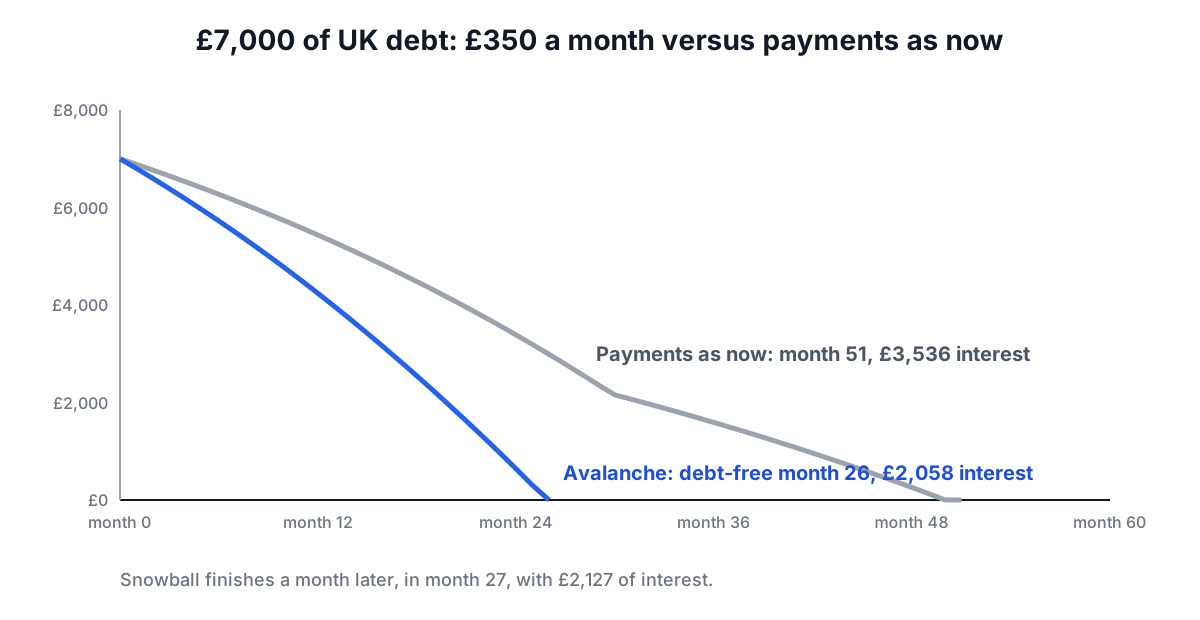
The avalanche plan clears the overdraft first, in month 12, then the store card in month 16 and the card in month 26. An arranged overdraft is often the most expensive debt a household has: since April 2020 FCA rules have made banks charge it as a single annual interest rate, and that rate is frequently higher than a credit card's.
The Debt Payoff Calculator runs these plans for your own debts. It charges APR ÷ 12 each month, which slightly overstates interest on a UK APR. For an exact match, enter the monthly equivalent rate: 22.44% for a 24.9% APR, 26.45% for 29.9% and 34.05% for 39.9%.
When minimum payments become persistent debt
FCA rules define persistent credit card debt as paying more in interest, fees and charges than you repay of the balance over 18 months. Paying a flat £130 a month on the £4,200 card at 24.9% does exactly that: over 18 months £1,250.82 goes on interest and only £1,089.18 off the balance. Your card provider then has to contact you, and if it continues for 36 months, it must offer ways to repay faster, which can include reducing or waiving interest.
When a 0% balance transfer helps
Moving the £3,500 balance of a 24.9% card to a 0% offer for 24 months with a 3.49% fee costs £122.15. Pay £150.92 a month and it is gone inside the offer for the cost of the fee; pay £120 and £742.15 is left when the standard rate returns. The UK Balance Transfer Calculator finds the payment that clears your balance in time. It only works if the card is not used for new spending.
How lenders look at your debts
UK mortgage lenders do not use a US-style debt-to-income ratio. They start from a multiple of income, and the Bank of England's Financial Policy Committee limits the share of new mortgages at 4.5 times income or more to about 15% across the market. Within that, each lender's affordability check takes committed spending off your income, and car finance is usually the largest item. A £542 HP payment can noticeably reduce what you are offered. If a mortgage application is coming, it is usually better to apply before taking new car finance, or to clear a small loan first. The UK Mortgage Affordability Calculator shows the income multiple for your salary.
Student loans are not like other debt
Student loans in the UK are repaid through payroll as a share of income above a threshold, and the balance is written off after a set time. The current repayment thresholds are:
| Plan | Repay | On income above |
|---|---|---|
| Plan 1 | 9% | £26,900 |
| Plan 2 (England and Wales, courses from 2012) | 9% | £29,385 |
| Plan 4 (Scotland) | 9% | £33,795 |
| Plan 5 (England, courses from August 2023) | 9% | £25,000 |
| Postgraduate Loan | 6% | £21,000 |
On a £35,000 salary, a Plan 2 borrower repays £505.35 a year (about £42 a month) and a Plan 5 borrower £900 a year (£75 a month). The balance and its interest do not change the payment at all; only your income does. Plan 2 loans are written off 30 years after the April you were first due to repay, and Plan 5 loans after 40.
That changes the usual advice. Paying extra on a card or overdraft always saves interest. Paying extra on a student loan only saves money if you would otherwise clear it before the write-off; for many Plan 2 borrowers on average earnings, the extra is simply money that would have been written off. Clear the expensive debts first.
Putting it together
- For a car, compare HP and PCP on the total amount payable, not the monthly figure, and check what you would owe halfway through.
- Know your half-way point under sections 99 and 100 before you need it.
- For cards and overdrafts, fix a monthly total above the minimums and aim it at the highest APR.
- If you have paid mostly interest on a card for 18 months, expect your provider to contact you, and ask what help it offers.
- Before a mortgage application, avoid new car finance in the months before.
- Leave student loan overpayments until everything else is cleared, and then only if you would repay it in full anyway.
If you are struggling, MoneyHelper's free debt advice tool finds a free adviser, and the Breathing Space scheme can pause interest, charges and enforcement on most debts for up to 60 days while you get advice. For the biggest loan most households take on, see the mortgage guide.
Frequently asked questions
Is PCP or HP better?
HP costs less in total because every payment reduces the debt, and you own the car at the end. PCP has lower monthly payments and gives you the choice to hand the car back at the end, but costs more interest and leaves you owing more for longer. In the example, PCP costs £1,823.87 more interest over four years.
Can I give my car back halfway through the finance?
On HP and PCP, yes: once you have paid half the total amount payable, or by paying up to that half, you can end the agreement under the Consumer Credit Act and return the car, as long as it has been reasonably cared for. On the example PCP that point comes after 36 payments because the final payment counts towards the total.
Should I pay off my overdraft or credit card first?
Usually the overdraft, if its rate is higher, which it often is. The avalanche method pays the highest APR first; in the example it clears the 39.9% overdraft in month 12 and saves about £70 against the snowball method.
Does car finance affect getting a mortgage?
Yes. Lenders take committed monthly payments off your income in their affordability check, so a car finance payment can reduce the amount offered, and a new credit application shortly before a mortgage can count against you. Applying for the mortgage first is usually safer.
Should I overpay my student loan?
Only after clearing more expensive debts, and only if you expect to repay the loan in full before it is written off. Repayments are 9% of income above the threshold whatever the balance, so many Plan 2 borrowers never repay the whole amount.
Sources and further reading
- Our work on motor finance: update, Financial Conduct Authority. PCP as hire purchase with a balloon linked to the GMFV.
- Consumer Credit Act 1974, section 100, legislation.gov.uk. Liability on voluntary termination of a hire-purchase agreement.
- Car finance claims, Financial Conduct Authority. The redress scheme and its current status.
- Help for consumers who are in persistent credit card debt, Financial Conduct Authority. The 18-month and 36-month stages.
- PS19/26: High loan to income lending, Bank of England. The 15% limit on new mortgages at 4.5 times income or more, applied across the market from 28 October 2026.
- Repaying your student loan: what you pay, GOV.UK. Thresholds and rates by plan.
- When your student loan gets written off or cancelled, GOV.UK.
- Can Small Victories Help Win the War? Evidence from Consumer Debt Management, Journal of Marketing Research. Gal and McShane on paying off small balances first.
More Loans & Mortgages
Every tool in the Loans & Mortgages section, free and in your browser.