
BMI in Stones and Pounds: the NHS Bands Explained
How to work out BMI from stones, pounds, feet and inches, what the NHS and NICE bands mean, why some groups use 23 and 27.5, and when the waist matters more.
By Redbison Dev · · 6 min read
United Kingdom edition. Worked in stones, pounds, feet and inches, with the NHS adult bands, the NICE NG246 lower thresholds, the UK90 centiles used for children and the waist-to-height ratio the NHS asks for. US edition
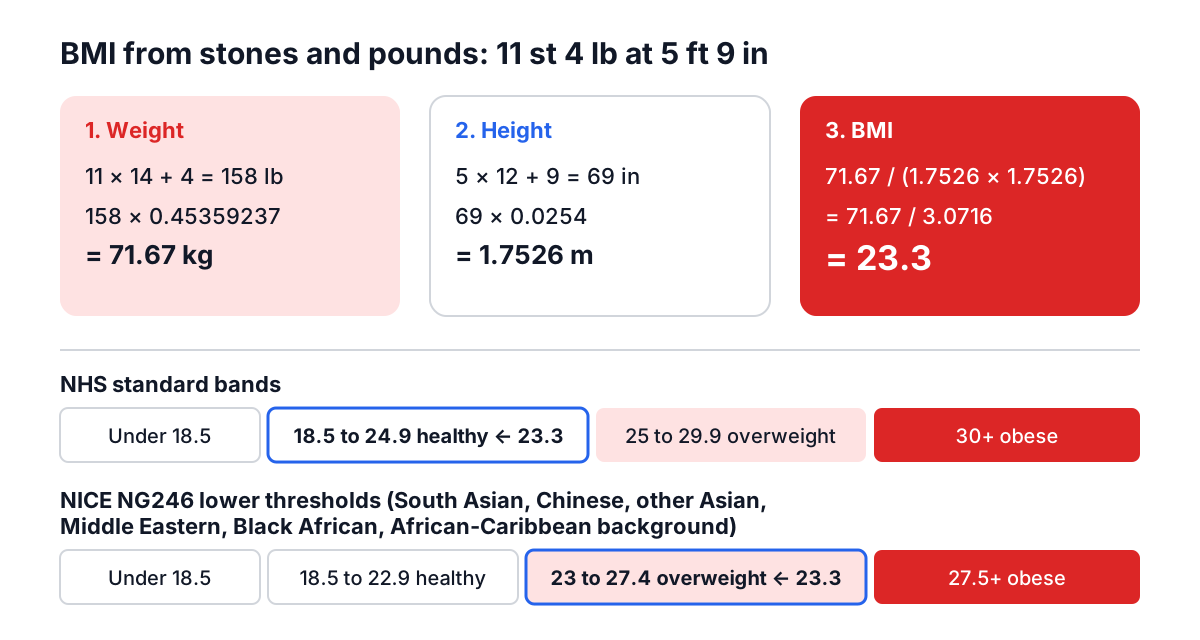
Most people in Britain step on the bathroom scales and read stones and pounds, then give their height in feet and inches. The NHS bands, though, are set in kilograms per square metre. At 5 ft 9 in and 11 st 4 lb your BMI is 23.3: a healthy weight on the standard NHS scale, but overweight on the lower scale NICE uses for people of South Asian, Chinese, other Asian, Middle Eastern, Black African or African-Caribbean family background. This guide shows how to get from stones to a BMI, which set of bands applies to you, and what the NHS looks at next.
It is general information. If you are worried about your weight, your GP or practice nurse can check it properly and tell you what services exist where you live.
From stones and pounds to a BMI
BMI is weight in kilograms divided by height in metres, squared. In the UK that means two conversions first:
Weight: (stones × 14 + pounds) × 0.45359237 = kg
Height: (feet × 12 + inches) × 0.0254       = m
BMI:    kg / (m × m)
For 11 st 4 lb and 5 ft 9 in:
11 × 14 + 4 = 158 lb      158 × 0.45359237 = 71.67 kg
5 × 12 + 9 = 69 in        69 × 0.0254      = 1.7526 m
1.7526 × 1.7526 = 3.0716
71.67 / 3.0716 = 23.33, shown as 23.3
If you prefer to stay in pounds and inches throughout, BMI is 703 × pounds ÷ inches². The UK BMI calculator does the arithmetic for you when you choose "Stones and pounds": whole stones in one box, the extra pounds in the other, so 12 st 9 lb is entered as 12 and 9, not 12.9. Typing 12.9 into a single box is the most common way to get a wrong answer, because 0.9 of a stone is 12.6 lb, not 9.
One stone is 6.35 kg. A loss of half a stone (3.2 kg) moves a 5 ft 9 in adult's BMI by just over 1 point; at 5 ft 2 in the same loss moves it by about 1.3, because the height squared is smaller.
Two sets of bands in the UK
The NHS uses the World Health Organization bands for most adults, and a lower set for people whose family background carries higher cardiometabolic risk at a given weight:
| BMI | Most adults (NHS) | South Asian, Chinese, other Asian, Middle Eastern, Black African or African-Caribbean background (NICE NG246) |
|---|---|---|
| Under 18.5 | Underweight | Underweight |
| 18.5 to 22.9 | Healthy weight | Healthy weight |
| 23 to 24.9 | Healthy weight | Overweight |
| 25 to 27.4 | Overweight | Overweight |
| 27.5 to 29.9 | Overweight | Obese |
| 30 and over | Obese | Obese |
The lower thresholds come from NICE guideline NG246, recommendation 1.9.11, which carries forward the public health action points of 23 and 27.5 proposed by a 2004 WHO expert consultation on Asian populations. The reasoning is that people from these backgrounds tend to store more fat centrally and develop type 2 diabetes and heart disease at a lower BMI. The NHS adult BMI calculator asks about ethnic background for the same reason.
Mixed heritage is not covered by a clear rule. If one side of your family is from one of the listed groups, it is reasonable to read both columns and pay more attention to your waist, below.
What weight crosses each line
Because so many people in the UK think in stones, here is where each threshold falls for common heights. Weights are rounded to the nearest pound.
| Height | BMI 18.5 | BMI 23 | BMI 25 | BMI 27.5 | BMI 30 |
|---|---|---|---|---|---|
| 5 ft 0 in | 6 st 11 lb | 8 st 6 lb | 9 st 2 lb | 10 st 1 lb | 11 st 0 lb |
| 5 ft 2 in | 7 st 3 lb | 9 st 0 lb | 9 st 11 lb | 10 st 10 lb | 11 st 10 lb |
| 5 ft 4 in | 7 st 10 lb | 9 st 8 lb | 10 st 6 lb | 11 st 6 lb | 12 st 7 lb |
| 5 ft 6 in | 8 st 3 lb | 10 st 3 lb | 11 st 1 lb | 12 st 2 lb | 13 st 4 lb |
| 5 ft 8 in | 8 st 10 lb | 10 st 11 lb | 11 st 10 lb | 12 st 13 lb | 14 st 1 lb |
| 5 ft 10 in | 9 st 3 lb | 11 st 6 lb | 12 st 6 lb | 13 st 10 lb | 14 st 13 lb |
| 6 ft 0 in | 9 st 10 lb | 12 st 2 lb | 13 st 2 lb | 14 st 7 lb | 15 st 11 lb |
| 6 ft 2 in | 10 st 4 lb | 12 st 11 lb | 13 st 13 lb | 15 st 4 lb | 16 st 10 lb |
Read across your row: on the NHS standard scale the healthy range runs from the 18.5 column to just under the 25 column; on the lower scale it ends just under the 23 column. At 5 ft 4 in that is the difference between a ceiling of about 10 st 5 lb and one of about 9 st 7 lb.
Three readers, three answers
These are the examples in the UK calculator, worked with its own function.
5 ft 9 in, 11 st 4 lb: BMI 23.3. Healthy on the NHS standard scale. For someone of Indian, Pakistani or Bangladeshi heritage it is overweight on the NICE scale. Neither is a diagnosis, but in the second case a waist check and, if your GP agrees, a blood sugar test are worth more than the BMI itself.
5 ft 4 in, 10 st 7 lb: BMI 25.2. Overweight on both scales. About a pound and a half separates her from 24.9, so on the standard scale this is a borderline result. On the lower scale the healthy range ends at about 9 st 7 lb at her height, a stone away.
6 ft 0 in, 15 st: BMI 28.5. Overweight on the standard scale, obese on the lower one. A front-row forward of this size may carry little fat, which BMI cannot tell from muscle. The NHS notes exactly this: the calculator "cannot tell the difference between muscle and fat". The tape measure settles it.
The waist: half your height
The NHS puts it simply: keep your waist to less than half your height. NICE NG246 (recommendation 1.9.14) turns that into bands for adults with a BMI under 35, the same for all ethnicities:
| Waist-to-height ratio | NICE description |
|---|---|
| 0.4 to 0.49 | Healthy central adiposity |
| 0.5 to 0.59 | Increased health risks |
| 0.6 or more | High health risks |
In inches, a 5 ft 9 in (69 in) adult should keep the waist under 34.5 in, and a 5 ft 4 in (64 in) adult under 32 in. Measure halfway between the bottom of your ribs and the top of your hips, after breathing out normally, not where your trousers sit. The NHS has a separate waist-to-height ratio tool; the UK waist-to-hip ratio calculator also reports the ratio from the same tape measurements.
The waist is where the two scales converge. A 6 ft rugby player with a 33 in waist has a ratio of 0.46 whatever his BMI says. A 5 ft 4 in woman with a healthy BMI of 22 and a 35 in waist has a ratio of 0.55, a reason to act that BMI alone would miss.
Children: centiles, not bands
The adult table does not apply to anyone still growing. The NHS children's BMI calculator covers ages 2 to 17 and uses the same data as the Royal College of Paediatrics and Child Health growth charts. The UK compares a child's BMI with the UK 1990 reference for their age and sex, and uses two pairs of lines:
| Purpose | Overweight | Obesity |
|---|---|---|
| Clinical assessment of an individual child | 91st centile and above | 98th centile and above |
| Population monitoring (surveys and prevalence statistics) | 85th centile and above | 95th centile and above |
A 2012 joint statement from the Scientific Advisory Committee on Nutrition and the RCPCH recommended keeping all four lines for these two jobs, and used National Child Measurement Programme data (the Reception and Year 6 measurements in England) to show how much the choice moves the prevalence figures. So a headline percentage of children "overweight" and a GP's assessment of one child are not drawn on the same lines, and the second sets a higher bar.
When the number unlocks NHS help
BMI decides eligibility for some NHS services, and the thresholds move with your background.
- Weight management services and medicines are set by NICE guidance and commissioned locally, so what is available differs between areas. Your GP can tell you what applies.
- Weight loss surgery may be considered on the NHS at a BMI of 40 or more, or 35 to 40 with a condition that might improve with weight loss, such as type 2 diabetes or high blood pressure. NICE NG246 applies a 2.5-point reduction to BMI thresholds for people of South Asian, Chinese, other Asian, Middle Eastern, Black African or African-Caribbean background, and the NHS surgery page notes that surgery may be considered below 40 for these groups.
This is one reason to know which column you sit in: a BMI of 38 with no related condition is below the standard bar of 40 but above the lowered one of 37.5.
Mistakes that skew a UK reading
- Entering 10.7 for 10 st 7 lb. As above, decimals of a stone are not pounds.
- Using shoe-on height. An inch of heel at 5 ft 4 in lowers BMI by about 0.8.
- Comparing two sets of scales. Bathroom scales and pharmacy scales often differ by a pound or two; track one set, at the same time of day.
- Reading a child's result off the adult table. Use the children's calculator or a growth chart.
- Ignoring age. Over about 65, muscle loss can hide fat behind a healthy BMI. The waist ratio and a GP review matter more.
Where to go next
If the result points to a change, the UK calorie calculator estimates your daily need against the NHS 2,000 and 2,500 kcal guide, and the UK edition of the guide to BMR and TDEE explains how that estimate is built. The UK ideal weight calculator gives a target range in stones as well as kilograms, and the UK body fat calculator estimates fat percentage from tape measurements. The original BMI guide covers the history of the index and how it was chosen.
Frequently asked questions
Is 11 stone overweight at 5 ft 5 in?
At 5 ft 5 in, 11 st 0 lb gives a BMI of 25.6, just inside the overweight band on the NHS standard scale. On the lower NICE scale it is also overweight. Losing about 4 lb would bring it under 25. Check your waist too: under 32.5 in at that height is a healthy waist-to-height ratio.
Why does the NHS ask about my ethnic background?
Because NICE NG246 uses lower BMI thresholds (23 for overweight and 27.5 for obesity) for people of South Asian, Chinese, other Asian, Middle Eastern, Black African or African-Caribbean family background. These groups tend to develop type 2 diabetes and heart disease at a lower BMI, so the standard 25 and 30 would miss risk.
What BMI is a healthy weight for a South Asian adult in the UK?
On the NICE thresholds, 18.5 to 22.9. At 5 ft 6 in that is roughly 8 st 3 lb to 10 st 2 lb. A BMI of 23 to 27.4 is overweight, and 27.5 or more is obese.
Why do child obesity statistics use different centiles from my GP?
The SACN and RCPCH statement keeps two pairs of lines on the UK 1990 reference: the 85th and 95th centiles for population monitoring and prevalence figures, and the 91st and 98th centiles for assessing an individual child in clinic. A child between the 85th and 91st centiles counts towards the overweight statistics but is not classed as overweight in clinic.
How do I convert my weight in stones to kilograms?
Multiply the stones by 14, add the extra pounds, then multiply by 0.45359237. So 13 st 2 lb is 184 lb, or 83.5 kg. A quick check is 6.35 kg to the stone.
Sources and further reading
- Obesity: diagnosis, NHS. Adult BMI bands, the 23 and 27.5 thresholds for some ethnic groups, and the half-your-height waist advice.
- Calculate your BMI for adults, NHS. The adult calculator, which asks about ethnic background.
- Calculate BMI for children and teenagers, NHS. Ages 2 to 17, using RCPCH growth chart data.
- Weight loss surgery: why it's done, NHS. BMI criteria for surgery and the lower threshold for some backgrounds.
- Overweight and obesity management (NG246), National Institute for Health and Care Excellence. Recommendations 1.9.11 (lower BMI thresholds) and 1.9.14 (waist-to-height ratio bands).
- Consideration of issues around the use of BMI centile thresholds for defining underweight, overweight and obesity in children, SACN and RCPCH (GOV.UK), 2012. The 85th/95th and 91st/98th centile lines.
- Appropriate body-mass index for Asian populations and its implications for policy and intervention strategies, The Lancet, 2004. The WHO expert consultation behind the 23 and 27.5 action points.
More Fitness Calculators
Every tool in the Fitness Calculators section, free and in your browser.
- BMI Calculator
- Calorie Calculator
- Protein Calculator
- Hydration Calculator
- Calorie Deficit Planner
- Body Fat Calculator
- Ideal Weight Calculator
- Running Pace Calculator
- Target Heart Rate Calculator
- One Rep Max Calculator
- Barbell Plate Calculator
- RPE Calculator
- Interval Timer
- Calories Burned Calculator
- Body Surface Area Calculator
- Waist-to-Hip Ratio Calculator
- VO2 Max Calculator
- Steps to Distance & Calories Calculator