
How Many Calories Do I Need a Day? BMR and TDEE in the UK
Where the NHS 2,000 and 2,500 kcal figures come from, how the SACN energy method compares with a calorie calculator, and how to set a 1 to 2 lb a week target.
By Redbison Dev · · 6 min read
United Kingdom edition. Uses the NHS 2,000 and 2,500 kcal guide, the SACN dietary reference values for energy (Henry equations and measured activity levels), kcal and kJ as on UK labels, NHS weight loss rates in pounds and kilograms, and examples in stones. US edition
The NHS rule of thumb is about 2,000 kcal a day for a woman and 2,500 kcal for a man. The 2,000 kcal figure is the reference intake on UK food labels, but your own need can be several hundred kcal either side. A 40-year-old woman who is 163 cm, 68 kg (10 st 10 lb) and lightly active comes out at about 1,840 kcal on the UK calorie calculator, roughly 160 kcal below the label figure. This guide explains what the calculator's estimate is made of, how it compares with the method the UK's own nutrition advisers use, and how to turn it into a target for losing 1 to 2 lb a week.
It is general information. If you have diabetes, kidney disease, an eating disorder or another medical condition, speak to your GP or a registered dietitian before changing what you eat.
Two numbers: resting energy and the day's total
Your body spends most of its energy just keeping you alive: heart, brain, liver, temperature. That is the basal metabolic rate (BMR). On top come digestion, every step you take, and any exercise. Total daily energy expenditure (TDEE) is the sum, and it is the number that keeps your weight steady.
Every method in use estimates the total the same way:
TDEE = BMR × activity factor
They differ in the equation used for BMR and in what the activity factor represents.
How the calculator does it: Mifflin-St Jeor
The calculator predicts resting energy with the Mifflin-St Jeor equation, published in 1990 and found in a 2005 systematic review to be the common equation most likely to land within 10% of measured values:
Men:    10 × kg + 6.25 × cm − 5 × age + 5
Women:  10 × kg + 6.25 × cm − 5 × age − 161
For the woman above:
BMR  = 10 × 68 + 6.25 × 163 − 5 × 40 − 161
     = 680 + 1,018.75 − 200 − 161 = 1,337.75 kcal
TDEE = 1,337.75 × 1.375 (light) = 1,839 kcal, or 7,690 kJ
If you know your weight in stones, convert it first: stones × 14, plus the pounds, times 0.45359237. So 14 st 2 lb is 198 lb, or 89.8 kg. The equation needs kilograms and centimetres.
How the UK sets its reference figures: SACN
The Scientific Advisory Committee on Nutrition published the UK's dietary reference values for energy in 2011. Its method uses the same multiplication but different ingredients:
- BMR from the Henry equations (2005), calculated at a healthy body weight, one equivalent to a BMI of 22.5 at the population's average height, not at people's actual weight.
- Physical activity level (PAL) taken from doubly labelled water studies, which measure the total energy people really spend over one to two weeks. In the reference population the median PAL was 1.63, with 1.49 at the 25th centile and 1.78 at the 75th.
The result is an estimated average requirement of 2,605 kcal (10.9 MJ) a day for men and 2,079 kcal (8.7 MJ) for women. SACN also noted that the older COMA figures from 1991 assumed a PAL of only 1.4 for adults, which it judged too low because it underplayed the energy cost of ordinary daily life.
The NHS 2,500 and 2,000 kcal are rounded population figures in the same territory. None of them is your personal number: SACN's values are averages for groups at a healthy weight, while the calculator estimates for one person at their current weight.
The activity setting matters more than the equation
Here is the calculator's activity scale next to the activity levels SACN found when energy use was actually measured:
| Calculator setting | Factor | SACN reference point |
|---|---|---|
| Sedentary | 1.2 | Below 1.27; only 38 of the 929 adults measured (about 4%) had a PAL that low |
| Light | 1.375 | Close to the bottom of the usual range (1.38 to 2.5) |
| Moderate | 1.55 | Between the 25th centile (1.49) and the median (1.63) |
| High | 1.725 | Between the median (1.63) and the 75th centile (1.78) |
| Very high | 1.9 | Above the 75th centile |
Two cautions before reading too much into the match. The calculator multiplies a Mifflin resting estimate at your actual weight, SACN a Henry BMR at a healthy weight, so the factors are not perfectly interchangeable. And SACN's reference group came from two large US studies (OPEN and Beltsville), used because their levels of overweight and obesity were close to England's.
Even so, the table makes one thing plain. The sedentary setting is a cautious floor, lower than nearly anyone who walks to a bus stop and climbs stairs will measure. That is deliberate: underestimating needs gives you a deficit you can relax, while overestimating gives a "deficit" that is really maintenance. If you are on your feet for part of the day, light is a reasonable start; reserve moderate and above for regular structured exercise.
A worked example in stones
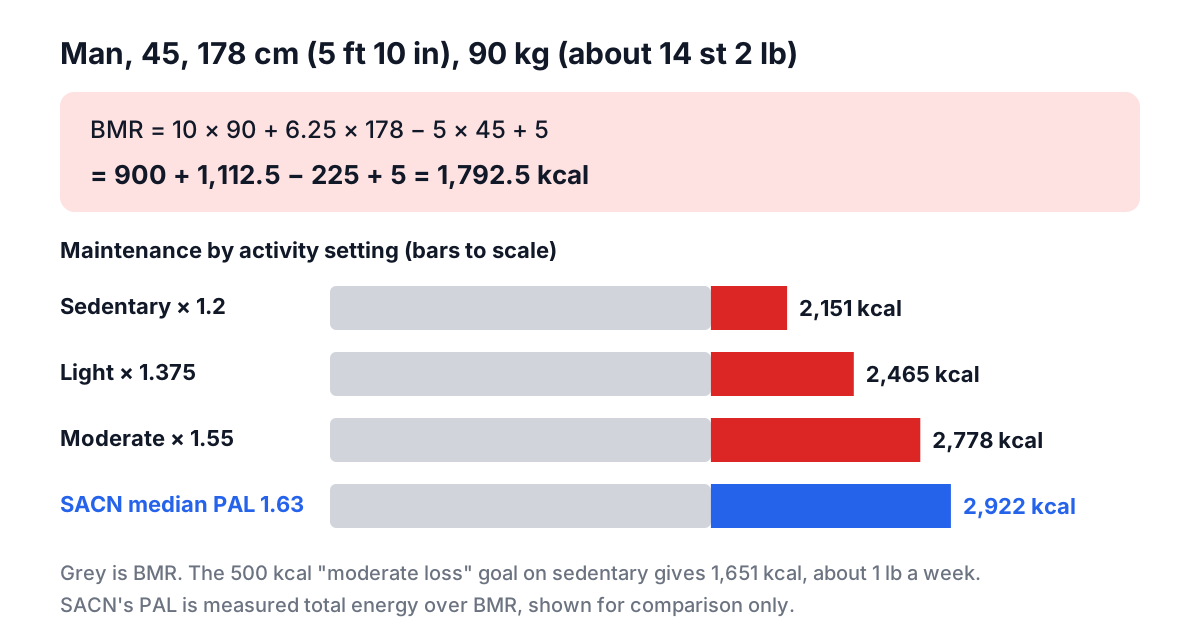
A 45-year-old man, 178 cm (5 ft 10 in), 90 kg (about 14 st 2 lb), with an office job and no regular exercise:
BMR = 10 × 90 + 6.25 × 178 − 5 × 45 + 5
    = 900 + 1,112.5 − 225 + 5 = 1,792.5 kcal
| Setting | Maintenance | With a 500 kcal cut |
|---|---|---|
| Sedentary (1.2) | 2,151 kcal | 1,651 kcal |
| Light (1.375) | 2,465 kcal | 1,965 kcal |
| Moderate (1.55) | 2,778 kcal | 2,278 kcal |
His BMI is 28.4. The calculator's moderate goal gives him 1,651 kcal on the sedentary setting, about 1 lb a week on the 3,500 kcal per pound rule the calculator uses. The NHS suggests losing 0.5 to 1 kg (1 to 2 lb) a week, and NHS Scotland dietitians put that at about 600 kcal a day less than you need. At 1 lb a week, a stone takes about 14 weeks on paper; in practice loss slows as weight falls.
Note the spread across the three rows: over 600 kcal between sedentary and moderate, more than his whole deficit. The activity dropdown, not the equation, is where most calculators disagree. Multiplying his BMR by SACN's median PAL of 1.63 instead gives 2,922 kcal. The two kinds of factor are not strictly interchangeable, as noted above, but it shows how far the sedentary setting sits below a typical measured day, and why it works as a cautious starting point rather than a prediction.
Kilocalories and kilojoules on UK labels
UK nutrition labels must give energy in both kilojoules and kilocalories, according to the NHS. One kcal is 4.184 kJ, so 2,000 kcal is about 8,370 kJ and the woman's 1,839 kcal is about 7,690 kJ. The calculator can show either; pick the one you will compare with packets.
Correcting the estimate with your scales
The equation is a starting point. Your weight over a few weeks is the real answer.
- Eat close to your estimate for two to three weeks and log it honestly.
- Weigh yourself on the same scales, at the same time of day, a few mornings a week, and compare weekly averages rather than single days.
- If the average holds steady, your intake is your maintenance. If it moves, adjust by 100 to 200 kcal and wait another fortnight.
In pounds, a steady change of 1 lb a week means you are about 500 kcal a day away from maintenance on the calculator's rule. Ignore the first week of any change: water and stored carbohydrate can move the scales by a few pounds on their own.
UK-specific traps
- Using the label figure as your target. The 2,000 kcal on a packet is a reference for labelling. For the woman above it would mean a small daily surplus.
- Adding your watch's exercise calories on top. If you chose an activity level that includes your training, you have already counted it.
- Not recalculating. Re-run the calculator after each stone or so. For the 90 kg man, losing 6.35 kg lowers his BMR by about 64 kcal before any change in activity.
- Going below the floor. The calculator's own advice is not to go below 1,200 kcal (women) or 1,500 kcal (men) without medical supervision. Check any target it gives you against that line yourself.
Tools for the next step
The UK calorie deficit planner turns the target into a dated plan in kilograms and stones. The UK protein calculator compares your protein with the UK reference intake, and the UK macro calculator splits your calories against the government dietary recommendations. If you have not yet checked your BMI and waist, the UK edition of the guide to BMI in stones and pounds covers both.
Frequently asked questions
How many calories should I eat a day to lose weight in the UK?
Start from your own maintenance figure, not the 2,000 or 2,500 kcal label guide. The NHS suggests losing 0.5 to 1 kg (1 to 2 lb) a week, which NHS Scotland dietitians put at about 600 kcal a day below what you need. For a lightly active 40-year-old woman of 163 cm and 68 kg, maintenance is about 1,840 kcal, so a target of about 1,300 to 1,350 kcal.
What are the SACN energy requirements for adults?
SACN's 2011 report gives estimated average requirements of 2,605 kcal (10.9 MJ) a day for men and 2,079 kcal (8.7 MJ) for women. They are calculated with the Henry BMR equations at a healthy body weight and a median physical activity level of 1.63 measured by doubly labelled water.
How many calories do I need to cut to lose a stone?
A stone is 14 lb. On the rule of thumb the calculator uses (about 3,500 kcal per pound), that is roughly 49,000 kcal, or 500 kcal a day for about 14 weeks. Expect it to take longer, because your needs fall as you lose weight.
Why is my maintenance figure below 2,000 kcal?
Smaller, older and less active people need less energy. The 2,000 kcal figure is an average used for labelling. A 160 cm woman in her fifties with a desk job will often need well under 1,800 kcal.
Should I choose sedentary or light activity?
If you sit for work but walk to the station, do housework or climb stairs, light is usually closer. In SACN's reference data only about 4% of adults measured had a PAL below 1.27, and the sedentary setting is 1.2. Start with light and let your weight over three weeks tell you whether to move up or down.
Sources and further reading
- Understanding calories, NHS. The 2,000 and 2,500 kcal guide and calories on labels.
- Tips to help you lose weight, NHS. Losing 0.5 to 1 kg (1 to 2 lb) a week.
- What can I do to lose weight?, NHS Scotland (My Diabetes My Way). About 600 kcal a day less for 1 to 2 lb a week.
- Dietary reference values for energy, Scientific Advisory Committee on Nutrition (GOV.UK), 2011. Henry equations, PAL values of 1.49, 1.63 and 1.78, and the adult EARs.
- How to read food labels, NHS. Energy in kJ and kcal.
- A new predictive equation for resting energy expenditure in healthy individuals, The American Journal of Clinical Nutrition, 1990. Mifflin, St Jeor and colleagues.
- Comparison of predictive equations for resting metabolic rate in healthy nonobese and obese adults, Journal of the American Dietetic Association, 2005. Frankenfield and colleagues.
More Fitness Calculators
Every tool in the Fitness Calculators section, free and in your browser.
- BMI Calculator
- Calorie Calculator
- Protein Calculator
- Hydration Calculator
- Calorie Deficit Planner
- Body Fat Calculator
- Ideal Weight Calculator
- Running Pace Calculator
- Target Heart Rate Calculator
- One Rep Max Calculator
- Barbell Plate Calculator
- RPE Calculator
- Interval Timer
- Calories Burned Calculator
- Body Surface Area Calculator
- Waist-to-Hip Ratio Calculator
- VO2 Max Calculator
- Steps to Distance & Calories Calculator