
Car Loan EMI, Education Loans and Clearing Debt in India
Car loan EMI on the on-road price, flat versus reducing rates, clearing card and personal loan debt faster, and how education loan moratorium interest adds up.
By Redbison Dev · · 10 min read
India edition. India edition in rupees with lakh and crore, on-road car loans, the RBI Key Facts Statement and prepayment rules, credit card minimum due rules, FOIR, and education loans with moratorium, CSIS and PM-Vidyalaxmi. US edition
A car with an ex-showroom price of ₹9.5 lakh and ₹1.4 lakh of registration and insurance, bought with ₹2 lakh down, means an ₹8.9 lakh loan. At 9% over five years the EMI is ₹18,474.94 and the interest ₹2,18,496. Stretch it to seven years and the EMI drops to ₹14,319.28, but you pay ₹94,323 more. On the debt side, ₹4 lakh spread across a credit card, a personal loan and a no-cost EMI takes 36 months and ₹1,43,232 of interest at the fixed payments; ₹25,000 a month aimed at the card first clears it in 19 months for ₹63,303.
This edition works through car loans, paying off debt and education loans with Indian rules: lending on the on-road price, the RBI's Key Facts Statement, its prepayment and credit card directions, and the moratorium on education loans. Figures come from the Car Loan EMI Calculator and the other calculators linked below. It explains the arithmetic, not which loan to take; if you are already missing EMIs, talk to your bank before taking on new credit.
Car loans: the EMI starts from the on-road price
Indian banks lend on the on-road price, not just the ex-showroom price. The ex-showroom price already includes GST; registration, road tax and the first year's insurance sit on top. SBI's new car loan, for example, finances up to 100% of the on-road price over up to seven years, with interest on a daily reducing balance.
loan  = ex-showroom price + registration, road tax and insurance − down payment − exchange value
EMI   = P × r × (1 + r)^n ÷ ((1 + r)^n − 1),  r = yearly rate ÷ 12, n = months
| ₹8,90,000 at 9% | EMI | Total interest |
|---|---|---|
| 5 years (60 months) | ₹18,474.94 | ₹2,18,496.17 |
| 7 years (84 months) | ₹14,319.28 | ₹3,12,819.49 |
| 5 years, paying the ₹1,40,000 on-road costs yourself (₹7,50,000 loan) | ₹15,568.77 | ₹1,84,125.99 |
Funding registration and insurance through the loan costs ₹34,370 of interest over five years. Seven years costs ₹94,323 more than five, and the car will be seven years old and worth a fraction of its price when the last EMI is paid.
Flat rate against reducing balance
Some dealers and lenders quote a flat rate, charged on the original loan for the whole tenure. It looks cheap and is not. A 5% flat rate on ₹8,90,000 for five years means ₹2,22,500 of interest and an EMI of ₹18,541.67. Solve for the reducing-balance rate that gives the same EMI and it is about 9.15%, close to double the headline figure. As a rough guide, a flat rate is a little over half the true rate.
Since 1 October 2024, banks and NBFCs must give you a Key Facts Statement before you sign, with the APR including the processing fee and other charges. Compare loans on that APR, not on the quoted rate. The APR calculator works it out the same way, as an internal rate of return on the amount actually paid out.
Prepaying a car loan
Under the RBI's 2025 prepayment directions, floating rate loans to individuals for non-business purposes, sanctioned or renewed from 1 January 2026, cannot carry prepayment charges. Most car loans are fixed rate, where the lender's own policy decides, so read the foreclosure clause in the KFS. If you miss an EMI, the bank may levy a penal charge, but RBI rules say it must be a charge, not penal interest added to your rate, and it cannot be capitalised.
Paying off credit card, personal loan and EMI debt
When you have several debts, choose a fixed monthly amount above the minimums, then pay every minimum and send the extra to one target. When that debt is cleared, keep paying the same total so its old EMI moves to the next one.
- Avalanche: target the highest interest rate first. It always costs the least.
- Snowball: target the smallest balance first. It clears accounts sooner, which keeps some people going.
Take a typical mix: ₹1,20,000 on a credit card at an example 42% a year (3.5% a month), paying ₹6,000 a month; a ₹2,50,000 personal loan at 13% over three years, EMI ₹8,423.49; and ₹30,000 left on a no-cost EMI for a phone or appliance at ₹5,000 a month.
| Plan | Debt-free | Interest |
|---|---|---|
| Fixed payments only (₹19,423 a month, falling as debts end) | month 36 | ₹1,43,232 |
| ₹25,000 a month, avalanche | month 19 | ₹63,303 |
| ₹25,000 a month, snowball | month 19 | ₹65,576 |
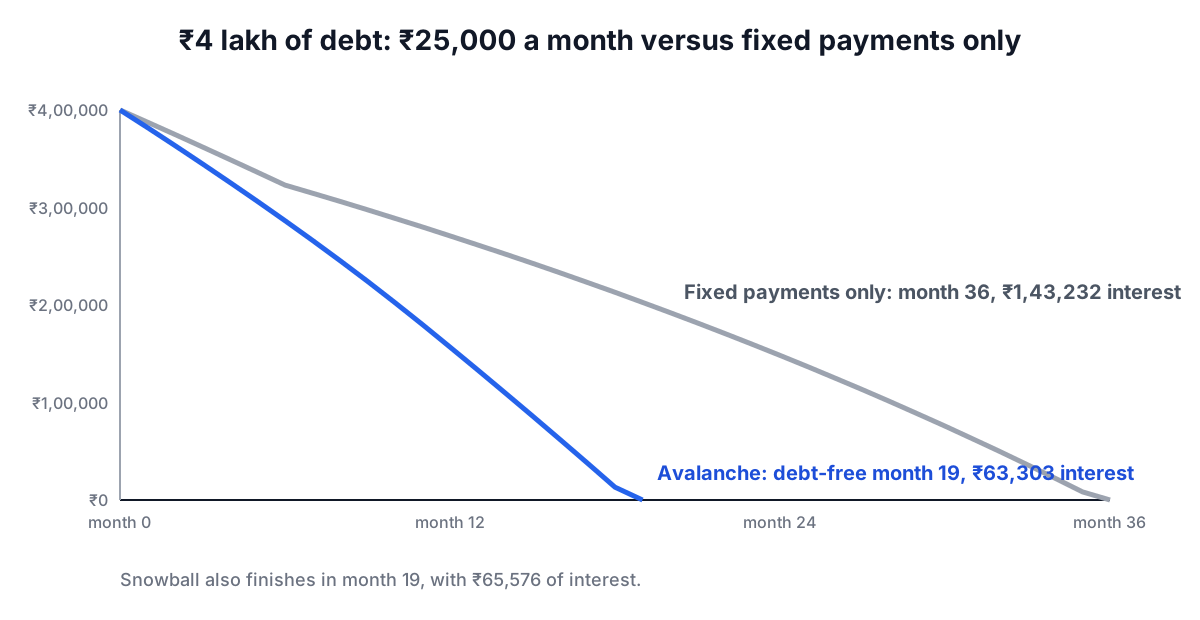
An extra ₹5,577 a month saves ₹79,929 and 17 months. Snowball pays off the interest-free no-cost EMI first, which is why it costs a little more here. Avalanche leaves it running at its own pace, since it costs nothing, and attacks the card. The Debt Payoff Calculator runs both for your own debts; enter each card's yearly rate (monthly rate × 12).
Why the minimum amount due is a trap
The RBI's credit card directions require the minimum amount due to be set so that it never causes negative amortisation, meaning the balance cannot grow if you pay it, and unpaid charges, levies and taxes cannot be added to the balance and charged interest. That protects you from a rising balance, not from a slow one. Paying only 5% of the balance each month (with a ₹500 floor) on ₹1,20,000 at 3.5% a month takes about 182 months and ₹2.37 lakh of interest, about twice the original debt. A fixed payment that does not fall as the balance falls is what changes the outcome.
Should you consolidate into a personal loan?
A personal loan at 13% to clear a card at 42% saves money only if the card then stays at zero. Check the processing fee in the KFS, compare the APR rather than the rate, and keep the tenure short: each extra year lowers the EMI and adds interest.
FOIR: how banks see your EMIs
Indian lenders check your fixed obligations to income ratio (FOIR): total EMIs, including the one you are applying for, as a share of monthly income. The RBI sets no single limit for retail loans; each bank applies its own policy, which often varies with income level and the type of loan.
FOIR = (all EMIs + new EMI) ÷ monthly income
On ₹1,20,000 of monthly in-hand income, the car EMI of ₹18,475 and the personal loan EMI of ₹8,423 already take 22.4%. A home loan EMI of ₹45,000 on top would bring FOIR to 59.9%, which many lenders would treat as stretched. Clearing a small loan before applying, or choosing a larger down payment, brings it down. Lenders also pull your credit report, so a missed EMI shows up on your CIBIL score.
Education loans: the interest before the first EMI
Education loans come with a moratorium, the course period plus one year at most banks, before EMIs begin. Interest still runs during it. SBI's Student Loan Scheme terms charge simple interest during the moratorium, and interest not paid is added to the principal when EMIs start. Check your own bank's terms, as the method can differ.
On ₹10 lakh at 9.5% for a four-year course plus a year:
| Choice | During the moratorium | EMI over 10 years | Total interest |
|---|---|---|---|
| Let interest build up | nothing | ₹19,086.14 on ₹14,75,000 | ₹12,90,337 |
| Pay the interest monthly, with SBI's 1% concession (8.5%) | about ₹7,083 a month | ₹12,398.57 | ₹9,12,828 |
| CSIS subsidy (family income up to ₹4.5 lakh) | Government pays it | ₹12,939.76 | ₹5,52,771 |
The ₹4,75,000 of moratorium interest is the expensive part, because once it is added to the principal it is charged interest for the whole repayment period. Under the Central Sector Interest Subsidy scheme the Government of India bears the moratorium interest on loans up to ₹10 lakh for students with family income up to ₹4.5 lakh, and PM-Vidyalaxmi gives a 3% interest subvention during the moratorium for family income up to ₹8 lakh. The Education Loan EMI Calculator shows each case with your own figures.
A checklist before you sign
- Ask the dealer for the on-road price break-up, and decide which parts you will pay in cash.
- Compare car loans on the APR in each Key Facts Statement, and convert any flat rate to a reducing rate.
- Keep the tenure as short as the EMI allows.
- For existing debts, set a fixed monthly amount above the minimums and aim it at the highest rate.
- Never pay only the minimum amount due on a card for more than a month or two.
- Before a home loan, work out your FOIR and clear small loans first.
- For an education loan, find out whether anyone can pay the moratorium interest, and whether you qualify for CSIS or PM-Vidyalaxmi.
For a single loan's EMI and schedule, the EMI calculator covers home and personal loans too. For the bigger picture of long-term saving, see the India retirement corpus guide.
Frequently asked questions
How do I convert a flat interest rate to a reducing rate?
Work out the EMI the flat rate gives (loan plus flat interest, divided by the months), then find the reducing-balance rate with the same EMI. A 5% flat rate over five years equals about 9.15% on a reducing balance. The Key Facts Statement's APR does this for you and adds the fees.
Is it better to take a car loan for 5 or 7 years?
Five, if you can manage the EMI. On ₹8.9 lakh at 9%, seven years lowers the EMI by ₹4,156 but adds ₹94,323 of interest, and you keep paying while the car loses most of its value.
Which debt should I pay off first?
The one with the highest interest rate, which is almost always the credit card. In the example, aiming the extra payment at the card first saves ₹2,274 compared with clearing the smallest balance first, and both plans save about ₹80,000 against fixed payments only.
What happens if I pay only the minimum amount due?
Interest at the card's monthly rate is charged on the whole unpaid balance, so the debt falls very slowly. RBI rules stop the balance from growing, but on ₹1.2 lakh at 3.5% a month, paying 5% of the balance each month takes about 15 years to clear.
Is interest charged on an education loan during the course?
Yes, unless you have a subsidy. Banks charge simple interest during the moratorium and add it to the principal when EMIs start. Paying it monthly during the course avoids that, and at SBI also earns a 1% concession for the whole tenure.
Sources and further reading
- Key Facts Statement (KFS) for Loans and Advances, Reserve Bank of India. APR including all charges, from 1 October 2024.
- Reserve Bank of India (Pre-payment Charges on Loans) Directions, 2025, Reserve Bank of India. No prepayment charges on floating rate loans to individuals from 1 January 2026.
- Master Direction: Credit Card and Debit Card, Issuance and Conduct Directions, 2022, Reserve Bank of India. Minimum amount due without negative amortisation; unpaid charges not capitalised.
- Fair Lending Practice: Penal Charges in Loan Accounts, Reserve Bank of India.
- SBI New Car Loan Scheme, State Bank of India. On-road funding and tenure up to seven years.
- Student loan repayment, State Bank of India. Moratorium and the 1% concession.
- SBI Student Loan Scheme: most important terms and conditions, State Bank of India. Simple interest during the moratorium, with accrued interest added to the principal.
- Government guidelines on the new CSIS scheme, Punjab National Bank. Moratorium interest subsidy for family income up to ₹4.5 lakh.
More Loans & Mortgages
Every tool in the Loans & Mortgages section, free and in your browser.