
Car Loans, Leases and Debt in Canada: The Math
How HST, trade-ins and term change a Canadian car loan, how a lease payment is built, paying down cards and lines of credit, GDS and TDS, and student loans.
By Redbison Dev · · 10 min read
Canada edition. Canadian edition in Canadian dollars, with GST/HST on trade-ins, Ontario lease and private-sale tax, the 35% criminal rate, CMHC GDS and TDS limits, and interest-free Canada Student Loans with the provincial portion. US edition
At an Ontario dealer, a CA$42,000 car with a CA$12,000 trade-in is taxed only on the CA$30,000 difference, which saves CA$1,560 of HST before the loan starts. With CA$3,000 down, CA$4,000 still owing on the trade and CA$899 of fees, you finance CA$35,799. Over 84 months at 7.49% that is CA$548.92 a month and CA$10,310.13 of interest; over 60 months, CA$717.17 a month and CA$7,231.11. On the debt side, CA$17,500 across two cards and a line of credit takes 51 months and CA$7,696.21 of interest at the current payments, while CA$700 a month aimed at the highest rate first clears it in 32 months for CA$4,394.28.
This edition walks through car loans, leases, paying down debt, the GDS and TDS ratios lenders use, and student loans, with Canadian rules and the figures from the Car Loan Calculator (Canada) and the related calculators below. It explains the math, not which deal to take. If minimum payments are already a struggle, a non-profit credit counselling agency is a better first call than a new loan.
Car loans: tax, trade-ins and term
The payment on a car loan uses the standard annuity formula:
payment = P × r × (1 + r)^n ÷ ((1 + r)^n − 1), r = rate ÷ 12, n = months
What changes from deal to deal is P, the amount financed:
amount financed = price − down payment − (trade-in value − amount owing on it)
                  + GST/HST or GST and PST + dealer fees (if financed)
Tax and the trade-in. The CRA has a dealer charge GST/HST on the price minus the trade-in allowance when the person trading in is not a registrant, which covers a typical driver. In Ontario that turns CA$5,460 of HST on the full CA$42,000 into CA$3,900. A private sale works differently: the buyer pays 13% retail sales tax on the greater of the price paid and the vehicle's wholesale value, and a trade does not reduce it. So selling your old car privately has to raise at least CA$1,560 more than the dealer's offer just to break even on tax.
Term. Seven- and eight-year terms are widely offered, and they cost:
| CA$35,799 at 7.49% | Payment | Interest |
|---|---|---|
| 60 months | CA$717.17 | CA$7,231.11 |
| 84 months | CA$548.92 | CA$10,310.13 |
Two extra years lower the payment by CA$168 and add CA$3,079 of interest. A long loan also keeps you owing more than the car is worth for longer, which is how negative equity builds.
Negative equity. Trade in a car worth CA$12,000 with CA$17,000 owing and no down payment, and the CA$5,000 shortfall joins the new loan: CA$51,799 financed, CA$794.25 a month and CA$14,918.15 of interest over 84 months. You are still paying for the old car, with interest, for seven more years.
The legal ceiling. Since January 1, 2025 the Criminal Code makes it an offence to charge an annual percentage rate above 35% on the credit advanced. Car loans from banks and captive lenders are far below it; some subprime auto and instalment loans come closer. The APR calculator (Canada) shows the rate including fees.
Negotiate the all-in price first, including freight, PDI and dealer fees, then the trade-in, then financing. If the dealer offers 0% or a cash rebate, run both: 0% on the full price, and your own lender's rate on the price less the rebate.
Leases: depreciation, a rent charge and HST on every payment
A lease is priced on the drop in value while you have the vehicle, plus a finance charge, plus tax:
adjusted cap cost = price + capitalized fees − down payment − trade-in
residual          = MSRP × residual %
depreciation      = (adjusted cap cost − residual) ÷ months
rent charge       = (adjusted cap cost + residual) × money factor
payment           = (depreciation + rent charge) × (1 + sales tax rate)
Canadian dealers usually quote a lease rate as a percentage. The money factor is that rate divided by 2,400, so 5.99% is about 0.0025. In Ontario the 13% HST is charged on each payment, not on the vehicle's price.
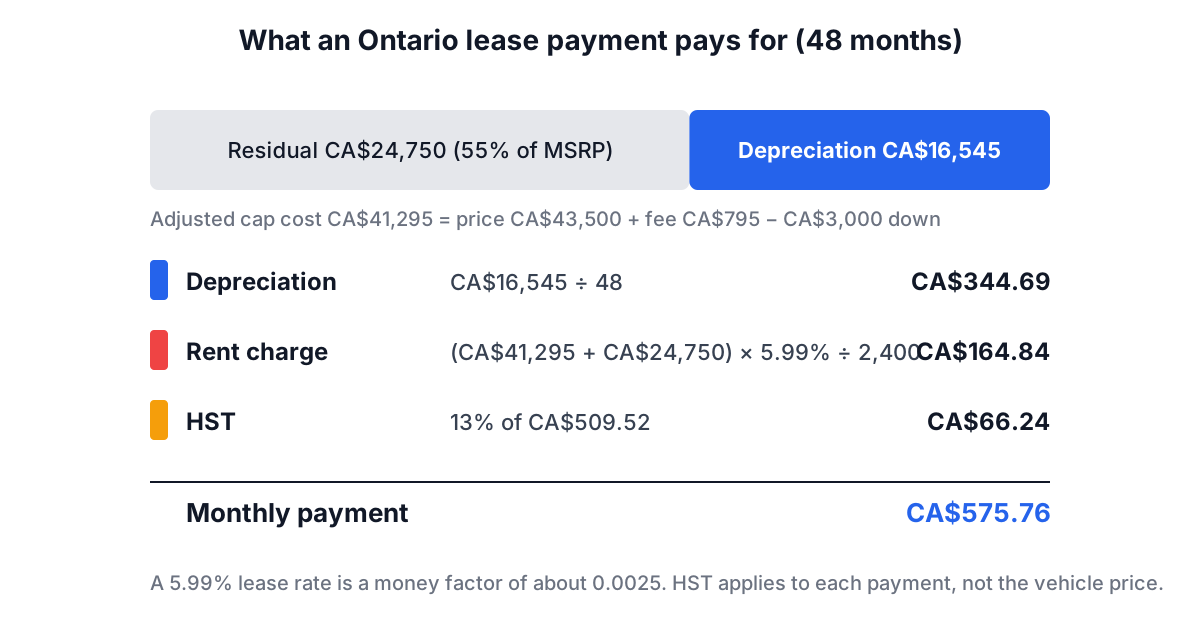
For a CA$45,000 MSRP vehicle negotiated to CA$43,500, with CA$3,000 down, a CA$795 acquisition fee, a 55% residual and 5.99% over 48 months, the payment is CA$509.52 before tax and CA$575.76 with HST. The total lease cost, payments plus the down payment, is CA$30,636.63, and buying the vehicle at the end costs the CA$24,750 residual. A 36-month lease on the same vehicle with a 62% residual comes to CA$615.60 a month with HST.
The FCAC notes that lease payments are generally lower than loan payments for the same term, but you may pay more overall and you do not own the vehicle, and that breaking a lease early can be very costly. Kilometre allowances and wear charges at turn-in are not in the payment; pick an allowance you will actually stay under. The Car Lease Calculator (Canada) rebuilds a dealer's quote from the residual and lease rate.
Paying down cards and lines of credit
With several debts, the method matters less than a fixed monthly total above the minimums. Pay every minimum, send the extra to one target, and when a debt is gone keep the same total so its old payment rolls to the next.
- Avalanche targets the highest rate first and always costs the least interest.
- Snowball targets the smallest balance first and clears accounts sooner.
Take a CA$9,000 Visa at 20.99% (CA$270 a month), a CA$2,500 store card at 29.99% (CA$100) and CA$6,000 on a line of credit at 11.5% (CA$150).
| Plan | Debt-free | Interest |
|---|---|---|
| Payments as now, CA$520 a month falling as debts clear | month 51 | CA$7,696.21 |
| CA$700 a month, avalanche | month 32 | CA$4,394.28 |
| CA$700 a month, snowball | month 32 | CA$4,796.49 |
| CA$800 a month, avalanche | month 27 | CA$3,629.49 |
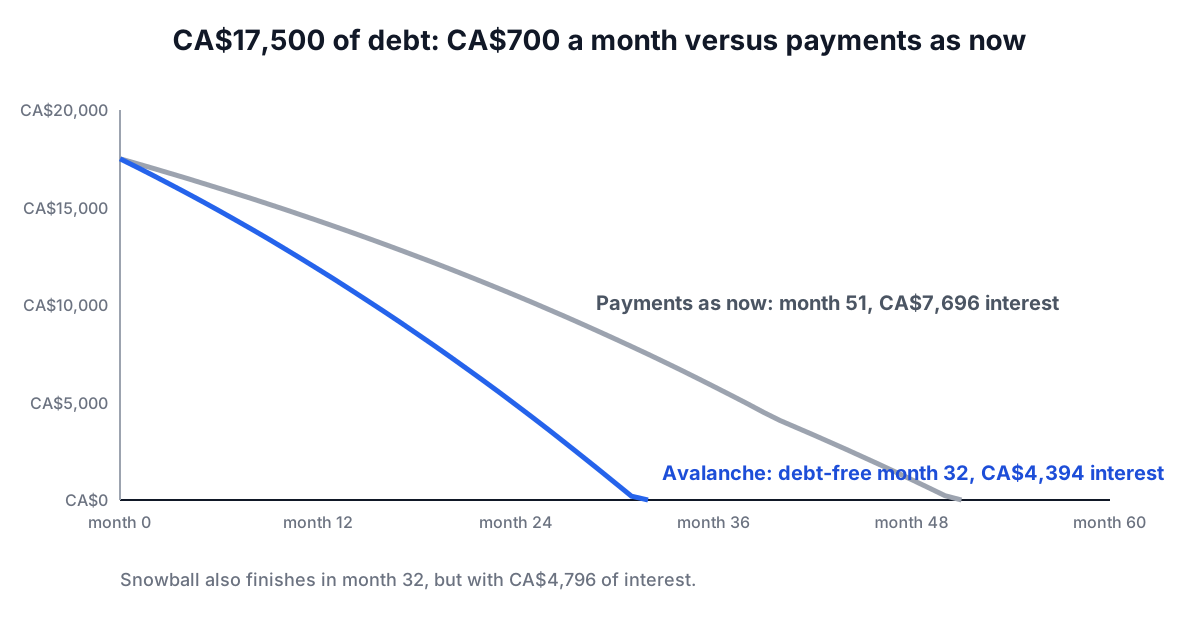
Here the choice of method is worth about CA$400, because the snowball pays down the cheap line of credit before the Visa. The choice to pay CA$180 a month more is worth CA$3,300 and 19 months. The Debt Payoff Calculator runs the plans for your own balances. If one loan looks simpler, the Debt Consolidation Calculator (Canada) compares a fixed-rate loan with the same debts; the FCAC warns that you may only qualify for a higher rate than your current products, and that consolidation fails if the cards fill up again.
GDS and TDS: what a mortgage lender sees
Canadian lenders do not use the US front-end and back-end DTI. They use the gross debt service (GDS) and total debt service (TDS) ratios, and CMHC caps insured mortgages at GDS 39% and TDS 44%:
GDS = (mortgage payment + property tax + heating + 50% of condo fees) ÷ gross monthly income
TDS = (GDS costs + all other debt payments) ÷ gross monthly income
The mortgage payment is worked out at the qualifying rate, the greater of the contract rate plus 2 points or 5.25%, not the rate you will actually pay. A CA$560,000 mortgage at 4.19% over 25 years costs CA$3,003.68 a month, but at the 6.19% qualifying rate it is CA$3,646.40. With CA$425 of property tax and CA$130 of heating, housing is CA$4,201.40.
On a CA$135,000 household income (CA$11,250 a month) that is a GDS of 37.35%. A CA$650 car payment takes TDS to 43.12%, just inside 44%, with CA$98.60 a month of room. Add a second CA$400 car payment and TDS reaches 46.68%, over the limit. That is the practical point: if a home purchase is coming, finance the car afterwards, or pay off a small loan first. The GDS and TDS Calculator shows your room under 44%.
Student loans: the federal part is interest-free
Most Canadian student loans have two parts. Interest on Canada Student Loans was permanently eliminated from April 1, 2023; the provincial part depends on the province. Ontario charges prime plus 1% on its portion of OSAP, including during the six-month grace period, and adds that grace-period interest to the principal. British Columbia eliminated interest on its student loans in 2019.
| Portion | Balance | Rate | Payment over 9.5 years | Interest |
|---|---|---|---|---|
| Canada Student Loan | CA$18,000 | 0% | CA$157.89 | none |
| Ontario portion | CA$9,000 (CA$9,245.25 after grace interest) | example 5.45% | CA$104.08 | CA$2,864.74 |
An extra CA$100 a month on the Ontario portion clears it in 51 months instead of 114 and cuts its interest to CA$1,374.50. The same CA$100 on the federal portion saves nothing, because it charges no interest. And a card at 20.99% beats both as the place for spare money. If payments are hard to manage, the Repayment Assistance Plan can reduce or pause them based on family income. The Student Loan Calculator (Canada) runs each portion separately.
Putting it together
- Settle the car price, then the trade-in, then financing, and check the amount financed and the tax on it.
- For a lease, get the residual, lease rate, fees and kilometre allowance in writing and rebuild the payment.
- For debts, fix a monthly total above the minimums and aim it at the highest rate.
- Before a mortgage application, check GDS and TDS at the qualifying rate and hold off on new car financing.
- Put extra student loan payments on the provincial portion only after higher-rate debts are gone.
For the mortgage itself, the Mortgage Calculator (Canada) handles CMHC premiums and half-yearly compounding.
Frequently asked questions
Do I pay HST on the full price when I trade in my car?
Not at a dealer. The CRA has the dealer charge GST/HST on the price minus the trade-in allowance when you are not a GST/HST registrant. In Ontario a CA$12,000 trade-in saves CA$1,560 of HST. On a private purchase in Ontario, the buyer pays 13% RST on the greater of the price and the wholesale value, with no reduction for a trade.
Is an 84-month car loan a bad idea?
It is expensive. On CA$35,799 at 7.49%, 84 months instead of 60 lowers the payment by about CA$168 but adds CA$3,079 of interest, and it leaves you owing more than the car is worth for longer, which makes the next trade-in harder.
Should I pay off my line of credit or credit card first?
Usually the credit card, because its rate is higher. In the example, paying the 29.99% store card and the 20.99% Visa before the 11.5% line of credit saves about CA$400 compared with clearing the smallest balance first.
What are the GDS and TDS limits for a mortgage?
For CMHC-insured mortgages, at most 39% of gross household income for housing costs and 44% for housing plus all other debt payments, both worked out at the qualifying rate. Private insurers and lenders on uninsured mortgages set their own limits.
Should I pay extra on my student loan?
Only on the part that charges interest. Canada Student Loans have been interest-free since April 1, 2023, so extra payments there only finish sooner. Extra payments on an interest-bearing provincial portion, after higher-rate debts, save real money.
Sources and further reading
- GST/HST in special cases (trade-ins), Canada Revenue Agency. Tax on the price minus the trade-in allowance.
- Retail Sales Tax: specified vehicles, Government of Ontario. 13% RST on private used vehicle sales.
- Car financing options, Financial Consumer Agency of Canada. Loans and leases compared.
- Criminal Code, section 347, Justice Laws. The criminal interest rate above 35% APR.
- Calculating GDS / TDS, CMHC. Limits of 39% and 44% and the qualifying rate.
- Government of Canada provides interest-free loans for students, Employment and Social Development Canada.
- Pay back OSAP, Government of Ontario. Prime plus 1% on the Ontario portion.
- Debt consolidation, Financial Consumer Agency of Canada.
More Loans & Mortgages
Every tool in the Loans & Mortgages section, free and in your browser.