
Rent or Buy in New Zealand: Weekly Rent vs a Mortgage
Is it better to rent or buy in NZ? Compare weekly rent with a 20% deposit or a 5% First Home Loan by net worth, with rates, LIM costs and price growth tested.
By Redbison Dev · · 6 min read

New Zealand edition. Written for New Zealand renters and first home buyers: NZ dollars, weekly rent, the 20% deposit and 5% First Home Loan, lawyer and LIM costs, council rates, the natural hazards levy in house insurance, rent increase rules and the bright-line test. US edition
A NZ$850,000 house bought with a 20% deposit and a 5.5% loan over 30 years costs NZ$3,860.97 a month in repayments. A similar house rents for NZ$650 a week, which is NZ$2,816.67 a month. Comparing those two numbers tells you little. Comparing what each household owns after ten years tells you more: if prices rise 3% a year and the renter invests the deposit at 6%, the renter is NZ$25,496 ahead after 10 years and still ahead after 20. Raise price growth to 4% and buying moves ahead in year 4. This edition walks through that comparison with the Rent or Buy Calculator (New Zealand), and the NZ rules and costs that belong in it. It explains a method, not advice for your situation; a mortgage adviser or financial adviser can look at your own numbers.
Start with the weekly rent
New Zealand rents are quoted by the week, and a common slip is turning a weekly rent into a monthly one by multiplying by four. A year has 52 weeks, so:
monthly rent = weekly rent × 52 ÷ 12
NZ$650 a week is NZ$2,816.67 a month, not NZ$2,600. Over a year the "times four" shortcut hides NZ$2,600 of rent, which is enough to tilt a close comparison.
What goes into an NZ comparison
The deposit. settled.govt.nz says most lenders ask first home buyers for a deposit of at least 20%; on a NZ$900,000 home that is NZ$180,000. With a First Home Loan underwritten by Kāinga Ora, you might need only a 5% deposit. Don't confuse this with the sales deposit you pay the agent when you sign, usually around 10% of the price, which is part of the price rather than an extra cost.
Day-one costs. Lawyer or conveyancer fees, a building inspection, the council LIM report, any bridging finance, and moving and reconnecting services. Residential purchases do not usually include GST, though there are exceptions when either party is GST registered.
Running costs. Council rates, house insurance, maintenance, and body corporate levies for a unit or townhouse. House insurance includes the Natural Hazards Commission levy, collected by your insurer; the maximum levy is currently NZ$480 plus GST a year for residential building cover that is generally capped at NZ$300,000 plus GST per event.
No tax deduction. Inland Revenue says the residential property deduction rules do not apply to your main home; deductions are claimed against rental income, so the calculator's tax rate stays at 0 for an owner-occupier.
Selling costs. When you leave, agent commission and marketing come out of the sale price. The NZ version defaults to 3%; use the quote you would expect for your area.
How the comparison works
The calculator runs two households side by side. On day one the buyer pays the deposit and day-one costs, and the renter invests the same money. Every year, whichever household spent less on housing invests the difference. At the end, the buyer's net worth is the home's value after selling costs, less the loan still owing, plus anything invested; the renter's is the portfolio. The gap between them is the answer.
Worked example: an NZ$850,000 house
Inputs: NZ$850,000 price, NZ$170,000 deposit, 5.5% over 30 years, NZ$4,000 of lawyer, LIM and inspection costs, rates NZ$3,800, insurance NZ$2,500, maintenance NZ$4,000, 3% selling costs. Rent NZ$650 a week rising 3% a year, contents insurance NZ$300. Prices grow 3%, investments return 6%, costs rise with 2.5% inflation.
| After | Buy minus rent |
|---|---|
| 1 year | −NZ$29,252 |
| 3 years | −NZ$28,674 |
| 5 years | −NZ$27,969 |
| 10 years | −NZ$25,496 |
| 15 years | −NZ$21,655 |
| 20 years | −NZ$15,882 |
The buyer narrows the gap every year but does not catch up within 20 years on these assumptions. The reason is the monthly gap: repayments plus rates, insurance and upkeep start more than NZ$1,800 a month above the rent, and the renter invests that difference every year.
Which assumptions decide it
Change one input at a time and the ten-year answer swings by more than the house's day-one costs:
| Change from the base case | Break-even | Buy minus rent after 10 years |
|---|---|---|
| Base case | none within 10 years | −NZ$25,496 |
| Prices grow 4% a year | year 4 | +NZ$86,906 |
| Prices grow 2% a year | none | −NZ$128,494 |
| Mortgage rate 4.5% | year 4 | +NZ$58,866 |
| Mortgage rate 6.5% | none | −NZ$111,905 |
| Rent NZ$750 a week | year 5 | +NZ$54,296 |
| Rent rises 5% a year | year 9 | +NZ$19,678 |
| Investments return 5% | year 8 | +NZ$16,672 |
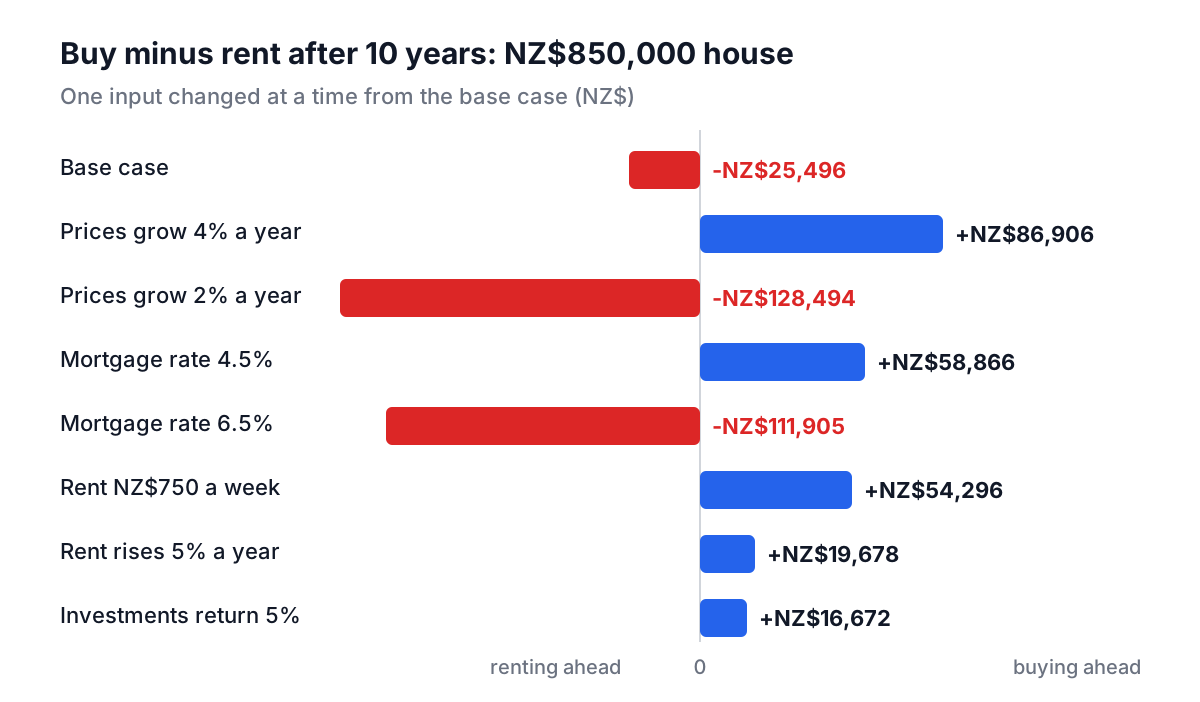
Price growth and the mortgage rate move the result most. One point of price growth is worth more than NZ$100,000 either way over ten years. Many NZ home loans are fixed for a set period and then refixed at whatever rates apply then, so the 5.5% here is an average guess over the whole period, not a quote. Run the calculator at a low, middle and high rate and see whether the answer changes sign.
Worked example: a 5% First Home Loan
A NZ$650,000 townhouse with a 5% deposit (NZ$32,500), NZ$3,500 of day-one costs, rates NZ$3,000, insurance NZ$2,000 and maintenance NZ$3,000, against renting at NZ$550 a week (NZ$2,383.33 a month), other assumptions as above:
- repayments are NZ$3,506.10 a month on a NZ$617,500 loan;
- buying moves ahead in year 6 and leads by NZ$25,101 after 10 years.
With a 20% deposit (NZ$130,000) on the same townhouse, repayments fall to NZ$2,952.50, but buying moves ahead a year later, in year 7, and leads by NZ$21,160 after 10 years. A small deposit leaves the renter little to invest, so the opportunity cost that keeps the renter ahead in the first example is much smaller. Check the actual rate and fees a low-deposit loan carries, because a higher rate changes this quickly.
NZ rules that change the timing
- Bright-line test. For residential property sold on or after 1 July 2024, a gain is taxable if you sell within 2 years of the bright-line start date (usually when title passes, generally settlement). A property that has been your main home is generally excluded, if your use meets Inland Revenue's criteria. It matters if plans change and you sell a home you did not live in.
- KiwiSaver first-home withdrawal. If you have contributed to KiwiSaver for at least 3 years you may be able to withdraw savings towards a first home. That money would otherwise stay invested, so in the calculator it belongs in the deposit, and the renter's side should assume it stays in KiwiSaver earning a return.
- Rent increases. A landlord can only raise rent 12 months after the tenancy started and 12 months after the last increase, with at least 60 days' written notice, but the law does not limit how much it can rise. Tenancy Services' Market Rent tool shows rents for similar homes nearby, which helps you choose a realistic rent increase.
What the calculator does not model
Your security of tenure as a renter, the freedom to renovate or keep pets as an owner, the risk of being forced to sell in a downturn, and the cost of moving again are real but not in the net worth figure. Neither is any change in KiwiSaver contributions or the tax on investment returns, which in practice reduce the renter's 6%. If the result is close, those factors should decide it, not the last thousand dollars.
Frequently asked questions
Is it cheaper to rent or buy in New Zealand?
It depends mostly on price growth, the mortgage rate and how long you stay. For an NZ$850,000 house renting at NZ$650 a week, renting stays ahead for 10 years at 3% price growth and a 5.5% rate, while 4% growth or a 4.5% rate puts buying ahead from year 4.
How do I convert weekly rent to monthly?
Multiply by 52 and divide by 12. NZ$650 a week is NZ$2,816.67 a month. Multiplying by four gives NZ$2,600 and understates a year's rent by NZ$2,600.
How much deposit do I need to buy a house in NZ?
settled.govt.nz says most lenders ask first home buyers for at least 20%, so NZ$180,000 on a NZ$900,000 home. A First Home Loan underwritten by Kāinga Ora might need only 5%.
Does the bright-line test apply to my own home?
Generally not when the property has been your main home and your use meets Inland Revenue's criteria. For other residential property sold on or after 1 July 2024, a gain is taxable if sold within 2 years of the bright-line start date.
Sources and further reading
- Thinking about your finances when buying, settled.govt.nz. Deposits, First Home Loan, KiwiSaver first-home withdrawal, sales deposit and buying costs.
- The bright-line test, Inland Revenue. The 2-year period and start and end dates.
- Increasing rent, Tenancy Services. Rent increases once every 12 months with 60 days' written notice; Market Rent tool.
- About natural hazards cover, Natural Hazards Commission Toka Tū Ake. Levy of up to NZ$480 plus GST and the NZ$300,000 plus GST building cap.
- Residential rental property deductions, Inland Revenue. Deductions belong against rental income, not an owner-occupied home.
Open the Rent vs Buy Calculator
More Analysis Tools
Every tool in the Analysis Tools section, free and in your browser.