
Compound Interest Australia: Savings, Term Deposits, Super
How compound interest works in Australian dollars: daily-calculated savings interest, bonus rate conditions, term deposits, offset accounts and super growth.
By Redbison Dev · · 6 min read
Australia edition. Written for Australians: examples in Australian dollars, savings accounts that calculate interest daily and pay monthly, bonus rate conditions, term deposits and ATO timing, offset accounts, super growth from the 12% Super Guarantee and the Financial Claims Scheme. US edition
Leave $20,000 in an Australian savings account at 4.5% for three years and you finish with $22,884.96 if the interest is paid monthly and left in, against $22,823.32 if it were paid once a year. Over 30 years in super, the same arithmetic turns a $40,000 balance plus $765 a month into $1,009,357.02 at 6% after fees. Compound interest is small month to month and large over decades, and in Australia it shows up in bonus saver conditions, term deposit options, your offset account and your super.
This edition works through those cases in Australian dollars (AUD) with the Australian compound interest calculator and the term deposit interest calculator. It explains the maths; it is not advice on any account or fund.
How compounding works
A = P × (1 + r/n)^(n × t)
P is the starting balance, r the annual rate as a decimal, n the number of times interest is added each year, and t the years. Each time interest is added, the next period's interest is worked out on a slightly bigger balance. Regular deposits add a second part, which the calculator works out period by period.
Savings accounts: daily interest, paid monthly
Most Australian savings accounts calculate interest on the daily balance and pay it monthly, so the interest compounds monthly. The difference from annual compounding is real but modest:
| Interest added | $20,000 at 4.5% after 3 years | Interest |
|---|---|---|
| Annually | $22,823.32 | $2,823.32 |
| Quarterly | $22,873.49 | $2,873.49 |
| Monthly | $22,884.96 | $2,884.96 |
| Daily | $22,890.55 | $2,890.55 |
Monthly crediting adds $61.64 over three years compared with annual crediting; daily adds only $5.59 more. The rate itself matters far more than how often it is paid.
Bonus rates and the base rate
Many Australian savings accounts pay a headline bonus rate only in months when you meet conditions, such as depositing a set amount and making no withdrawals; otherwise they pay a much lower base rate. Compounding magnifies the gap. Saving $500 a month for five years at 4.5% compounded monthly gives $33,572.78, of which $3,572.78 is interest. If the account paid an illustrative base rate of 1.5% instead, the same deposits would give $31,133.47, only $1,133.47 of interest. Use the base rate for any month you might miss the conditions.
Term deposits: interest at maturity or along the way
A term deposit fixes the rate for the term. For terms longer than a year, banks typically offer interest paid at maturity, annually, or monthly, and the rate can differ between options. At the same rate, what happens to the interest changes the total:
| $50,000 at 4.4% for 3 years | Interest |
|---|---|
| Interest paid out to another account (simple) | $6,600.00 |
| Interest added annually | $6,894.66 |
| Interest added monthly | $7,041.64 |
The term deposit interest calculator shows all three: choose Simple Interest for interest paid away, or Compound Interest with the crediting frequency.
When the ATO counts the interest
Interest is assessable income. The ATO says you declare interest in the income year it is credited to you, and if a term deposit is rolled over or reinvested at maturity, you declare the interest earned as at the rollover date. A two-year deposit that pays everything at maturity can therefore put two years of interest into one income year, which may push part of it into a higher marginal rate. Give your bank your tax file number, or tax may be withheld from the interest.
Offset accounts: compounding in reverse
An offset account turns the arithmetic around. Moneysmart explains that the balance in an offset account is subtracted from the home loan balance each day before interest is calculated, and that the account itself earns no interest. Owe $750,000 with $50,000 in the offset, and you are charged interest on $700,000.
Because the money reduces interest you would otherwise pay, it earns, in effect, your home loan rate. For an owner-occupier that saving is not taxable income, while savings interest is. So money in an offset against a loan at a higher rate than your savings account, and with no tax on the saving, usually works harder than the same money in a savings account. The trade-off is discipline: the money is easy to spend.
Super: compound growth over a working life
From 1 July 2025 employers pay the Super Guarantee at 12% of ordinary time earnings. On a $90,000 salary that is $900 a month, or $765 after the 15% contributions tax the fund deducts. Starting from $40,000 and adding $765 a month for 30 years:
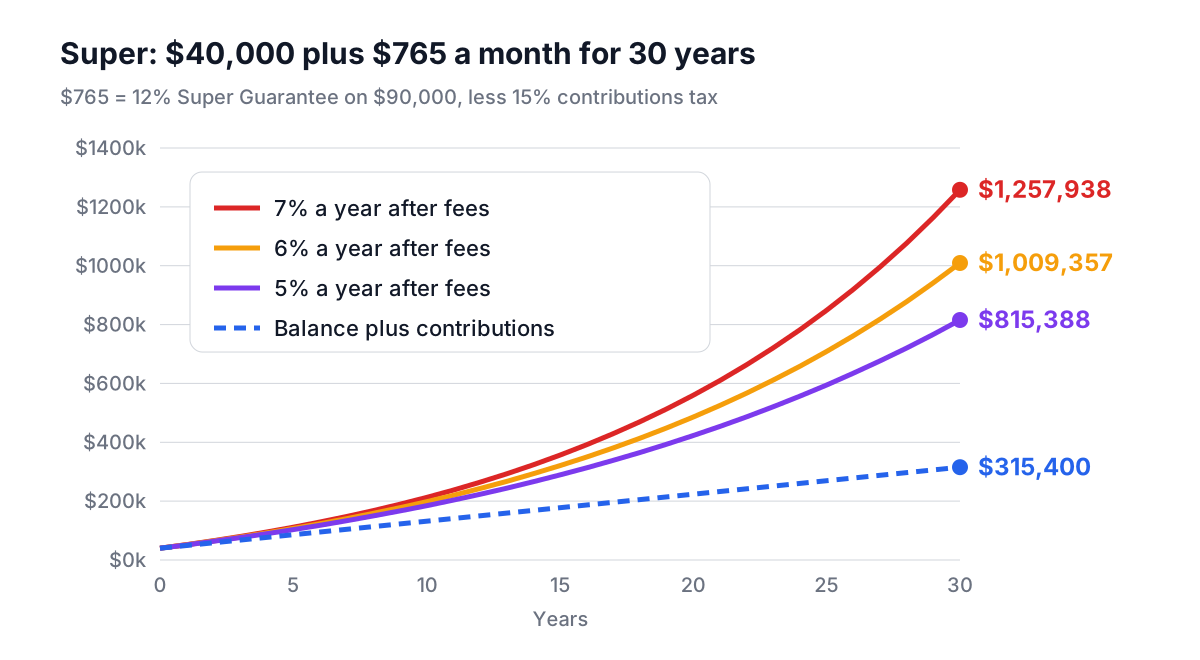
| Return after fees and earnings tax | Balance after 30 years | Of which growth |
|---|---|---|
| 5% a year | $815,387.63 | $499,987.63 |
| 6% a year | $1,009,357.02 | $693,957.02 |
| 7% a year | $1,257,937.71 | $942,537.71 |
The starting balance and contributions total $315,400 in every row. Two percentage points of return separate the 5% and 7% outcomes by more than $440,000, which is why fees and the investment option matter as much as contributions. Enter the net return your fund reports; super funds tax earnings at up to 15% in accumulation phase and charge fees. These figures are in future dollars, before inflation.
The rule of 72 and the 2 to 3% target
Divide 72 by the yearly rate to estimate how long money takes to double: at 4.5%, about 16 years; at 6%, about 12. The rule works for prices too. The Reserve Bank's target is CPI inflation of 2 to 3%, aiming for the 2.5% midpoint. At 2.5% inflation, prices double in about 29 years, so a savings account at 4.5%, taxed at a 30% marginal rate, grows purchasing power by only about 0.65% a year.
Mistakes Australians make with compound interest
- Planning on the bonus rate. One missed condition drops that month to the base rate.
- Comparing term deposits on the headline rate alone. Check whether the interest is paid at maturity, annually or monthly, and whether the rate differs.
- Forgetting tax timing. Interest is income when it is credited, including at rollover.
- Ignoring the deposit guarantee limit. The Financial Claims Scheme covers up to $250,000 per account holder at each authorised deposit-taking institution; brands sharing a banking licence share one limit.
- Using a gross return for super. Use the return after fees and earnings tax.
Tools for this job
- Australian compound interest calculator: savings and super with regular deposits and a year-by-year table.
- Term deposit interest calculator: interest paid out against interest added.
- Australian savings goal calculator: the monthly amount needed for a target such as a home deposit.
- Australian investment calculator: regular investing or a lump sum outside super.
The US edition of this guide covers the same formula with US terms.
Frequently asked questions
How is interest calculated on Australian savings accounts?
Most banks calculate interest on the closing balance each day and pay it monthly, so it compounds monthly. $20,000 at 4.5% grows to $22,884.96 over three years that way, $61.64 more than with annual crediting.
Is a term deposit with monthly interest worse than interest at maturity?
At the same rate, interest added and left to compound earns slightly more than interest paid out. Banks often set a lower rate for monthly payment, so compare the options at their own rates. Monthly interest paid out suits people who spend the income.
When do I declare term deposit interest to the ATO?
In the income year the interest is credited to you. If the deposit rolls over or is reinvested at maturity, you declare the interest earned at the rollover date, even if you leave it in the account.
How much will my super grow with the 12% Super Guarantee?
It depends mostly on time and the net return. A $40,000 balance plus $765 a month, the Super Guarantee on $90,000 after contributions tax, reaches about $1.01 million after 30 years at 6% after fees, or about $815,000 at 5%, before inflation.
Is an offset account better than a savings account?
Often, if you have a home loan with an offset and the loan rate is higher than the savings rate. Offset money reduces the interest charged on the loan each day, and for an owner-occupier that saving is not taxed, while savings interest is. The account itself pays no interest.
Sources and further reading
- Investment income, Australian Taxation Office. Declaring interest in the year it is credited, including at rollover.
- The final SG rate increase is coming on 1 July, Australian Taxation Office. Super Guarantee of 12% from 1 July 2025.
- Mortgage offset accounts, Moneysmart, ASIC. How the offset balance reduces daily loan interest.
- Compound interest calculator, Moneysmart, ASIC.
- Financial Claims Scheme: banks, building societies and credit unions, Australian Prudential Regulation Authority. $250,000 per account holder per institution.
- Statement on the Conduct of Monetary Policy, Reserve Bank of Australia. Inflation target of 2 to 3%.
- 6.4 Compound Interest, OpenStax.
Open the Compound Interest Calculator
More Calculators
Every tool in the Calculators section, free and in your browser.
- Investment Calculator
- Compound Interest Calculator
- Simple Interest Calculator
- Interest Calculator
- EMI Calculator
- Retirement Calculator
- Time-Weighted Return Calculator
- Savings Goal Calculator
- Inflation Calculator
- CAGR Calculator
- ROI Calculator
- Present and Future Value Calculator
- NPV and IRR Calculator
- 401(k) Calculator
- Roth IRA Calculator
- APY and CD Calculator
- SIP Calculator
- Annuity Calculator
- Bond Price and Yield Calculator
- Currency Converter
- Dividend Calculator
- Stock Average Calculator
- RMD Calculator