
Compound Interest on UK Savings: AER, Gross Rate and Tax
How compound interest works on UK savings in pounds: AER against the gross rate, monthly or annual interest, regular savers, and the Personal Savings Allowance.
By Redbison Dev · · 6 min read
United Kingdom edition. Written for UK savers: worked examples in pounds, AER and gross rates as UK banks quote them, fixed-rate bonds and regular savers, the Personal Savings Allowance, cash ISAs, the FSCS limit and how a UK APR is calculated. US edition
Leave £10,000 in an account paying 4% a year for 30 years and let the interest stay in, and you finish with £32,433.98. Take the interest out each year instead and you have the same £10,000 plus £12,000 of interest received along the way: £22,000. That gap of more than £10,000 is compound interest, and on UK savings it shows up in three everyday choices: whether a bond pays interest out or adds it, how a rate is quoted (AER or gross), and whether tax eats part of each year's interest.
This edition works through those choices with figures in pounds from the UK compound interest calculator and the UK savings interest calculator. It explains the arithmetic; it does not recommend any account.
Interest paid out or interest added
Many UK fixed-rate bonds ask you to choose at account opening: interest paid to another account, or interest added to the bond. Paid-out interest never earns anything, so the total is simple interest, P × r × t. Added interest becomes part of the balance and earns interest itself.
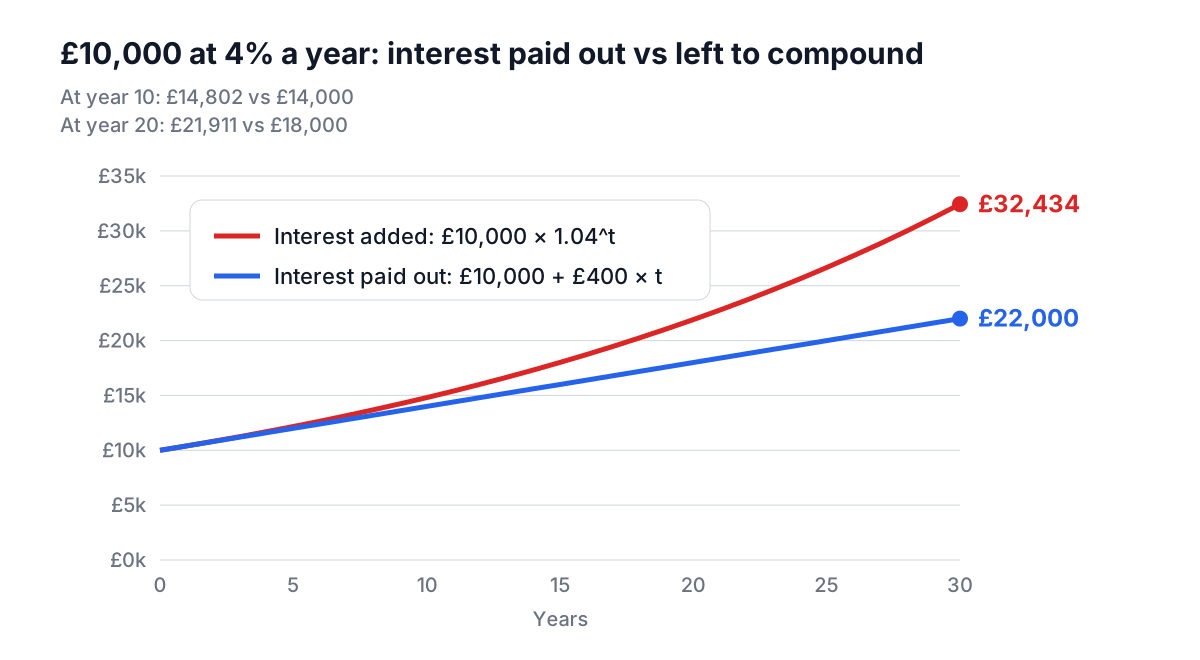
| Years at 4% | Interest paid out (total received plus £10,000) | Interest added (balance) |
|---|---|---|
| 5 | £12,000.00 | £12,166.53 |
| 10 | £14,000.00 | £14,802.44 |
| 20 | £18,000.00 | £21,911.23 |
| 30 | £22,000.00 | £32,433.98 |
Over a two-year bond the choice barely matters: £15,000 at 4.3% earns £1,290.00 paid out and £1,317.73 added, a difference of £27.73. The difference matters when money is left alone for decades, which is why it is the central idea behind pensions and stocks and shares ISAs rather than one-year bonds.
AER and the gross rate
UK savings adverts show two rates. The gross rate is the yearly rate before tax, without compounding. The AER (annual equivalent rate) is what that gross rate would be if interest were paid and compounded once a year. For an account that pays interest annually, the two are the same.
The formula behind the compound interest calculator is the usual one:
A = P × (1 + r/n)^(n × t)
with P the deposit, r the gross rate as a decimal, n the number of times a year interest is added, and t the years. AER is then (1 + r/n)^n − 1.
That gives the two rules for entering a UK rate:
- Enter an AER as a rate per year with annual compounding. £10,000 at 4% AER for five years is £12,166.53. Entering 4% with monthly compounding would count the compounding twice and give £12,209.97.
- Enter a gross rate with the account's real compounding. £10,000 at 4.4% gross, paid monthly, earns £448.98 in a year, which is an AER of about 4.49%.
How much monthly interest adds
Here is £10,000 for five years at a gross 4.5%, compounded at different intervals:
| Interest added | Balance after 5 years | Interest | AER |
|---|---|---|---|
| Once a year | £12,461.82 | £2,461.82 | 4.50% |
| Twice a year | £12,492.03 | £2,492.03 | 4.55% |
| Quarterly | £12,507.51 | £2,507.51 | 4.58% |
| Monthly | £12,517.96 | £2,517.96 | 4.59% |
| Daily | £12,523.05 | £2,523.05 | 4.60% |
Monthly interest is worth £56.14 more than annual interest over five years on £10,000, and daily interest only £5.09 more again. This is why banks offering a monthly-interest version of a bond usually set a slightly lower gross rate: the AER of both versions ends up close. When you compare two accounts, compare AERs and ignore how often the interest is paid.
Regular savers: why 5% does not mean 5% of what you pay in
Regular saver accounts pay some of the highest headline rates in the UK, but the rate only applies to the balance, which starts at nothing. Put £200 a month into a regular saver at 5% for a year and you earn £55.77, not 5% of £2,400 (£120). Your money is in the account for about five and a half months on average.
A larger saver at a higher rate shows the same pattern: £300 a month for a year at 6.5% earns £109.21 on £3,600 paid in. To model one in the UK compound interest calculator, set the principal to 0, the monthly deposit, the rate and monthly compounding, and a term of 1 year. For a goal such as a house deposit, the savings goal calculator works backwards from the target to the monthly amount.
Tax: the Personal Savings Allowance and cash ISAs
Interest outside an ISA is taxable savings income. GOV.UK sets out three layers of tax-free interest for the 2026 to 2027 tax year:
- the Personal Savings Allowance: £1,000 of interest for basic-rate taxpayers, £500 for higher-rate and £0 for additional-rate;
- the starting rate for savings: up to £5,000 of interest tax-free if your other taxable income is below £17,570, reduced by £1 for every £1 of other income above the Personal Allowance;
- interest inside a cash ISA, which does not count towards either.
The worked example: £30,000 at 4.5% AER earns £1,350.00 in a year. A basic-rate taxpayer pays 20% on the £350 above the allowance (£70); a higher-rate taxpayer pays 40% on £850 (£340). In a cash ISA the same interest is tax-free.
Two changes from April 2027 make the calculation harder to ignore. The cash ISA limit for savers under 65 falls to £12,000 a year (the overall ISA limit stays £20,000), and Budget 2026 set income tax rates on savings income of 24%, 44% and 49% from April 2027, against 20%, 40% and 45% in 2026 to 2027. Tax works like a lower rate: at 4.5% interest and a 40% tax rate on every pound above the allowance, the money compounds at about 2.7% after tax.
Compound interest on borrowing: how a UK APR differs
Compounding works against you on credit cards and loans, and the UK quotes those rates differently from many countries. Under the Consumer Credit (Total Charge for Credit) Regulations 2010, the APR equates the present values of what you borrow and what you repay, with time measured in years. It is an annual effective rate that already includes the compounding and the compulsory charges.
So a card with a 24.9% APR and no fees charges about 1.87% a month, because 1.0187^12 is about 1.249. A £2,000 balance left to grow at that rate for three years would reach £3,896.88: enter it in the calculator as 24.9% a year, compounded annually. Real cards require minimum payments, so this is the worst case, but it shows why the rule of 72 says such a balance doubles in about 72 / 24.9 = 2.9 years.
The rule of 72 with UK rates
Divide 72 by the yearly rate to estimate how long money takes to double. At 4% that is 18 years, and the calculator agrees: £10,000 at 4% a year reaches £20,258.17 after 18 years. The same rule works for prices. The Bank of England's inflation target is 2%, and at 2% prices double in about 36 years; at 4% inflation, in about 18. A savings rate below inflation loses purchasing power even while the balance grows.
Mistakes UK savers make with the maths
- Treating AER as a gross rate, or the other way round. Check which one the account page shows before entering it.
- Projecting an easy-access rate for five years. Variable rates change; only a fixed-rate bond fixes the rate for its term.
- Rounding the term. An 18-month bond is 1.5 years: £10,000 at 4% AER gives £10,605.96, not £10,400.
- Forgetting the FSCS limit. The Financial Services Compensation Scheme protects up to £120,000 per person at each authorised bank or building society, including interest. Brands that share a banking licence share one limit.
- Ignoring tax on large bonds. A multi-year bond can push a year's interest over the Personal Savings Allowance, and from April 2027 the rate on the excess goes up.
Tools for this job
- UK compound interest calculator: AER or gross rates, monthly deposits and a year-by-year table.
- UK savings interest calculator: fixed-rate bonds with interest paid out or added.
- UK savings goal calculator: the monthly amount needed for a target.
- UK investment calculator: the same compounding for a stocks and shares ISA or pension, where returns are not fixed.
For investing month by month rather than saving at a fixed rate, see the UK guide to lump sums and monthly investing. The US edition of this guide covers the same maths with US terms (APY and APR).
Frequently asked questions
Should I choose monthly or annual interest on a fixed-rate bond?
Compare the AER of both options. Annual interest left in the bond compounds to slightly more at the same gross rate, so banks usually set a lower gross rate for monthly interest. If the AERs are close, monthly interest suits people who spend the income and annual interest suits people who leave it alone.
How do I put an AER into a compound interest calculator?
Enter it as a rate per year with annual compounding. AER already includes compounding, so entering 4% AER with monthly compounding counts it twice and overstates five years of interest on £10,000 by £43.44.
Is interest from a cash ISA counted in my Personal Savings Allowance?
No. Interest inside an ISA is tax-free and does not use the Personal Savings Allowance or the starting rate for savings, which are left free for interest from accounts outside the ISA.
What monthly rate is a 24.9% APR credit card?
About 1.87% a month, with no fees. A UK APR is an annual effective rate that already includes compounding, so the monthly rate is the one that compounds to 24.9% over twelve months, not 24.9% divided by 12. A rate quoted per month, by contrast, compounds to much more than twelve times itself over a year.
What is £10,000 worth after 10 years at 4% compound interest?
£14,802.44 with interest added once a year, before tax. Taken out each year instead, the interest totals £4,000, so leaving it in adds £802.44. Interest outside an ISA may be taxed each year, which lowers the compounding rate.
Sources and further reading
- Tax on savings interest: how much is tax free, GOV.UK. Personal Savings Allowance and the starting rate for savings.
- Individual Savings Accounts, GOV.UK. £20,000 ISA allowance for the 2026 to 2027 tax year.
- Reduction in the cash ISA limit, HM Revenue and Customs. £12,000 cash ISA limit for under-65s from 6 April 2027.
- Budget 2026: Annex A, rates and allowances, HM Treasury and HMRC. Savings income rates of 24%, 44% and 49% for 2027 to 2028.
- The Consumer Credit (Total Charge for Credit) Regulations 2010, Schedule, paragraph 2, legislation.gov.uk. The APR equation, with time in years.
- Check your money is protected, Financial Services Compensation Scheme. £120,000 per person per authorised firm.
- Inflation and the 2% target, Bank of England.
- Cash savings at a glance, MoneyHelper.
Open the Compound Interest Calculator
More Calculators
Every tool in the Calculators section, free and in your browser.
- Investment Calculator
- Compound Interest Calculator
- Simple Interest Calculator
- Interest Calculator
- EMI Calculator
- Retirement Calculator
- Time-Weighted Return Calculator
- Savings Goal Calculator
- Inflation Calculator
- CAGR Calculator
- ROI Calculator
- Present and Future Value Calculator
- NPV and IRR Calculator
- 401(k) Calculator
- Roth IRA Calculator
- APY and CD Calculator
- SIP Calculator
- Annuity Calculator
- Bond Price and Yield Calculator
- Currency Converter
- Dividend Calculator
- Stock Average Calculator
- RMD Calculator