
Compound Interest in India: FD, RD and PPF Maths
How compounding works on Indian FDs, RDs and PPF in rupees: quarterly and yearly compounding, cumulative versus payout FDs, the 5 April rule and tax.
By Redbison Dev · · 6 min read
India edition. Written for savers in India: rupee examples with lakh and crore, quarterly compounding on bank FDs and RDs, PPF's yearly credit and 5th-of-the-month rule, TDS and Form 121, DICGC cover and the RBI inflation target. US edition
A ₹2 lakh fixed deposit at 7% for three years pays ₹42,000 if you take the interest out every quarter, and ₹46,287.86 if the bank adds it back and compounds it each quarter. Over 15 years, the same idea is why ₹1.5 lakh a year in PPF becomes ₹40,68,209.22 on ₹22.5 lakh deposited. In India, compound interest is not an abstract formula: it decides which FD option you tick, the day of the month you deposit, and how much tax you pay.
This edition works through the Indian products that compound, with every figure from the calculators: the FD interest calculator, the PPF calculator and the RD calculator. It explains the arithmetic and does not recommend any scheme.
Payout or reinvestment: simple and compound interest on an FD
Most bank FD forms offer two options:
- Non-cumulative (payout): interest is paid to your savings account monthly or quarterly. The deposit itself never grows, so you earn simple interest, SI = P × R × T / 100.
- Cumulative (reinvestment): interest is added to the deposit and paid with the principal at maturity. SBI's Reinvestment Plan page, for example, says interest is compounded quarterly and paid at the end of the term.
For ₹2,00,000 at 7% for 3 years:
| Option | Interest | Maturity |
|---|---|---|
| Payout (simple, ₹3,500 a quarter) | ₹42,000.00 | ₹2,00,000 returned |
| Reinvestment (compounded quarterly) | ₹46,287.86 | ₹2,46,287.86 |
The cumulative FD earns ₹4,287.86 more because each quarter's interest earns interest for the remaining quarters. The calculation is A = P × (1 + r/4)^(4t) = 2,00,000 × 1.0175^12. To reproduce it, open the FD interest calculator, choose Compound Interest, Quarterly, ₹2,00,000, 7% and 3 years.
A payout FD is not worse; it suits someone who lives on the interest, such as a retired parent. It just does not compound.
Why 7% quarterly is really 7.19%
Banks quote FD rates per annum, but compounding quarterly makes the effective yearly rate higher. Here is ₹1,00,000 at 7% for 5 years under different compounding:
| Compounding | Maturity after 5 years | Interest | Effective yearly rate |
|---|---|---|---|
| Yearly | ₹1,40,255.17 | ₹40,255.17 | 7.00% |
| Half-yearly | ₹1,41,059.88 | ₹41,059.88 | 7.12% |
| Quarterly | ₹1,41,477.82 | ₹41,477.82 | 7.19% |
| Monthly | ₹1,41,762.53 | ₹41,762.53 | 7.23% |
Going from yearly to quarterly compounding adds ₹1,222.65 on ₹1 lakh over five years; monthly adds only ₹284.71 more. When you compare a bank FD with a post office time deposit or a corporate deposit, compare the effective yearly rate, not just the quoted rate.
PPF: yearly compounding and the 5 April rule
The Public Provident Fund works differently from a bank FD. The National Savings Institute rules say interest is worked out each month on the lowest balance between the 5th and the last day of the month, but credited only once, at the end of the financial year. So PPF compounds yearly, and the date you deposit decides how many months your money earns.
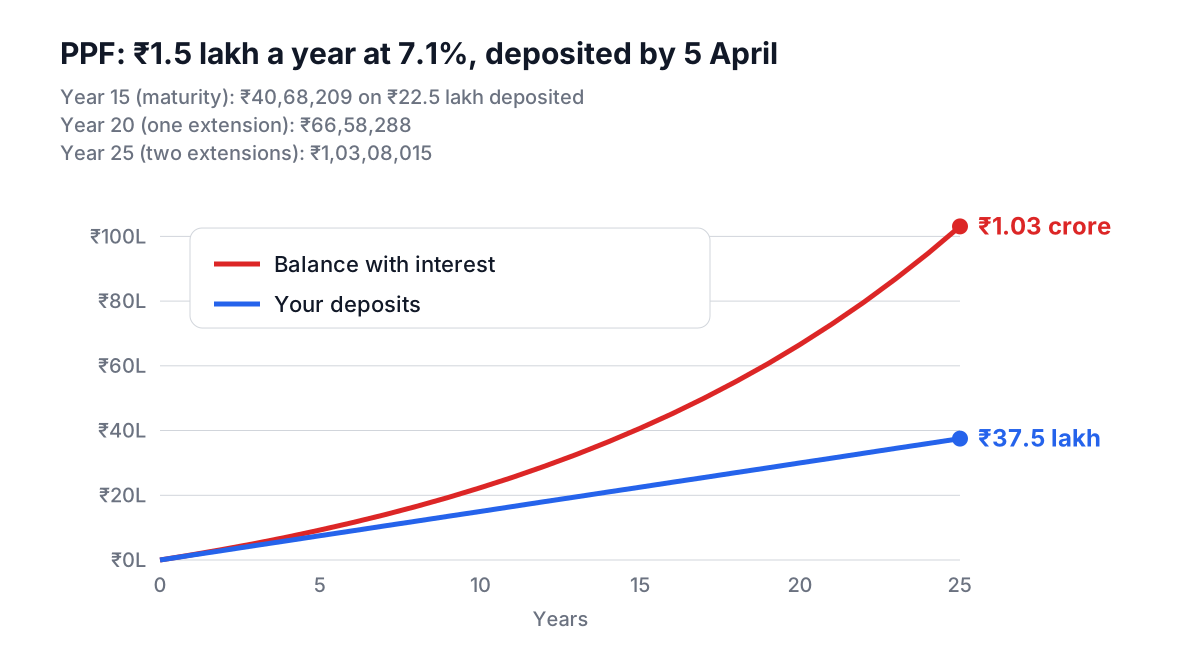
At the 7.1% rate notified for October to December 2026, depositing the full ₹1,50,000 each year:
| Plan | Maturity | Your deposits | Interest |
|---|---|---|---|
| 15 years, deposited by 5 April | ₹40,68,209.22 | ₹22,50,000 | ₹18,18,209.22 |
| 15 years, deposited at year end | ₹37,98,514.68 | ₹22,50,000 | ₹15,48,514.68 |
| 20 years (one extension) | ₹66,58,288.17 | ₹30,00,000 | ₹36,58,288.17 |
| 25 years (two extensions) | ₹1,03,08,014.97 | ₹37,50,000 | ₹65,58,014.97 |
Depositing late every year costs ₹2,69,694.54 over 15 years, because each deposit misses a full year of interest. Extensions show compounding most clearly: years 16 to 20 add ₹7.5 lakh of deposits and about ₹18.4 lakh of interest. The rate is reset each quarter, so treat long projections as estimates.
To run your own numbers, the PPF calculator opens with these defaults: principal 0, a yearly deposit, 7.1% compounded annually, and Deposits Paid In at the start of each period.
RD: monthly instalments with quarterly compounding
A recurring deposit takes a fixed instalment every month, and banks and India Post compound the interest quarterly. Each instalment therefore earns for a different number of months. India Post lists its 5-year RD at 6.7% a year compounded quarterly. ₹5,000 a month for 60 months at that rate matures at ₹3,56,829.14: ₹3,00,000 of deposits and ₹56,829.14 of interest.
Note how much less interest that is than a lump sum: on average an RD rupee is deposited for only about half the term. The RD calculator handles the quarterly compounding and also works backwards from a goal to the monthly instalment.
Tax changes the rate that compounds
Compound interest grows on what you keep. Three Indian rules matter:
- FD and RD interest is taxable at your slab rate every year, whether paid out or reinvested. In the 30% slab, a 7% FD compounds at roughly 4.9% after tax (before cess).
- TDS and Form 121. Banks deduct TDS on interest above a threshold. From 1 April 2026, Form 121 under the Income-tax Act, 2025 replaced Forms 15G and 15H for people whose tax on their total income for the year will be nil.
- PPF interest is tax-free, and deposits count towards the ₹1,50,000 deduction in the old regime only, now in section 123 of the Income-tax Act, 2025 (section 80C of the 1961 Act).
That is why a 7.1% PPF can beat a higher-rate FD for someone in a high slab, and why a payout FD for a retired parent with low total income may lose no tax at all.
When compounding costs you: monthly rates
Informal lending and some credit products in India quote a rate per month. "1% a month" sounds like 12% a year, and it is, if the interest is simple: ₹1,00,000 for a year costs ₹12,000. If unpaid interest is added to the loan every month, it costs ₹12,682.50, an effective 12.68%.
The effect grows quickly at higher monthly rates. If a card's finance charge is 3.5% a month (check the rate in your card's terms), an unpaid ₹50,000 balance would grow to ₹75,553.43 in a year if nothing were paid and the interest compounded monthly: an effective 51.1% a year. Enter such rates in the PPF and compound interest calculator with Rate Duration set to monthly, so the rate is used exactly as quoted.
The rule of 72 with Indian rates
Divide 72 by the yearly rate to estimate how long money takes to double. At PPF's 7.1%, that is about 10.1 years, and the calculator agrees: ₹1,00,000 at 7.1% compounded yearly reaches ₹1,98,561.35 after 10 years.
The rule also works for prices. The RBI's inflation target is 4% CPI inflation, with a band of 2% to 6%, renewed for April 2026 to March 2031. At 4% inflation, prices double in about 18 years. A taxable FD earning 4.9% after tax is growing your purchasing power by less than 1% a year at that inflation.
Mistakes that throw Indian calculations off
- Using yearly compounding for a bank FD. Most cumulative FDs compound quarterly; using yearly understates the maturity.
- Using quarterly compounding for PPF. PPF credits interest once a year.
- Treating an RD like a lump sum. ₹5,000 for 60 months is not ₹3 lakh invested for five years.
- Forgetting DICGC limits. Deposit insurance covers up to ₹5,00,000 per depositor per bank, principal and interest together.
- Ignoring tax. Compare products after tax at your own slab, not on headline rates.
Tools for this job
- FD interest calculator: payout against cumulative FDs with quarterly compounding.
- PPF calculator: yearly deposits, the 5 April timing and five-year extensions.
- RD calculator: monthly instalments with quarterly compounding, or the instalment for a goal.
- Lump sum calculator and SIP calculator: the same compounding for mutual funds, where returns are not fixed.
For market-linked investing, the India guide to SIP and lump sum investing applies the same maths to mutual funds. The US edition of this guide explains the formula without Indian products.
Frequently asked questions
Is FD interest compounded quarterly or yearly in India?
Most banks compound cumulative FD interest quarterly and pay it at maturity; SBI's Reinvestment Plan is one example. A payout FD pays the interest out instead, so it earns simple interest. Check the deposit advice, because some products differ.
How much does a ₹2 lakh FD at 7% give after 3 years?
₹2,46,287.86 as a cumulative FD compounded quarterly, before tax. As a payout FD it pays ₹42,000 of interest over the three years and returns the ₹2 lakh at maturity.
Why is my PPF interest lower than the calculator shows?
Usually because of deposit timing. PPF pays interest on the lowest balance between the 5th and the end of each month, so money deposited after the 5th earns nothing for that month. A full deposit made after 5 April misses the first month of the year.
Is 1% per month the same as 12% per annum?
Only for simple interest. If interest is added to the balance each month, 1% a month compounds to 12.68% a year, so ₹1 lakh costs ₹12,682.50 in a year instead of ₹12,000.
How long does money take to double at 7.1% in PPF?
About ten years. The rule of 72 gives 72 / 7.1 = 10.1 years, and ₹1 lakh at 7.1% compounded yearly reaches ₹1,98,561.35 after ten years, if the rate stays the same.
Sources and further reading
- Public Provident Fund Account, National Savings Institute, Ministry of Finance. Deposit limits, the 5th-of-the-month rule, maturity and extensions.
- Post Office Saving Schemes, India Post. PPF 7.1% compounded yearly and RD 6.7% compounded quarterly for October to December 2026.
- Reinvestment Plan, State Bank of India. Interest compounded quarterly and paid at maturity.
- A guide to deposit insurance, Deposit Insurance and Credit Guarantee Corporation. ₹5,00,000 per depositor per bank.
- Form 121: frequently asked questions, Income Tax Department. Form 121 replaced Forms 15G and 15H from 1 April 2026.
- Section 123 of the Income-tax Act, 2025, ClearTax. The old section 80C deduction under the new Act.
- Speech by Deputy Governor Poonam Gupta, RBI Bulletin, Reserve Bank of India. 4% target with a 2% to 6% band for April 2026 to March 2031.
- 6.4 Compound Interest, OpenStax.
Open the Compound Interest Calculator
More Calculators
Every tool in the Calculators section, free and in your browser.
- Investment Calculator
- Compound Interest Calculator
- Simple Interest Calculator
- Interest Calculator
- EMI Calculator
- Retirement Calculator
- Time-Weighted Return Calculator
- Savings Goal Calculator
- Inflation Calculator
- CAGR Calculator
- ROI Calculator
- Present and Future Value Calculator
- NPV and IRR Calculator
- 401(k) Calculator
- Roth IRA Calculator
- APY and CD Calculator
- SIP Calculator
- Annuity Calculator
- Bond Price and Yield Calculator
- Currency Converter
- Dividend Calculator
- Stock Average Calculator
- RMD Calculator