
Beam Deflection Formulas and IS 800, IS 456 Limits
Where 5wL⁴/384EI comes from, and how Indian steel and RCC beams are checked: IS 800 Table 6 limits, IS 456 span/250 and span-to-depth ratios, ISMB examples.
By Redbison Dev · · 10 min read
India edition. Written for Indian practice: IS 800:2007 Table 6 deflection limits under service live load, IS 456:2000 clause 23.2 limits and span-to-effective-depth ratios for RCC, IS 808 ISMB section properties, Ec = 5000√fck, in kN, metres and mm. US edition
Indian beams are checked for deflection under two different codes depending on the material. Steel beams follow IS 800:2007, which gives span ratios under service live load in Table 6. RCC beams follow IS 456:2000, which limits the final deflection including creep and shrinkage and, for most beams, lets you satisfy the limit through span-to-effective-depth ratios instead of a calculation. Both start from the same formulas. This edition explains where those formulas come from, how the two codes apply them, and worked examples you can repeat in the Beam Deflection Calculator (IS 800, IS 456).
Where the formulas come from
All the standard results solve one equation for an elastic beam whose sections stay plane:
E I d²y/dx² = M(x)
For a simply supported span L with a uniformly distributed load w, the bending moment is M(x) = wx(L − x)/2. Integrating twice, with zero deflection at both supports, gives a deflected shape whose maximum, at midspan, is:
δmax = 5 w L⁴ / (384 E I)
The same steps give PL³/48EI for a central point load, PL³/3EI and wL⁴/8EI for cantilevers, and wL⁴/384EI for a beam fixed at both ends. What matters in practice:
- L⁴. A 10% longer span gives 46% more deflection under a UDL.
- E. IS 800 takes structural steel at 2 x 10⁵ N/mm² (200 GPa) whatever the grade, so E250 and E350 steel deflect equally. For concrete, IS 456 clause 6.2.3.1 gives the short-term modulus as Ec = 5000√fck N/mm²: 25,000 N/mm² for M25 and about 22,360 N/mm² for M20, with actual values within ±20%.
- I. For steel sections take Ixx, the major-axis value, from IS 808:1989 Table 2.1. ISMB 250 has Ixx = 5,130 cm⁴.
Steel: IS 800 Table 6
IS 800:2007 clause 5.6.1 says deflections are checked for the most adverse but realistic combination of service loads by elastic analysis, and calls the Table 6 values recommended limits that can be varied for the finishes and the client's intended use. The load factors for that check have been amended since 2007: Amendment No. 1 (January 2012), printed at the front of the public copy, replaces "a load factor of 1.0" with "load factors of Table 4" and adds that in Table 6, live load should include all post-construction loads, including superimposed dead loads. The BIS standards store lists two amendments to IS 800:2007, so apply the amendments in force when you check a design. For floors and roofs of ordinary buildings under live load:
| Member | Elements supported | Limit |
|---|---|---|
| Simple span | not susceptible to cracking | span/300 |
| Simple span | susceptible to cracking (plaster, tiles, brittle cladding) | span/360 |
| Cantilever | not susceptible to cracking | span/150 |
| Cantilever | susceptible to cracking | span/180 |
Purlins, gantry girders and industrial buildings have their own rows.
Worked example: ISMB 250 over 6 m
An ISMB 250 floor beam spans 6 m and carries a service live load of 10 kN/m, with a plastered and tiled ceiling below. Enter in the calculator: simply supported, UDL 10 kN/m, span 6 m, E 200 GPa, I 5,130 cm⁴, limits IS 800 / IS 456.
δ = 5 x 10 N/mm x 6000⁴ mm⁴ / (384 x 200,000 N/mm² x 51.3 x 10⁶ mm⁴)
  = 16.45 mm = span/365
Span/360 allows 16.67 mm, so the beam passes, but at 98.7% of the limit. Span/300 would allow 20 mm.
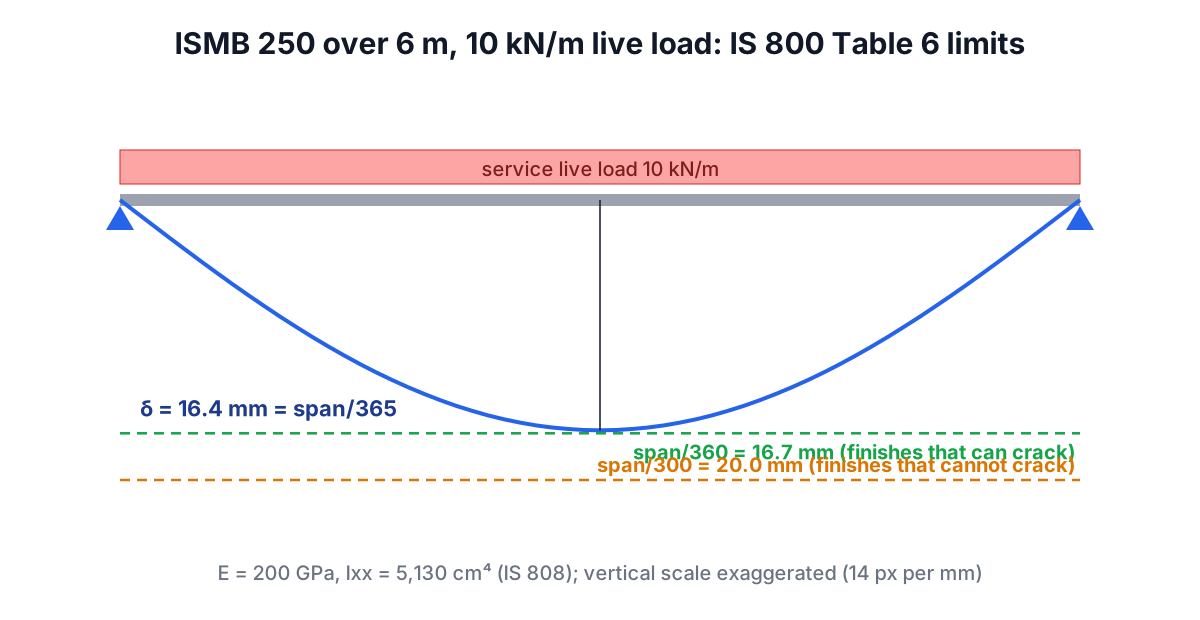
A beam that close to the line deserves a second look at the load. If the live load is really 12 kN/m, as in the calculator's default example, the same beam deflects 19.7 mm and fails span/360. Moving up to an ISMB 300 (Ixx 8,990 cm⁴ in IS 808 Table 2.1) at 10 kN/m brings the deflection down to 9.4 mm, span/639. Cutting the span to 5 m works too: 7.9 mm, span/630.
Two mistakes are common in Indian design offices:
- Factored loads. The strength design uses 1.5 times the loads; the deflection check does not. Running Table 6 with factored load overstates the deflection by half.
- The wrong load in the live-load row. Table 6 limits are set against live load, and Amendment No. 1 counts every load applied after construction as live load for this purpose, including superimposed dead loads such as finishes, screeds and partitions. Leaving those out understates the deflection; adding the self-weight of the beam and slab cast before them goes beyond what the amended clause asks for.
RCC: IS 456 clause 23.2
IS 456:2000 clause 23.2 sets two limits for floors, roofs and other horizontal members:
- the final deflection due to all loads, including temperature, creep and shrinkage, measured from the as-cast level of the supports, should not normally exceed span/250;
- the deflection after partitions and finishes are in place, including creep and shrinkage, should not normally exceed span/350 or 20 mm, whichever is less.
Clause 23.2.1 lets you assume those limits are met if the span-to-effective-depth ratio does not exceed the basic values for spans up to 10 m: 7 for a cantilever, 20 for a simply supported member and 26 for a continuous one, modified by the factors in Fig. 4 to 6 for tension steel, compression steel and flanged beams. For spans over 10 m the basic values are multiplied by 10/span, except for cantilevers, which need a calculation.
Worked example: a 230 x 450 mm beam over 5 m
A simply supported 230 x 450 mm M25 beam spans 5 m. With an effective depth of about 410 mm, L/d = 5000/410 = 12.2, well under the basic value of 20, so the deemed-to-satisfy check passes before modification factors.
The calculator can show why a calculation alone would mislead. With Ec = 25,000 N/mm² and the gross section (I = 230 x 450³/12 = 1.75 x 10⁹ mm⁴), a service load of 20 kN/m gives an elastic deflection of only 3.73 mm, span/1,341. The real beam cracks, which lowers the effective I well below the gross value, and then creeps under sustained load: IS 456 clause 6.2.5.1 gives a creep coefficient of 1.6 for loading at 28 days. Annex C of IS 456 sets out how to combine short-term deflection on a cracked section with shrinkage and creep. Use the calculator's elastic figure as a lower bound, not as the clause 23.2 check.
When the simple formulas stop working
The tabulated formulas assume a prismatic, elastic member with small deflections and negligible shear deformation. Deep beams (span under about ten times depth), tapered or notched members and beams with large web openings need more than a single formula. Loads can be added because the theory is linear: a UDL plus a point load deflects by the sum of the two results.
These calculations are for preliminary sizing and checking. Members that carry people or property should be designed or checked by a qualified structural engineer under the governing code and the National Building Code of India.
Tools for this job
- Beam Deflection Calculator (IS 800, IS 456): deflection, slopes and the IS 800 Table 6 and IS 456 limits in kN, m and mm.
- Section Properties Calculator: I for rectangles, tubes and I-sections.
- Shear and Bending Moment Calculator: bending moment diagrams for mixed loads.
The US edition of this guide covers IBC Table 1604.3 and US timber values.
Frequently asked questions
What is the deflection limit for a steel beam as per IS 800?
Table 6 of IS 800:2007 recommends span/300 for floor and roof members whose supported elements are not susceptible to cracking and span/360 where they are, under live load. Cantilevers get span/150 and span/180.
What is the span-to-depth ratio for a simply supported beam in IS 456?
The basic value is 20 for spans up to 10 m (7 for cantilevers and 26 for continuous members), modified for the tension and compression reinforcement and for flanged sections. For longer spans it is multiplied by 10/span.
Should the deflection check use factored or service loads?
Service loads. IS 800 clause 5.6.1 checks deflection under service loads by elastic analysis; Amendment No. 1 (2012) points it to the load factors of Table 4 rather than a flat 1.0, so apply the amendments in force. IS 456 limits refer to deflections under the loads actually applied, plus creep and shrinkage.
What is the moment of inertia of ISMB 250 and ISMB 300?
IS 808:1989 Table 2.1 gives Ixx = 5,130 cm⁴ for ISMB 250 and 8,990 cm⁴ for ISMB 300. Enter them in cm⁴ and the calculator converts.
Sources and further reading
- IS 800:2007 General construction in steel, code of practice, Bureau of Indian Standards (public copy). Clause 5.6.1, Tables 4 and 6, and Amendment No. 1 (January 2012), which is printed before the title page.
- IS 456:2000 Plain and reinforced concrete, code of practice, Bureau of Indian Standards (public copy). Clauses 6.2.3.1, 6.2.5.1, 23.2, 23.2.1 and Annex C.
- IS 808:1989 Dimensions for hot rolled steel beam, column, channel and angle sections, Bureau of Indian Standards (public copy). Table 2.1, ISMB sections.
- National Building Code of India, Bureau of Indian Standards.
- Solid Mechanics (course 1.050), MIT OpenCourseWare. Beam bending theory.
Open the Beam Deflection Calculator
More Civil & Structural
Every tool in the Civil & Structural section, free and in your browser.