
Rent or Buy in Australia: Stamp Duty and Break-Even
Is it better to rent or buy in Australia? Melbourne examples with stamp duty, the first home buyer exemption, the 5% Deposit Scheme, strata levies and weekly rent.
By Redbison Dev · · 6 min read
Australia edition. Written for Australian renters and buyers: Australian dollars, weekly rent, Victorian stamp duty and first home buyer exemption, the 5% Deposit Scheme, council rates, strata levies and the main residence CGT exemption. US edition
An $800,000 established house in Melbourne with a 20% deposit and a 6% home loan over 30 years costs $3,837.12 a month in repayments. Rent on a similar house is $600 a week, or $2,600 a month. Compared by what each household owns, the renter who invests the $205,570 the buyer spends on the deposit, stamp duty and fees stays ahead for 11 years, at 4% price growth and a 6% return. A first home buyer purchasing a $600,000 unit without stamp duty pulls ahead in year 3.
The difference between those two answers is mostly stamp duty, which is why the question has a different answer in each state and for each type of buyer. This guide works through it with the Rent or Buy Calculator for Australia. All amounts are in Australian dollars. It explains a method, not personal advice; a licensed financial adviser can look at your whole situation.
What changes in an Australian comparison
- Rent is weekly. Convert it to monthly before entering it: weekly × 52 ÷ 12, so $600 a week is $2,600 a month. Multiplying by 4 gives $2,400 and understates a year of rent by about 8%.
- Stamp duty is paid up front, by state. In Victoria, general land transfer duty on a dutiable value between $130,000 and $960,000 is $2,870 plus 6% of the amount over $130,000: $43,070 on $800,000. First home buyers pay no duty on a dutiable value of $600,000 or less, with a concession up to $750,000.
- No deduction for your own home. Interest is deductible only when the loan earns assessable income, as with an investment property. For the home you live in the tax rate in the comparison is 0.
- Council rates and strata levies are owner costs. A tenant does not pay them directly.
- No capital gains tax on your main residence, if you are an Australian resident, it was your home for the whole time you owned it, it was not used to produce income and the land is 2 hectares or less.
How the calculator compares the two
Both households start with the same cash. The buyer spends it on the deposit, stamp duty and fees; the renter invests it. Each year the calculator totals housing costs on each side, and whichever household spent less invests the difference. At the end it compares the buyer's equity after agent and selling costs, plus any investments, with the renter's portfolio. Repayments are not set against rent directly, because part of every repayment comes back as equity.
Worked example 1: an established Melbourne house
Inputs: $800,000 price, $160,000 deposit, 6% over 30 years, $45,570 of up-front costs ($43,070 Victorian duty plus $2,500 conveyancing and fees), council rates $2,200, building insurance $1,800, maintenance $4,000, selling costs 2.5%, rent $600 a week ($2,600 a month) rising 3%, contents insurance $300, prices rising 4% a year, a 6% return on the renter's savings and 2.5% inflation on running costs.
| Year | Buy minus rent |
|---|---|
| 1 | −$62,067 |
| 3 | −$53,943 |
| 5 | −$44,179 |
| 10 | −$11,252 |
| 12 | +$5,939 |
| 15 | +$36,880 |
The buyer spends $54,045 on housing in year one against $31,500 for the renter, but gains ground every year as repayments and price growth build equity. Buying moves ahead in year 12. If you are likely to sell within ten years, renting comes out ahead at these assumptions.
Worked example 2: a first home buyer's unit
A $600,000 unit, $120,000 deposit, 6% over 30 years, no stamp duty under the Victorian first home buyer exemption, $2,500 of fees, strata levies $4,000 a year, council rates $1,500, insurance $400, maintenance $2,000 and rent of $520 a week ($2,253.33 a month). Repayments are $2,877.84 a month.
| Year | 20% deposit | 5% deposit through the 5% Deposit Scheme |
|---|---|---|
| 1 | −$11,102 | −$11,267 |
| 3 | +$3,425 | +$2,908 |
| 5 | +$20,514 | +$19,609 |
| 10 | +$76,713 | +$74,664 |
| 15 | +$157,450 | +$153,959 |
Without $40,000-plus of duty to recover, the buyer overtakes in year 3. The second column uses the Australian Government 5% Deposit Scheme, which since its expansion on 1 October 2025 lets eligible first home buyers buy with a 5% deposit and no lenders mortgage insurance, with no income caps and unlimited places, subject to price caps by location. With $30,000 down the loan is $570,000 and repayments rise to $3,417.44 a month, yet the result barely changes: the renter has less to invest, and the buyer pays more interest, and the two roughly cancel at a 6% rate and a 6% return.
Check eligibility before relying on either concession. The Victorian exemption needs a dutiable value of $600,000 or less, and you lose it if you or your partner have already received a first home owner grant or first home buyer duty concession.
Which assumptions move the answer
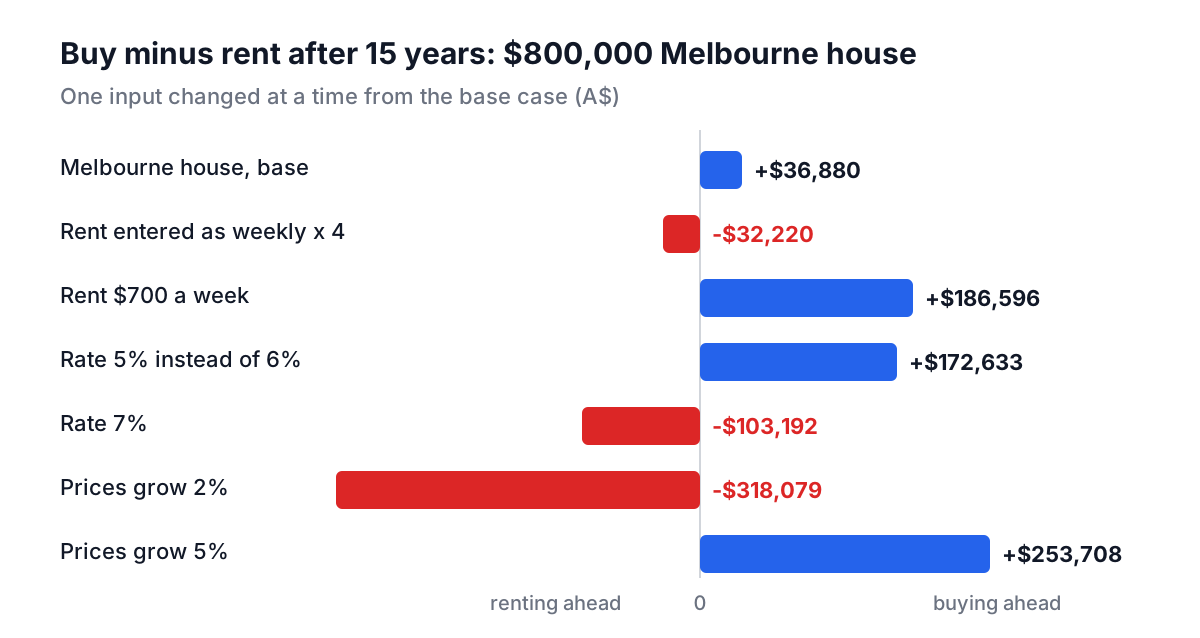
| Change from the Melbourne base case | Buying ahead from | Buy minus rent after 15 years |
|---|---|---|
| Base case | year 12 | +$36,880 |
| Rent entered as $600 × 4 = $2,400 | after year 15 | −$32,220 |
| Rent $700 a week | year 6 | +$186,596 |
| Home loan at 5% | year 6 | +$172,633 |
| Home loan at 7% | after year 15 | −$103,192 |
| Prices grow 2% a year | after year 15 | −$318,079 |
| Prices grow 5% a year | year 5 | +$253,708 |
| Renter earns 8% | after year 15 | −$205,764 |
Price growth is the biggest lever, as everywhere. In Australia the rate comes a close second because most home loans are variable: a one-point move either way changes the 15-year result by well over $100,000 here. And the weekly-rent mistake alone is enough to flip the answer, which is a good reason to convert rent carefully.
Things the calculator does not model
- Offset accounts. Money in an offset account reduces the balance interest is charged on, so it works like an extra repayment you can take back. Treat the calculator's result as the case without offset.
- Lenders mortgage insurance. Outside the 5% Deposit Scheme, a deposit under 20% usually means LMI. Add the lender's quote to the up-front costs, or to the loan if it is capitalised.
- Rentvesting. Renting where you live and buying an investment property elsewhere is a different calculation, with rental income, deductible interest and capital gains tax. The Real Estate Investment Analyzer handles the investment side.
- Super. The renter's return here is on money outside super, such as an ETF portfolio.
- Moving costs and security of tenure. These have a value the calculator cannot put a number on, but you can weigh them against the dollar result.
For stamp duty in other states, use your state revenue office's calculator and enter the figure in the up-front costs. For the loan itself, the comparison rate calculator shows what fees do to the true cost, and the Australian home loan guide covers repayments, serviceability and refinancing.
Frequently asked questions
Is it better to rent or buy in Melbourne?
It depends on how long you stay and what you buy. An $800,000 established house with $43,070 of stamp duty only overtakes renting in year 12 at 4% price growth, while a first home buyer's $600,000 unit with no duty pulls ahead in year 3. Higher rent, lower rates or faster price growth all bring the break-even forward.
How do I enter weekly rent in a rent or buy calculator?
Multiply the weekly rent by 52 and divide by 12. $600 a week is $2,600 a month. Multiplying by 4 gives $2,400, which understates a year of rent by about 8%; in the Melbourne example it turns a $36,880 lead for buying after 15 years into a $32,220 lead for renting.
Does the 5% Deposit Scheme make buying better than renting?
It makes buying possible sooner without lenders mortgage insurance, but it does not change the answer much by itself. On a $600,000 unit, buying with a 5% deposit was $153,959 ahead of renting after 15 years, against $157,450 with a 20% deposit, at a 6% rate and a 6% return on the renter's savings.
Do I pay capital gains tax when I sell my home?
Usually not. Your main residence is exempt if you are an Australian resident, it was your home for the whole time you owned it, it was not used to produce income and the land is 2 hectares or less. Renting it out or running a business from it can reduce the exemption.
Should council rates and strata levies go on the renter's side too?
No. A landlord pays council rates and strata levies, and they are built into the rent. Enter them only on the buying side. Strata levies cover building insurance, common areas and the sinking fund, so an apartment owner's own insurance and maintenance figures are usually lower than a house owner's.
Sources and further reading
- General land transfer duty property current rates, State Revenue Office Victoria. Duty bands used in the examples.
- First home buyer duty exemption, concession or reduction, State Revenue Office Victoria. Exemption to $600,000 and concession to $750,000.
- Australian Government 5% Deposit Scheme, Housing Australia. 5% deposit, no LMI, expanded from 1 October 2025.
- First home buyers, Housing Australia. No income caps and unlimited places.
- Your main residence (home), Australian Taxation Office. Main residence exemption from capital gains tax.
- APRA maintains current macroprudential policy settings, Australian Prudential Regulation Authority. The 3-point serviceability buffer lenders test home loans at.
Open the Rent vs Buy Calculator
More Analysis Tools
Every tool in the Analysis Tools section, free and in your browser.