
Rent or Buy a Flat in India: EMI vs Rent Worked Out
Should you buy a flat or keep renting in an Indian metro? A ₹1 crore case with home loan EMI, stamp duty, society maintenance, both tax regimes and SIP returns.
By Redbison Dev · · 6 min read

India edition. Written for Indian buyers and tenants: rupees in lakh and crore, RBI loan-to-value limits, stamp duty and registration, society maintenance, old and new tax regimes, HRA and GST on under-construction flats. US edition
A ₹1 crore flat bought with ₹25 lakh down and a ₹75 lakh home loan at 8.5% for 20 years has an EMI of ₹65,087. A similar flat in most Indian metros rents for far less, say ₹25,000 a month, a rental yield of 3%. If the tenant invests the ₹31.5 lakh the buyer spends up front and the yearly difference in costs at 8%, the tenant is about ₹30.1 lakh ahead after 15 years even with flat prices rising 6% a year. Buying wins only when prices rise faster than the tenant's investments, or when rent is high compared with the price.
That is the opposite of the advice many families give, so it is worth working through carefully. This guide uses the Rent or Buy Calculator for India and the EMI Calculator to show where the answer comes from and which inputs change it. It explains a method; it is not investment or tax advice, and a SEBI-registered adviser or chartered accountant can look at your own case.
Why EMI against rent is the wrong comparison
An EMI is not the same kind of money as rent. Part of it repays principal, which you keep as equity in the flat; the rest is interest, which is a cost like rent. Owning also brings costs a tenant does not pay: stamp duty and registration, society maintenance, municipal property tax, repairs and insurance. And the tenant keeps the down payment, which can be invested.
So the calculator compares net worth. Both households start with the same cash: the buyer spends it on the down payment, stamp duty and registration; the tenant invests it. Every year, whichever household spent less on housing invests the difference. At the end, the buyer's flat (after brokerage on sale) minus the loan balance, plus any investments, is set against the tenant's portfolio.
What is specific to India
- The down payment is large by rule. RBI's housing finance rules cap the loan-to-value ratio at 90% for loans up to ₹30 lakh, 80% above ₹30 lakh up to ₹75 lakh and 75% above ₹75 lakh. Stamp duty and registration are usually not funded by the loan, so on a ₹1 crore flat you need ₹25 lakh plus those charges in cash.
- Stamp duty and registration vary by state. Duty is charged on the agreement value or the circle (ready reckoner) rate, whichever is higher, and several states give women buyers a lower rate. Take the figure from your state's IGR portal or your lawyer; this guide uses an assumed ₹6.5 lakh.
- GST on under-construction flats. Since April 2019, an under-construction flat carries an effective 5% GST without input tax credit (1% for affordable housing, defined as up to 60 sq m carpet area in metros or 90 sq m elsewhere and up to ₹45 lakh). A ready flat sold after the completion certificate carries no GST, so check which you are buying.
- Most home loans float. Rates are usually linked to an external benchmark such as the repo rate, so the EMI or tenure moves during the loan. Under RBI rules, banks cannot charge a prepayment penalty on a floating-rate loan taken by an individual for a non-business purpose.
- Tax depends on your regime. Under the new regime, the default since AY 2024-25, there is no deduction for interest on a self-occupied flat, and no HRA exemption for the tenant either. Under the old regime, interest is deductible up to ₹2,00,000 a year (section 22(2) of the Income-tax Act, 2025, section 24(b) of the 1961 Act) and a salaried tenant can claim HRA exemption.
Worked example: a ₹1 crore flat
Inputs in the Rent or Buy Calculator: agreement value ₹1,00,00,000, down payment ₹25,00,000, 8.5% for 20 years, stamp duty and registration ₹6,50,000 (assumed), brokerage on sale 1%, society maintenance ₹48,000 a year, property tax ₹10,000, repairs ₹20,000, home insurance ₹3,000, rent ₹25,000 a month rising 5% a year, flat prices rising 6%, the tenant's investments returning 8%, costs rising 4% a year, new tax regime (tax rate 0).
Year one. The buyer pays ₹7,81,041 in EMIs and ₹81,000 in other costs, ₹8,62,041 in all. The tenant pays ₹3,00,000 of rent and invests the ₹5,62,041 difference on top of the ₹31,50,000 starting sum. At the end of the year the flat is worth ₹1,06,00,000 and the loan balance is ₹73,50,733, so the buyer's net worth after 1% brokerage is ₹31,43,267. The tenant has ₹39,86,523. Renting is ahead by ₹8,43,255.
| Year | Buy minus rent (new regime) |
|---|---|
| 1 | −₹8,43,255 |
| 3 | −₹10,47,764 |
| 5 | −₹12,79,277 |
| 10 | −₹20,04,926 |
| 15 | −₹30,12,095 |
| 20 | −₹44,24,831 |
The gap widens rather than closes because the yearly cost difference is large: even in year 15 the buyer spends ₹9,21,307 against ₹5,93,979 of rent. At a 3% rental yield, the tenant's invested savings outgrow the flat's equity.
The old regime and the ₹2 lakh limit
Under the old regime, interest on a loan for buying or building a self-occupied home is deductible up to ₹2,00,000 a year (section 22(2) of the Income-tax Act, 2025, which replaced section 24(b) of the 1961 Act from tax year 2026-27), with a lower limit in some cases, for example when construction is not completed within five years. Confirm the rules for your tax year with your tax adviser before you file.
Enter your slab rate with 4% cess as the tax rate, 31.2% for the 30% slab, and set the yearly deduction limit to 200000. The saving is then ₹62,400 a year while interest exceeds ₹2 lakh, and the tenant's lead after 15 years falls to ₹12,50,031. Without the limit, the calculator would treat the full ₹6.3 lakh of first-year interest as deductible and wrongly show buying ahead by ₹16,15,160. Two things the calculator does not include: principal repaid counts towards the old regime's ₹1,50,000 overall deduction limit, which helps the buyer, and a salaried tenant on the old regime can also claim HRA exemption, which helps the tenant.
Which assumptions move the answer
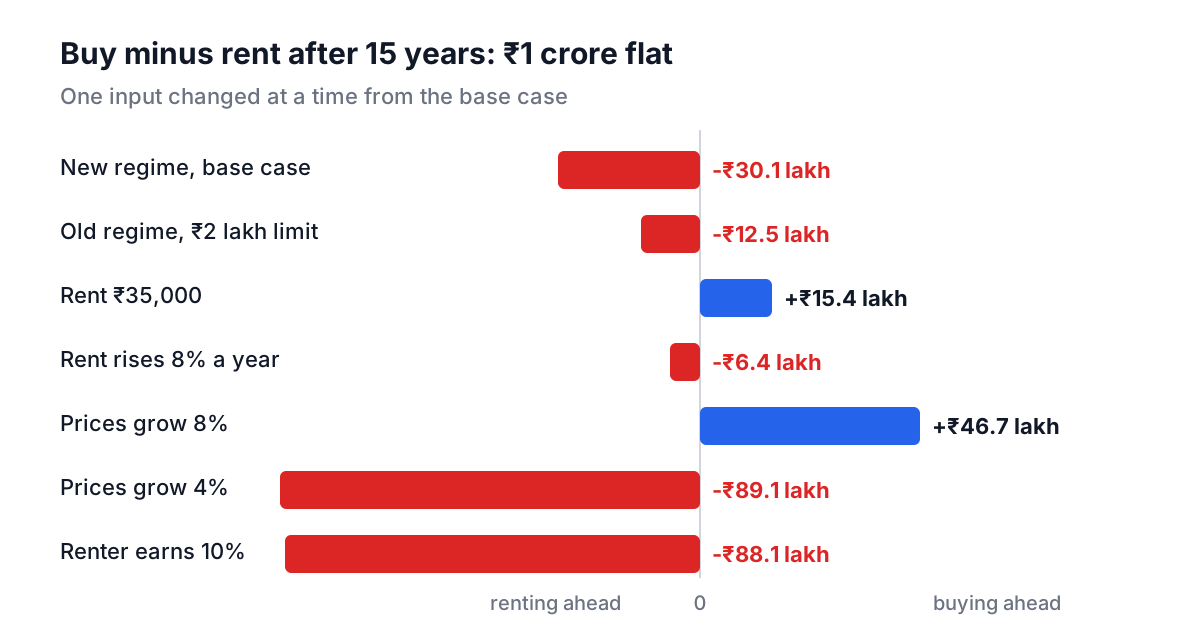
| Change from the base case | Buying ahead from | Buy minus rent after 15 years |
|---|---|---|
| Base case, new regime | not within 20 years | −₹30,12,095 |
| Old regime, 31.2% with the ₹2 lakh limit | not within 20 years | −₹12,50,031 |
| Rent ₹35,000 (4.2% yield) | year 9 | +₹15,35,787 |
| Rent rising 8% a year | year 17 | −₹6,35,735 |
| Flat prices rising 8% a year | year 5 | +₹46,66,453 |
| Flat prices rising 4% a year | not within 20 years | −₹89,08,680 |
| Tenant's investments earning 10% | not within 20 years | −₹88,10,195 |
| Tenant's investments earning 7% | year 18 | −₹5,69,932 |
| Home loan at 9.5% | not within 20 years | −₹48,02,782 |
Three lessons for Indian buyers:
- Rental yield decides most of it. At a 3% yield the buyer starts far behind; at 4.2% the same flat is a reasonable purchase within nine years. Divide a year's rent by the price before anything else.
- Price growth and investment return are both guesses. Buying needs flat prices to grow roughly as fast as the tenant's portfolio. Test a pessimistic case for each, not just the one you hope for.
- The tenant has to invest. The renter's lead exists only if the down payment and the monthly difference, about ₹47,000 a month in year one, really go into an SIP, PPF or fixed deposits. If that money would be spent, buying wins by default.
Things the calculator leaves to you
- Under-construction years. If the flat will take three years to deliver, you pay pre-EMI interest or EMI and rent at the same time. Add those years of rent to the buying side.
- Capital gains on sale. A house held for more than 24 months gives a long-term capital gain, which is taxed unless you reinvest under the exemption rules. The calculator does not deduct that tax.
- One-time society charges. Corpus fund, transfer fees and parking charges belong in the up-front costs.
- Floating rates. Run the sum at a rate 1 to 2 points higher; at 9.5% the tenant's lead after 15 years grows to ₹48,02,782.
- Non-financial reasons. Security of tenure, school admissions and the cost of moving every 11 months under a leave and licence agreement are real. The calculator puts a price on the financial side so you can judge whether those reasons are worth it.
The home loan guide for India covers resets, prepayment and balance transfers. To see the schedule behind the EMI, use the EMI Calculator; to compare loan offers with processing fees, the APR Calculator works out the annual rate from the Key Facts Statement figures.
Frequently asked questions
Is it better to rent or buy a flat in an Indian metro?
At typical metro rental yields of 2% to 3% and home loan rates around 8.5%, renting and investing the difference often comes out ahead over 10 to 20 years. In the ₹1 crore example the tenant is about ₹30.1 lakh ahead after 15 years. Buying wins when rent is high compared with the price, or when flat prices grow faster than the tenant's investments.
Can I claim home loan interest under the new tax regime?
Not for a self-occupied home. The Income Tax Department's FAQ on the two regimes says interest on borrowed capital for a self-occupied property is not allowed as a deduction under the new regime, and HRA exemption is not available either. Under the old regime the interest deduction is limited to ₹2,00,000 a year, under section 22(2) of the Income-tax Act, 2025 (section 24(b) of the 1961 Act).
How much cash do I need to buy a ₹1 crore flat?
At least ₹25 lakh, because RBI caps the loan at 75% of the property value for loans above ₹75 lakh, plus stamp duty, registration and any one-time society charges, which are usually not funded by the loan. In the example those add an assumed ₹6.5 lakh, so the buyer needs ₹31.5 lakh in cash.
Does an under-construction flat cost more than a ready one?
Usually in two ways. GST applies at an effective 5% without input tax credit on an under-construction flat (1% for affordable housing), and a ready flat with a completion certificate carries none. You may also pay rent and pre-EMI interest together until possession, which the calculator does not include unless you add it.
What rental yield makes buying worth it?
There is no single figure, but the example shows how sensitive the answer is. At 3% (₹25,000 a month on ₹1 crore) renting stays ahead for 20 years; at 4.2% (₹35,000) buying moves ahead in year 9 and is ₹15.4 lakh ahead after 15 years, with the same 6% price growth and 8% investment return.
Sources and further reading
- Master Circular: Housing Finance, Reserve Bank of India. Loan-to-value limits by loan size.
- Levy of foreclosure charges / pre-payment penalty on floating rate term loans, Reserve Bank of India. No prepayment penalty for individuals on floating-rate loans.
- FAQs on New Tax vs Old Tax Regime, Income Tax Department. No housing loan interest deduction for a self-occupied property and no HRA exemption under the new regime.
- Section 22 of the Income-tax Act, 2025, Income Tax Department. Section 22(2): interest on borrowed capital for a self-occupied home, the old section 24(b).
- Reset of floating interest rate on EMI based personal loans, Reserve Bank of India. Circular of 18 August 2023: higher EMI, longer tenure or both at a reset, and prepayment at any time.
- Recommendations of the 33rd GST Council meeting, Press Information Bureau. Effective 5% and 1% GST on under-construction residential property.
- GST on real estate: frequently asked questions, GST Council. Rates, affordable housing and completed flats.
Open the Rent vs Buy Calculator
More Analysis Tools
Every tool in the Analysis Tools section, free and in your browser.