
Home Loans in India: EMI, Prepayment, Transfer and APR
How a home loan EMI is worked out in India, what a repo rate reset does, when to prepay or move your loan, and how to read the APR in the Key Facts Statement.
By Redbison Dev · · 10 min read
India edition. Written for Indian home buyers: rupees in lakh, EMI and tenure, RBI loan-to-value limits, floating-rate resets, prepayment without penalty, balance transfer, the KFS APR and both tax regimes. US edition
A ₹60 lakh flat bought with ₹12 lakh of your own money leaves a ₹48 lakh home loan. At 8.5% for 20 years the EMI is ₹41,655.52, and over the full tenure you pay ₹51,97,324 in interest, more than the loan itself. Almost every home loan in India floats, so that EMI or the tenure will change during the loan, and you can prepay without penalty. Those two facts shape every decision below.
This guide works through the home loan sums an Indian borrower meets, using the EMI Calculator and the APR Calculator. It explains the arithmetic and the RBI rules; it is not advice on a particular loan, and a chartered accountant or SEBI-registered adviser can look at your full situation.
How much the bank will lend
RBI's housing finance rules cap the loan-to-value (LTV) ratio by loan size:
| Loan amount | Maximum LTV | Minimum own contribution |
|---|---|---|
| Up to ₹30 lakh | 90% | 10% |
| Above ₹30 lakh to ₹75 lakh | 80% | 20% |
| Above ₹75 lakh | 75% | 25% |
A ₹48 lakh loan on a ₹60 lakh flat is exactly 80%, the limit for its band. Stamp duty and registration are generally not counted in the property cost for LTV, so you pay them in cash on top of the down payment.
Within those limits, the bank decides how much EMI your income can carry. Each lender sets its own share of net monthly income that all EMIs together may take, so the same salary can get different sanctions from different banks. A longer tenure lowers the EMI and so raises the amount you qualify for: ₹48 lakh at 8.5% over 30 years is ₹36,907.85 a month instead of ₹41,655.52, but total interest rises from about ₹52 lakh to about ₹85 lakh.
How the EMI is worked out
Banks use the reducing-balance formula. Interest each month is one-twelfth of the annual rate on what you still owe:
EMI = P × r × (1 + r)^n / ((1 + r)^n − 1)

P = loan                ₹48,00,000
r = 8.5% ÷ 12 ÷ 100     0.7083% a month
n = 20 × 12             240 EMIs
EMI                     ₹41,655.52
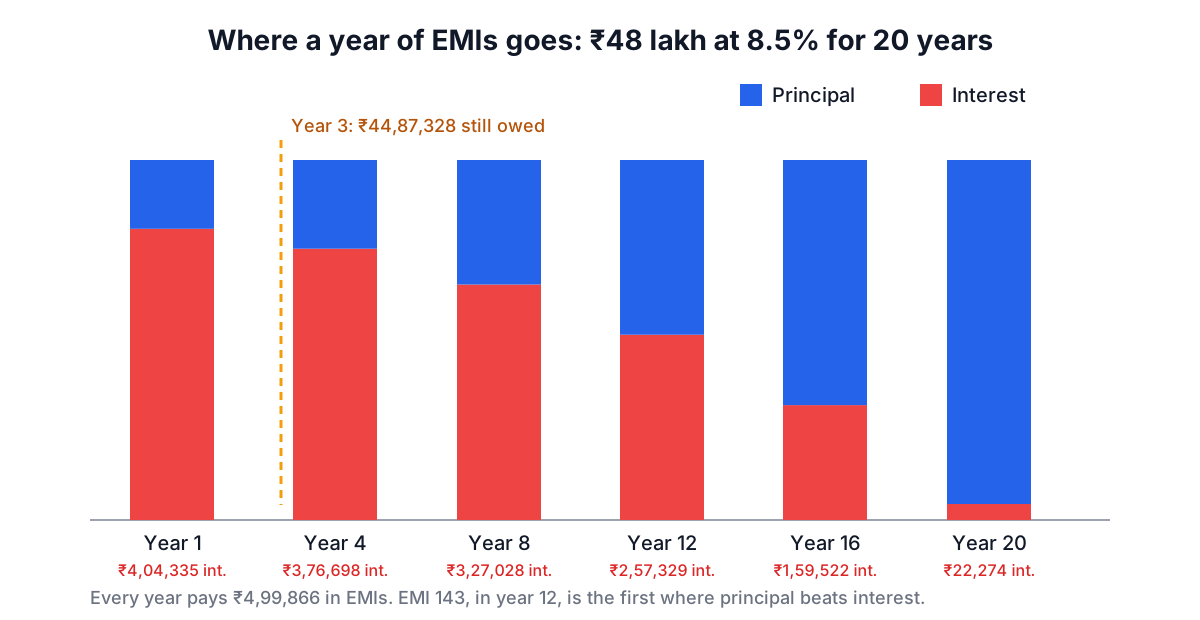
The first EMI carries ₹34,000 of interest and only ₹7,655.52 of principal. EMI 143, in year 12, is the first in which principal outweighs interest, and after three years you still owe ₹44,87,328.
When the repo rate moves: higher EMI or longer tenure
Most home loans are linked to an external benchmark such as the repo rate, so the lender resets your rate when the benchmark moves. RBI's circular of 18 August 2023 requires lenders to tell you about a reset, to let you choose a higher EMI, a longer tenure or a mix of both, and to let you prepay in part or in full at any time; lenders may also offer a switch to a fixed rate under their policy.
Suppose the rate rises from 8.5% to 9% after three years, with ₹44,87,328 owed and 204 EMIs left:
| Choice | EMI | Remaining EMIs | Interest from here |
|---|---|---|---|
| Raise the EMI | ₹43,024.68 | 204 | ₹42,89,706 |
| Keep the EMI, extend the tenure | ₹41,655.52 | 221 | ₹47,10,803 |
Keeping the EMI looks painless but adds 17 EMIs and about ₹4.2 lakh of interest. At 9.5% the extension would be 39 EMIs. Many lenders extend the tenure by default, so check the revised schedule after every reset and ask for the higher EMI if you can afford it.
Prepaying: reduce the tenure or the EMI?
Under RBI rules, banks and other regulated lenders cannot charge a prepayment or foreclosure penalty on a floating-rate loan taken by an individual for a non-business purpose; the Pre-payment Charges on Loans Directions, 2025 restate this for loans sanctioned or renewed from 1 January 2026. Fixed-rate loans can carry a charge, so read the sanction letter.
On the ₹48 lakh loan at 8.5%:
- ₹1 lakh extra every year clears the loan in 165 EMIs instead of 240 and saves ₹18,27,099 of interest.
- ₹5,000 extra every month clears it in 185 EMIs and saves ₹13,73,298.
- A ₹5 lakh lump sum after two years saves ₹14,45,667 if the bank shortens the tenure (194 EMIs in all), but only ₹4,77,894 if it keeps the tenure and lowers the EMI to ₹37,128.23.
When you prepay, ask in writing for the tenure to be reduced. Before prepaying, compare with what the money could earn elsewhere after tax, and keep an emergency fund.
Balance transfer: when moving your loan pays
A balance transfer moves the outstanding loan to another lender at a lower rate. The cost is the new lender's processing fee with GST, plus legal, valuation and stamp duty charges on the new mortgage.
Take a ₹48 lakh, 20-year loan taken at 9.25%. After three years the EMI is ₹43,961.61 and ₹45,12,424 is owed. Moving to 8.5% for the remaining 204 months, with an assumed ₹16,800 of costs (₹10,000 processing fee, ₹1,800 GST and ₹5,000 legal and valuation), the EMI falls to ₹41,888.48, a saving of ₹2,073.13 a month. Costs divided by the saving gives month 9; counting the faster fall in the balance at the lower rate, the switch pays for itself by month 6 and saves about ₹4.2 lakh of interest over the remaining tenure.
Before moving, ask your current lender whether it will lower the rate on your existing loan; if it charges a fee for that, compare the fee with the transfer costs above.
The APR in your Key Facts Statement
Since 1 October 2024, banks and NBFCs must give every retail term loan borrower, home loans included, a Key Facts Statement (KFS) showing the Annual Percentage Rate. The APR is the annual cost of credit including interest and all other charges the lender levies, with third-party charges it collects, such as insurance or legal fees, included and shown separately. RBI's illustration computes it on the net disbursed amount by the IRR method on a reducing balance.
For the ₹48 lakh loan at 8.5% with a ₹10,000 processing fee plus 18% GST (₹11,800) deducted, the APR is 8.534%. Add ₹8,000 of legal and valuation charges collected by the lender and it becomes 8.557%. On a 20-year loan the fees move the APR very little, so for home loans the rate, the benchmark spread and how resets are passed on matter more than the processing fee. The APR Calculator checks the figure in your own KFS.
Tax: old regime and new regime
The two regimes treat a home loan for a self-occupied flat very differently:
- New regime (the default since AY 2024-25): no deduction for home loan interest on a self-occupied property, and no deduction for principal.
- Old regime: interest is deductible up to ₹2,00,000 a year (section 22(2) of the Income-tax Act, 2025, section 24(b) of the 1961 Act), and principal repaid counts towards the overall ₹1,50,000 deduction limit (section 80C of the 1961 Act, section 123 of the Income-tax Act, 2025 from tax year 2026-27).
On this loan the first year's interest is ₹4,04,335, so only ₹2 lakh of it would count under the old regime. Whether the old regime is worth choosing depends on your other deductions; confirm the current rules for your tax year with a tax adviser.
A checklist before you sign
- Check the loan against the RBI LTV band and keep cash aside for stamp duty and registration.
- Reproduce the EMI from the sanction letter's amount, rate and tenure.
- Read the KFS: APR, benchmark, spread and every charge.
- Find out whether a reset will change your EMI or your tenure by default.
- Confirm there is no prepayment charge on a floating-rate loan, and how prepayments are applied.
- Decide on your tax regime before counting on any home loan deduction.
If you are still deciding whether to buy at all, the rent or buy guide for India and the Rent or Buy Calculator compare the two by net worth.
Frequently asked questions
How is a home loan EMI calculated in India?
With the reducing-balance formula EMI = P × r × (1 + r)^n / ((1 + r)^n − 1), where r is the annual rate divided by 12 and 100 and n is the tenure in months. A ₹48 lakh loan at 8.5% for 240 months has an EMI of ₹41,655.52, and the first EMI carries ₹34,000 of interest.
Should I reduce the EMI or the tenure after a prepayment?
Reducing the tenure saves far more. A ₹5 lakh prepayment after two years on a ₹48 lakh, 20-year loan at 8.5% saves ₹14,45,667 of interest if the tenure is cut, against ₹4,77,894 if the EMI is lowered instead. Lower the EMI only if you need the monthly cash.
What happens to my home loan when the repo rate goes up?
The lender resets a repo-linked rate and either raises the EMI or extends the tenure. RBI requires lenders to let you choose. If the rate on a ₹44.9 lakh balance with 204 EMIs left rises from 8.5% to 9%, the EMI rises to ₹43,024.68, or the same EMI runs for 17 more months and costs about ₹4.2 lakh more interest.
Is a home loan balance transfer worth it for a 0.75% lower rate?
Usually, if the costs are modest. Moving ₹45.1 lakh from 9.25% to 8.5% with 17 years left saves ₹2,073 a month and pays back about ₹16,800 of fees within six months. Ask your current lender for a lower rate first and compare any fee it charges with the transfer costs.
Can a bank charge a penalty for prepaying a home loan?
Not on a floating-rate loan taken by an individual for a non-business purpose: RBI does not allow foreclosure charges or prepayment penalties on such loans. Fixed-rate home loans can carry a charge, so check the sanction letter and the KFS.
Sources and further reading
- Master Circular: Housing Finance, Reserve Bank of India. LTV limits by loan size.
- Section 22 of the Income-tax Act, 2025, Income Tax Department. Section 22(2): interest on borrowed capital for a self-occupied home, the old section 24(b).
- Reset of floating interest rate on EMI based personal loans, Reserve Bank of India. Circular of 18 August 2023: the choice of higher EMI or longer tenure at a reset.
- Reserve Bank of India (Pre-payment Charges on Loans) Directions, 2025, Reserve Bank of India. No prepayment charges on floating-rate loans to individuals for non-business purposes.
- Levy of foreclosure charges / pre-payment penalty on floating rate term loans, Reserve Bank of India.
- Key Facts Statement (KFS) for Loans and Advances, Reserve Bank of India. APR and the KFS for retail loans from 1 October 2024.
- Regulatory Framework for Microfinance Loans, illustrative APR computation, Reserve Bank of India. The IRR method on the net disbursed amount.
- FAQs on New Tax vs Old Tax Regime, Income Tax Department. No housing loan interest deduction for a self-occupied property under the new regime.
More Loans & Mortgages
Every tool in the Loans & Mortgages section, free and in your browser.