
How Home Loans Work in Australia: Repayments to Refinancing
How Australian home loan repayments are set, what fortnightly repayments and an offset do, how the 3% buffer limits borrowing and how to read a comparison rate.
By Redbison Dev · · 10 min read
Australia edition. Written for Australian borrowers: Australian dollars, principal and interest against interest-only, fortnightly repayments, offset accounts, APRA's serviceability buffer and DTI limit, the 5% Deposit Scheme and the comparison rate. US edition
A $640,000 home loan at a 6% variable rate over 30 years has principal and interest repayments of $3,837.12 a month. In the first month $3,200 of that is interest and only $637.12 comes off the loan, and over 30 years the interest adds up to $741,364, more than the amount borrowed. Paying half the monthly amount every fortnight instead would clear the same loan in about 24½ years and save about $160,900.
This guide works through the sums behind an Australian home loan: how repayments are set, what fortnightly repayments, extra repayments and an offset account do, how lenders decide how much you can borrow, and how to read a comparison rate. All amounts are in Australian dollars. Most calculations can be repeated in the Mortgage Calculator (set mortgage insurance to none and leave property tax at 0, as council rates are billed separately) and the Comparison Rate Calculator. It explains the arithmetic and the rules, not which loan suits you; a licensed mortgage broker or financial adviser can do that.
How a principal and interest repayment is set
Home loan rates are quoted per year; for a monthly repayment the calculation uses one-twelfth of the rate each month. Lenders that charge interest daily will differ by a few cents. The repayment is the level amount that clears the loan exactly at the end of the term:
repayment = L × r × (1 + r)^n / ((1 + r)^n − 1)

L = loan                $640,000
r = 6% ÷ 12             0.5% a month
n = 30 × 12             360 repayments
repayment               $3,837.12
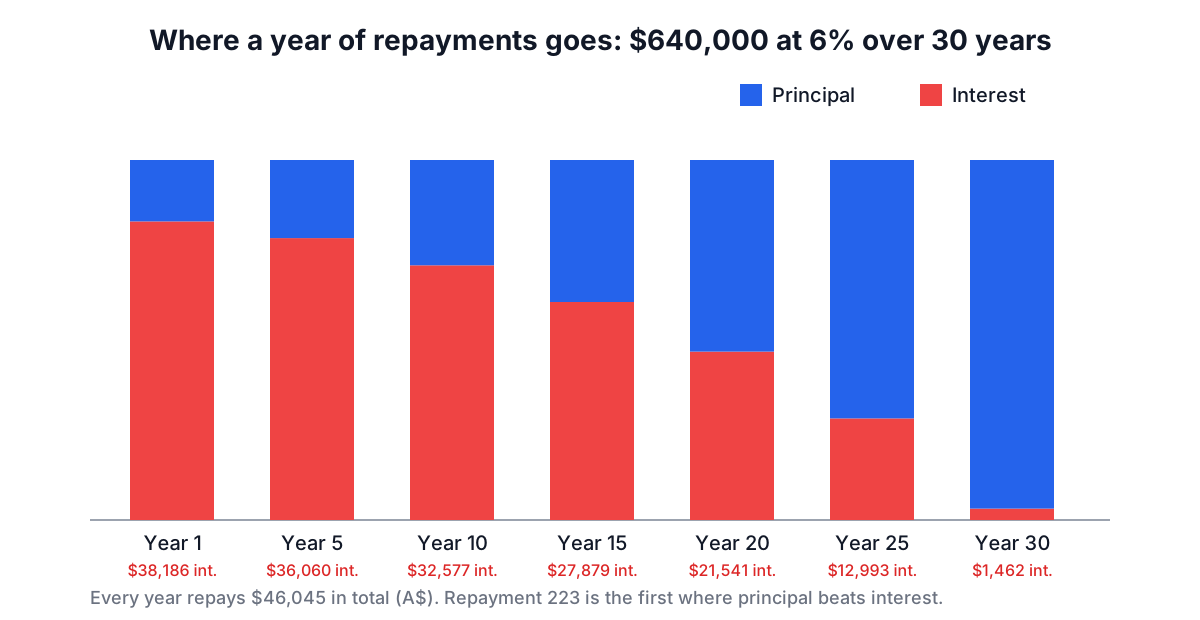
Because interest is charged on what you still owe, early repayments are mostly interest. Repayment 223, more than 18 years in, is the first where principal outweighs interest. After 10 years you still owe $535,589.
Interest-only periods
On an interest-only loan the repayment is just the interest: $3,200 a month on $640,000 at 6%. When a five-year interest-only period ends, the whole $640,000 must be repaid over the remaining 25 years, so repayments jump to $4,123.53. Total interest over the life of the loan rises from $741,364 to $789,059. For a home you live in, interest-only delays the cost rather than reducing it.
Fortnightly repayments, extra repayments and offset accounts
Australian lenders let you repay weekly, fortnightly or monthly, and the way the fortnightly amount is set matters:
| On $640,000 at 6% over 30 years | Repayment | Paid off in | Interest saved |
|---|---|---|---|
| Monthly | $3,837.12 a month | 30 years | none |
| Fortnightly, monthly × 12 ÷ 26 | $1,770.98 a fortnight | about 29.9 years | $5,171 |
| Fortnightly, half the monthly | $1,918.56 a fortnight | about 24.5 years | $160,889 |
Paying half the monthly amount 26 times a year adds up to 13 monthly repayments instead of 12, and the extra goes straight to principal. Paying an extra $500 a month instead has a similar effect: the loan ends after 269 months instead of 360 and about $217,200 less interest is paid.
An offset account is a transaction account linked to the loan; its balance is subtracted from the loan balance before interest is charged. $50,000 in the offset saves $250 of interest in the first month at 6%. If that $50,000 stayed in the offset for the whole loan, it would have the same effect as repaying $50,000 at the start: the loan would end about 5½ years early and save about $203,600 of interest, while the money stays available to withdraw. Offset accounts are often part of a package with an annual fee, which is where the comparison rate comes in.
Deposit, LMI and the 5% Deposit Scheme
Lenders usually charge lenders mortgage insurance (LMI) when the deposit is under 20%. It protects the lender, not you. The Australian Government 5% Deposit Scheme, expanded on 1 October 2025, lets eligible first home buyers buy with a 5% deposit (2% for single parents) without paying LMI, with no income caps and unlimited places, subject to property price caps that vary by location. You must live in the property as an owner-occupier to keep the guarantee.
The deposit is not the only cash you need. Stamp duty is a state tax paid at settlement. In Victoria, for example, duty on an $800,000 established home is $43,070 at the general rates, while first home buyers pay none on a dutiable value of $600,000 or less. Use your state revenue office's calculator for the exact figure.
How much you can borrow: the 3% buffer and the DTI limit
Australian banks do not use the US 28/36 rule. Two regulatory settings from APRA shape what they lend:
- The serviceability buffer. APRA-regulated lenders must check that a new borrower could still make repayments at an interest rate at least 3 percentage points above the loan's rate. APRA confirmed in May 2026 that the buffer stays at 3 points.
- The debt-to-income limit. Banks can make at most 20% of their new owner-occupier lending, and 20% of new investor lending, to borrowers with a debt-to-income ratio of six times or more.
For the $640,000 loan at 6%, the lender assesses repayments at 9% or more: $5,149.58 a month instead of $3,837.12. A household earning $110,000 a year with no other debts would have a debt-to-income ratio of 5.82; on $100,000 the ratio is 6.40, putting the loan in the share that each bank has to ration. The House Affordability Calculator gives a first estimate; your lender's own expense assessment decides the final figure.
Reading a comparison rate
Every advertised Australian home loan rate must come with a comparison rate. Under regulations 97 to 100 of the National Consumer Credit Protection Regulations 2010, it is a nominal yearly rate that includes the known fees, worked out for a home loan on a benchmark of $150,000 over 25 years. Government fees such as mortgage registration are left out, and it carries a warning that it is true only for the example given.
| $150,000 over 25 years | Repayment | Comparison rate |
|---|---|---|
| 6.09%, no fees | $974.72 | 6.09% |
| 6.09%, $600 up-front fees | $974.72 | 6.13% |
| 5.89%, $600 up-front and a $395 annual package fee | $956.39 | 6.29% |
On the benchmark the package loan looks dearer. On a real $640,000 loan over 30 years the same package fee is spread over a much larger balance, and the package loan's effective rate including fees is 5.98%, against 6.10% for the no-package loan at the same size. The comparison rate is a good filter between loans of similar size, but for a large loan rerun it at your own amount in the Comparison Rate Calculator.
Refinancing and the break-even month
Refinancing replaces your loan with a new one, usually at a lower rate. The costs are typically a discharge fee from the old lender, government registration fees and any establishment fee from the new one; breaking a fixed rate early can also bring a break cost.
Take $600,000 owing with 25 years left at 6.3%, refinanced to 5.8% over the same 25 years with $1,200 of costs. Repayments fall from $3,976.58 to $3,792.79, saving $183.79 a month. Costs divided by the saving is 7 months; counting the faster fall in the balance at the lower rate, the Refinance Calculator puts break-even at month 5, and the switch saves about $55,100 of interest over the term.
The trap is the term. Refinance the same $600,000 at 5.8% over a fresh 30 years and the repayment falls to $3,520.52, a saving of $456.06 a month, but you pay about $74,400 more interest than keeping the old loan, and about $129,600 more than refinancing over 25 years, because the loan runs five years longer. If you refinance, keep the remaining term or keep paying the old repayment amount.
A checklist before you sign
- Reproduce the repayment from the loan amount, rate and term.
- Test repayments at a rate 3 points higher, the way the lender will.
- Compare loans by comparison rate at a similar amount, then rerun package fees at your own loan size.
- Check whether the fortnightly repayment is half the monthly amount or monthly × 12 ÷ 26.
- Ask whether an offset account is full or partial and what it costs each year.
- Budget for stamp duty, LMI if it applies, conveyancing and registration fees.
If you are still deciding whether to buy, the Australian rent or buy guide and the Rent or Buy Calculator compare the two by net worth, including stamp duty and weekly rent.
Frequently asked questions
Are fortnightly repayments better than monthly?
Only if the fortnightly amount is half the monthly repayment. On a $640,000 loan at 6% over 30 years, paying $1,918.56 a fortnight clears the loan in about 24.5 years and saves about $160,900 of interest. A fortnightly amount worked out as monthly × 12 ÷ 26 ($1,770.98) pays the same each year and saves almost nothing.
How much does an offset account save?
The offset balance is taken off the loan balance before interest is charged, so $50,000 saves $250 in the first month at 6%. Kept there for the whole of a $640,000, 30-year loan, it would end the loan about 5½ years early and save about $203,600 of interest, while the money stays available to you.
What is the serviceability buffer?
It is the margin APRA requires banks to add when testing whether you can afford a loan: at least 3 percentage points above the loan's rate. For a $640,000 loan at 6%, the lender checks you could pay $5,149.58 a month at 9%, not the $3,837.12 you will actually pay.
Why is the comparison rate higher than the interest rate?
Because it adds the known fees to the interest, on a benchmark of $150,000 over 25 years for home loans. A 5.89% loan with $600 up front and a $395 annual fee has a comparison rate of 6.29%. On a much larger loan the same fees matter less, so rerun the numbers at your own loan amount.
Is it worth refinancing for a 0.5% lower rate?
Often, if the costs are modest and you keep the same remaining term. Moving $600,000 from 6.3% to 5.8% with $1,200 of costs breaks even in about five months and saves about $55,100 of interest over 25 years. Stretching the new loan to 30 years lowers the repayment more but costs about $74,400 more interest than keeping the old loan, and about $129,600 more than refinancing over 25 years.
Sources and further reading
- APRA maintains current macroprudential policy settings, Australian Prudential Regulation Authority. The 3-point serviceability buffer and the 20% limit on lending at six times income or more, May 2026.
- APRA's System Risk Outlook, May 2026, Australian Prudential Regulation Authority. How the serviceability buffer applies to new borrowers.
- National Consumer Credit Protection Regulations 2010, Federal Register of Legislation. Regulations 97 to 100 on the comparison rate, its benchmarks and warning.
- Australian Government 5% Deposit Scheme, Housing Australia. 5% deposit without LMI and the owner-occupier condition.
- First home buyers, Housing Australia. No income caps and unlimited places since the scheme's expansion.
- General land transfer duty property current rates, State Revenue Office Victoria. Duty on an $800,000 home.
- First home buyer duty exemption, concession or reduction, State Revenue Office Victoria.
More Loans & Mortgages
Every tool in the Loans & Mortgages section, free and in your browser.