
Steel Weight per Metre: UB, SHS, CHS and N-Bar Reo (AU)
Work out Australian steel weights in kg: 200UB25.4 names, AS/NZS 1163 SHS and CHS tables vs the formula, N12 reo nominal vs merchant mass, plate per mm.
By Redbison Dev · · 9 min read
Australia edition. Written for Australia: section names with the mass built in (200UB25.4), InfraBuild merchant tables for AS/NZS 1163 SHS and CHS, the AS/NZS 1163 CHS mass formula, Class N reo to AS/NZS 4671 with merchant rolling allowances, DuraGal coatings and prices in A$. US edition
In Australia the weight of a rolled beam is printed in its name. A 200UB25.4 is a 200 mm universal beam that weighs 25.4 kg per metre, so a 9 m length is 228.6 kg and two of them are close to half a tonne. Hollow sections, reo and plate are where you need to calculate, and where the merchant's figure and a textbook formula can disagree by a percent or two. This edition explains where Australian section masses come from, why the Steel Weight Calculator (Australia) reads slightly heavy on some SHS, why N12 bar can be invoiced at more than its nominal mass, and how to check a delivery for a patio or carport.
Reading Australian section names
Australian designations put the mass last. InfraBuild's Know Your Steel catalogue (edition 9, June 2023, page 11) lists universal beams to AS/NZS 3679.1:2016 like this:
| Designation | Actual size | Mass | Metres per tonne |
|---|---|---|---|
| 200UB18.2 | 198 x 99 mm | 18.2 kg/m | 55 |
| 200UB22.3 | 202 x 133 mm | 22.3 kg/m | 45 |
| 200UB25.4 | 203 x 133 mm | 25.4 kg/m | 39 |
| 200UB29.8 | 207 x 134 mm | 29.8 kg/m | 34 |
| 250UB31.4 | 252 x 146 mm | 31.4 kg/m | 32 |
| 310UB40.4 | 304 x 165 mm | 40.4 kg/m | 25 |
Two things follow. The "200" is a nominal depth (the four 200UB sections run from 198 to 207 mm deep), so set out from the actual size. And the mass is exact enough to order and lift on: there is nothing to calculate for a UB or UC except length times kg/m. If you rebuild a UB from its plate dimensions in a calculator, it will come out a little light because the root fillets between web and flange are not in a two-flanges-plus-web formula.
Hollow sections: table versus formula
SHS and RHS in Australia are cold-formed to AS/NZS 1163:2016. The corner radius takes steel out of a square tube, so the weight is the sharp-cornered area less the corner material:
A = 2t (B + H − 2t) − (4 − π)(ro² − ri²)
kg/m = A (mm²) x 0.00785
The calculator's cold-formed option uses the European EN 10219 radii (outside radius 2t for walls up to 6 mm). Australian tube is not made to identical corner geometry, so the calculator reads up to about 1.7% heavy against the merchant table for some walls:
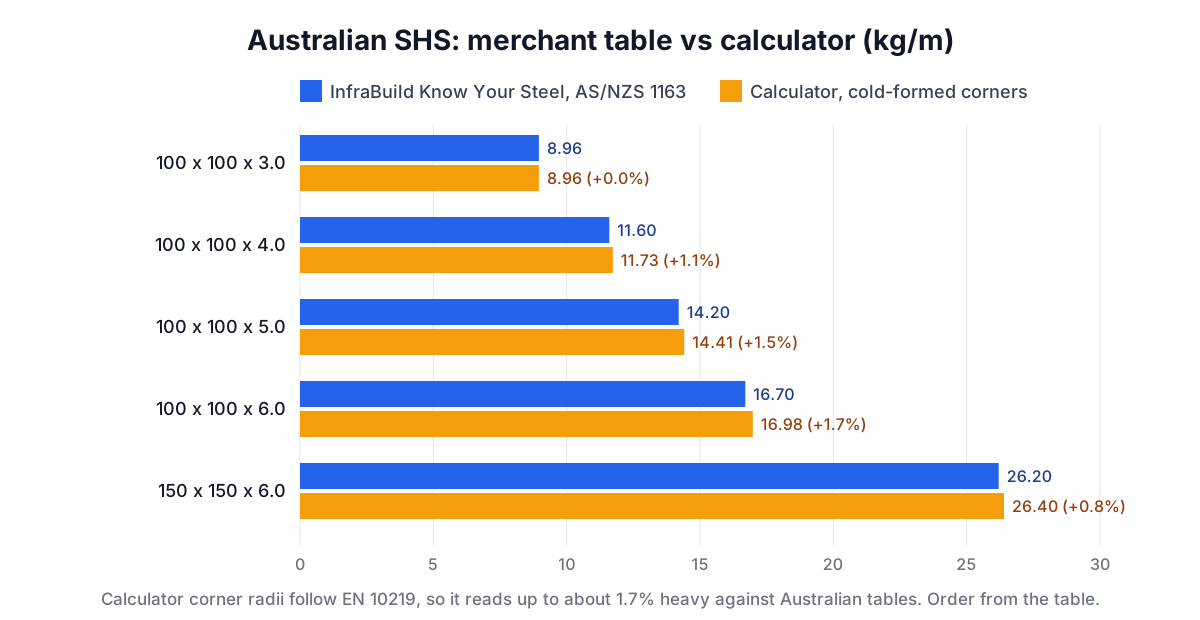
Table figures are from Know Your Steel page 28. For ordering, use the table. For checking that a pack is roughly right, or for a lift where you would add a margin anyway, a 1.5% difference does not matter.
Circular hollow sections are simpler because there are no corners. The same catalogue gives the AS/NZS 1163 formula for CHS mass per metre:
kg/m = (OD − t) x t x 0.0246615
which is exactly π x 0.00785. For a 101.6 x 4.0 CHS that is 97.6 x 4.0 x 0.0246615 = 9.63 kg/m, and the calculator's round tube gives the same 9.63 kg/m.
N-class reo: nominal mass and merchant mass
Reinforcing bar to AS/NZS 4671 is named by its class and diameter: N12 is a 12 mm Class N bar. Its nominal mass is the 12 mm circle at 7,850 kg/m³, 0.888 kg/m, which is what a bar schedule and the calculator use.
Merchants can list more. Know Your Steel (page 64) gives Class N bar as:
| Bar | Listed mass | Nominal (calculator) |
|---|---|---|
| N10 | 0.64 kg/m | 0.617 kg/m |
| N12 | 0.93 kg/m | 0.888 kg/m |
| N16 | 1.65 kg/m | 1.578 kg/m |
| N20 | 2.58 kg/m | 2.466 kg/m |
with the note that the calculated mass includes an allowance for rolling manufacturing variations under its terms and conditions. The listed N12 figure is about 4.8% above nominal. If you buy by the tonne, ask whether the invoice uses the nominal or the listed mass, because on a large slab the difference is real money.
Worked example: steel for a patio roof
A patio uses two 200UB25.4 beams at 9 m, four 100 x 100 x 3.0 SHS posts at 3 m and, for the slab, one hundred N12 bars at 6 m.
| Item | Calculator inputs | Calculator | Merchant table |
|---|---|---|---|
| UB | name mass 25.4 kg/m x 9 m x 2 | 457.2 kg | |
| SHS posts | square tube 100 x 3, cold-formed, 3 m, qty 4 | 8.96 kg/m, 107.5 kg | 8.96 x 3 x 4 = 107.5 kg |
| N12 | round bar 12 mm, 6 m, qty 100 | 0.888 kg/m, 532.7 kg | 0.93 x 600 = 558 kg |
The delivery is about 1.1 tonnes. Each beam is 228.6 kg, a lift for a crane truck or telehandler rather than people. If a merchant quotes A$2,500 a tonne for the beams (an example figure, not a current price), enter A$2.50 per kg: the two beams come to about A$1,143 before cutting, coating and delivery.
Coatings, plate and other adjustments
- Galvanised tube. InfraBuild's DuraGal hot-dip coating has a minimum average zinc mass of 100 g/m², per Know Your Steel page 28. A 100 x 100 tube has roughly 0.39 m² of outside surface per metre (the Blue Book lists 0.390 m² for 100 x 100 x 3.0), so that is in the order of 40 g/m from the outside face, small against 8.96 kg/m but not zero.
- Plate. 7.85 kg/m² per millimetre. A 2,400 x 1,200 mm sheet of 10 mm plate is 226.1 kg. For floor (checker) plate the same catalogue says to add 2 kg/m² for the raised pattern.
- Flats, squares and rounds. Width x thickness x 0.00785 kg/m for flats, side² x 0.00785 for squares and d² x 0.006165 for rounds, as the catalogue's handy tips page gives them.
- Rolling tolerance. The catalogue notes that some of its mass calculations include a 2.5% rolling tolerance. Read the footnotes of whichever table you order from.
Tools for this job
- Steel Weight Calculator (Australia): SHS, RHS, CHS, flats, plate and reo in kg per metre and per length, priced in A$.
- Beam Deflection Calculator: takes the self-weight in kg/m as one of its loads; the beam deflection formulas guide explains the cases.
- Rebar Calculator: bar count and spacing for the slab before converting to kilograms.
- Concrete Calculator: the slab volume for the same job.
All figures here are nominal or catalogue values. Use the supplier's weight for a lift plan and have lifts planned by a competent person.
Frequently asked questions
How much does a 100 x 100 x 5 SHS weigh per metre in Australia?
InfraBuild lists 14.2 kg/m for 100 x 100 x 5.0 SHS to AS/NZS 1163. The calculator's cold-formed option gives 14.41 kg/m because it uses European corner radii; order from the table.
What does the 25.4 in 200UB25.4 mean?
It is the mass in kilograms per metre. The 200 is the nominal depth class; the actual section is 203 x 133 mm.
Why is my reo invoice heavier than the bar schedule?
Bar schedules use nominal mass (0.888 kg/m for N12), while some merchants list a higher calculated mass that includes a rolling allowance (0.93 kg/m for N12 in InfraBuild's catalogue). Ask which basis the price uses.
What is the formula for CHS weight per metre?
(OD − t) x t x 0.0246615 kg/m, with the outside diameter and wall in millimetres, as given for AS/NZS 1163 sections. A 101.6 x 4.0 CHS is 9.63 kg/m.
Sources and further reading
- Know Your Steel, edition 9 (June 2023), InfraBuild Steel Centre. Page 11 universal beams; page 28 SHS masses and DuraGal zinc mass; page 64 Class N bar masses and rolling allowance; handy tips page with the CHS formula and floor plate allowance.
- AS/NZS 1163:2016 Cold-formed structural steel hollow sections, Standards Australia. The product standard for Australian SHS, RHS and CHS.
- AS/NZS 3679.1:2016 Structural steel, Part 1: Hot-rolled bars and sections, Standards Australia. The product standard for UB and UC sections.
- AS/NZS 4671:2019 Steel for the reinforcement of concrete, Standards Australia. The product standard for reinforcing steel.
- Cold-formed square hollow sections: dimensions and properties, Steel for Life and SCI. EN 10219 table (100 x 100 x 5.0 at 14.4 kg/m) that shows where the calculator's corner radii come from.
- Eurocode 3: Design of steel structures, European Commission Joint Research Centre. The European steel design standards.
Open the Steel Weight Calculator
More Civil & Structural
Every tool in the Civil & Structural section, free and in your browser.