
Steel Weight per Metre: UB, UC, SHS, Plate and Rebar (UK)
How to work out steel weight in kg for UK sections: Blue Book masses for UB and UC, cold-formed vs hot-finished SHS, plate per mm, rebar and LOLER lifts.
By Redbison Dev · · 9 min read
United Kingdom edition. Written for UK steelwork: Blue Book section masses (Steel for Life and SCI), EN 10219 cold-formed and EN 10210 hot-finished hollow sections, UK serial-size names, prices per tonne in pounds and the LOLER duty to plan lifts. US edition
In the UK most steel arrives with its weight already in the name. A 203 x 133 x 25 UB is a universal beam about 203 mm deep and 133 mm wide that weighs 25 kg per metre, so eight 6 m lengths are roughly 1.2 tonnes before you touch a calculator. The arithmetic matters for everything the name does not cover: hollow sections, flats and plate cut to size, bundles of bar, and the cut list for a whole delivery. This edition shows where the UK figures come from (the Blue Book tables), why a formula undershoots a rolled beam, why the same SHS size has two masses, and how the numbers feed a lift plan. Every example can be repeated in the Steel Weight Calculator (UK).
How UK sections are named and why the name is not the size
UK open sections are ordered by serial size: nominal depth x nominal width x mass per metre. The name rounds the dimensions but not the mass. The Blue Book table for universal beams, published by Steel for Life and the Steel Construction Institute, lists a 203 x 133 x 25 UB at:
| Property | Value |
|---|---|
| Mass per metre | 25.1 kg/m |
| Depth h | 203.2 mm |
| Width b | 133.2 mm |
| Web tw | 5.7 mm |
| Flange tf | 7.8 mm |
| Root radius r | 7.6 mm |
So the true mass is 25.1 kg/m, not 25, and the true depth is 203.2 mm. The same table lists a 254 x 146 x 31 UB at 31.1 kg/m with a depth of 251.4 mm, which is shallower than its name. Take dimensions from the table, never from the designation, when you set out a connection or enter the section in a calculator.
Hollow sections are named differently: outside size x outside size x wall, all in millimetres, with no mass in the name. That is where most hand calculations are needed.
The calculation the tables are built on
Mass per metre is the cross-section area times the density of steel. With the area in mm² and steel at 7,850 kg/m³, divide by 1,000,000 to get kg/m:
kg/m = A (mm²) x 7,850 / 1,000,000 = A x 0.00785
The 0.00785 is worth memorising, because it turns any area in mm² straight into kg/m. A 100 x 10 mm flat has 1,000 mm² and weighs 7.85 kg/m; a 6 m length is 47.1 kg. Plate follows the same rule per square metre: every millimetre of thickness is 7.85 kg/m², so 10 mm plate is 78.5 kg/m².
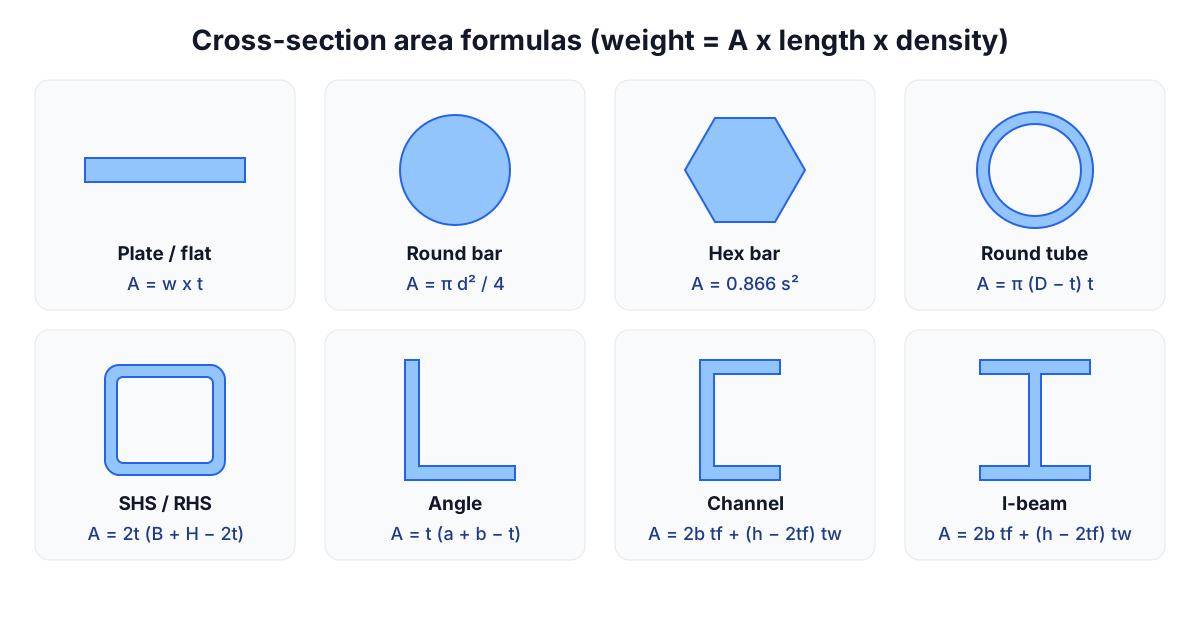
For each shape the area comes from its geometry. Round bar is π d²/4, a hollow section is the outer square minus the inner square less the corner material, and a beam is two flanges plus the web between them. The area formulas illustration on the US edition lists them all, and the calculator applies them.
Why a formula comes in light on a rolled beam
Enter the Blue Book dimensions of a 203 x 133 x 25 UB into the calculator as an I-beam (203.2 x 133.2 mm, web 5.7 mm, flange 7.8 mm) and it returns 24.71 kg/m. The table says 25.1 kg/m. The 1.6% gap is the four root fillets of 7.6 mm radius where the web meets the flanges, which a two-flanges-plus-web formula leaves out. The 254 x 146 x 31 UB shows the same pattern: 30.76 kg/m from the formula against 31.1 kg/m in the table.
For UB, UC, PFC and angles the rule is simple: use the table mass for ordering, billing and lifting, and use the formula only to sanity-check a quantity or a section that is not in the table, such as a fabricated plate girder (which has no root fillets, so the formula is right for it).
Cold-formed or hot-finished: two masses for one SHS size
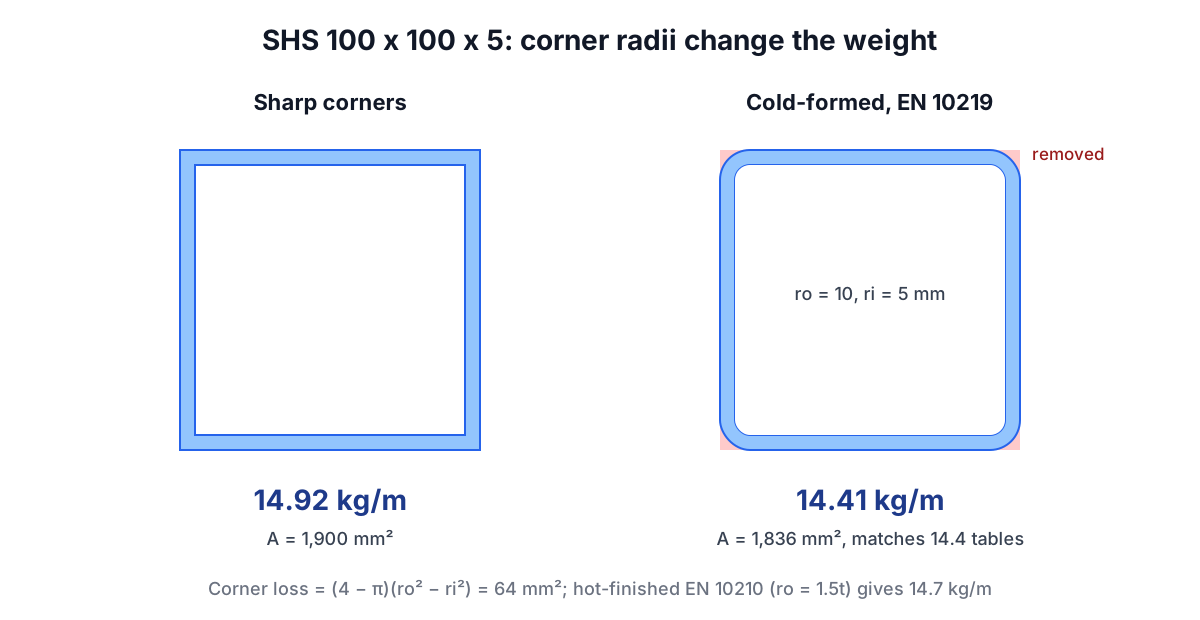
A 100 x 100 x 5 SHS can be cold-formed to BS EN 10219 or hot-finished to BS EN 10210, and the two weigh different amounts because the product standards set different corner radii. Cold-formed tube has larger, softer corners, which remove a little more steel. The Blue Book lists both, and the calculator models both:
| 100 x 100 SHS | Blue Book, cold-formed | Calculator, cold-formed | Blue Book, hot-finished | Calculator, hot-finished |
|---|---|---|---|---|
| 4.0 mm wall | 11.7 kg/m | 11.73 kg/m | 11.9 kg/m | 11.92 kg/m |
| 5.0 mm wall | 14.4 kg/m | 14.41 kg/m | 14.7 kg/m | 14.70 kg/m |
Figures from the cold-formed SHS and hot-finished SHS tables. A sharp-cornered box of the same size would be 14.92 kg/m, which is why a plain "outer square minus inner square" sum overestimates every hollow section.
Not every wall exists in both forms. The hot-finished table runs 3.6, 4.0, 5.0, 6.3, 8.0 and 10.0 mm walls for 100 x 100, while the cold-formed table has 3.0, 4.0, 5.0, 6.0 and 8.0 mm. A drawing that calls for 6.3 mm is asking for hot-finished tube. The two forms are designed as different products, so ask the engineer before substituting one for the other.
Worked example: a delivery for a rear extension
A small job orders eight 203 x 133 x 25 UB at 6 m, twelve 100 x 100 x 5 cold-formed SHS posts at 7.5 m and fifty 16 mm reinforcing bars at 6 m for the slab edge. In the calculator:
| Item | Inputs | Calculator result | Using the table mass |
|---|---|---|---|
| UB | I-beam 203.2 x 133.2, web 5.7, flange 7.8, 6 m, qty 8 | 24.71 kg/m, 148.2 kg each, 1,186 kg | 25.1 x 6 x 8 = 1,204.8 kg |
| SHS | Square tube 100 x 5, cold-formed, 7.5 m, qty 12 | 14.41 kg/m, 108.1 kg each, 1,297 kg | 14.4 x 7.5 x 12 = 1,296 kg |
| Bar | Round bar 16 mm, 6 m, qty 50 | 1.578 kg/m, 9.47 kg each, 473.5 kg | (nominal mass) |
The delivery is about 2.97 tonnes using the table masses. Two things follow. First, a single UB is 151 kg at the table mass, which is a mechanical lift, not a two-person carry. Second, if your merchant quotes £1,200 a tonne for the beams (an example rate, not a market price), enter £1.20 per kg in the price box: the eight beams cost about £1,446 at the table mass.
For reinforcing bar the calculator's figure is the nominal mass, the nominal cross-section at 7,850 kg/m³, which is the basis bar is ordered and invoiced on. A 16 mm bar is 1.578 kg/m, a 12 mm bar 0.888 kg/m and a 25 mm bar 3.853 kg/m.
From weight to a safe lift
The Lifting Operations and Lifting Equipment Regulations 1998, regulation 8, require every employer to ensure that each lifting operation is properly planned by a competent person, appropriately supervised and carried out in a safe manner. The HSE guidance on planning lifting operations adds that lifting equipment must be of adequate strength for the proposed use, which you cannot judge without the load.
In practice:
- Use the certified or table weight for the plan, and the calculated weight to check that a delivery ticket or a bundle label is plausible.
- Add what is attached. Cleats, end plates, base plates and bolts are not in the section mass. Weigh the fabricated piece, or add each plate as its own item in the calculator.
- Galvanising adds mass. Ask the galvaniser for the coated weight if a lift is close to a crane's capacity at the radius you need.
- Read the chart at the real radius. A crane's rated load falls as the radius grows, and the beam usually has to go at the far end of the reach.
Quick checks to carry in your head
- Plate: 7.85 kg/m² per mm. An 8 x 4 sheet (2,440 x 1,220 mm) of 6 mm plate is 140.2 kg; a 2,500 x 1,250 mm sheet of 10 mm is 245.3 kg.
- Flats and squares: width x thickness x 0.00785 kg/m.
- Round bar: d² x 0.006165 kg/m (16 mm is 1.578, 25 mm is 3.853).
- UB and UC: the last number in the name, to the nearest kilogram, then the table for the exact figure.
- SHS and RHS: the Blue Book for the right form (cold-formed or hot-finished); the formula with corner radii agrees to within about 0.05 kg/m for the sizes above.
- Stainless 304 (1.4301) is about 7,900 kg/m³ and 316 (1.4401) about 8,000 kg/m³, so stainless of the same size is about 0.6% to 1.9% heavier than carbon steel at 7,850 kg/m³; aluminium 6082 at 2,700 kg/m³ is about a third.
Tools for this job
- Steel Weight Calculator (UK): kg/m, per length, delivery totals and cost for every section above.
- Section Properties Calculator: area, second moment of area and section modulus for shapes outside the Blue Book.
- Beam Deflection Calculator (UK): checks the UB once its self-weight is known; the UK beam deflection guide explains the National Annex limits.
- Sheet Metal Weight Calculator: thin sheet by gauge or thickness.
Weights from formulas and tables are nominal. Have the lift planned by a competent person and use the supplier's certified weight for anything close to a limit.
Frequently asked questions
How much does a 203 x 133 x 30 UB weigh?
The Blue Book lists 30.0 kg/m for a 203 x 133 x 30 UB, with a depth of 206.8 mm and a width of 133.9 mm. A 6 m length is 180 kg. It is the heavier sister of the 25 kg/m section and is deeper and wider, so it does not drop into the same detail without checking.
Is an RSJ the same as a UB?
In everyday UK use, "RSJ" (rolled steel joist) means any steel beam over an opening, and what is supplied today is almost always a universal beam or column. Ask for the serial size from the engineer's drawing, not "an RSJ", and use the Blue Book mass for that size.
Why does my SHS weigh less than outer square minus inner square?
Because the corners are rounded. Cold-formed SHS to BS EN 10219 has outside corner radii of about two to three times the wall, so a 100 x 100 x 5 tube weighs 14.4 kg/m instead of the 14.92 kg/m a sharp-cornered box would. Hot-finished tube has tighter corners and weighs 14.7 kg/m.
How many 16 mm bars make a tonne?
At 1.578 kg/m, a 12 m bar weighs 18.94 kg, so about 53 bars of 12 m make a tonne. Thirty bars of 12 m weigh 568.2 kg. Check your bar schedule's lengths: shorter cut-and-bent bars change the count but not the kilograms per metre.
Sources and further reading
- Universal beams: dimensions and properties, Steel for Life and SCI (Blue Book, Eurocode 3 UK NA). Masses, depths, widths, web and flange thicknesses and root radii for 203 x 133 x 25, 203 x 133 x 30 and 254 x 146 x 31 UB.
- Cold-formed square hollow sections: dimensions and properties, Steel for Life and SCI. 100 x 100 x 4.0 at 11.7 kg/m and 100 x 100 x 5.0 at 14.4 kg/m.
- Hot-finished square hollow sections: dimensions and properties, Steel for Life and SCI. 100 x 100 x 4.0 at 11.9 kg/m, 100 x 100 x 5.0 at 14.7 kg/m and the available wall thicknesses.
- The Lifting Operations and Lifting Equipment Regulations 1998, regulation 8, legislation.gov.uk. Lifting operations must be properly planned by a competent person, appropriately supervised and carried out safely.
- Planning and organising lifting operations, Health and Safety Executive. Competence, supervision and adequate strength of lifting equipment.
- Eurocode 3: Design of steel structures, European Commission Joint Research Centre. The design code behind the UK National Annex tables.
Open the Steel Weight Calculator
More Civil & Structural
Every tool in the Civil & Structural section, free and in your browser.