
How Many Kilojoules Do I Need a Day? BMR and TDEE in kJ
Work out your daily kilojoules from height, weight, age and activity, compare them with the 8,700 kJ on food labels, and set a weight-loss target in kJ.
By Redbison Dev · · 6 min read
Australia edition. Worked in kilojoules as on Australian food labels, with the 8,700 kJ reference from healthdirect and the Food Standards Code, the Mifflin-St Jeor equation the ABS now uses for BMR, and kJ weight-loss targets. US edition
healthdirect puts the average adult need at about 8,700 kilojoules a day, the same figure the percentage daily intake on food labels is based on. Your own figure depends on your size, age, sex and how much you move. A moderately active 35-year-old woman who is 165 cm and 70 kg needs about 9,050 kJ to maintain her weight, according to the kilojoule and calorie calculator; a lightly active 42-year-old man of 180 cm and 92 kg needs about 10,590 kJ. This guide shows how those numbers are built, in kilojoules from start to finish, and how to turn them into a target you can check on the scales.
It is general information. If you have diabetes, kidney disease, an eating disorder or are pregnant, see your GP or an Accredited Practising Dietitian before changing your intake.
Kilojoules, calories and the 8,700 kJ on the label
Australia measures food energy in kilojoules. The Food Standards Code requires nutrition information panels to give energy in kilojoules, or in kilojoules and kilocalories, per serve and per 100 g (or 100 mL). Where a panel shows percentage daily intake, Schedule 12 of the Code states that the percentages are based on an average adult diet of 8,700 kJ.
One kilocalorie, what most apps and overseas websites call a calorie, is 4.184 kJ; healthdirect rounds it to 4.2. So 2,000 kcal is about 8,370 kJ, and 8,700 kJ is about 2,080 kcal. If you follow a plan written in calories, the calculator can show either unit.
Step one: resting energy
The energy your body uses at rest, to run the heart, lungs, brain and organs and hold your temperature, is the basal metabolic rate (BMR). It cannot be measured at home, so it is predicted from body size, age and sex.
The calculator uses the Mifflin-St Jeor equation, published in 1990 and found in a 2005 systematic review to be the common equation most likely to land within 10% of measured values. It is also the equation the Australian Bureau of Statistics now uses to estimate BMR in the food and nutrient data of its Intergenerational Health and Mental Health Study: the ABS moved to Mifflin-St Jeor from the older Schofield method, converting the result from kcal to kJ.
The equation is usually printed in kcal. Multiplying each term by 4.184 puts it straight into kilojoules:
Men:    41.84 × kg + 26.15 × cm − 20.92 × age + 20.9
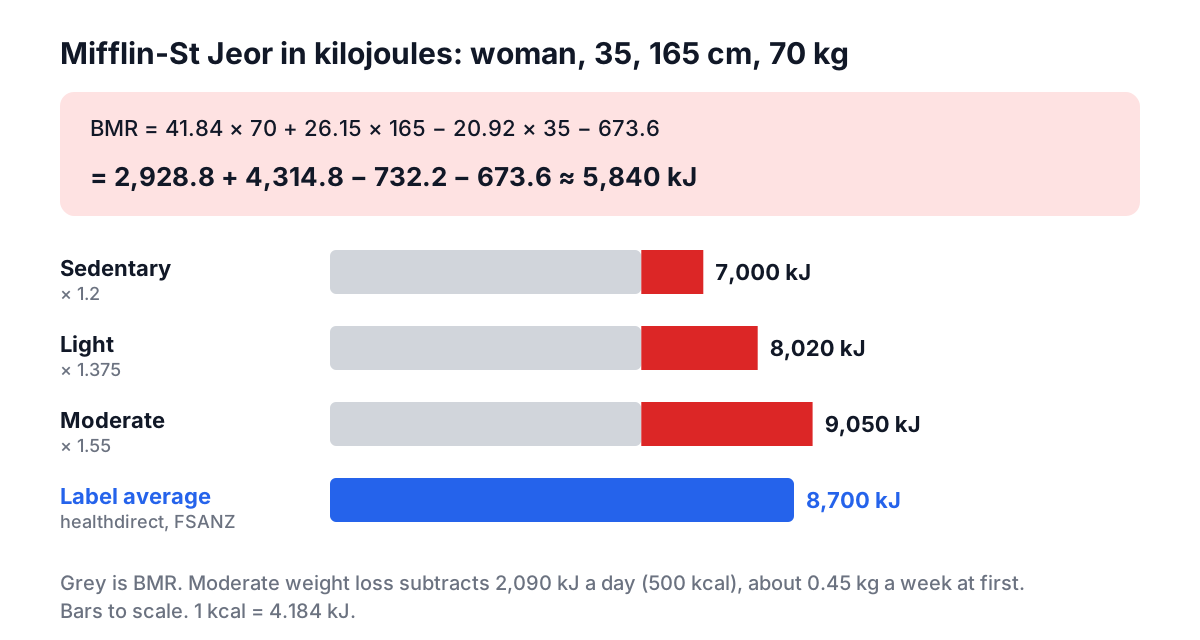
Women:  41.84 × kg + 26.15 × cm − 20.92 × age − 673.6
For the woman above, 35 years, 165 cm, 70 kg:
41.84 × 70   =  2,928.8
26.15 × 165  =  4,314.8
20.92 × 35   =    732.2  (subtract)
constant     =    673.6  (subtract)
BMR          ≈  5,837.7 kJ, about 5,840 kJ (1,395 kcal)
Step two: the activity factor
Total daily energy expenditure (TDEE) is BMR times a factor for how active you are. For her:
| Setting | Factor | Daily need |
|---|---|---|
| Sedentary | 1.2 | 7,000 kJ |
| Light | 1.375 | 8,020 kJ |
| Moderate | 1.55 | 9,050 kJ |
| High | 1.725 | 10,070 kJ |
| Very high | 1.9 | 11,090 kJ |
Each step up adds about 1,000 kJ a day. That makes the activity choice the biggest source of error. The settings describe exercise, but the factor has to cover your whole week, including the hours at a desk or on the couch. If you train hard three times a week and sit the rest of the time, light is often more accurate than moderate.
healthdirect lists the things that change your need: activity level, muscle mass, stage of life, age, sex, height and weight. The 8,700 kJ average sits between her light and moderate figures; a smaller, older or less active adult will often need less, a tall or very active one more.
A weight-loss target in kilojoules
To lose body fat, healthdirect says, you need to take in fewer kilojoules than your body uses. The calculator's goals subtract 1,050, 2,090 or 3,140 kJ a day (250, 500 or 750 kcal).
Take the 42-year-old man of 180 cm and 92 kg who walks most days but does no formal exercise:
| Step | Result |
|---|---|
| BMR | about 7,700 kJ (1,840 kcal) |
| Maintenance, light (× 1.375) | 10,590 kJ |
| Moderate weight loss (−2,090 kJ) | 8,490 kJ |
A kilogram of body fat holds roughly 7,700 kcal, or about 32,200 kJ, on the usual rule of thumb. A daily gap of 2,090 kJ is therefore about 0.45 kg a week at first. In practice loss slows over time, because a lighter body uses less energy; re-run the calculator after every 5 kg.
The calculator's own advice is not to go below 5,020 kJ (1,200 kcal) a day for women or 6,280 kJ (1,500 kcal) for men without medical supervision. Check any target against that line.
Reading labels against your target
Two habits make a kilojoule target work in an Australian supermarket:
- Compare per 100 g. Serving sizes on panels differ between brands and often from what you actually eat. The per 100 g column lets you compare like with like.
- Check the serve you eat. A 600 mL soft drink or a large café muffin is often one serve to the person eating it, whatever the panel says.
Checking the estimate against your weight
The equation is a starting point; your scales give the answer.
- Eat close to your estimated kJ for two to three weeks.
- Weigh yourself in the morning, on the same scales, a few times a week and compare weekly averages.
- If the average is steady, your intake is your real maintenance. If it is moving, adjust by 400 to 800 kJ a day and watch another two weeks.
Ignore the first week of any change. Shifts in water and stored carbohydrate can move the scales by a kilogram or more on their own.
Mistakes worth avoiding
- Treating 8,700 kJ as your target. It is an average used on labels, not a personal figure.
- Adding exercise kilojoules from a watch on top. If your activity setting already includes your training, you would count it twice, and wearables often overestimate.
- Mixing units. A plan in calories and labels in kilojoules is a common way to be out by a factor of four. Pick one unit and convert everything to it.
- Never recalculating. Every 5 kg lost lowers BMR by about 210 kJ before activity is counted.
Tools for the next step
The kilojoule deficit planner turns your target into a dated plan, and the protein calculator for Australia compares your protein with the Australian reference intakes. If you have not checked your BMI and waist, the Australian edition of the guide to healthy BMI and waist size covers both, and the calories burned calculator estimates the energy cost of specific activities.
Frequently asked questions
How many kilojoules should I eat a day?
healthdirect gives about 8,700 kJ as the average adult need, but your figure depends on your size, age, sex and activity. A moderately active 35-year-old woman of 165 cm and 70 kg needs about 9,050 kJ; the same woman with a desk job and little exercise needs about 7,000 to 8,000 kJ.
How do I convert calories to kilojoules?
Multiply calories (kcal) by 4.184; healthdirect rounds this to 4.2. So 1,500 kcal is about 6,280 kJ and 2,000 kcal about 8,370 kJ. To go the other way, divide kilojoules by 4.184.
How many kilojoules should I cut to lose weight?
About 2,100 kJ a day gives roughly 0.45 kg a week at first, on the rule of thumb that a kilogram of fat holds about 32,200 kJ. Smaller cuts of about 1,050 kJ are easier to keep up. Real loss slows as your weight falls.
What is my BMR in kilojoules?
Using Mifflin-St Jeor in kJ: 41.84 × weight in kg + 26.15 × height in cm − 20.92 × age, then add 20.9 for men or subtract 673.6 for women. For a 35-year-old woman of 165 cm and 70 kg that is about 5,840 kJ a day.
Why is the 8,700 kJ figure on food labels?
Schedule 12 of the Food Standards Code sets the format of the percentage daily intake panel and states that the percentages are based on an average adult diet of 8,700 kJ. It is a reference for comparing foods, not an individual target.
Sources and further reading
- Kilojoules, healthdirect (Australian Government). The 8,700 kJ average, the 4.2 conversion and what changes your need.
- Nutrition information panels, Food Standards Australia New Zealand. Energy in kJ, or kJ and kcal, per serve and per 100 g.
- Food Standards Code, Schedule 12: nutrition information panels, Federal Register of Legislation. Percentage daily intakes based on an average adult diet of 8,700 kJ.
- Energy and nutrient intake, Australian Bureau of Statistics. BMR estimated with Mifflin-St Jeor, replacing Schofield, expressed in kJ.
- A new predictive equation for resting energy expenditure in healthy individuals, The American Journal of Clinical Nutrition, 1990. Mifflin, St Jeor and colleagues.
- Comparison of predictive equations for resting metabolic rate in healthy nonobese and obese adults, Journal of the American Dietetic Association, 2005. Frankenfield and colleagues.
More Fitness Calculators
Every tool in the Fitness Calculators section, free and in your browser.
- BMI Calculator
- Calorie Calculator
- Protein Calculator
- Hydration Calculator
- Calorie Deficit Planner
- Body Fat Calculator
- Ideal Weight Calculator
- Running Pace Calculator
- Target Heart Rate Calculator
- One Rep Max Calculator
- Barbell Plate Calculator
- RPE Calculator
- Interval Timer
- Calories Burned Calculator
- Body Surface Area Calculator
- Waist-to-Hip Ratio Calculator
- VO2 Max Calculator
- Steps to Distance & Calories Calculator