
Daily Calorie Needs for Indians: BMR, TDEE and ICMR Figures
How many kcal an Indian adult needs, why ICMR-NIN lowered its figures in 2020, and which calculator activity level matches Indian daily life.
By Redbison Dev · · 6 min read

India edition. Built around the ICMR-NIN 2020 energy requirements for Indians (lower BMR, PAL 1.40 for sedentary work, 65 kg and 55 kg reference adults) and the 2024 Dietary Guidelines for Indians, with examples in kg, cm and kcal. US edition
ICMR-NIN puts the daily energy need of a sedentary Indian man of 65 kg at 2,110 kcal and of a sedentary woman of 55 kg at 1,660 kcal. A calorie calculator set to "sedentary" will usually give a lower figure: a 30-year-old man of 170 cm and 65 kg comes out at 1,881 kcal on the daily calorie calculator for India. The difference is not an error in either. It comes from what each method means by "sedentary", and once you see that, you can pick the setting that matches an Indian working day. This guide walks through both methods with the same people.
It is general information, not dietary advice for a medical condition. If you have diabetes, kidney disease, thyroid disease or are pregnant, ask your doctor or a registered dietitian.
The same formula underneath
Every energy estimate, ICMR's included, multiplies two things:
Total energy need = BMR × activity factor
BMR (basal metabolic rate) is the energy used at complete rest: heart, lungs, brain, liver, body temperature. The activity factor scales it up for everything you do in a day. ICMR-NIN calls this factor the physical activity level, or PAL.
How ICMR-NIN set the Indian figures
The 2020 Nutrient Requirements for Indians changed both halves of that formula for adults.
BMR came down. International FAO/WHO/UNU equations, whose data set included young and muscular subjects, were found to overestimate the BMR of Indians by 10 to 12%, because Indian adults carry relatively more fat and less muscle at the same weight. The 2010 committee had already cut the equation's BMR by 5%; the 2020 committee cut it by a further 5%.
The sedentary PAL came down. The energy cost of each activity had been taken from studies of Western populations. Using values measured in Indian studies, the sedentary PAL fell from 1.53 to 1.40, and the other levels fell too.
Together these lowered adult energy needs by 3 to 8 kcal per kg per day:
| Adult | Work | ICMR 2020 | ICMR 2010 | Change |
|---|---|---|---|---|
| Man, 65 kg | Sedentary | 2,110 kcal | 2,320 kcal | −210 |
| Man, 65 kg | Moderate | 2,710 kcal | 2,730 kcal | −20 |
| Man, 65 kg | Heavy | 3,470 kcal | 3,490 kcal | −20 |
| Woman, 55 kg | Sedentary | 1,660 kcal | 1,900 kcal | −240 |
| Woman, 55 kg | Moderate | 2,130 kcal | 2,230 kcal | −100 |
| Woman, 55 kg | Heavy | 2,720 kcal | 2,850 kcal | −130 |
Pregnancy adds 350 kcal a day, and breastfeeding adds 600 kcal in the first six months and 520 kcal from seven to twelve months. Per kilogram, the 2020 figures work out at 32, 42 and 53 kcal for men and 30, 39 and 49 kcal for women across the three work levels. ICMR-NIN says actual needs should be adjusted for a group's real weight and activity, which is the job a personal calculator does.
How the calculator does it
The calculator predicts BMR with the Mifflin-St Jeor equation (1990), which a 2005 systematic review found the most likely of the common equations to land within 10% of measured values:
Men:    10 × kg + 6.25 × cm − 5 × age + 5
Women:  10 × kg + 6.25 × cm − 5 × age − 161
For a 30-year-old man of 170 cm and 65 kg:
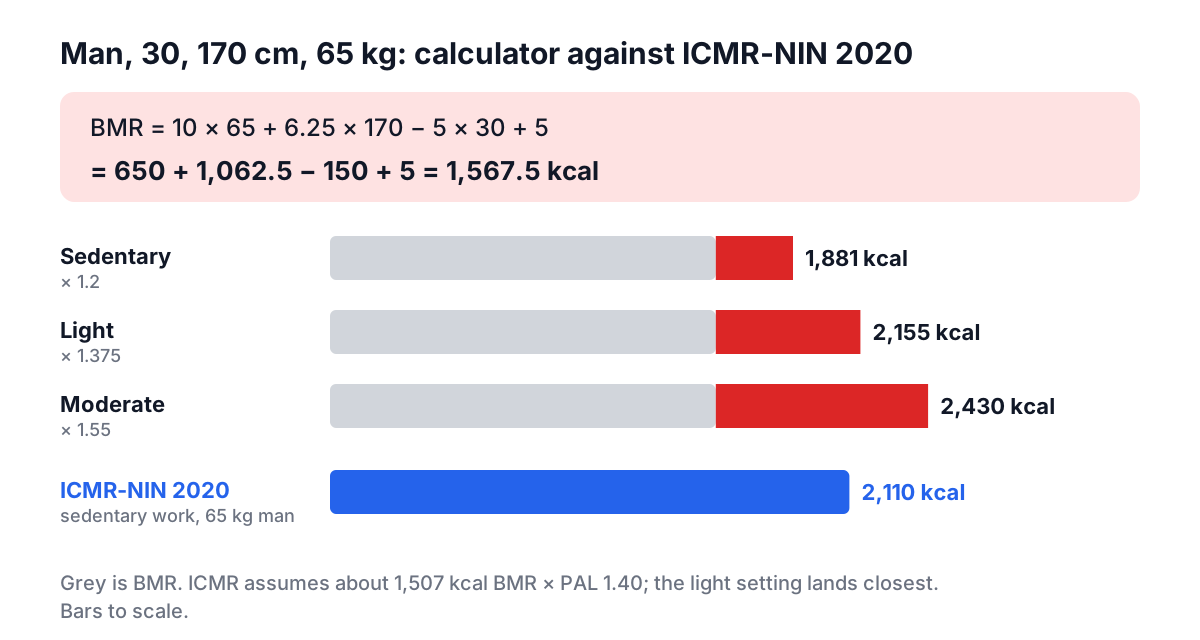
BMR = 10 × 65 + 6.25 × 170 − 5 × 30 + 5
    = 650 + 1,062.5 − 150 + 5 = 1,567.5 kcal
Then it multiplies by one of five activity factors: 1.2 (sedentary), 1.375 (light), 1.55 (moderate), 1.725 (high) or 1.9 (very high).
Putting the two side by side
Divide ICMR's sedentary figure by its PAL of 1.40 and you get the BMR it assumes for the reference adults: about 1,507 kcal for the 65 kg man and 1,186 kcal for the 55 kg woman. Mifflin-St Jeor gives 1,568 and 1,183 kcal for a 30-year-old man of 170 cm and a 35-year-old woman of 155 cm at those weights. The resting estimates are close. The gap is almost all in the activity factor.
| Man, 30, 170 cm, 65 kg | Woman, 35, 155 cm, 55 kg | |
|---|---|---|
| BMR (Mifflin-St Jeor) | 1,568 kcal | 1,183 kcal |
| Calculator, sedentary (× 1.2) | 1,881 kcal | 1,419 kcal |
| Calculator, light (× 1.375) | 2,155 kcal | 1,626 kcal |
| Calculator, moderate (× 1.55) | 2,430 kcal | 1,833 kcal |
| ICMR-NIN 2020, sedentary work | 2,110 kcal | 1,660 kcal |
ICMR's PAL of 1.40 for sedentary work is a whole-day figure recalculated from the energy cost of activities measured in Indian studies, while the calculator's sedentary factor of 1.2 assumes very little movement beyond rest. So for most office workers and homemakers in India the light setting lands nearest the ICMR figure, within about 50 kcal for both of these adults.
The reverse happens at the heavy end. ICMR's heavy work figure for the 65 kg man, 3,470 kcal, implies a PAL of about 2.3. The calculator's highest factor is 1.9, giving 2,978 kcal. Construction workers, farm labourers and others in hard physical jobs should treat the calculator as a floor.
A weight-loss example
A 40-year-old man of 172 cm and 78 kg who walks a little each day:
| Step | Result |
|---|---|
| BMR | 1,660 kcal |
| Maintenance on light (× 1.375) | 2,283 kcal |
| Moderate loss goal (−500 kcal) | 1,783 kcal |
His BMI is 26.4, in the obesity band on the Asian Indian cut-offs. A 500 kcal daily gap is roughly 0.45 kg a week on the usual rule of thumb that a kilogram of body fat holds about 7,700 kcal. The Dietary Guidelines for Indians (2024) advise slow and steady weight reduction and warn that extreme approaches can harm health, so this pace fits. Losing a full 1 kg a week would need a gap of about 1,100 kcal a day, too steep for most people.
Where Indian calories come from
The guidelines also give useful markers for building a target:
- Visible fat: ICMR-NIN limits cooking oil to 20 to 50 g a day depending on energy need, and no more than 27 g for a 2,000 kcal diet. At 9 kcal per gram, 27 g is about 240 kcal.
- Sugar: under 5% of total energy for adults. At 1,800 kcal that is 90 kcal, about 22 g, including the sugar in tea.
- Cereals: prefer whole grains and millets to refined grains, and combine cereals with pulses.
- Activity: at least 30 to 45 minutes a day of brisk walking or moderate activity for adults.
Checking the estimate against your weight
Neither ICMR's table nor the calculator knows your real day. Your weight does.
- Eat close to your estimate for two to three weeks.
- Weigh yourself in the morning, before breakfast, on the same scale, a few times a week, and compare weekly averages.
- If the average is steady, that intake is your maintenance. If not, change by 100 to 200 kcal and watch another two weeks.
Ignore the first few days of any new diet: water and stored carbohydrate shift the scale by a kilogram or more on their own.
Next steps
The calorie deficit planner for India turns a target into a dated plan in kilograms, and the protein calculator for India compares your protein with the ICMR-NIN 0.83 g per kg RDA. If you have not checked your BMI against the Indian cut-offs, the India edition of the guide to normal BMI for Indians covers that and the waist limits.
Frequently asked questions
How many calories does an Indian man need per day?
ICMR-NIN (2020) gives 2,110 kcal for a sedentary man of 65 kg, 2,710 kcal for moderate work and 3,470 kcal for heavy work. Your own need depends on your weight, height, age and real activity. For a desk job, a calculator's "light" setting usually comes closest to the ICMR sedentary figure.
How many calories does an Indian woman need per day?
ICMR-NIN (2020) gives 1,660 kcal for a sedentary woman of 55 kg, 2,130 kcal for moderate work and 2,720 kcal for heavy work. Pregnancy adds 350 kcal, and breastfeeding adds 600 kcal in the first six months and 520 kcal from seven to twelve months.
Why did ICMR reduce calorie requirements in 2020?
Two reasons. International BMR equations overestimate the BMR of Indians by 10 to 12%, so the committee reduced BMR by a further 5% on top of the 5% cut in 2010. And Indian studies showed that daily activities cost less energy than Western data suggested, so the sedentary PAL fell from 1.53 to 1.40.
Which activity level should I choose for a desk job in India?
Try light first. The calculator's sedentary setting (× 1.2) assumes almost no movement, while ICMR-NIN's sedentary work figure includes ordinary daily activity. For a 30-year-old man of 170 cm and 65 kg, light gives 2,155 kcal against ICMR's 2,110 kcal.
How many calories should I cut to lose 1 kg a week?
About 1,100 kcal a day, on the rule of thumb that 1 kg of body fat holds roughly 7,700 kcal. That is steep. A 500 kcal daily cut gives about 0.45 kg a week, closer to the slow and steady pace the Dietary Guidelines for Indians recommend.
Sources and further reading
- Nutrient Requirements for Indians: brief note, ICMR-National Institute of Nutrition, 2020. Energy requirements, the BMR reduction, PAL 1.40 for sedentary work, and visible fat limits.
- Dietary Guidelines for Indians, ICMR-National Institute of Nutrition, 2024. Sugar under 5% of energy, slow and steady weight loss, 30 to 45 minutes of activity.
- Human energy requirements: report of a joint FAO/WHO/UNU expert consultation, Food and Agriculture Organization, 2004. The international equations ICMR-NIN adjusted.
- A new predictive equation for resting energy expenditure in healthy individuals, The American Journal of Clinical Nutrition, 1990. Mifflin, St Jeor and colleagues.
- Comparison of predictive equations for resting metabolic rate in healthy nonobese and obese adults, Journal of the American Dietetic Association, 2005. Frankenfield and colleagues.
More Fitness Calculators
Every tool in the Fitness Calculators section, free and in your browser.
- BMI Calculator
- Calorie Calculator
- Protein Calculator
- Hydration Calculator
- Calorie Deficit Planner
- Body Fat Calculator
- Ideal Weight Calculator
- Running Pace Calculator
- Target Heart Rate Calculator
- One Rep Max Calculator
- Barbell Plate Calculator
- RPE Calculator
- Interval Timer
- Calories Burned Calculator
- Body Surface Area Calculator
- Waist-to-Hip Ratio Calculator
- VO2 Max Calculator
- Steps to Distance & Calories Calculator