
How Many Calories Do I Need? A Canadian Guide to TDEE
Work out your daily Calories from pounds and inches, compare a calculator with Health Canada's energy equations, and set a 1 lb a week target you can check.
By Redbison Dev · · 6 min read
Canada edition. Worked in pounds and inches as Canadians weigh themselves, with Calories as on the Nutrition Facts table, Health Canada's estimated energy requirement equations and activity categories, its BMI classes and Canada's food guide. US edition
Most Canadians step on the scale in pounds and give their height in feet and inches, while the Nutrition Facts table counts Calories. A moderately active 35-year-old man who is 5 feet 10 inches and 180 lb needs about 2,720 Calories a day to hold his weight, according to the Canadian calorie calculator. Health Canada publishes its own equations for the same question, and for the same man they give a noticeably different answer. This guide shows how both work from pounds and inches, why they differ, and how to let your scale settle it.
It is general information. If you have diabetes, kidney disease, a history of disordered eating or are pregnant, talk to your family doctor or a registered dietitian before changing what you eat.
A Calorie on the label is a kilocalorie
The Calories on a Canadian Nutrition Facts table are kilocalories, the same unit the calculator and the equations below use. One Calorie is 4.184 kilojoules, which matters only if you compare with a product labelled in kJ.
Canada's food guide does not set a daily Calorie number. Its healthy eating recommendations are about what goes on the plate: plenty of vegetables and fruits, whole grains and protein foods, protein from plants more often, and water as your drink of choice. A Calorie target answers a different question, how much of that plate.
From pounds and inches to a resting estimate
The calculator predicts resting energy with the Mifflin-St Jeor equation, published in 1990 and found by a 2005 systematic review to be the common equation most likely to land within 10% of measured values. It works in kilograms and centimetres, so the calculator converts first:
180 lb × 0.45359237 = 81.65 kg
5 ft 10 in = 70 in × 2.54 = 177.8 cm

BMR = 10 × 81.65 + 6.25 × 177.8 − 5 × 35 + 5
    = 816.5 + 1,111.25 − 175 + 5
    = 1,757.7 Calories
For women the final constant is −161 instead of +5. Switching the calculator between pounds and kilograms changes nothing: the conversions are exact.
Then the activity factor
The calculator multiplies that resting figure by one of five factors:
| Setting | Factor | Man, 35, 5 ft 10 in, 180 lb |
|---|---|---|
| Sedentary | 1.2 | 2,109 Calories |
| Light | 1.375 | 2,417 Calories |
| Moderate | 1.55 | 2,724 Calories |
| High | 1.725 | 3,032 Calories |
| Very high | 1.9 | 3,340 Calories |
Moving from light to moderate adds over 300 Calories a day. That one choice moves the answer more than any detail of the equation.
Health Canada's equations
Health Canada's Dietary Reference Intakes pages set out equations that estimate a whole day's energy directly from age, height, weight and an activity category, instead of resting energy times a factor. A 2023 National Academies report, requested by the US and Canadian governments, updated the estimated energy requirements for both countries. For adults the activity categories are described in everyday terms, on top of the activities of daily living:
| Category | Physical activity level | Example day |
|---|---|---|
| Inactive | 1.00 to under 1.53 | Daily living, such as 30 minutes of walking plus 90 minutes of light to moderate tasks like vacuuming or raking |
| Low active | 1.53 to under 1.68 | Plus 60 to 80 minutes of walking at 5 to 7 km/h |
| Active | 1.68 to under 1.85 | Plus 30 to 50 minutes of walking at 5 to 7 km/h, 45 minutes of moderate cycling and 40 minutes of doubles tennis |
| Very active | 1.85 to under 2.50 | Plus 45 minutes of moderate cycling, 25 minutes of jogging at 10 km/h and 60 minutes of doubles tennis |
For the same man, the equations give:
| Category | Equation (age in years, height in cm, weight in kg) | Result |
|---|---|---|
| Inactive | 753.07 − 10.83 × 35 + 6.50 × 177.8 + 14.10 × 81.65 | 2,681 Calories |
| Low active | 581.47 − 10.83 × 35 + 8.30 × 177.8 + 14.94 × 81.65 | 2,898 Calories |
| Active | 1,004.82 − 10.83 × 35 + 6.52 × 177.8 + 15.91 × 81.65 | 3,084 Calories |
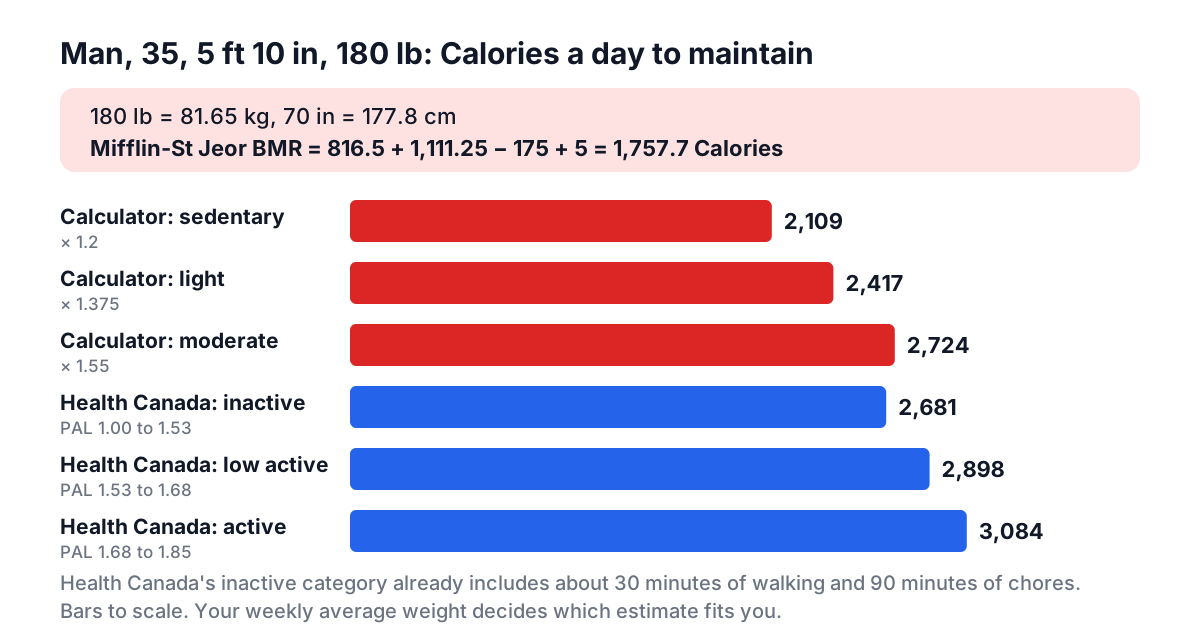
Health Canada's inactive figure, 2,681, is close to the calculator's moderate figure (2,724) and almost 600 Calories above its sedentary one. The difference lies in what counts as inactive. Health Canada's lowest category already includes half an hour of walking and an hour and a half of chores every day, and spans activity levels up to 1.53. The calculator's sedentary factor of 1.2 assumes much less movement than that.
Which number to start from
Health Canada answers this itself: "Relative body weight (that is, loss, stable, gain) is the preferred indicator of energy adequacy." Both methods are predictions. A practical way to use them:
- To maintain, start near Health Canada's figure for your honest category, or the calculator's light or moderate setting, and adjust.
- To lose weight, start from the calculator's lower figure. If you have overestimated your needs, a deficit built on the lower number still works; one built on the higher number may turn out to be maintenance.
A weight-loss example in pounds
A 50-year-old woman, 5 feet 4 inches and 160 lb, who walks a few times a week:
| Step | Result |
|---|---|
| BMI | 27.5, overweight in Health Canada's classification (25.0 to 29.9) |
| Calculator maintenance, light | 1,830 Calories |
| Moderate loss goal (−500) | 1,330 Calories |
| Health Canada estimate, inactive | 2,014 Calories |
| Health Canada estimate, low active | 2,179 Calories |
The calculator's goal uses the rule of thumb that a pound of fat holds about 3,500 Calories, so 500 a day is about 1 lb a week. Her target is close to the calculator's own advice not to go below 1,200 Calories a day for women (1,500 for men) without medical supervision, so adding activity is the easier way to widen the gap. The spread between the two methods, about 180 to 350 Calories at her likely activity level, is the reason to weigh in and adjust rather than trust either one.
Health Canada's classification also uses waist size: 102 cm (40 in.) or more for men and 88 cm (35 in.) or more for women indicates increased risk. For people 65 and older, it notes the "normal" BMI range may begin slightly above 18.5.
Checking against your scale
- Eat close to your starting figure for two to three weeks.
- Weigh yourself in the morning on the same scale a few times a week and compare weekly averages.
- If the average is steady, that intake is your maintenance. If you are losing or gaining, each 1 lb a week is about 500 Calories a day on the calculator's rule. Adjust by 100 to 200 at a time.
Expect the first week of any change to move the scale by a few pounds of water, and expect loss to slow over months as your needs fall. Re-run the calculator after every 10 lb or so.
Tools for the next step
The Canadian calorie deficit planner turns a target into a dated plan, the Canadian protein calculator compares your protein with Health Canada's reference intake, and the Canadian macro calculator splits your Calories into carbohydrate, protein and fat. The ideal weight calculator for Canada gives a target range in pounds and kilograms. The original BMR and TDEE guide covers the history of the equations in more depth.
Frequently asked questions
How many Calories should I eat a day in Canada?
There is no single national number, and Canada's food guide does not set one. Your need depends on your size, age, sex and activity. A moderately active 35-year-old man of 5 feet 10 inches and 180 lb needs about 2,720 Calories on the calculator; Health Canada's equations give 2,681 for the same man in its inactive category and 3,084 if active.
What are Health Canada's estimated energy requirement equations?
They predict a day's energy from age, height in centimetres and weight in kilograms, with a separate equation for each sex and activity category (inactive, low active, active, very active). For an inactive man the equation is 753.07 − 10.83 × age + 6.50 × height + 14.10 × weight.
Why does Health Canada give a higher number than my calculator?
Its inactive category already includes about 30 minutes of walking and 90 minutes of light to moderate tasks a day. The calculator's sedentary setting assumes less movement than that. Compare Health Canada's inactive figure with the calculator's light or moderate setting instead.
How many Calories do I cut to lose 1 lb a week?
About 500 a day, on the rule of thumb that a pound of body fat holds roughly 3,500 Calories. Real loss slows over time, so check your weekly average weight and adjust.
Do I count Calories or follow Canada's food guide?
Both. The food guide tells you what a healthy plate looks like, with vegetables and fruits, whole grains and protein foods. A Calorie target tells you how much of it suits your goal.
Sources and further reading
- Dietary reference intakes tables: equations to estimate energy requirement, Health Canada. Adult equations, activity categories and the body weight indicator.
- Dietary reference intakes for energy, National Academies of Sciences, Engineering, and Medicine, 2023. Requested by the US and Canadian governments to update estimated energy requirements.
- Canadian guidelines for body weight classification in adults: quick reference tool, Health Canada. BMI classes, waist cut-offs and the note for adults 65 and older.
- Canada's food guide: healthy eating recommendations, Health Canada.
- A new predictive equation for resting energy expenditure in healthy individuals, The American Journal of Clinical Nutrition, 1990. Mifflin, St Jeor and colleagues.
- Comparison of predictive equations for resting metabolic rate in healthy nonobese and obese adults, Journal of the American Dietetic Association, 2005. Frankenfield and colleagues.
More Fitness Calculators
Every tool in the Fitness Calculators section, free and in your browser.
- BMI Calculator
- Calorie Calculator
- Protein Calculator
- Hydration Calculator
- Calorie Deficit Planner
- Body Fat Calculator
- Ideal Weight Calculator
- Running Pace Calculator
- Target Heart Rate Calculator
- One Rep Max Calculator
- Barbell Plate Calculator
- RPE Calculator
- Interval Timer
- Calories Burned Calculator
- Body Surface Area Calculator
- Waist-to-Hip Ratio Calculator
- VO2 Max Calculator
- Steps to Distance & Calories Calculator